SLA vs PolyJet vs MJF: Which 3D Printing Method Does Your Scottish Fold Justice
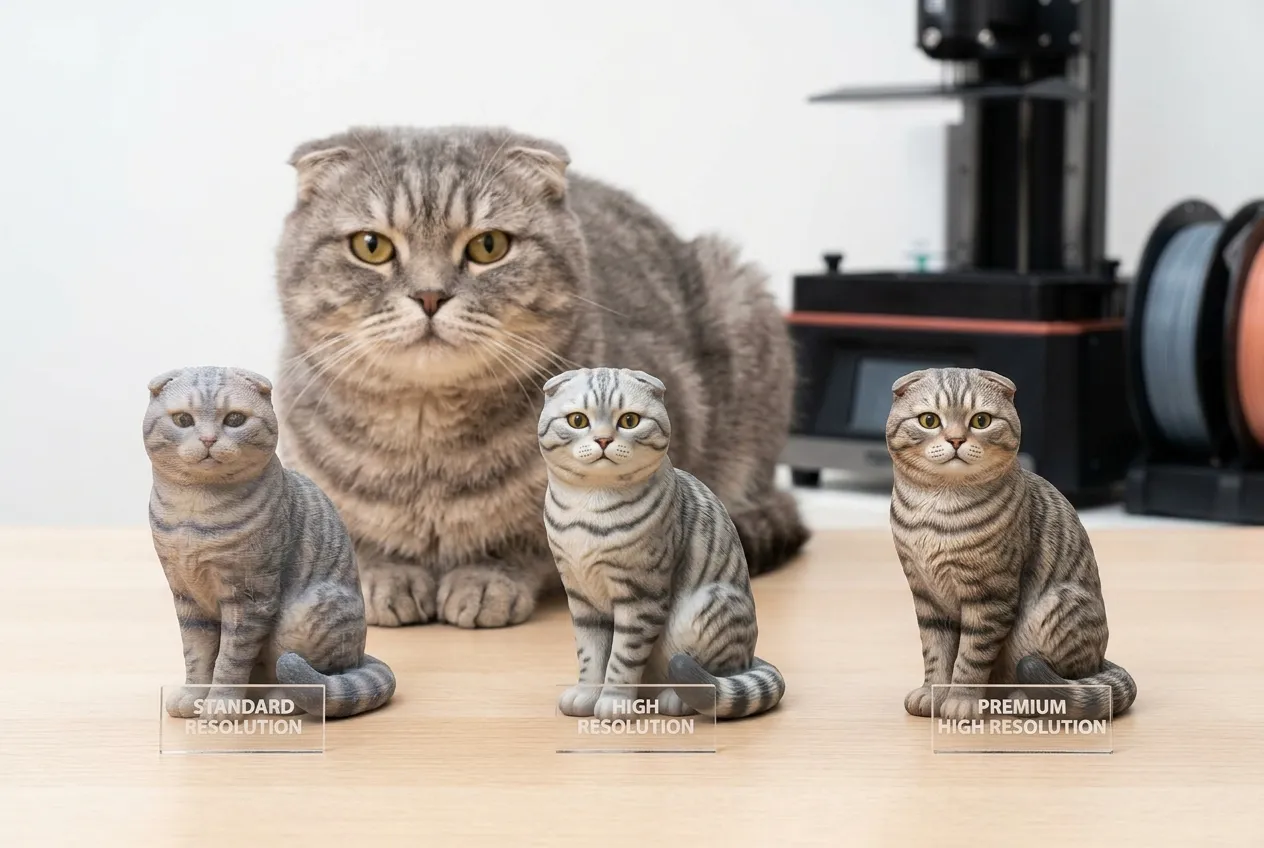
A recent survey by the Cat Fanciers' Association found that Scottish Fold owners are three times more likely to commission a custom figurine of their cat than owners of any other breed—and when you've spent any time around those owl-like ears and round, moon-penny eyes, the impulse makes perfect sense. But here's the part most people get wrong: choosing SLA vs PolyJet for a pet figurine (or MJF, for that matter) isn't just a tech preference. It's the difference between a figurine that captures your Fold's personality and one that captures… well, a vaguely cat-shaped object on your shelf.
Quick Takeaways
- Not all 3D printing is equal for pets — PolyJet-style full-color printing embeds color directly in resin, producing far more lifelike results than single-material SLA
- Scottish Folds present unique sculpting challenges — their folded ears, round heads, and dense coats require specific digital modeling techniques most guides overlook
- Post-processing matters more than print resolution — a perfectly printed figurine can still fail at the curing or clear-coat stage
- Photo quality determines figurine quality — explore PawSculpt's custom figurine process to see exactly what reference images work best
- MJF is great for prototyping, not pet portraits — its grayscale output means you'd need post-processing painting, which defeats the purpose of a lifelike keepsake
Why Most 3D Printing Comparisons Miss the Point for Pet Figurines
Alright, let me be straight with you. If you Google "SLA vs PolyJet vs MJF," you'll get a hundred articles written for mechanical engineers comparing tensile strength and dimensional tolerances for industrial parts. That's useful if you're manufacturing a bracket for a drone chassis. It's almost useless if you're trying to figure out which technology will do justice to your Scottish Fold's peculiar way of tucking her paws under her chest.
The angle nearly every comparison misses? Context of use. A pet figurine isn't a functional prototype. It's an emotional object. The metrics that matter aren't load-bearing capacity or heat deflection temperature—they're color fidelity, surface texture, the ability to reproduce the specific gradient where your cat's silver tabby markings fade into white on her belly.
That reframing changes everything about which technology "wins."
"We don't evaluate print technologies by spec sheets. We evaluate them by whether a pet parent tears up when they see the preview."
— The PawSculpt Team
Here's the counterintuitive insight that most comparison articles won't give you: higher resolution doesn't automatically mean a better figurine. We've seen prints at 25-micron layer heights (that's 0.025 millimeters—thinner than a strand of your cat's fur) that looked clinical and lifeless, and prints at 50-micron layers that felt warm, accurate, emotionally right. The difference wasn't the printer. It was the digital sculpting upstream and the post-processing downstream.
Let's unpack each technology through that lens.
SLA 3D Printing for Pet Figurines: Beautiful Detail, Missing Color
How SLA Actually Works
Stereolithography (SLA) uses an ultraviolet laser to cure liquid photopolymer resin, layer by layer, from a vat. Think of it like a laser pointer drawing on the surface of a puddle, and everywhere the laser touches, the liquid hardens into solid plastic. The build platform lifts incrementally—often in layers as thin as 25–50 microns—and the next cross-section is traced.
The result? Incredibly smooth surfaces. Fine details. Crisp edges.
Sounds perfect, right? Here's the catch.
The Single-Color Problem
SLA machines print in one resin color at a time. Your Scottish Fold figurine comes out of the printer as a single, monochromatic shape—usually a muted gray, clear, or off-white. To get color, someone has to apply it afterward, either through painting, dyeing, or some kind of surface treatment.
And that right there is the fundamental limitation for pet figurines.
Personal Aside: Our team spent about three months early on testing whether SLA + manual color application could achieve the results we wanted. The detail was gorgeous. But every time we compared a hand-finished SLA print to a full-color PolyJet output, the color registration—especially along fur texture boundaries—was noticeably less precise. The PolyJet version just looked more like the actual cat. We moved on.
Here's what SLA does well and where it falls short for pet work:
| Feature | SLA Performance for Pet Figurines | Notes |
|---|---|---|
| Surface smoothness | Excellent | Near-injection-mold quality |
| Fine detail (whiskers, fur texture) | Very good (25–50 µm layers) | Requires careful orientation |
| Color accuracy | Poor without post-coloring | Monochrome output only |
| Durability | Moderate | Cured resin can be brittle |
| Cost per unit | Low to moderate | Resin cost varies by type |
| Best use case | Master patterns, molds | Not ideal for finished full-color figurines |
SLA's Hidden Challenge: Support Scars on Organic Shapes
Here's something practitioners know that spec sheets don't tell you: SLA prints need support structures—thin scaffolding that holds overhanging geometry in place during printing. When you remove those supports, they leave tiny marks on the surface called support pitting or support scars.
On a geometric part—a phone case, a chess piece—you can orient the model so supports land on flat, hidden surfaces. Easy.
On a Scottish Fold figurine? There are no flat, hidden surfaces. Everything is curved. The belly, the folded ears, the tucked paws, the tail—every surface is visible and organic. You're guaranteed to have support contact points on surfaces that matter. Cleaning those up on a monochrome print is one thing. Trying to match color over a sanded support scar? That's where things get messy.
This is one of those failure modes that doesn't show up in marketing materials but absolutely shows up on your mantel.
PolyJet 3D Printing for Pet Figurines: The Full-Color Advantage
How PolyJet Technology Actually Works
PolyJet operates more like an inkjet printer, but in three dimensions. The print head jets tiny droplets of photopolymer resin—each droplet can be a different color or material—and immediately cures them with UV light. Layer by layer, voxel by voxel (a voxel is basically a 3D pixel), the machine builds your figurine with color already embedded in the resin itself.
Read that again, because it's the key distinction: the color is part of the material, not a coating on top of it.
Your Scottish Fold's silver tabby pattern, the warm amber of her eyes, the pink inside her folded ears—all of that is printed into the resin during manufacturing. There's no painting step. No color matching by hand. No brush.
Why This Matters for Scottish Folds Specifically
Scottish Folds present a set of challenges that are, honestly, a masterclass in why full-color printing matters for pet figurines:
- The ears. The signature forward-folding ears create deep undercuts and shadows. In a single-color print, those shadows are literally just shadows—geometry. In a full-color print, the digital artist can model the subtle color shift where the inside of the ear meets the outer fur, and the printer reproduces that gradient directly.
- The round face and large eyes. Scottish Folds have notably round, wide-set eyes. Getting eye color right—not just the iris color, but the reflective highlight, the dark limbal ring, the slight color variation from center to edge—requires voxel-level color control. PolyJet delivers that.
- The dense, plush coat. Folds (especially longhair variants) have thick, plushy fur that catches light in complex ways. A digital sculptor can model this texture as surface displacement, and the full-color printer can apply the subtle color variations along each tuft.
"A Scottish Fold's personality lives in the eyes and the ear set. Get those two things right and the figurine is instantly recognizable. Get them wrong and it's just a generic cat."
The Post-Processing Pipeline for PolyJet Figurines
This is where I want to get specific, because "post-processing" gets hand-waved in most comparison articles, and it's actually where figurine quality is won or lost.
After a full-color PolyJet-style print comes off the build platform, here's what actually happens:
- Support removal. PolyJet uses a soluble or gel-like support material that's dissolved in a chemical bath or carefully removed with water jets. This is gentler than SLA support snapping, but it still requires care—overly aggressive water jetting can erode fine surface detail on ears or whisker bumps.
- Cleaning and inspection. The print gets examined under raking light (a light held at a shallow angle to the surface) to reveal any surface defects: tiny air bubbles, support residue, layer lines that are more prominent than expected. This is the quality control step most people don't realize happens.
- UV curing. Additional UV exposure in a curing chamber hardens the resin fully and locks in the color. Under-curing leaves the surface tacky and vulnerable to yellowing; over-curing can make colors shift warm (especially blues going slightly green). There's a sweet spot, typically in the range of a few minutes depending on geometry and resin chemistry, that experienced operators learn by doing.
- Clear coat application. This is the one manual finishing step. A thin, UV-resistant clear coat is applied to the entire surface. It serves three purposes: protects the color from UV degradation over time, gives the surface a consistent sheen (matte, satin, or gloss, depending on the formula), and slightly smooths the natural 3D print texture. This is not paint—it's a protective topcoat, like varnish on a photograph.
That's it. No painting. No airbrushing. No color application by hand at all.
| Post-Processing Step | Purpose | Risk If Done Poorly |
|---|---|---|
| Support removal | Clean surface | Erosion of fine detail |
| Surface inspection | Catch defects early | Missed bubbles or artifacts |
| UV curing | Harden resin, lock color | Tackiness (under) or color shift (over) |
| Clear coat | UV protection + sheen | Uneven finish, orange peel texture |
What "Full-Color Resin" Actually Looks Like
Let me set expectations here, because this matters. A full-color resin 3D print looks different from a photograph, and it looks different from a hand-finished painted miniature. It has its own aesthetic.
The colors are vibrant and accurate—especially warm tones like oranges, creams, and browns that are common in Scottish Folds. There's a natural, very fine grain to the surface from the printing process. The clear coat softens this but doesn't eliminate it. The overall effect is something closer to a high-quality porcelain figure than a glossy plastic toy. It has warmth. Texture. Presence.
It's the kind of thing that looks better on a bookshelf at three feet than in a macro photograph at three inches. Which, honestly, is exactly how you're going to display it.
MJF 3D Printing: The Industrial Workhorse That's Wrong for This Job
How MJF Works (and Why It's Popular for the Wrong Reasons)
Multi Jet Fusion (MJF), developed by HP, is a powder-bed technology. It spreads a thin layer of nylon (polyamide) powder across a build area, then selectively jets a fusing agent where the part should solidify. An infrared lamp passes over the bed, and the areas with fusing agent absorb the heat and melt together. Unfused powder acts as its own support structure—which is actually a nice feature, because MJF parts emerge with no support scars at all.
The parts are strong. Dimensionally accurate. Excellent for functional prototyping, snap-fit enclosures, and mechanical components.
For pet figurines? There's a dealbreaker.
The Color Limitation
MJF produces parts in gray or black nylon. That's it. There is an HP MJF technology variant (the 580/380 series) that offers limited color capability, but we're talking about a constrained color gamut that can handle basic patterns—not the full spectrum you need for realistic pet reproduction.
If you want your Scottish Fold figurine to show the specific seal-point coloring, the cinnamon-tipped ears, the contrast between her darker back and lighter belly—MJF in its standard form simply can't do it without manual painting afterward. And at that point, you've lost the entire advantage of integrated, machine-printed color.
Where MJF Does Excel (Just Not Here)
Credit where it's due: MJF parts are remarkably durable. The nylon material is tougher and more impact-resistant than most photopolymer resins. If you needed a figurine that a toddler could throw at a wall and it would bounce, MJF nylon would be your choice.
But that's a durability-for-color tradeoff, and for a display figurine—something that sits on a shelf, a desk, a memorial space—color wins. Every time.
| Technology | Color Capability | Surface Detail | Durability | Best For Pet Figurines? |
|---|---|---|---|---|
| SLA | Monochrome (needs post-coloring) | Excellent (25–50 µm) | Moderate (brittle) | No — color is the bottleneck |
| PolyJet | Full color, embedded in resin | Very good (16–30 µm typical) | Good (with clear coat) | Yes — the clear winner |
| MJF | Gray/black (limited color option) | Good (80 µm typical) | Excellent (nylon) | No — color gamut too limited |
The Digital Sculpting Step Everyone Underestimates
Here's the thing that surprised us most when we started working in this space: the print technology matters less than the digital sculpt.
A mediocre 3D model printed on a world-class PolyJet machine will produce a mediocre figurine. A brilliant 3D model printed on a decent machine will produce something that takes your breath away. The sculpting is the bottleneck, and it's where the real craft lives.
Photo-to-Sculpt: What Actually Happens
When you provide reference photos of your Scottish Fold, a digital sculptor doesn't just trace the outline in 3D software. They're doing something much more nuanced:
- Proportional analysis. Scottish Folds have distinctive proportions—the round head is large relative to the body, the nose is short, the ears sit low and forward. A sculptor checks these ratios against the reference photos and against breed-standard references to make sure the figurine reads as "Scottish Fold" and not "generic shorthair with weird ears." This is where knowledge of the Cat Fanciers' Association breed standards actually becomes relevant production knowledge.
- Coat flow mapping. Fur doesn't just exist on a cat—it flows in specific directions. On a Scottish Fold, the chest fur radiates outward from a central whorl. The back fur flows from the spine downward. The tail fur may spiral slightly. A skilled digital sculptor models this directionality into the surface texture, and when the full-color print reproduces it, the figurine has a sense of life that flat textures miss.
- Expression capture. This is the hardest part. Cats—especially Folds with their naturally rounded, somewhat concerned-looking faces—have subtle expression differences that come down to millimeters of geometry. The degree of eye opening. The angle of the ear fold. Whether the mouth line curves slightly up or slightly down. Experienced sculptors know how to find these details in photos and translate them into geometry that reads correctly at figurine scale.
- Anatomy checks. The model gets checked against feline anatomy references to make sure the underlying structure is plausible—the skeleton implied by the pose makes sense, the muscles are consistent with the position, the paws are proportional. Without this step, you end up with the uncanny valley problem: something that looks almost right but feels weirdly wrong.
The Scale Problem No One Talks About
A figurine is typically 3–6 inches tall. Your cat is roughly 10–12 inches at the shoulder. That's a significant reduction, and not everything scales down linearly.
Whiskers, for example. On a real cat, whiskers are maybe 0.1mm in diameter and 4–5 inches long. Scaled down to figurine size, they'd be thinner than the printer can reliably reproduce. So sculptors make creative decisions—slightly thickening whiskers, or suggesting them with raised ridges rather than free-standing filaments—to preserve the impression of whiskers without asking the printer to do something it physically can't.
The folded ears on a Scottish Fold are another example. On the real cat, the fold creates a thin, double-layered ear that reveals the inner ear canal. At figurine scale, printing that thin double-fold risks fragility—the ear tip could snap off during handling. So the sculpt often subtly thickens the ear geometry while maintaining the visual line of the fold. You don't notice the difference looking at the finished figurine. But it's the reason the ear survives shipping.
"The art isn't in reproducing every detail—it's in knowing which details matter and which to quietly reinterpret."
What to Expect: The Full-Color Figurine Process From Photo to Shelf
If you're considering a custom Scottish Fold figurine—or honestly any breed—here's a clear-eyed walkthrough of what the actual process looks like. Not the marketing version. The real one.
Step 1: Reference Photos
You'll need to provide multiple photos of your cat. And here's where most people's expectations diverge from reality: more photos and better photos always equal a better figurine. We're not talking about professional studio shots (though those help). We're talking about variety:
- Front face, straight-on. For eye placement, ear fold angle, facial proportions.
- Profile view (both sides if possible). For nose length, ear position relative to the skull, body proportions.
- Three-quarter angle. This is actually the most useful single photo because it reveals depth and dimensionality.
- Full body from above. For coat color pattern mapping.
- Any specific markings. Close-ups of distinctive spots, color breaks, or features.
Blurry photos are the number one cause of revision cycles. The sculptor can't invent details that aren't visible in the reference material. Harsh direct flash washes out color. Natural window light on a calm day? Chef's kiss.
Step 2: Digital Sculpting
A 3D artist builds your cat's model in software like ZBrush or Blender, working from your reference photos. This step involves constant back-and-forth checking—rotating the model, comparing it to reference images from multiple angles, adjusting proportions.
For a Scottish Fold, expect particular attention to:
- The specific degree of ear fold (single fold, double fold, triple fold—each looks different)
- Eye spacing and pupil shape
- Body roundness (Folds tend toward a stocky, rounded body type)
- Paw positioning if a specific pose is requested
Step 3: Preview and Revision
You'll see a digital preview before anything is printed. This is your chance to request changes—and honestly, this step is critical. Look at the preview on a large screen if possible, not just your phone. Pinch-zoom in on the face. Compare it side by side with your actual cat photo.
Common revision requests we see: "The ears need to be a little more folded." "The body is slightly too thin." "Can the eyes be a warmer gold?" All reasonable, all fixable at the digital stage. For details on how revisions work, check PawSculpt's FAQ page.
Step 4: Full-Color 3D Printing
Once you've approved the digital model, it goes to the printer. The PolyJet-style machine builds your figurine voxel by voxel, embedding color directly into the UV-cured resin. The print itself, depending on size and geometry, may take several hours.
Step 5: Post-Processing and Quality Control
Support material is removed, the print is inspected under raking light, UV curing locks in the colors, and a clear coat is applied for protection and finish. The figurine gets a dimensional check (does it match the approved digital model?) and a final visual inspection.
Step 6: Shipping
Carefully packaged—because cured resin, while reasonably durable, doesn't love impacts. Expect proper cushioning.
For current details on timelines, pricing, and shipping, visit pawsculpt.com directly—those details shift seasonally and are always most accurate on the site.
Common Mistakes When Choosing a 3D Printing Technology for Pet Figurines
Let me save you some time and frustration. These are the mistakes we see most often:
Mistake #1: Choosing Based on Resolution Alone
"This printer has 16-micron layer height!" Cool. But layer height only tells you about Z-axis resolution (vertical). The XY resolution (horizontal detail) is a separate spec. And neither spec tells you anything about color accuracy, which is arguably the most important factor for a pet figurine.
Don't chase microns. Chase the end result.
Mistake #2: Assuming All "Full-Color" Printing Is the Same
Some companies advertise "full color" but actually print a white or neutral model and then use an inkjet process to spray color onto the surface only. This is fundamentally different from voxel-level color embedding. Surface-sprayed color can chip, fade, and doesn't penetrate into crevices as well.
Ask specifically: is the color in the material or on the material? That one question tells you a lot.
Mistake #3: Ignoring Post-Processing Entirely
The figurine that comes right off the build platform is not the finished product. The curing, the support cleanup, the clear coat—these steps collectively have as much impact on the final quality as the print itself. A shop that rushes post-processing will deliver a figurine with tacky surfaces, visible support marks, or inconsistent sheen.
Mistake #4: Not Providing Enough Reference Photos
This one's on you, the customer. And it's the single highest-impact thing you can control. Three blurry phone photos taken from the same angle will produce a figurine that's generically cat-shaped. Twelve well-lit photos from multiple angles and distances will produce a figurine that makes you emotional.
| Mistake | Why It Happens | How to Avoid It |
|---|---|---|
| Choosing on resolution alone | Spec sheets emphasize numbers | Ask to see finished examples, not specs |
| Assuming all "full-color" is equal | Marketing ambiguity | Ask: "Is color in the material or on the surface?" |
| Ignoring post-processing | It's invisible to the customer | Ask about their QC and finishing steps |
| Not enough reference photos | Underestimating the process | Submit 8–15 photos, varied angles, natural light |
The Psychology Behind Why Physical Figurines Hit Different
Okay, let me put on a slightly different hat for a moment. Because there's a reason custom pet figurines resonate so deeply, and it's grounded in actual psychology—not just sentiment.
Attachment theory, originally developed by John Bowlby to describe human infant-caregiver bonds, has been extended by researchers to describe the bond between humans and companion animals. The bond with a pet activates many of the same neurological pathways as a bond with a human family member. When that bond is disrupted—through loss, separation, or even just the anticipation of loss—the psychological response follows similar patterns: searching behavior, protest, despair.
Here's where it gets interesting for figurines specifically. Psychologists studying grief have identified a concept called continuing bonds—the idea that healthy grief doesn't require "letting go" of the deceased, but rather finding new ways to maintain the relationship in a changed form. A physical object that accurately represents the lost individual serves as an anchor for continuing bonds. It gives the grief a place to live that isn't just inside your head.
A photo does this too, of course. But a three-dimensional object engages spatial cognition differently. You can hold it. Turn it. See it from the angle you used to see your cat from when she sat on the arm of the couch. That spatial familiarity activates memory networks more richly than a flat image.
We're not therapists—for genuine grief support, organizations like the Association for Pet Loss and Bereavement offer resources and counseling. But we've heard from enough families to know that a figurine sitting in the corner of a room—occupying space the way the pet used to—provides something a photo on a phone screen can't.
Personal Aside: One customer told us she keeps her cat's figurine on the windowsill where her Scottish Fold used to sit and watch birds. "It doesn't replace her," she said. "But that spot was so empty." That single sentence has shaped how we think about what we do more than any technical spec ever has.
Should You Actually Care About the Printing Technology?
Honest answer? Kind of. But not the way you think.
You shouldn't need to become an expert in photopolymer chemistry or UV curing wavelengths to order a figurine of your cat. That's the maker's job. What you should care about is:
- Is the color integrated into the material? (PolyJet-style = yes. SLA = no. Standard MJF = no.)
- Can I see examples of finished figurines—of cats, specifically? (Dogs and cats are very different sculpting challenges.)
- What does the post-processing involve? (A clear coat for protection is standard and expected. Extensive manual finishing might indicate the print quality isn't doing the work.)
- How many reference photos do they recommend? (A company that says "just send one photo" is a red flag. You can't sculpt accurately from a single reference.)
- Do they offer a digital preview before printing? (If not, you're gambling.)
The best 3D printing technology for pet figurines is the one that produces a full-color, dimensionally accurate, emotionally resonant result—and right now, that's full-color resin printing in the PolyJet family. SLA is a great technology for other applications. MJF is a powerhouse for functional parts. But for a Scottish Fold figurine that makes you feel something when you see it on the shelf? The answer is pretty clear.
Caring for Your 3D-Printed Figurine
Quick practical notes, because we get these questions constantly:
- Avoid direct sunlight for extended periods. The clear coat provides UV resistance, but no material is immune to years of direct sun exposure. A bookshelf away from a south-facing window is ideal.
- Dust gently. A soft brush or microfiber cloth. No solvents, no water immersion, no dishwasher (yes, someone asked).
- Handle from the base. The thinnest parts—ear tips, tail tip—are the most vulnerable to breakage. Pick it up from the body or base.
- Temperature stability. Cured photopolymer resin is stable at normal room temperatures. Don't leave it in a hot car or on a radiator. The material can soften at elevated temperatures (typically above 50–60°C / 120–140°F).
These aren't exotic care instructions. Treat it roughly the way you'd treat a nice ceramic figure—with normal, reasonable care—and it'll last.
The Empty Corner of the Room
Let me circle back to where we started. The reason Scottish Fold owners commission figurines at such a disproportionate rate probably isn't complicated. These cats have an almost human quality to their faces—that round head, those wide eyes, the way they sit upright like little people. They're present in a room in a way that other cats sometimes aren't. They take up emotional space.
And when that space is empty—whether through loss, or because you've moved and your cat is with an ex, or because you're deployed overseas and your Fold is with family back home—the absence has a shape. A spatial, three-dimensional shape.
A flat photo doesn't fill that shape. A figurine does. Not perfectly, not as a replacement, but as an acknowledgment that something real occupied that corner of the room, that spot on the windowsill, that dip in the couch cushion.
The best 3D printing for pet figurines isn't just the technology with the finest resolution or the broadest color gamut. It's the one that understands the assignment: not to create a miniature cat, but to preserve the specific cat that belonged in that specific space in your life.
If you're curious about how the process works—from photo submission to digital sculpt to full-color resin printing—PawSculpt's process page walks through it in detail. But you already know the important part. You know your cat. And now you know enough about SLA vs PolyJet pet figurine technology to make sure whoever captures them does it right.
The space on the shelf is waiting.
Frequently Asked Questions
What is the best 3D printing technology for pet figurines?
For lifelike, full-color pet figurines, PolyJet-style full-color resin printing is the standout choice. It embeds color directly into the resin material during printing, which means the colors are part of the figurine itself—not a coating that can chip or fade. SLA produces excellent detail but requires separate coloring, and standard MJF only prints in gray or black.
How many photos should I provide for a custom Scottish Fold figurine?
Aim for 8 to 15 photos taken in natural light from varied angles. At minimum, you need a straight-on face shot, both side profiles, a three-quarter view, and a full-body overhead image. Close-ups of any distinctive markings or features are also extremely helpful. The quality and variety of your reference photos is the single biggest factor you can control in the final result.
What's the actual difference between SLA and PolyJet for pet figurines?
SLA uses a UV laser to cure a single-color resin, producing a monochrome model that needs color applied afterward. PolyJet jets tiny droplets of different-colored resins simultaneously, building the figurine with color already embedded in the material. For a pet figurine where accurate color matters, PolyJet's integrated color is a significant advantage.
How should I care for a 3D-printed resin figurine?
Display it away from prolonged direct sunlight, dust it with a soft brush or microfiber cloth, and handle it from the base rather than thin extremities like ear tips or tails. Avoid water immersion, solvents, and temperatures above roughly 120–140°F. With normal household care, a clear-coated resin figurine will last for years.
Can MJF printing produce a realistic full-color pet figurine?
Not in its standard form. Standard MJF prints in gray or black nylon, which would require full manual coloring afterward to look anything like your pet. HP's color-capable MJF variants offer limited color but can't match the full spectrum and voxel-level precision of PolyJet-style printing for realistic animal reproduction.
What makes Scottish Folds particularly challenging to capture as figurines?
Their folded ears create thin, double-layered geometry that risks fragility at figurine scale. Their unusually round faces and wide-set eyes require precise proportional sculpting—even slight inaccuracies make the face look wrong. And their dense, plush coats have complex color gradients that demand full-color printing technology to reproduce accurately.
Ready to Capture Your Scottish Fold's Personality?
Every fold of those distinctive ears, every shade of amber in those round eyes, every subtle stripe along the coat—your Scottish Fold isn't generic, and their figurine shouldn't be either. Whether you're preserving the memory of a companion who's crossed the rainbow bridge or celebrating the cat currently hogging your favorite chair, a full-color 3D-printed figurine captures the details that make your pet yours.
The best 3D printing for pet figurines starts with understanding what the technology can do—and now you do.
Visit pawsculpt.com to explore the full process, see examples, and learn about current options and guarantees