
Nobody Tells You the Ashes Can Wait: Surviving the First Week After Losing Your Family's German Shepherd

The golden light of late afternoon cuts across the backyard, and there it is—the tennis ball, half-buried in dirt beside the fence, still carrying the tooth marks of a German Shepherd who will never retrieve it again. Losing a German Shepherd grief hits like this: not in the big moments, but in the small relics they leave scattered across your yard like breadcrumbs back to a life that ended too soon.
Quick Takeaways
- Your German Shepherd's ashes don't need immediate decisions — give yourself at least two weeks before choosing urns or scattering locations
- Teens grieve differently than adults — watch for withdrawal, anger, or sudden attachment to the dog's belongings as normal processing
- The "phantom dog" effect is neurological, not imaginary — your brain needs4-6 weeks to stop anticipating their presence
- A tangible memorial can anchor grief — families find comfort in custom pet figurines that preserve their dog's unique stance and expression
- Remaining pets feel the absence too — expect behavioral changes for 2-8 weeks in surviving animals
The First 72 Hours: What Nobody Prepares You For
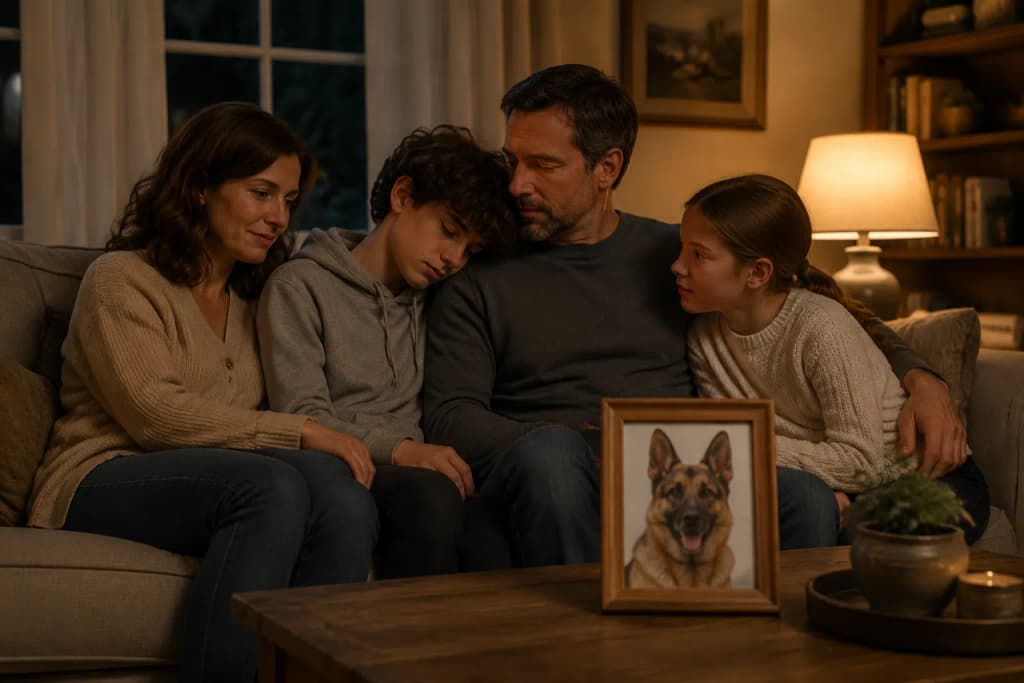
Let's talk about a family we worked with recently. The Okafor family—two parents, a sixteen-year-old son, a thirteen-year-old daughter, and until last month, a nine-year-old German Shepherd named Atlas. Atlas had hip dysplasia that progressed into something worse. The decision came on a Wednesday. By Thursday morning, the family was sitting in a kitchen that felt like it had tripled in size.
Here's what nobody told the Okafors, and what nobody tells most families: the first week isn't about grief in the way you expect it. It's about logistics crashing into emotion at full speed. The vet's office calls about cremation options. Your teen won't come out of their room. The other dog keeps pacing. And you're standing there holding a leash you don't need anymore, trying to figure out what to do first.
The answer? Almost nothing. And that's the counterintuitive insight most grief guides miss entirely.
Why "Doing Nothing" Is Neurologically Sound
Your brain is running on cortisol and adrenaline. The hypothalamic-pituitary-adrenal axis—your stress response system—is firing at the same intensity it would for any major loss. Research from the human-animal bond field suggests that pet loss activates the same neural grief pathways as losing a human family member. Your prefrontal cortex, the part responsible for decision-making, is literally impaired.
So when the cremation service asks whether you want a private or communal cremation, whether you want the ashes returned in a standard container or an upgradedurn, whether you want a paw print impression—you are being asked to make consumer decisions while neurologically compromised.
The ashes can wait. They genuinely can. Most cremation services will hold remains for weeks. Some for months. You don't need to decide today.
| Decision | Can It Wait? | Recommended Timeline | Why |
|---|---|---|---|
| Cremation type (private vs. communal) | 24-48 hours | Ask thevet to hold | Vet offices have limited storage |
| Urn or container selection | Weeks to months | 2-4 weeks minimum | You'll know what feels right later |
| Scattering vs. keeping ashes | Indefinitely | No rush at all | Preferences shift as grief evolves |
| Memorial purchase | Weeks to months | When it brings comfort, not obligation | Premature decisions often lead to regret |
| Removing dog's belongings | Weeks | 3-6 weeks | Premature removal can spike grief |
The Emotion Nobody Admits: Relief and Its Cruel Aftermath
Here's where we need to get honest. Really honest.
If your German Shepherd was sick—if you watched hip dysplasia steal their mobility, if cancer hollowed them out, if cognitive dysfunction turned your sharp, loyal companion into a confused shadow—you probably felt relief when it ended. Maybe for a split second. Maybe for an entire afternoon.
And then the guilt arrived like a freight train.
"Relief doesn't cancel love. It confirms it. You carried something unbearable so they didn't have to."
This is one of grief's cruelest cognitive loops. Psychologists call it cognitive dissonance—holding two contradictory truths simultaneously. You loved them desperately AND you're relieved they're gone. Both are true. Both are valid. The brain struggles to hold contradictions, so it converts the discomfort into guilt, which feels more "logical" than relief.
The Okafor family's son, Dayo, said something to his mother three days after Atlas died that stopped her cold: "I'm glad he's not in pain anymore, but I feel like a monster for being glad about anything right now."
Sixteen years old. Already caught in the loop.
What actually helps: Name the relief out loud. Say it to someone safe. "I'm relieved his suffering ended." The moment you externalize it, the guilt loses approximately half its power. This isn't pop psychology—it's related to affect labeling, a well-documented phenomenon where naming an emotion reduces amygdala activation.
The Second-Guessing Spiral
Closely related: the euthanasia timing question. Did we do it too soon? Could we have waited another week? What if the new medication would have worked?
German Shepherds are particularly prone to this dynamic because they're stoic. They hide pain. They'll drag themselves to the door to greet you on legs that are failing. So owners often feel they "missed" a window where the dog was still okay—or conversely, that they waited too long and caused unnecessary suffering.
Both feelings are normal. Both are your brain trying to retroactively control something that was, fundamentally, uncontrollable.
The specific comfort: You made the decision with information you had, consultation with a veterinarian, while watching your dog's quality of life. You didn't make it casually. The fact that you're second-guessing proves how seriously you took it.
Pet Loss When Your Family Includes Teenagers
Most pet loss resources are written for adults processing grief alone. But what to do after your dog dies looks completely different when you're also parenting through it.
Teenagers are neurologically wired for intense emotional experiences—their limbic systems are fully online while their prefrontal cortexes are still under construction. This means they feel grief at full volume but lack the regulatory architecture to modulate it. The result often looks like:
- Rage that seems disproportionate (slamming doors, snapping at siblings)
- Complete withdrawal (headphones in, door closed, monosyllabic responses)
- Sudden attachment to the dog's collar, bed, or toys
- Performing "fine" at school while falling apart at home
- Posting extensively on social media, then deleting everything
- Wanting to talk about it at11 PM but not at dinner
What Works (And What Backfires)
Backfires: Forcing family grief rituals before they're ready. Saying "Atlas is in a better place." Removing the dog's things without asking. Comparing this loss to a human death ("at least it wasn't..."). Buying a new pupy within weeks.
Works: Leaving the dog's bed out until THEY say they're ready. Sharing your own mesy feelings ("I keep thinking I hear him at the door—does that happen to you?"). Giving them permission to grieve on their own timeline. Letting them keep one item that smells like the dog without questioning it.
The Okafors' daughter, Amara, slept with Atlas's collar under her pillow for three weeks. Her parents almost said something. They didn't. By week four, she moved it to her bookshelf on her own. That's the timeline grief needs—self-directed, not managed.
"Grief doesn't need a manager. It needs a witness."
The "Phantom Dog" Phenomenon
For the first 4-6 weeks, you will hear your German Shepherd. The click of nails on hardwood. The thump of a tail against a wall. The heavy sigh from the corner of the room.
This isn't supernatural. It's neuroplasticity in reverse. Your brain spent years building predictive models around your dog's presence—anticipating their sounds, their weight against your leg, their schedule. Those neural pathways don't dissolve overnight. Your auditory cortex is literally generating expected stimuli that no longer have a source.
It fades. Not linearly—more like a radio signal weakening. Some days it's loud. Some days you forget. Then it's loud again. By6-8 weeks, most families report the phantom experiences becoming rare rather than daily.
What to Do With Their Things (A Practical Timeline)
The internet will tell you to "take your time" with your dog's belongings. That's vague to the point of uselessness. Here's what actually works, based on patterns we've observed across hundreds of grieving families:
Days 1-7: Touch nothing. Seriously. Leave the water bowl where it is. Leave the leash on the hook. Your brain needs environmental consistency right now, even if those objects trigger tears. Removing them too early can create a "where did everything go" panic that compounds the loss.
Days 7-14: Consolidate, don't eliminate. Move items to one location—a basket, a shelf, a corner. This acknowledges the change without erasing the evidence of their life.
- Keep permanently (collar, favorite toy, a tuft of fur if you have one)
- Donate (unopened food, unused medications back to the vet, beds in good condition)
- Decide later (everything else goes in a box, revisit in 3months)
Day 30+: Create, don't just preserve. This is where memorial objects become meaningful rather than obligatory. A shadow box. A garden stone. A custom figurine that captures their exact coloring and stance. The key is choosing something that represents who they WERE—their personality, their posture, their particular way of existing in space—not just a generic German Shepherd shape.
| Item | When to Address | What to Do Why This Timing | |
|---|---|---|---|
| Food & water bowls | Day 3-5 | Wash and store (don't discard yet) | Reduces daily visual triggers without erasing |
| Leash & harness | Week 2+ | Keep one, donate extras | The primary leash often becomes a kepsake |
| Bed | Week 2-4 | Let remaining pets use it, or store | Other animals may find comfort in the scent |
| Medications | Week 1 | Return to vet for proper disposal | Practical and helps other animals |
| Toys | Week 3-4 | Keep favorites, donate the rest | Favorites carry the most scent memory |
| Collar & tags | Indefinitely | Keep | Almost universally the most treasured item |
The Isolation Problem: Why German Shepherd Owners Grieve Differently
Here's something breed-specific that generic grief guides completely miss: German Shepherd owners often have their entire daily structure built around their dog. More than most breeds, GSDs demand routine. They need exercise, mental stimulation, training reinforcement, and structured interaction. Your morning wasn't just "feed the dog." It was a45-minute ritual of feeding, walking, training, and bonding.
When that structure vanishes, you don't just lose a companion. You lose your schedule. Your reason to get up at 6 AM. Your excuse to be outside. Your conversation partner on walks (yes, you talked to them—everyone does).
This creates a particular kind of isolation that non-GSD owners don't fully understand. And it's compounded by something else: feeling judged for the intensity of your grief.
"It was just a dog" is a sentence that has ended friendships. If you've heard it—or sensed someone thinking it—the resulting isolation is real and valid. You're not overeacting. The American Kennel Club recognizes that the human-canine bond can be as significant as human-human attachment bonds. Your grief is proportional to your love. Period.
"The depth of grief is just the depth of love, measured from the other direction."
— The PawSculpt Team
Breaking the Isolation
Specific actions that help more than "reach out to friends":
- Find your people online. Subreddits like r/petloss and breed-specific Facebook groups contain people who GET it. You don't need to post. Lurking and reading others' stories can reduce the "am I crazy?" feeling within hours.
- Tell one person the full truth. Not the sanitized version. The version where you cried in the car for twenty minutes. The version where you're angry at the vet. The version where you feel relief. One person who can hold all of it.
- Maintain one physical routine from your dog's schedule. Walk the same route at the same time, even without them. Your body expects the movement. Removing it adds physiological disruption to emotional disruption.
Week One: A Day-by-Day Survival Map
This isn't about "stages of grief." Kübler-Ross herself said those stages were never meant to be linear or prescriptive. This is about what's likely to happen and what you can do about it.
Day 1: Shock. Numbness. Possibly hyper-functionality (cleaning, making calls, handling logistics). This isn't denial—it's your nervous system's protective buffer. Let it work.
Day 2: The buffer starts cracking. Expect sudden crying triggered by absurd things—a commercial with a dog, the sound of kible in a bag at the store, reaching for a leash that's still on the hook. Your anterior cingulate cortex is processing the absence, and it does so through association chains, not logic.
Day 3: Anger often surfaces here. At the disease. At the vet. At yourself. At your partner for grieving "wrong." At the neighbor's healthy dog. This is normal. It's not who you are. It's cortisol looking for a target.
Day 4-5: The "what now" void. The routines are gone. The house is too quiet. You might feel purposeless. This is the day to do ONE small thing: order a paw print kit (if you got an impression), write down three specific memories before they blur, or simply sit in their favorite spot and let yourself feel whatever comes.
Day 6-7: Oscillation begins. You'll have moments of normalcy—laughing at something, enjoying a meal—followed immediately by guilt for feeling okay. This is called the Dual Process Model of grief: your psyche oscillates between loss-oriented coping (feeling the pain) and restoration-oriented coping (re-engaging with life). Both are necessary. Neither is betrayal.
Creating Meaning Without Rushing It
The memorial industry knows you're vulnerable in week one. Ads for urns, jewelry, and kepsakes will find you—algorithms are ruthless that way. Here's our honest take: most people who make memorial purchases in the first three days end up unsatisfied with their choices.
Not because the products are bad. Because grief-brain doesn't know what it wants yet. The urn you choose on Day 2 might feel wrong by Day 20because your relationship to the loss has shifted.
What we've seen work better: collect now, create later.
In the first week, gather raw materials of memory:
- Photos (especially candid ones showing their personality, not just posed shots)
- Measurements or physical impressions (paw prints, nose prints if you have them)
- Written memories (voice memos work too—just talk about them for five minutes)
- Fabric with their scent (seal it in a ziplock bag; scent fades within 2-3 weeks in open air)
Then, when you're ready—and "ready" might be three weeks or three months—you can make intentional choices about how to honor them. Maybe it's a garden stone. Maybe it's a donation to a GSD rescue in their name. Maybe it's a full-color 3D-printed figurine that captures the exact tilt of their head when they heard the word "walk." The point is: the materials don't expire. Your clarity will come.
The PetAshes Container Question
Since you're likely dealing with this decision: here's what most people don't know about pet ashes and containers in the first week.
Standard containers from cremation services are fine. They're typically a simple tin or plastic box. They're not beautiful, but they're functional and sealed. Your dog's ashes are safe in there for as long as you need.
You do NOT need to:
- Transfer them immediately to a decorative urn
- Decide on scattering vs. keeping right now
- Split them among family members this week
- Feel guilty about the plain container
You CAN:
- Keep them in a closet if seeing them is too much
- Place them somewhere visible if that brings comfort
- Wait months before choosing a permanent vessel
- Change your mind about what to do with them multiple times
The Okafor family kept Atlas's ashes in the original container on a bookshelf for six weeks. Then Amara asked if they could put them in something "that looked more like him." They ended up choosing a ceramic container in the same dark sable color as his coat. The timing was right because it was HER timing, not the industry's.
When Your Other Pets Are Grieving Too
If you have other animals in the house, you're managing parallel grief processes. Dogs, cats, and even smaller animals notice absence. They're not grieving in the human cognitive sense—they're not contemplating mortality—but they ARE experiencing disrupted social bonds and environmental change.
Signs your remaining pet is affected:
- Searching behavior (checking the deceased pet's usual spots)
- Appetite changes (eating less OR stress-eating)
- Vocalization changes (more whining, or unusual silence)
- Clinginess toward humans
- Lethargy or restlessness
- Changes in sleep location
What helps them: Maintain their routine as rigidly as possible. They've lost a companion AND their human is behaving differently (crying, staying in bed, being distracted). The more predictable you can make their world, the faster they stabilize. Most behavioral changes resolve within 2-8 weeks.
What doesn't help: Getting a new pet "for them." Animals don't process replacement the way we imagine. A new animal in the house during acute grief adds stress, not comfort—for everyone.
The Fear of Forgetting
This one creps in around week two or three, but it starts planting seeds in week one. You'll notice you can't quite remember the exact sound of their bark. Or the precise shade of their sadle markings. Or how heavy they felt leaning against your leg.
This fear is almost universal among pet owners, and it's rarely discussed.
It's roted in how memory actually works. Episodic memories—specific moments—are stored differently than semantic memories—general knowledge. You'll always KNOW your German Shepherd was loyal, intelligent, and goofy. But the specific sensory memories (their smell, their weight, their particular bark) are more fragile. They're encoded in the hippocampus and can fade without reinforcement.
This is why capturing details in the first week matters, even if you're not ready to do anything with them yet. Not for a memorial. For your own memory architecture.
Practical memory preservation:
- Record a voice memo describing their physical quirks (the way one ear flopped, the scar on their nose, their "talking" sounds)
- Save videos to cloud storage with backup (phones break, get lost)
- Write down their daily routine—you'll forget the specifics faster than you think
- Note their favorite spots, toys, and foods
- Ask each family member to share one memory the others might not know
These details become the foundation for whatever memorial you eventually choose—whether that's a scrapbook, a charitable donation, or a digitally sculpted figurine that captures their exact proportions and coloring through advanced 3D printing technology.
What Actually Helps vs. What People Tell You Helps
| Common Advice | Why It Falls Short | What Works Better |
|---|---|---|
| "Give it time" | Too vague; feels dismissive | "The acute phase typically shifts around week 3-4" |
| "They're in a better place" | Invalidates current pain | "They mattered. This hurts because they mattered." |
| "Get a new dog when you're ready" | Implies replacement | "You'll know if/when you want another dog. There's no timeline." |
| "Stay busy" | Avoidance delays processing | "Alternate between feeling it and doing normal things" |
| "Be strong for the kids" | Models emotional suppression | "Let your kids see you grieve—it gives them permission" |
| "It was just a dog" | Delegitimizes the bond | Remove this person from your grief circle immediately |
Returning to the Backyard
Three weeks after Atlas died, the Okafor family was eating dinner when Amara said, "Can we go sit in the backyard? That was his place."
They did. All four of them, in lawn chairs, in the spot where Atlas used to patrol the fence line every evening. Nobody said much. Dayo pointed out that the grass was already growing back in the worn path Atlas had paced along the property line. The light was doing that golden late-afternoon thing.
It wasn't a ceremony. It wasn't planned. It was just a family sitting in the space their dog had loved, letting the absence be present without trying to fix it.
That's what the first week—and the weeks after—actually look like. Not a linear progression from pain to peace. Not a checklist of grief tasks completed. Just a family learning to be in spaces that used to hold a ninety-pound dog and now hold only the memory of one.
The tennis ball is still by the fence. They left it there on purpose.
And the ashes? Still in the original container on the bookshelf. Still waiting. Still perfectly fine exactly where they are.
Your German Shepherd gave you years of unwavering presence. You owe them nothing except honesty about how much it hurts—and patience with yourself as you figure out what comes next. The decisions, the memorials, the ashes, the empty bed—none of it needs to be resolved this week. Or next week. Or on anyone's timeline but yours.
The grief of losing a German Shepherd isn't something you move past. It's something you move with, until one day the weight of it shifts from crushing to carrying—and carrying starts to feel like holding.
Frequently Asked Questions
How long does grief last after losing a German Shepherd?
There's no clean answer, but here's a realistic framework: the acute phase—where grief dominates your daily functioning—typically lasts 3-6 weeks. The adjustment period, where you're rebuilding routines and the absence feels less sharp, extends 3-12 months. You may always feel a pang on their birthday or adoption anniversary. That's not unresolved grief. That's love with nowhere to go.
Is it normal to hear my dead dog's nails clicking on the floor?
Completely normal, and it's neuroscience, not wishful thinking. Your brain spent years building predictive auditory models around your dog's movements. Those neural pathways take 4-6 weeks to quiet down. You're not losing your mind. Your brain is just slow to update its expectations.
What should I do with my dog's ashes in the first week?
Nothing, if you're not ready. The standard container from the cremation service is sealed and safe. You can keep ashes indefinitely before choosing a permanent vessel or scattering location. Most people who rush this decision end up changing their minds later. Give yourself at least 2-4 weeks before making permanent choices.
How do I help my teenager cope with our family dog dying?
Don't manage their grief—witness it. Leave the dog's belongings accessible. Share your own mesy emotions so they have permission to feel theirs. Watch for signs of complicated grief (complete withdrawal lasting more than 2 weeks, academic collapse, self-harm language) that might warrant professional support. Otherwise, trust their process.
Should I get a new dog to help my other pets grieve?
Not yet. Introducing a new animal during acute household grief adds stress for everyone—humans and animals alike. Your remaining pets need routine stability, not a stranger in their disrupted territory. Most pet behavioral changes resolve within 2-8 weeks. Revisit the question when the household has found its new equilibrium.
Is it normal to feel relief after euthanizing a sick dog?
Yes. If your dog was suffering, relief is a natural and compassionate response. It doesn't diminish your love—it confirms it. You chose their comfort over your desire to keep them alive. The guilt that follows relief is cognitive dissonance, not evidence of inadequate love. Name the relief out loud to someone you trust. It loses power when spoken.
Ready to Honor Your German Shepherd's Memory?
When the time feels right—not today, not this week, but when you're ready—preserving your dog's unique presence can become part of how you carry them forward. A PawSculpt figurine captures the specific details that made your German Shepherd yours: the exact pattern of their sadle markings, their characteristic head tilt, the way they stood when alert. Digitally sculpted by master3D artists and precision-printed in full-color resin, every detail is reproduced directly in the material itself.
Surviving the first week after losing a German Shepherd grief is about patience with yourself and trust that clarity comes. When it does, we're here.
Visit pawsculpt.com to explore the process, see examples, and learn about current options