
That Last Video Clip Is Enough: What Art History Teaches Solo Owners About the First Hour of Grief After Losing a Persian Cat
The golden light was cutting sideways through the pines when your Persian stopped walking—just stopped, mid-trail, and you knew. Losing a Persian cat alone, without anyone beside you to confirm what your body already understood, begins in moments exactly like that one.
Quick Takeaways
- The first hour of grief isn't chaos—it's neurological shock — your brain is protecting you, not failing you
- Art history proves that a single image holds more than memory — one photo or video clip can anchor an entire relationship
- Solo owners face unique grief patterns — isolation amplifies guilt, but solitude also permits raw honesty
- A tangible memorial object reduces "fear of forgetting" anxiety — consider a custom 3D-printed figurine as a physical anchor for memory
- The counterintuitive move: don't reach out immediately — the first hour belongs to you and your cat alone
Why Art History Matters When Your Persian Dies (And You're Alone)
Here's the thing nobody writes about in pet loss articles: the first hour after your cat dies isn't about grief. Not yet. It's about perception—how your brain processes the sudden absence of a living creature who occupied physical space in your world for years.
Art historians have a term for this. They call it negative space—the area around and between subjects that defines the subject itself. When Matisse cut his paper shapes, the empty space wasn't empty. It held the form. It gave the figure meaning.
Your Persian's absence in that first hour works the same way. The dip in the couch cushion. The water bowl with its slight film of dust around the rim. The shaft of afternoon light hitting the floor where she used to sleep, illuminating nothing now but carpet fibers.
This isn't poetic abstraction. Neuroscience confirms that your visual cortex continues to "expect" familiar stimuli for hours—sometimes days—after they disappear. Your brain literally keeps rendering your cat in peripheral vision. You'll turn toward a sound that isn't there. You'll feel the weight shift on the bed.
And if you're alone? There's no one to reality-check against. No one to say "yeah, I keep seeing her too." The solo owner sits inside that negative space without a witness.
The Neurological First Hour
Let's get specific about what's happening in your body during those first sixty minutes. Your hypothalamic-pituitary-adrenal axis fires—cortisol floods your system. But here's what's counterintuitive: you probably won't cry. Not right away.
Most solo owners we've heard from describe the first hour as eerily calm. Almost administrative. You might find yourself:
- Straightening the blanket she was lying on
- Washing her food bowl
- Texting your vet's office in complete, grammatically correct sentences
- Staring at your phone's camera roll without scrolling
This isn't denial. It's your prefrontal cortex taking temporary executive control while your limbic system processes the magnitude of what just happened. Think of it as your brain's circuit breaker tripping to prevent emotional overload.
The tears come later. Usually when you do something habitual—reach for the treat bag, step over the spot where her litter box used to be, hear the specific creak of the cabinet where you kept her medication.
"Grief doesn't arrive. It ambushes you in the kitchen at 7 AM."
The Solo Owner's Specific Burden: Guilt Without a Witness
Here's what I want to name directly, because almost no one does: many solo Persian cat owners feel relief when their cat dies. And then they feel monstrous for feeling relieved.
Persians are high-maintenance cats. The daily groming. The eye cleaning. The breathing issues that come with brachycephalic anatomy. The vet visits that stack up—especially in the final months. If your Persian had polycystic kidney disease (which affects roughly 36-49% of the breed, according to veterinary research), you spent those last weeks administering subcutaneous fluids, monitoring appetite, watching her shrink.
That wave of relief you felt when her suffering ended? It doesn't make you a bad person. It makes you someone who loved her enough to prioritize her comfort over your own need to keep her close. The guilt that follows that relief is one of grief's cruelest tricks—a kind of cognitive dissonance where two true things exist simultaneously: you're glad she's not suffering, and you'd give anything to have her back.
Solo owners carry this alone. There's no partner to turn to and say, "Is it okay that I feel lighter?" No one to normalize the complicatedangle of emotions. And so the guilt calcifies. It becomes a story you tell yourself: I must not have loved her enough if I feel relieved.
That story is a lie. But it's a convincing one when you're the only person in the room.
What Actually Helps (It's Not What You Think)
The standard advice—call friend, join a support group, write in a journal—isn't wrong. But it's not first-hour advice. In the first hour, you need something more immediate and more physical.
Touch something. This sounds absurd, but your nervous system is searching for the tactile feedback it just lost. Your Persian's fur was a sensory constant—that impossibly dense, soft coat that you ran your fingers through dozens of times daily. Your hands are, neurologically speaking, confused.
Pick up her brush. Hold her collar. Press your palm flat against the spot on the couch where she slept—it might still be warm. This isn't morbid. It's your body's way of completing the sensory loop one final time.
| First-Hour Response | What It Looks Like | What's Actually Happening (Neurologically) |
|---|---|---|
| Numbness/calm | Cleaning, organizing, texting clearly | Prefrontal cortex override; cortisol suppressing emotional response |
| Hypervigilance | Hearing phantom sounds, seeing movement | Visual cortex still predicting familiar stimuli |
| Physical restlessness | Pacing, inability to sit still | Adrenaline with no action to direct it toward |
| Compulsive checking | Looking at photos, rewatching videos | Brain seeking confirmation that the cat existed |
| Relief Feeling lighter, then immediately guilty | Cognitive dissonance between love and exhaustion |
That Last Video Clip: Why One Image Is Enough
Art history teaches us something radical about memory and representation: a single image can contain an entire relationship.
Think about Vermeer's Girl with a Pearl Earring. We know nothing about her—not her name, not her life, not whether she was real or imagined. But that single captured moment—the turn of her head, the light on her skin, the parted lips—contains a universe of implied narrative. We project an entire life onto one frozen instant.
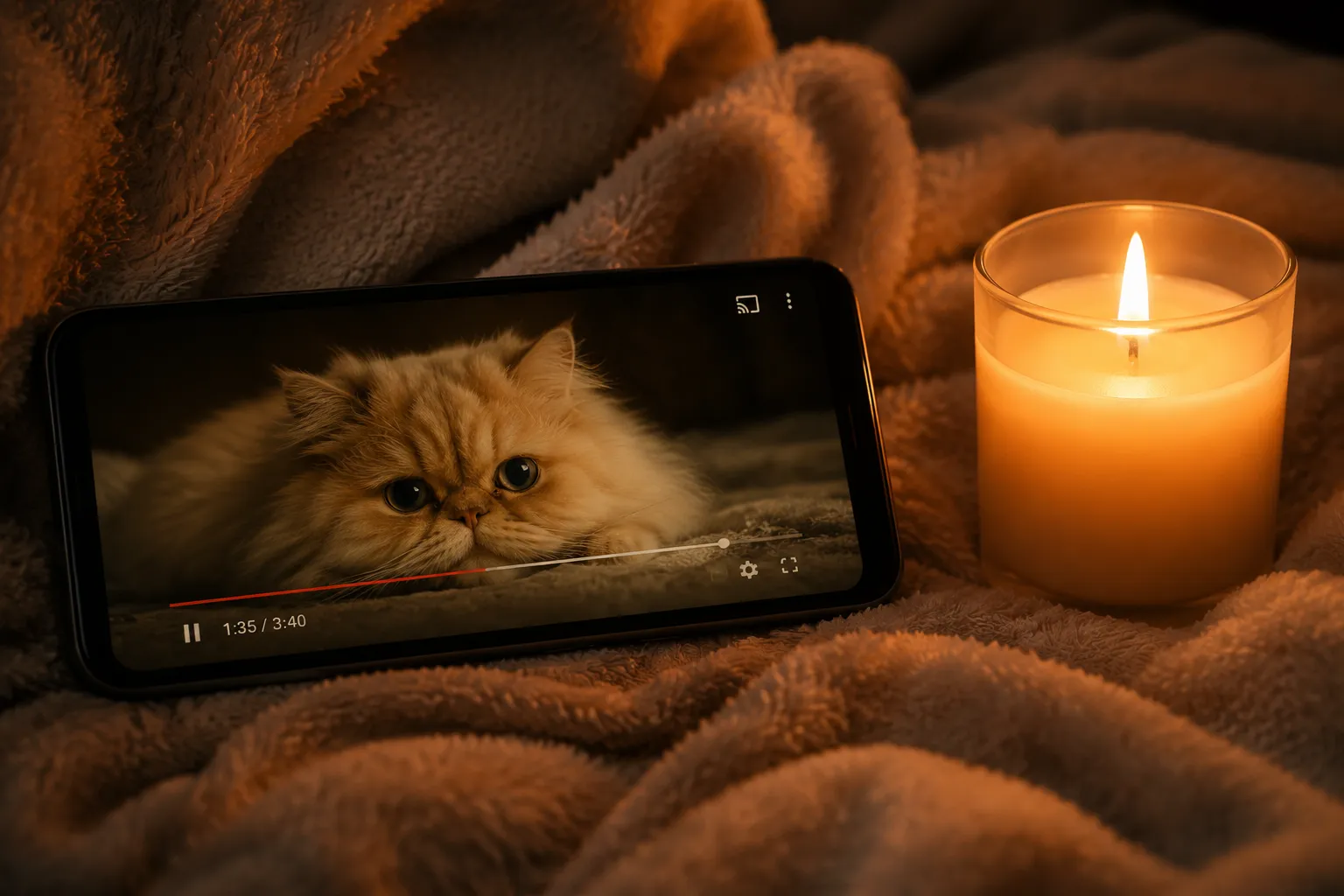
Your last video clip of your Persian works the same way. Maybe it's twelve seconds long. Maybe she's just sitting on the windowsill, blinking slowly in the afternoon light, her cream-colored fur catching gold. Maybe you can hear yourself breathing behind the camera.
That clip isn't a fragment. It's a compression of everything. Every morning she woke you up. Every evening she settled into your lap. Every vet visit, every groming session, every time she knocked something off the counter with that particular Persian indiference.
The Counterintuitive Truth About Documentation
Here's where I want to challenge the common advice: you don't need to frantically gather every photo and video right now. The internet is full of grief guides telling you to immediately compile a memory box, create a photo album, organize your camera roll.
Don't. Not in the first hour. Not even in the first day.
Why? Because your brain is in consolidation mode. It's actively encoding the emotional weight of this experience. If you force yourself into archival mode—sorting, selecting, organizing—you're asking your prefrontal cortex to do administrative work while your limbic system needs to process. You're interrupting your own grief.
One clip is enough. One photo is enough. The rest will be there tomorrow, next week, next month. They're not going anywhere.
"You don't need every photo. You need the one that makes you feel her weight in your lap."
What art history teaches us—from cave paintings to Instagram—is that humans have always known that a single mark can hold infinite meaning. The handprint on the cave wall at Lascaux isn't a comprehensive record of a person's life. It's a moment of presence. I was here. I existed. I touched this wall.
Your twelve-second video is your cat's handprint on the cave wall.
The Fear of Forgetting: Your Brain's Cruelest Anxiety
Let's talk about the emotion that hits solo owners hardest, usually around hour two or three: the terror that you'll forget.
Not forget that she existed—you won't. But forget the specifics. The exact shade of her eyes (that particular amber-green that Persians get). The weight of her—heavier than people expected, always. The sound of her pur, which wasn't loud but had a specific frequency you could feel in your chest when she lay against you.
This fear is neurologically grounded. Memory consolidation is imperfect, and your brain knows it. Emotional memories are stored differently than factual ones—they're encoded in the amygdala rather than the hippocampus, which means they're vivid but imprecise. You'll remember how she made you feel long after you've lost the exact visual details.
This is why tangible objects matter so much in grief. Not as replacements—nothing replaces a living creature—but as external memory anchors. They offload the burden of remembering from your fallible brain onto something physical and permanent.
Some people keep the collar. Some frame a paw print. Some commission a custom memorial figurine—a full-color 3D-printed replica that captures the exact markings, the specificilt of the head, the way the fur fell. The technology now exists to reproduce your Persian's unique coloring directly in resin, voxel by voxel, so the cream and copper and shadow of her coat aren't painted on but built into the material itself.
"We've seen families hold a figurine for the first time and say, 'That's her weight distribution—she always leaned left.' The details matter more than people expect."
— The PawSculpt Team
But here's what I want to emphasize: you don't need to decide about memorials in the first hour. The fear of forgetting creates urgency that isn't real. Your memories aren't dissolving. They're consolidating. Give them time.
What the Research Says About Memory Anchors
The Association for Pet Loss and Bereavement has documented that pet owners who create or obtain a physical memorial object within the first month report lower anxiety about memory loss six months later. The object doesn't need to be elaborate. It needs to be specific—something that captures a detail only you would recognize.
This is where art history circles back. The most powerful portraits in Western art aren't the most detailed. They're the ones that capture a single defining gesture. Rembrandt's late self-portraits work because of the eyes—tired, knowing, unflinching. Everything else is loose brushwork and shadow.
What's your Persian's defining gesture? The slow blink? The way she tucked one paw under her chest? The particular angle of her flat face when she was annoyed?
That's what you hold onto. That's what you anchor.
| Memorial Type | Emotional Function | Best Timing | Specificity Level |
|---|---|---|---|
| Keeping the collar/brush | Tactile comfort, sensory continuity | Immediately | Low (general association) |
| Framing a photo | Visual anchor, daily reminder | First week | Medium (captures appearance) |
| Paw print casting | Physical trace, proof of existence | Must be done immediately | Medium (unique but abstract) |
| Custom 3D figurine | Full dimensional memory anchor | When ready (weeks/months) | Very high (captures pose, markings, personality) |
| Planting a memorial garden | Living tribute, ongoing care ritual | First month | Low (symbolic) |
| Video compilation | Sensory-rich, captures movement/sound | When emotionally ready | Very high (most complete) |
The Counter-Point: When Solitude Is Actually Better
I want to be honest about something that goes against the grain of every grief article you'll find: sometimes being alone when your cat dies is better.
Not always. Not for everyone. But for some solo owners, the absence of another person in that first hour is a gift they don't recognize until later.
Here's why. When someone else is present—a partner, a friend, a family member—you perform. Not intentionally. Not consciously. But your social brain activates. You modulate your grief for the audience. You cry the "right" amount. You say the "right" things. You worry about making them uncomfortable.
Alone, you don't perform. You can sit on the floor next to her body forty-five minutes without anyone suggesting you should "probably call someone." You can talk to her. You can be silent. You can laugh at something absurd—the way she always hated that one specific corner of the apartment—without anyone giving you a concerned look.
Attachment theory suggests that the bond between a solo owner and their cat is often more intense precisely because it's undiluted. There's no partner competing for the cat's attention, no children she's tolerating. She was yours completely, and you were hers. That kind of bond deserves a private goodbye.
The loneliness comes later. And it will come—hard. But the first hour? The can be sacred in its solitude.
When to Break the Solitude
That said, there's a line. If you find yourself in the first hour:
- Unable to breathe normally for more than a few minutes
- Experiencing chest pain or dizziness
- Having thoughts of self-harm
- Feeling completely dissociated (like you're watching yourself from outside)
Then reach out. Call someone. Text a crisis line. The 988 Suicide and Crisis Lifeline is available 24/7. Grief is not supposed to be dangerous, and asking for help isn't weakness—it's the same instinct that made you take your cat to the vet when she was suffering.
What Happens After the First Hour: A Realistic Timeline
Nobody gives you a roadmap for this. So here's one—imperfect, approximate, but based on what we've observed working with thousands of pet families who've walked this path.
Hours 1-3: The Administrative Phase
Your brain handles logistics. Calling the vet. Deciding about cremation or burial. Texting the one or two people who need to know. You'll feel weirdly competent. This is normal.
Hours 3-12: The First Wave
The cortisol buffer fades. Emotions arrive—not gradually but in surges. You might cry for twenty minutes, then feel nothing for an hour, then cry again. The waves have no pattern. Don't look for one.
Hours 12-24: The Phantom Period
This is when your brain's predictive processing is most active. You'll hear her. See her in peripheral vision. Feel the bed shift. Your nervous system hasn't updated its model of the world yet. This is neuroplasticity in real-time—your brain literally rewiring its expectations.
Days 2-7: The Absence Inventory
Every routine that involved her becomes a small grief event. Morning feeding. Evening groming. The sound of the can opener that used to bring her running. Each one is a micro-loss within the larger loss.
Weeks 2-4: The Decision Window
This is when most people feel ready to make memorial decisions—what to keep, what to create, how to honor her. Some people commission a 3D-printed memorial figurine during this window, when the details are still vivid but the acute pain has softened enough to engage with the process. Others wait months. There's no wrong timing.
The Painting That Explains Everything
There's a painting by Pierre Bonnard—The Bathroom (1932)—that I think about whenever someone tells me about losing their Persian.
Bonnard painted his wife Marthe obsessively for decades. After she died, he kept painting her—from memory, from the ghost-image his brain refused to release. The paintings got looser, more abstract, but they never stopped. He painted her in the bathtub, in the garden, at the table. Always from the same angles. Always in the same golden light.
He wasn't trying to create a perfect record. He was trying to maintain the neural pathway. Every painting was an act of rehearsal—keeping the memory active, refusing to let the synaptic connections fade.
You don't need to paint. But you might find yourself doing own version of Bonnard's practice. Rewatching that video clip. Scrolling to the same three photos. Telling the same story about the time she got stuck behind the refrigerator.
This isn't pathological. It's memory maintenance. Your brain is doing exactly what it's supposed to do—strengthening the connections it wants to keep.
"Memory isn't a photograph. It's a painting you keep retouching."
The Emotion Nobody Talks About: Jealousy
I want to name one more feeling that solo owners carry in silence: jealousy of people who still have their cats.
It hits you at strange moments. A friend posts an Instagram story of their cat sleeping in a sunbeam. A neighbor walks past your window carrying a cat carrier. Someone at work mentions their "fur baby" in casual conversation, and something hot and sharp moves through your chest.
This isn't pettiness. It's not a character flaw. It's your brain's social comparison system operating on raw, unprocessed grief. You're not actually angry at your friend for having a living cat. You're angry at the universe for taking yours.
And if you're a solo owner, this jealousy compounds with isolation. You go home to an empty apartment. No one greets you at the door. The specific loneliness of a home that used to contain another heartbeat and now doesn't—it's a particular kind of quiet that people in relationships rarely understand.
Name it. Feel it. Let it pass through you without judging yourself for it. It doesn't make you a bad friend. It makes you a person who loved deeply and lost.
Practical Steps for the Solo Owner's First Hour
Because you came here looking for something to do, and I've given you a lot of theory. Here's the practical version:
- Don't move her immediately. Unless there's a medical reason, you can sit with her body for as long as you need. There's no rush. She's not going anywhere, and neither are you.
- Take one photo or video. Just one. Of her as she is right now, or of the space she occupied. You might not want it today. You might want it in six months.
- Text one person. Not for comfort—just for witness. "Luna died today." That's enough. You don't need to perform grief for them. You just need someone in the world to know.
- Touch something of hers. Her fur, her blanket, her favorite spot. Let your hands have their goodbye.
- Don't clean up yet. The food bowl, the litter box, the fur on the couch—leave it. You'll know when you're ready to dismantle her world. It doesn't have to be today.
- Write down one specific detail. Not a eulogy. Just one thing: the exact color of her eyes. The sound she made when she wanted dinner. The way she smelled after sleeping in the sun. One detail you're afraid you'll lose.
Closing: Back on the Trail
That golden light through the pines—it'll be there tomorrow. The trail will still exist. You'll walk it again, eventually, and the absence beside you will feel different each time. Less like a wound, more like a watermark. Still visible, but integrated into the paper of your life.
The first hour of pet loss solo owner grief isn't something you survive. It's something you inhabit—fully, messily, without audience or apology. Your Persian gave you years of uncomplicated presence. The least you can give her is one hour of uncomplicated goodbye.
That video clip on your phone—twelve seconds of golden light and slow blinking—it's enough. It was always going to be enough. Not because it captures everything, but because it doesn't need to. Like Bonnard's paintings, like Vermeer's girl, like the handprint on the cave wall: one true moment holds the whole story.
And when you're ready—days, weeks, months from now—you'll find ways to anchor that moment in the physical world. A collar in a shadow box. A garden stone. A full-color figurine that captures the exact way she tucked her paws. The memorial isn't the memory. It's the frame that keeps the memory visible.
For now, though? Sit with her. The trail will wait. The light will come back. And that last video clip—it's enough.
Frequently Asked Questions
How long does grief last after losing a Persian cat?
There's no clean answer. The acute phase—where it hits you multiple times daily—typically runs 2-4 weeks. But grief isn't linear. You might feel fine for a month, then hear a can opener and fall apart. The waves get further apart and less intense, but they don't fully stop. That's not a failure of healing. That's love with nowhere to go.
Is it normal to feel relief after my cat dies?
Completely normal, and far more common than people admit. Especially with Persians, who often have chronic health issues requiring intensive daily care. Relief and love aren't opposites—they coexist. The relief is about their suffering ending, not about your love being insufficient.
How do I cope with losing my cat when I live alone?
The solo owner's path is different, not worse. In the first hours, focus on physical anchors: touch her things, take one photo, text one person for witness (not comfort—just acknowledgment). In the following days, resist the urge to immediately erase her presence from your home. Let the dismantling happen gradually, on your timeline.
Should I get another cat after my Persian dies?
The anxiety around this question is itself normal. You're not "replacing" anyone. Some people adopt within weeks because the empty home is unbearable. Others wait years. Both are valid. The only wrong answer is getting cat to avoid grief rather than because you're ready to love again.
What should I do in the first hour after my cat dies?
Stay with her. Don't rush into logistics. Take one photo or video if you can. Text one person. Touch something of hers. Don't clean up her things yet. The first hour belongs to you and her—not to decisions, not to other people's expectations, not to productivity.
How can I memorialize my Persian cat?
Options range from simple (keeping her collar, framing a favorite photo) to elaborate (commissioning a custom figurine that captures her exact markings through full-color 3D printing, planting a memorial garden). The best memorial is the one that feels right to you—not what Instagram suggests or what someone else did. Visit pawsculpt.com if you're considering a physical kepsake that captures her specific details.
Ready to Honor Your Persian's Memory?
When you're ready—not today, not necessarily this week, but when the time feels right—a physical memorial can become the anchor your memory needs. A custom PawSculpt figurine captures the details that made your Persian uniquely yours: the exact tilt of her flat face, the way her coat caught the light, the pose she held a thousand times on your windowsill. For solo owners coping with cat death in that first hour and beyond, having something tangible to hold makes the fear of forgetting a little less sharp.
Visit pawsculpt.com to learn more about our process, materials, and guarantees