
Remember Me Thursday, One Year On: Your First Shiba Inu's Favorite Meal and the Ashes Box
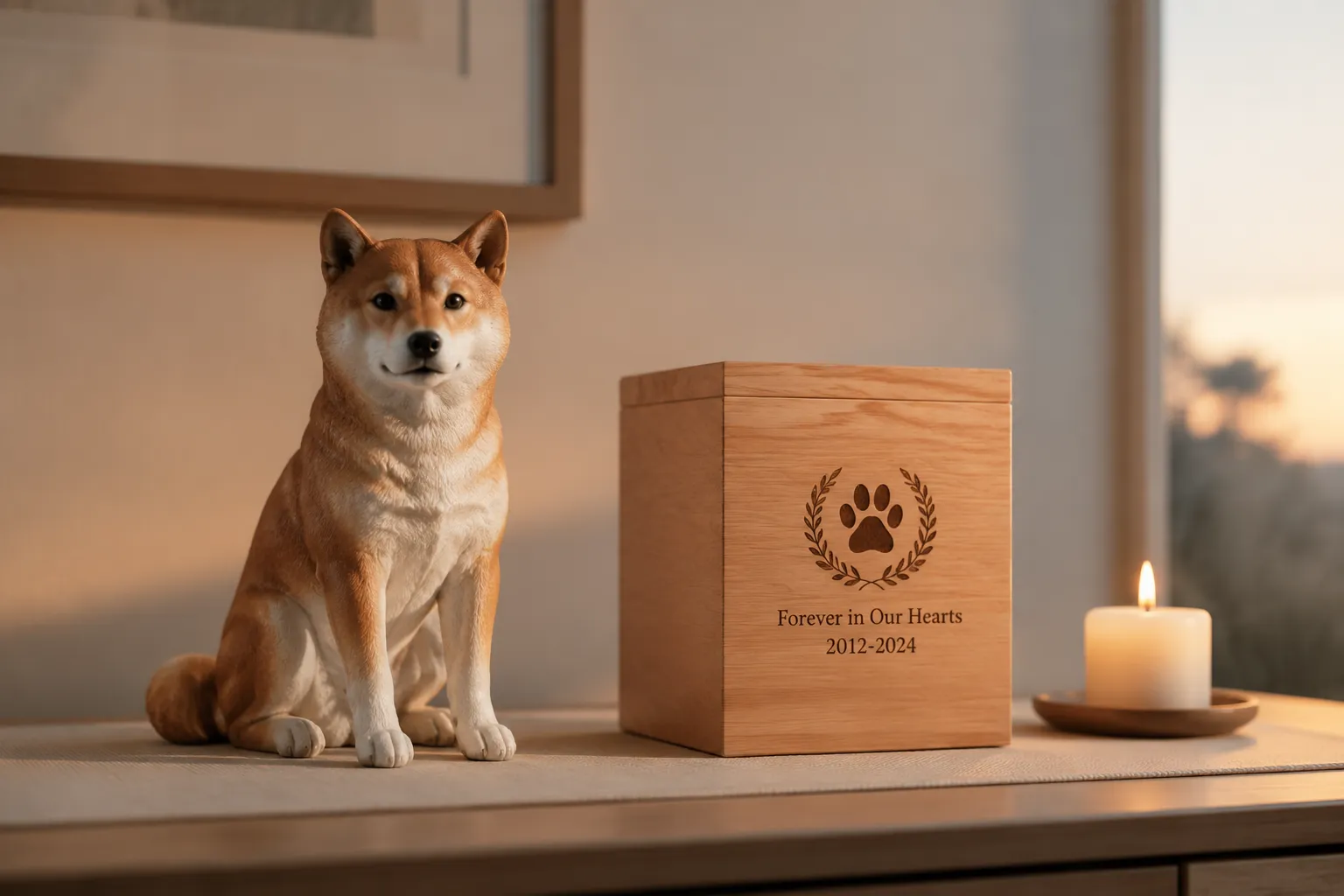
You're parked in the driveway, engine ticking as it cools, and Remember Me Thursday glows on your phone calendar — the same week you lost her last year. No claws scrabbling the back window. No happy huff fogging the glass. Just you, the key in your hand, and a Shiba-shaped absence in the passenger seat.
Quick Takeaways
- The first pet anniversary peaks in anticipation, not the day itself — plan for the week before, not just the date.
- Recreate one specific sensory memory — her favorite meal beats a generic candle for activating real grief and real comfort.
- The ashes box stays sealed because it's a noun, not a verb — turn it into a ritual you do, not an object you store.
- Sound triggers grief faster than sight — name the silences before they ambush you.
- A tangible anchor helps the brain hold what photos flatten — some families choose custom pet figurines that bring a pet's exact markings back into three dimensions.
Remember Me Thursday Isn't About the Day — It's About the Week Before
Here's something most grief guides get backward. They tell you to "brace for the anniversary." They circle the date in red and hand you a tissue.
But the data on anniversary grief points somewhere else. Anticipatory grief — the dread that builds in the days leading up — almost always outweighs the day itself. Your nervous system starts running the countdown long before your calendar does.
Remember Me Thursday lands on the last Thursday of September every year. It's a global day of remembrance for pets who've passed, marked with candle-lighting at sunset. Beautiful. Quiet. Public.
And if you lost your Shiba around that time, the day carries double weight — the collective ritual stacked on top of your private one.
"Anniversaries don't reopen the wound. They remind you the wound was real, and that the love behind it still has a pulse."
So the first move isn't to white-knuckle the Thursday. It's to map the runway.
The 14-Day Approach Window
In our years working with pet families through their first anniversaries, we've noticed a pattern. The grief doesn't arrive on schedule. It leaks in early.
You'll be fine on a Tuesday. Then a song plays, or the light hits the kitchen floor at the angle she used to nap in, and you're gutted two weeks ahead of time.
Name this. Out loud if you can. "The anniversary is coming, and I'm already feeling it." That single sentence does more than it should. It converts a vague, free-floating dread into a known thing with edges.
Known things are survivable. Ambushes are not.
Why the Spiritual Frame Changes the Math
Treat Remember Me Thursday as a sacred appointment, not a sad obligation. The difference is everything.
An obligation is something you endure. A sacred appointment is something you show up for — a deliberate space you hold open for a presence that hasn't fully left.
Your Shiba's spirit doesn't need you to suffer on cue. The bond you two built was a kind of contract: she gave you her whole short life, and you keep her legacy lit. That's the assignment. Not grief for its own sake — remembrance with intention.

The First Pet Anniversary Follows a Predictable Curve
Grief feels chaotic. But the first-anniversary version of it moves through recognizable stages, and knowing the map makes the territory less terrifying.
Below is the curve we've watched hundreds of families travel. Your timeline may shift by a few days in either direction — and that's normal — but the shape tends to hold.
| Phase | When | What It Sounds Like | Your Anchor |
|---|---|---|---|
| The Creep | 10-14 days before | A song, a silence, sudden tears | Name it: "It's coming" |
| The Dread | 3-5 days before | Trouble sleeping, irritability, avoidance | Plan the ritual now |
| The Day | Remember Me Thursday | Heavy, hollow, strangely calm | Do the ritual, don't perform grief |
| The Drop | 1-3 days after | Flatness, "is that it?", guilt | Rest. The body is exhausted |
| The Lift | 1-2 weeks after | Lighter, with a new steadiness | Notice the shift, honor it |
Look at "The Drop." That post-anniversary flatness catches people completely off guard.
You built up to this enormous emotional event, you got through it, and then... nothing. A weird numbness. Some people feel guilty about it, like they didn't grieve "correctly" or hard enough.
You did. The flatness is your nervous system catching its breath. It's not a failure of love. It's the body doing exactly what it's built to do after a sustained emotional sprint.
A Morning in the Approach Window
Here's how this plays out in real life, not theory.
It's the Saturday before. You wake up to your alarm instead of a paw on your chest and that low Shiba grumble that meant get up, the day is wasting. The apartment is too quiet. You make coffee, and the absence of nails clicking across the floor toward the kibble bin hits you harder than any photo could.
So you don't fight it. You pull out the calendar, you write "light her candle, make her meal" on Thursday, and the dread loosens its grip by a single notch. Planning is a form of breathing.
Her Favorite Meal Is a Better Memorial Than Any Candle
This is the part nobody tells you, and it's the heart of why the food matters so much.
Generic memorial gestures — a store-bought candle, a framed stock-photo quote, a balloon release — engage almost nothing. They look like remembrance. They rarely feel like it.
But your Shiba's favorite meal? That's a multisensory time machine.
Why Food Outperforms Almost Everything
Memory and smell share a neural neighborhood. The olfactory bulb wires directly into the regions that handle emotion and memory, which is why a single scent can drop you into a moment from a decade ago.
When you cook the chicken-and-rice she went feral for, or warm the specific brand of food that made her do the spinning happy-dance, you're not just remembering her. You're re-summoning the sensory world you shared.
The sizzle. The smell filling the kitchen. The phantom sound of her claws hitting the tile at a dead sprint the second she heard the can opener.
"Grief lives in the senses. So that's exactly where remembrance has to meet it."
That's the counterintuitive truth: the more specific and sensory your ritual, the more it actually works. Vague gestures produce vague comfort. Precise gestures produce real connection.
Building the Meal Ritual
You don't need a recipe blog. You need intention. Here's a simple structure:
- Recreate the exact meal — same food, same bowl if you still have it, same spot on the floor.
- Narrate it — say her name, talk to her, describe the day you're having. Out loud matters.
- Set a place for the presence — not in a creepy way. A sacred space. A second bowl, a candle beside it.
- Eat alongside her — make yourself something too. Shared meals were your daily liturgy. Honor that.
- Sit in the after — don't rush to clean up. Let the smell linger. Let the moment breathe.
A family we worked with did this every Remember Me Thursday for their Shiba named Yuki. They'd grill the salmon skin she lived for, set her bowl out, and just... talk to her for twenty minutes. The mom told us it was the only time all year the grief felt warm instead of sharp.
A Quick Note on Shiba Inus Specifically
If you've loved a Shiba, you know they're not like other dogs. The independence. The cat-like grooming. The infamous "Shiba scream." The way they'd accept your affection on their terms and then give you the side-eye for getting too sentimental.
The American Kennel Club's breed profile calls them spirited and alert, bold and confident — and any Shiba parent will tell you that's underselling it.
So your Shiba Inu memorial should reflect her personality, not a generic dog. The stubborn one who refused to walk in the rain. The drama queen who screamed at the vet. The one who curled into that perfect cinnamon-roll shape and dared you to disturb her.
Memorialize the character, not just the loss.
The Ashes Box Problem Nobody Talks About
Let's talk about the box.
The cedar one, or the little engraved tin, or the plain cardboard temporary container you've been meaning to upgrade for eleven months. It sits on a shelf. You walk past it every day. And you almost never open it.
Here's the uncomfortable truth: for most people, the ashes box becomes a noun instead of a verb.
It's a thing you store. A presence you tiptoe around. Sometimes a source of low-grade guilt — should I be doing more with this? Am I supposed to scatter them? Is leaving them on the shelf disrespectful?
Why the Box Stays Sealed
In our experience with pet families, the box gets frozen for three reasons:
- Decision paralysis — scattering feels too final, burial feels too permanent, so you do nothing.
- Fear of the moment — opening it means confronting the physical reality, and that's a wall you're not ready to hit.
- No ritual attached — without a practice, the box is just an object gathering meaning it can't release.
That third one is the key. A pet ashes keepsake only becomes meaningful when you give it something to do.
Turning the Box Into a Practice
You don't have to scatter everything. You don't have to make one giant irreversible decision. The all-or-nothing framing is the trap.
Consider a split approach instead:
| What You Do | Emotional Effect | Reversible? |
|---|---|---|
| Keep all ashes in the box | Safe, but often stagnant | Yes |
| Scatter all at once | Powerful, but final and frightening | No |
| Scatter a portion at a meaningful spot | Ritual without total loss | Partly |
| Place a small amount in a keepsake | Daily presence, portable comfort | Yes |
| Plant a portion with a tree or shrub | Living legacy that grows | Partly |
Most families find peace somewhere in the middle of that table, not at the extremes.
Scatter a spoonful where she loved to dig. Keep the rest. Tuck a tiny amount into a wearable keepsake so a part of her travels with you. You're allowed to do several of these. Grief is not a single-select quiz.
"We've seen families heal the moment they stopped storing their pet and started honoring them. The box isn't the memorial. What you do with it is."
— The PawSculpt Team
The Sacred Space Idea
Instead of a shelf where the box hides, build a small sacred space. A dedicated corner. The box, a candle, her collar, a photo, maybe her favorite toy — that one squeaky thing she carried everywhere until the squeak died.
When the ashes have a context, they stop being a problem to solve and become a presence to visit. That shift — from avoidance to approach — is where a lot of the healing actually happens.
When the Guilt Shows Up Uninvited
We need to talk about the feeling almost no one says out loud.
If your Shiba's passing involved euthanasia — and for many older or sick dogs, it does — there's a specific torment that can haunt the first anniversary: second-guessing the timing.
Did I do it too soon? Did I rob her of good days? Or did I wait too long, and make her suffer because I couldn't let go?
This question can loop for months. On the anniversary, it gets loud.
Naming the Spiral
Here's what we want you to hear, plainly. That spiral is not evidence that you did something wrong. It's evidence that you loved her enough to agonize over getting it right.
People who make careless decisions don't lie awake replaying them a year later. You're not haunted because you failed. You're haunted because you cared about her experience more than your own comfort.
The relief you felt when her suffering ended — that flicker of thank god it's over — doesn't make you cold. It makes you someone who couldn't bear to watch her hurt. The guilt that chases that relief is one of grief's cruelest tricks, and it lies.
"You didn't choose between keeping her and losing her. You chose between her suffering and her peace. That's love, not failure."
If this guilt is consuming you, please know it's a recognized and common part of pet loss. Organizations like the Association for Pet Loss and Bereavement offer chat-based support specifically for this, staffed by people who understand that this grief is real and legitimate.
We're not grief counselors — for the heavy stuff, lean on people trained for it. But we can tell you this: in the hundreds of families we've talked to, the timing guilt fades. Not because you forget. Because you eventually forgive yourself for being human and finite and unable to control death.
The Other Quiet Guilt: Moving Forward
There's a second guilt that often surfaces around the first anniversary, and it's almost the opposite of the first.
You've started to feel okay. You laughed at something. You went a whole day without the ache. And then — guilt. Am I forgetting her? Does feeling better mean I loved her less?
No. Healing is not betrayal. The grief softening doesn't mean the love shrank. It means you're learning to carry her differently — less like an open wound, more like a presence you walk beside.
Her legacy was never your suffering. It was the joy she brought. Reclaiming that joy is honoring her.
What Helps the Brain Hold a Memory It's Starting to Lose
Now we hit the fear that ambushes nearly every pet parent in year one. The fear of forgetting.
Not forgetting that she existed. Forgetting the details. The exact pitch of her bark. The specific weight of her against your shins at 2 a.m. The precise rust-and-cream pattern of her coat where the colors blended.
You panic a little when you realize you can't quite hear her anymore.
Why Photos Aren't Enough
Photos flatten. They're 2D windows into a 3D life, and they age in a strange way — they freeze the look but lose the feel.
You can have a thousand pictures and still not be able to remember how it felt to cup her face in your hands. The dimensionality is gone. The presence is gone. There's a window, but you can't reach through it.
This is exactly why a growing number of pet families look for something with physical form — something that brings the body back into space, even in miniature.
"A photo shows you what she looked like. A figurine lets you hold what she was."
The Tangible Anchor
Grief researchers talk about "continuing bonds" — the healthy practice of maintaining a connection with the deceased rather than severing it. For pets, tangible objects do a lot of this heavy lifting.
A collar. A clay paw print. A lock of fur. And increasingly, dimensional keepsakes like 3D pet sculptures that recreate your pet's actual posture, markings, and proportions.
For a Shiba specifically, the dimension matters. That curled tail. The pricked ears. The fox-like face and the cinnamon-roll sleeping curl. A flat photo can't hold those signature shapes the way a figure in your palm can.
This is some of what we do at PawSculpt — and we'll be real, it's not the only path. Memorial gardens, photo books, and donation drives in your pet's name are all genuine, beautiful options. The right one is whatever helps you hold on without holding still.
What to Expect When You Turn a Memory Into Form
If a dimensional keepsake feels right, here's the honest version of how it works — minus the sales gloss.
A lot of people assume a custom pet figure means someone painting tiny details with a brush. That's not how modern technology does it. At PawSculpt, master 3D artists digitally sculpt your pet from your photos, then the model is precision 3D printed in full color. The color is printed directly into the resin, voxel by voxel — it's part of the material itself, not a coat applied on top.
The only manual step afterward is a protective clear coat that gives the piece its finish and durability. The result has a vibrant, true-to-life look with a subtle natural print texture — authentic, not glossy-plastic-perfect.
What Photos Actually Work Best
Since the whole thing is built from your images, the photos do the heavy lifting. Here's what gives the artists the most to work with:
| Photo Element | What Helps | What to Avoid |
|---|---|---|
| Lighting | Natural daylight, even and soft | Harsh shadows, dark rooms |
| Angle | Eye-level, straight-on and side profile | Extreme top-down or blurry action shots |
| Detail | Close-ups of markings and face | Heavy filters that alter real color |
| Quantity | Several angles of the same pet | A single distant photo |
| Expression | A pose that captures her personality | Stiff, unnatural setups |
If you only have a few photos — which is common when you're memorializing — don't panic. Skilled 3D artists can work with limited references and fill gaps with their experience reading breed structure. When you reach out about a memorial keepsake, it's worth sending whatever you have and asking what's possible.
The General Process, Honestly
Every studio runs differently, and specific turnaround times, revision policies, and pricing change — so we won't quote numbers that might be wrong by the time you read this. For current details, check pawsculpt.com directly.
Broadly, though, the journey looks like this:
- You share photos and describe what made your Shiba her.
- A digital sculpt is created by a 3D artist, capturing her posture and markings.
- You review a preview and request adjustments — the ears, the tail curl, that one expression.
- The piece is 3D printed in full-color resin once you're happy.
- A clear protective coat is applied, and the figure ships to you.
The review step is the one that matters most. This is where you make sure it's her — not a generic Shiba, but the specific soul you're honoring.
Designing Your Own Remember Me Thursday Ritual
Let's bring it together into something you can actually use this year.
You don't need all of this. Pick what resonates. The goal is a ritual that's specific, sensory, and yours.
- Sound — play the music you played when she was alive, or sit in deliberate quiet and let the silence be sacred instead of scary.
- Smell — cook her favorite meal, or burn the candle scent that fills your sacred space.
- Touch — hold her collar, her keepsake, a full-color figurine that lets your hands remember her shape.
- Sight — light a candle at sunset, the way Remember Me Thursday asks, and look at one photo, not a hundred.
- Voice — say her name. Tell her about your year. Speak the bond out loud.
Reclaiming the Sound
We've leaned on sound throughout this piece for a reason. The auditory absence is often the cruelest part of pet loss — the missing jingle of tags, the silence where the bark used to be, the quiet house that used to be loud with her.
So on Remember Me Thursday, give the sound back. Even briefly.
A family we worked with kept a 12-second voice memo of their Shiba's ridiculous scream-howl. Every anniversary, they play it once. The mom said it makes them all laugh and cry in the same breath — and that, she told us, is exactly what their dog would've wanted. Chaos and love, in stereo.
That's the energy of the bond, still humming. Not gone. Transformed.
Frequently Asked Questions
When is Remember Me Thursday?
Remember Me Thursday falls on the last Thursday of September each year. It's an international day of remembrance for pets who've passed, traditionally observed by lighting a candle at sunset. If you lost your pet near that date, the public ritual and your private anniversary often overlap — which can intensify the week.
Is it normal to feel guilty about euthanasia timing a year later?
Completely normal. Second-guessing whether you acted too soon or waited too long is one of the most common — and most painful — forms of pet-loss guilt. It doesn't mean you made the wrong call. It means you loved your Shiba enough to agonize over her comfort. That guilt usually softens as you forgive yourself for being human.
What should I do with my pet's ashes box if I can't decide?
You don't have to make one final decision. Many families find peace by splitting the ashes — scattering a small portion somewhere meaningful, keeping the rest in a keepsake, or planting a portion with a tree. The key is giving the box a practice rather than letting it sit untouched as something you tiptoe around.
Why does the first pet anniversary feel harder than I expected?
Because the dread usually peaks before the day, not on it. Anticipatory grief builds in the 10 to 14 days leading up, and many people also experience a strange flatness in the days after. Knowing this curve in advance makes both phases far less disorienting.
What photos work best for a Shiba Inu memorial figurine?
Clear, naturally lit photos taken at eye level work best — ideally a straight-on shot, a side profile, and a close-up of the face and coat markings. For a Shiba, references that show the curled tail and pricked ears help capture the signature look. If you only have a few photos, skilled 3D artists can often still work with them.
Can I keep part of my pet's ashes in a figurine or keepsake?
Many keepsakes are designed to hold a small portion of ashes, and some families keep a wearable piece while displaying a figurine separately. Options vary, so it's worth asking a studio directly about what's possible for your situation before deciding.
Ready to Honor Your Shiba's Memory?
A year on, the grief changes shape — but the love doesn't fade. Whether you're lighting a candle this Remember Me Thursday, cooking her favorite meal one more time, or finally giving that ashes box a ritual worthy of her, you're keeping a sacred contract alive. For families who want something to hold, a custom PawSculpt figurine brings your Shiba's exact markings, curled tail, and unmistakable personality back into three dimensions — a tangible anchor for a first pet anniversary and every one after.
Visit pawsculpt.com to learn more about our digital sculpting process, preview turnaround, and quality guarantee.