
That Saved Fur Clipping: A Gentle Family Ritual for Your German Shepherd's First Season
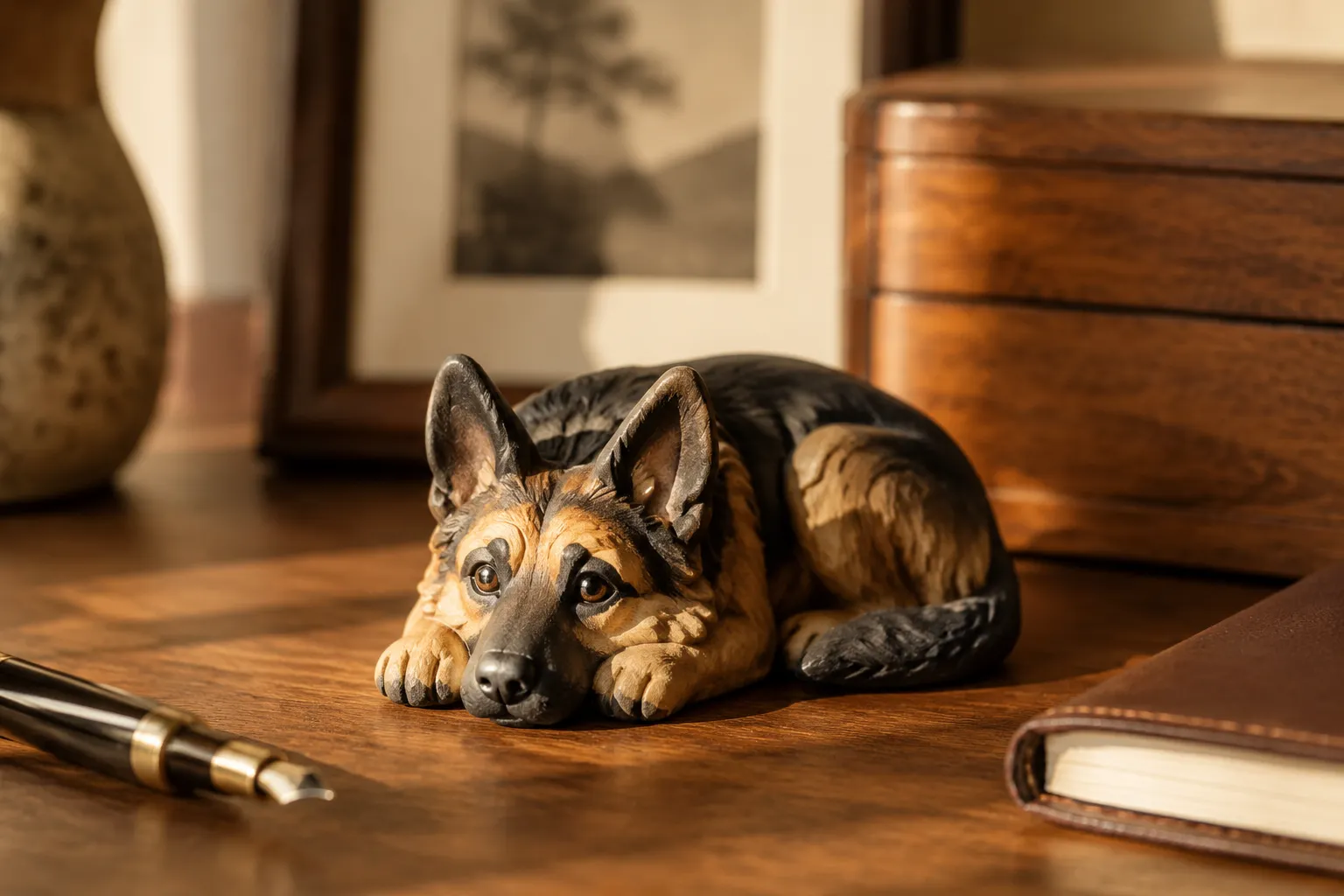
Halfway up the ridge trail, the old leash bag snags on a branch and a small envelope slips free. Inside: a curl of black-and-tan fur. That saved clipping is where a german shepherd memorial quietly begins.
A saved fur clipping becomes a meaningful german shepherd memorial when your family turns it into a shared seasonal ritual: setting aside one evening each spring to hold it, tell stories, and mark the turning season together. Kept in a sealed envelope, tin, or locket, the fur stays intact for years and anchors your grief to something you can actually touch.
Quick Takeaways
- Save the clipping before you think you need it — grief attaches to texture, and fur holds memory better than photos.
- Anchor the ritual to a season, not a date — spring shedding time feels natural and less clinical than a death anniversary.
- Make it a family act, not a solo one — coping with pet loss as a family works best when everyone has a role.
- Turn the keepsake into something lasting with options like custom pet memorial figurines that hold your dog's character, not just their likeness.
The Grief Nobody Warns German Shepherd Owners About
Here's something we've noticed across hundreds of memorial orders from Shepherd families: it isn't the empty food bowl that undoes them. It's the clean floor.
If you've lived with a German Shepherd, you know the truth. The fur is everywhere. Twice a year, during what breeders call "blowing coat" (the heavy seasonal shed when the undercoat releases in tufts), your Shepherd redecorates the entire house in a fine layer of black, tan, and silver. You vacuum. It comes back by dinner. You accept it as the tax on loving this breed.
Then they're gone. And the first spring rolls around, and the floors stay clean.
That absence has a color to it. The morning light hits the hardwood and there's no drift of undercoat catching the sun near the baseboard, no silver strands floating in the sunbeam by the window. The clean floor becomes a kind of proof. That's the grief trigger almost no one anticipates, because for years the fur was an annoyance, never a gift.
Which is exactly why that saved clipping matters more than most families realize when they tuck it away.
"You spend a decade sweeping their fur out the door. Then one clean season, you'd give anything to find one more tuft under the couch."
Why a Fur Clipping Outlasts a Photo
We're a portrait studio, so you'd expect us to be all about images. And photos matter. But grief is a physical thing, and fur does something a screen can't.
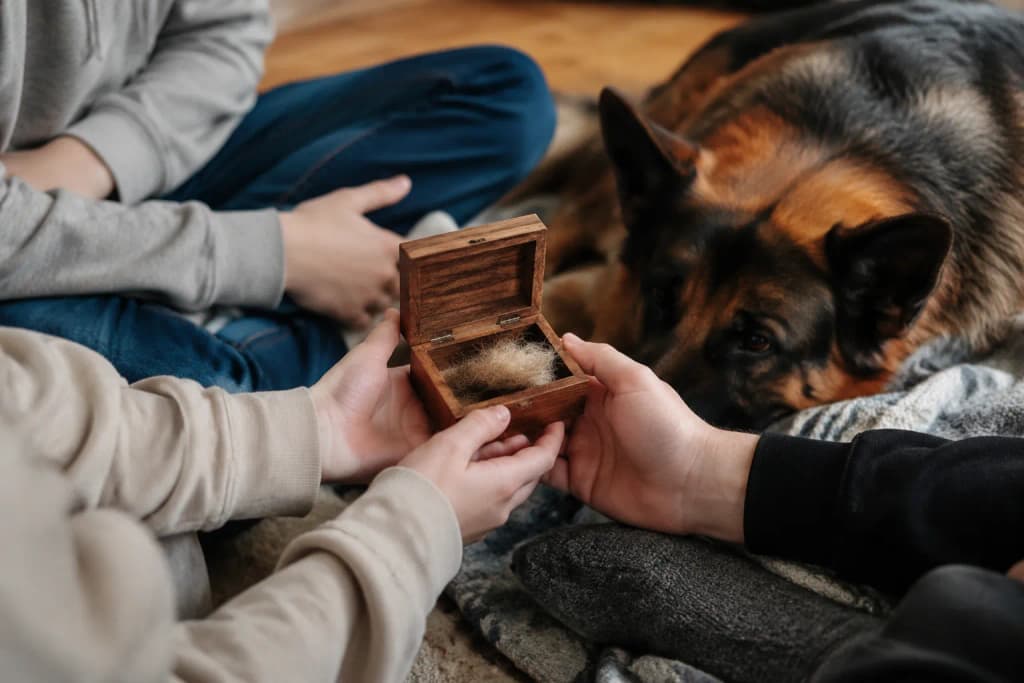
Texture bypasses your thinking brain. When you press that curl of undercoat between your fingers, you're back in the moment you cut it, the way their body felt warm under your hand, the specific gray at their muzzle in that last year. The Association for Pet Loss and Bereavement talks about the value of "linking objects" in grief, and few objects link harder than a piece of your dog you can still hold.
A photo shows you what they looked like. Fur reminds your hands what they felt like. That difference is the whole reason this ritual works.
There's a practical reason to act early, too. Fur doesn't degrade if you store it right, but the window to collect a good clipping is narrow around end-of-life, and grief fog makes people forget. If your Shepherd is still with you, do it now. Snip a small curl from somewhere soft, behind the ear or the ruff, and seal it away. You will not regret having it.
The First Season Is Harder Than the First Week
Most grief guides map the timeline wrong. They focus on the raw first days, and yes, those hurt. But in our years working with pet families, the ambush comes later, when the seasons turn and your body expects a routine that no longer exists.
Here's a rough shape of what the first year tends to look like for Shepherd families specifically. Every dog and every household is different, so hold this loosely.
| Time After Loss | What Often Surfaces | What Helps |
|---|---|---|
| First 72 hours | Shock, autopilot, disbelief | Let others handle logistics; don't decide anything permanent |
| Weeks 2–6 | The routine gaps hit (feeding time, walks) | Keep one walk route; change the ones that hurt most |
| First seasonal shed (2–6 months) | The "clean floor" ache, sensory absence | Bring out the fur clipping; start the ritual |
| 6–12 months | Guilt resurfaces, timing questions return | Talk it out; the ritual gives a container for it |
| First full year mark | Bittersweet acceptance, softer memory | Repeat the ritual; note what's changed in you |
The point of naming this: when the sadness spikes months in, you're not backsliding. You're hitting a season your nervous system remembers. That's normal, and it's exactly what a ritual is built to hold.
About That Guilt You're Not Saying Out Loud
Let's name the thing families rarely admit. Many Shepherd owners carry a quiet, gnawing question: did we wait too long, or not long enough?
This breed hides pain. They'll wag through arthritis, push up on failing hips because you reached for the leash. So when the end comes by your choice, the second-guessing can be brutal. You replay the vet's face, the specific afternoon light in the room, whether you read the signs right.
That doubt is not evidence you failed. It's evidence you loved a stoic dog who made the hardest decision of your life even harder by being brave.
Making a call for a creature who couldn't tell you where it hurt is an impossible math problem, and there was never a clean answer. The ritual we're about to walk through gives that guilt somewhere to go, instead of letting it circle at 2 a.m.
How to Build the Ritual: A Family Walkthrough
Coping with pet loss as a family is different from grieving alone. Everyone's on a different clock. One kid wants to talk constantly, another goes silent, and one adult buries themselves in work. A shared ritual gives the whole household a single place to put the feeling, without forcing anyone to grieve on someone else's schedule.
Keep it simple. Complexity is the enemy of a ritual you'll actually repeat. Here's a practical structure that families have adapted to their own homes.
- Pick your season, not a date. Anchor it to the first warm week of spring, roughly when your Shepherd used to start shedding. Seasons feel gentler and more natural than a death anniversary, which can feel like re-opening a wound on command.
- Set the scene with light. Do it in the late afternoon, the golden hour, near a window. Grief and warm light go together. Let the room feel soft, not solemn.
- Bring out the clipping. Pass the fur around. Everyone holds it. Little hands especially. Touch is the whole point.
- Go around and share one specific thing. Not "she was a good dog." Something concrete: the way he leaned his full weight against your shins, the specific bark he saved for the mail carrier, how her ears did that helicopter thing.
- Add one small gesture that closes it. Return the fur to its tin. Light a candle and blow it out together. Plant something. The ending signal tells everyone's nervous system that the grief has been honored and the day can go on.
The "So What?" of Anchoring to a Season
Why does the season-not-date choice matter so much? Because death anniversaries often become dread. Families brace for weeks. A seasonal anchor flips it. Instead of "the day we lost him," it becomes "the time of year we remember him," and remembrance is a warmer room to sit in than loss.
"We've learned that grief doesn't want to be fixed. It wants to be witnessed. A ritual is just a way of saying: this mattered, and we'll keep saying so."
— The PawSculpt Team
What to Actually Do With the Fur
A clipping in a sandwich bag in a drawer is a start, but families usually want something that feels intentional. Here are the common paths, with honest tradeoffs.
| Option | Effort | Best For | Worth Knowing |
|---|---|---|---|
| Sealed tin or envelope | Minimal | Simplicity, keeping it private | Store dry and cool; avoid humid bathrooms |
| Glass locket / vial | Low | Wearing a small amount daily | Keep the bulk stored elsewhere as backup |
| Framed shadow box | Medium | Displaying with collar tag, photo | Use UV-protective glass to prevent fading |
| Felted fur ornament | High | Hands-on families, seasonal display | Some fiber artists felt pet fur into small keepsakes |
| Companion to a sculpted portrait | Low | Pairing touch with a lasting figure | The fur sits beside a keepsake shaped like them |
Our honest take: don't put all the fur into one project. Keep a reserve in a sealed tin. If a locket breaks or a project fails, you'll be grateful you held some back. We've heard the heartbreak of a spilled vial, and there's no getting it back.
What We Wish We Knew Sooner (From Our Team)
A few candid things families have told us, and that we've come to believe:
- The clipping doesn't need to be big. People imagine a lock of hair like a keepsake from a movie. A small curl the size of a quarter is plenty. What matters is that it's theirs.
- Don't wash it. The instinct is to clean it up. Resist. A little of their real scent and dust is part of what makes it theirs, and washing can mat the undercoat.
- Kids often lead better than adults. Children tend to treat the ritual with a matter-of-fact tenderness that adults have trained out of themselves. Follow their lead.
- The first ritual will feel awkward. That's fine. By the second season, it becomes yours. Rituals earn their meaning by repetition, not by getting it perfect the first time.
When the Grief Belongs to the Whole House
Coping with pet loss as a family means reckoning with the fact that a German Shepherd is rarely one person's dog. They're the kids' guardian, the household's alarm system, the reason someone got out of bed. Different relationships, different griefs, under one roof.
A quick scenario we hear often: one parent wants to talk about the dog constantly, keeping the memory loud and present. A teenager can't stand it and leaves the room every time. Neither is wrong. The talker is processing out loud. The teen is protecting a wound that's still too raw for words. The ritual gives them a scheduled, bounded place to meet in the middle, so the griever isn't grieving at the avoider all week long.
Don't Forget the Dog Left Behind
If you have a second dog, watch them. Dogs grieve, and Shepherds are especially bonded. According to the American Kennel Club, surviving pets can show real behavioral shifts after losing a companion. Here's what to look for.
| Sign in the Remaining Dog | What It May Mean | What You Can Do |
|---|---|---|
| Searching the house, waiting at the door | Looking for their companion | Keep routines steady; extra floor-time |
| Loss of appetite for several days | Stress, disrupted routine | Hand-feed; monitor; call your vet if it persists |
| Increased clinginess or vocalizing | Anxiety, seeking reassurance | Calm presence, not over-coddling |
| Sudden lethargy | Depression-like response | More short walks; new gentle stimulation |
We're not vets, so if any of this lingers past a week or two, or if eating stops, call your veterinarian. But often what the surviving dog needs most is the thing you also need: a little more presence, a little more routine, and time.
Turning the Keepsake Into Something You'll Keep Forever
At some point, many families want more than fur in a tin. They want to see their dog again, in the room, in three dimensions. That's a natural next chapter, not a replacement for the clipping.
Families take different roads here. Some commission a painted portrait. Some plant a memorial tree where the golden afternoon light lands. And increasingly, pet parents choose a sculpted keepsake shaped like their dog, something the whole family can set beside the fur tin during the ritual.
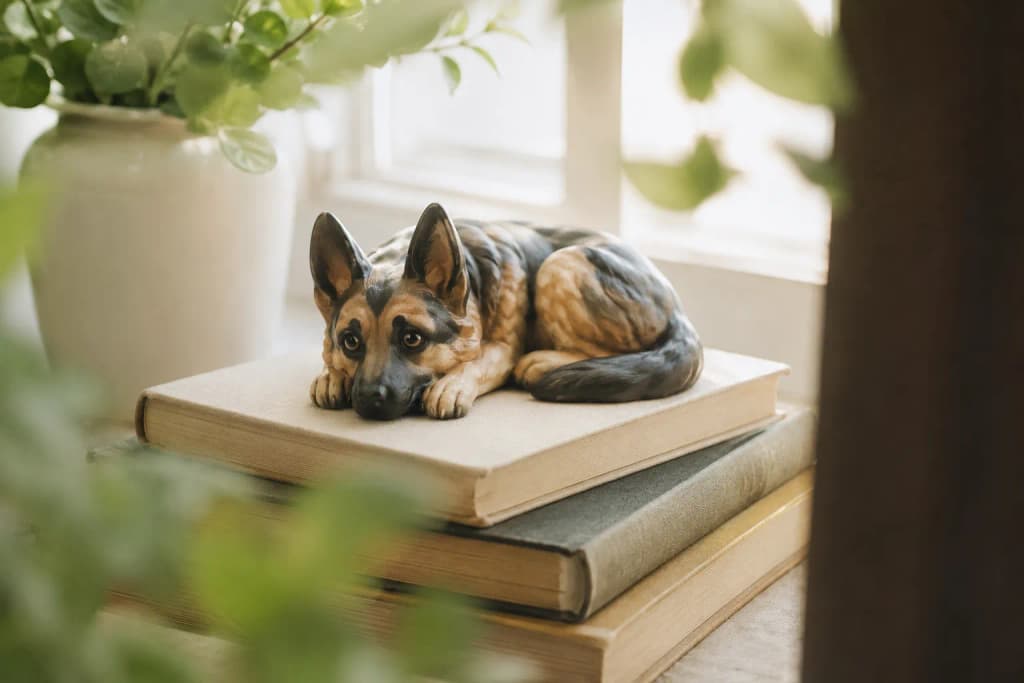
This is the work we do at PawSculpt. We digitally sculpt your dog by hand, then bring them to life through full-color 3D printing, where the color lives inside the resin itself rather than sitting on top of it. Your Shepherd's saddle markings, the tan on the legs, the set of the ears, all of it printed directly into a durable, UV-resistant figure with a protective clear coat and a natural, honest finish.
We're careful about one promise, and we want you to hear it straight: this is a portrait, not a photocopy. Our artists capture your dog's character, their posture, that specific tilt of the head, as a sculpted interpretation. It's not a photographic clone, and honestly, the families who love their 3D pet sculptures most are the ones who wanted the feel of their dog, not a mannequin.
If you're curious how your Shepherd might look, the site has a free instant AI preview, and after a deposit an artist shares a 3D preview within seven days so you can see the direction before anything is finalized. Explore the details at pawsculpt.com when you're ready. No rush. Grief has its own clock.
Bringing It Back to the Trail
That envelope that slipped out of the leash bag on the ridge? It wasn't an accident of packing. Some part of you saved that curl of black-and-tan fur because you already knew, before you had words for it, that you'd need something to hold when the floors went clean.
So here's your one actionable next step. Tonight, find that clipping, or if your Shepherd is still with you, cut a small one. Put it somewhere safe and sealed. Then, when spring comes and the shedding season arrives without them, gather whoever loved that dog, sit in the late-day light, and pass the fur around. Say one true thing each.
That's the whole german shepherd memorial. Not a monument. A tuft of undercoat, a window full of gold light, and a family agreeing out loud that this dog was here, and mattered, and is remembered. The fur will keep. So will they.
Frequently Asked Questions
How do I preserve a German Shepherd fur clipping so it lasts?
Keep a small curl in a sealed tin, envelope, or glass locket, stored somewhere dry and cool. Don't wash it, since a little of their natural scent and texture is part of what makes it theirs. Avoid humid bathrooms and direct sun, which can mat and fade the undercoat over years.
Is it normal to feel guilty about the timing of euthanasia?
Completely normal, and more common than most people admit. German Shepherds are stoic and hide pain, which makes the "too soon or too late" question especially cruel. That doubt is a sign of how much you cared, not proof you got it wrong. Talking it through, or writing it down, helps far more than replaying it silently.
How long does pet grief usually last?
There's no set clock. For many families, the ambush comes months in, when a season turns and your routine expects a dog who isn't there. Grief tends to soften over the first year but can spike around anniversaries and seasonal changes. That's normal, not backsliding.
What's the best way to grieve a pet as a whole family?
Build a small, repeatable ritual and anchor it to a season instead of a death date, which feels gentler. Gather everyone, pass around a keepsake like saved fur, and have each person share one concrete memory. It gives kids and adults a shared place for their grief without forcing the same timeline on anyone.
Should we get another dog right away?
There's no right answer, and anxiety about "replacing" your dog is a normal feeling. Some people find genuine comfort in a new companion within weeks. Others need a year. A good gut check: wait until a new dog feels like adding love to the house, not filling a hole.
Ready to Celebrate Your Pet?
Every pet has a story worth preserving. Whether you're honoring a beloved German Shepherd who's crossed the rainbow bridge or celebrating your furry friend's unique personality, a custom PawSculpt figurine, a sculpted portrait, not a photocopy, captures the character that makes your dog one-of-a-kind. Set beside a saved fur clipping, it turns a quiet german shepherd memorial into something the whole family can gather around, season after season.
Visit pawsculpt.com to try the free instant AI preview, see an artist's 3D preview before you commit, and learn how each piece ships insured, tracked, and carefully packed.