
When Grief Meets Crisis: Therapy, a Persian's Fur Clipping, and Letting Seasons Pass
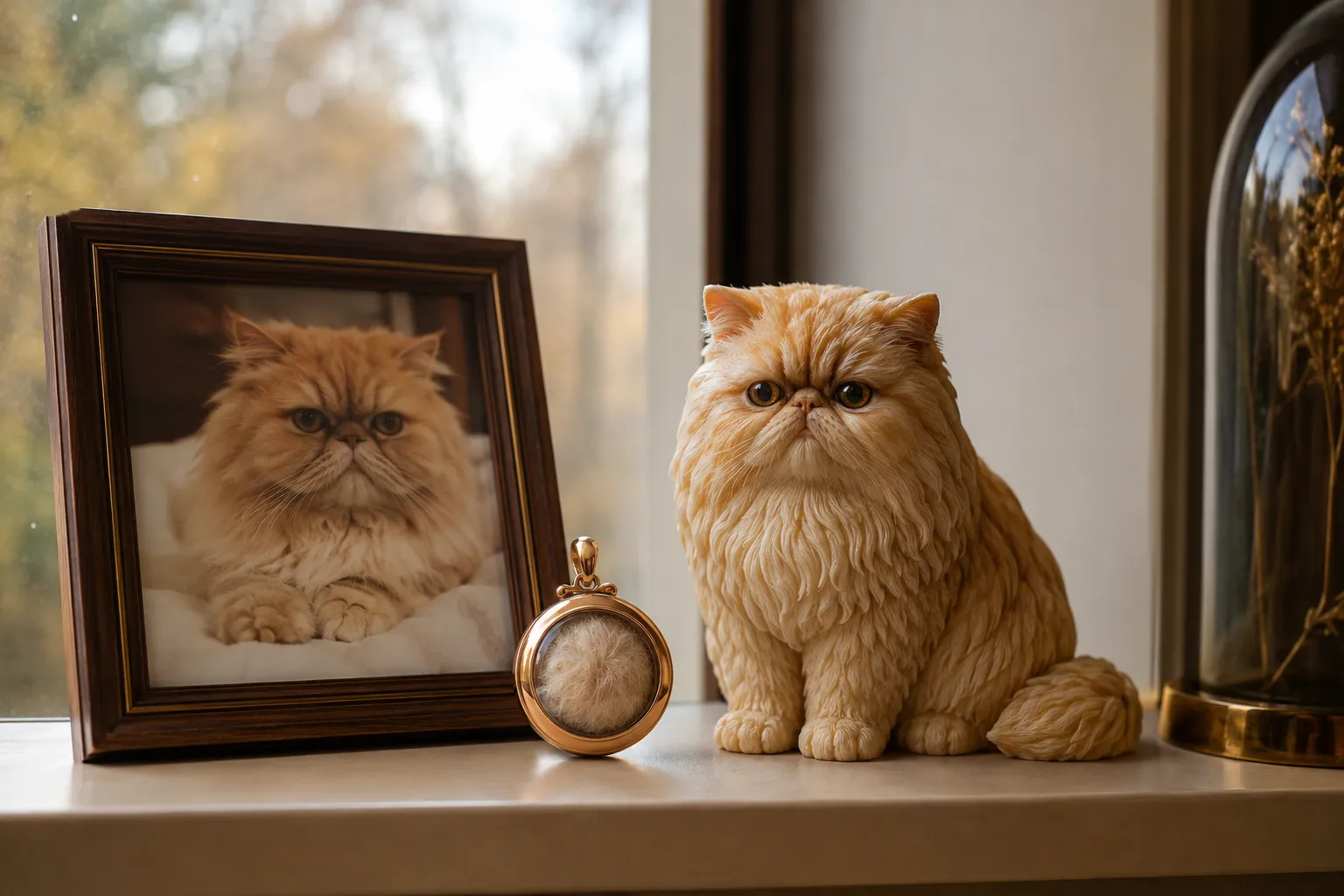
"What we once enjoyed and deeply loved we can never lose," Helen Keller wrote, "for all that we love deeply becomes a part of us." A clipping of silver Persian fur sits in a drawer now, soft as a held breath—the first artifact of persian cat loss you never planned to catalog.
Quick Takeaways
- Grief doesn't wait for a convenient season — expect it to collide with whatever crisis you're already surviving.
- Second-guessing the timing of goodbye is near-universal — the doubt is a symptom of love, not failure.
- A single physical anchor helps more than a shrine — fur, collar, or a tangible keepsake gives grief somewhere to land.
- Therapy for pet loss is legitimate care — you don't have to justify the depth of the bond to anyone.
- Let the seasons pass without measuring your progress — healing isn't linear, and there's no gold star at the end.
When Persian Cat Loss Arrives at the Worst Possible Time
Here's what almost no grief guide will tell you: pets rarely die when your life has room for it.
They go during the divorce. During the layoff. During the week your father's biopsy results come back, or the month you're packing a house you can no longer afford. Grief has terrible timing, and a Persian—those long-lived, high-maintenance, impossibly present companions—often leaves right when you have the least emotional bandwidth to feel it.
We worked with a customer we'll call Dana. Her Persian, Juniper, was seventeen. Juniper died the same season Dana's marriage did—two losses stacked so close together that Dana told us she couldn't tell where one grief ended and the other began. "I kept apologizing to people," she said. "For crying about a cat when my whole life was on fire."
That apology is the thing worth sitting with.
Because when persian cat loss lands in the middle of a larger crisis, most people don't grieve the cat. They rank it. They tell themselves the divorce is the "real" loss, the job is the "real" problem, and the animal who slept on their chest for seventeen years gets demoted to a footnote. The guilt of that demotion becomes its own quiet wound.
"Grief doesn't line up politely. It arrives all at once, and asks to be felt all at once."
The counterintuitive truth is that stacked grief isn't diluted grief. It's compounded. Two losses don't split your capacity in half—they borrow from the same reserve, and when that reserve runs dry, small things undo you. The empty spot on the windowsill where the sun used to warm a sleeping cat. The corner of the couch that stays cold now. The absence of that specific weight settling onto the foot of the bed at 2 a.m.
Spatial memory is cruel that way. A house doesn't forget where a cat used to be.
The permission you're waiting for
Look, we're not therapists, and we'll say that plainly. But in years of working with grieving pet families, we've noticed something: people going through a crisis often wait for permission to grieve the animal, as if there's a queue and the cat has to wait its turn.
There's no queue.
The nervous system doesn't process loss in order of perceived importance. It processes what's present, and a Persian who was physically woven into the fabric of your daily life—the brushing rituals, the lap-time, the specific chirp at the door—is deeply, physically present in your memory. Grieving that animal isn't a distraction from your bigger crisis. It's often the only loss in the pile that feels safe enough to actually cry about.
That's not weakness. That's the body finding the one door it can open.

Why Grief Therapy for Pet Loss Isn't What You Think
Most people picture grief therapy for pet loss as a last resort—something for people who "can't get over it." That framing is backwards, and it keeps people from getting help while help would still be preventive rather than reparative.
Therapy after pet loss isn't about fixing you. It's about having one room, for one hour, where you don't have to explain that the grief is proportionate. Where you don't have to preface your tears with "I know it's just a cat, but—"
That preface, by the way? Drop it. It's a habit of self-diminishment, and it does real damage over time.
What actually happens in pet loss counseling
A lot of people assume the counselor will spend the session telling them the loss is valid and handing over a pamphlet about the rainbow bridge. The good ones do something more useful. They help you locate the specific grief underneath the general sadness.
Because "I miss my cat" is the surface. Underneath it might be:
- The guilt that you clipped the mats out of her fur too roughly that last month.
- The regret that you were on your phone the last evening she was healthy.
- The second-guessing about whether you waited too long, or not long enough, to say goodbye.
- The shame that you feel more wrecked by this than by the human crisis running parallel to it.
Naming the specific thread is what loosens the knot. A skilled grief counselor helps you do that.
The Association for Pet Loss and Bereavement maintains resources and support options worth knowing about—their perspective on the human-animal bond is grounded and non-judgmental, and you can explore what they offer through the APLB's grief support resources. We mention them not because therapy is the only answer, but because too many people never learn that pet-loss-specific support exists at all.
"You don't owe anyone an explanation for a love that lived in your lap for seventeen years."
The euthanasia question that haunts people
We need to talk about the one that comes up most, because almost every family we work with carries some version of it.
Did I wait too long? Did I not wait long enough?
Second-guessing the timing of euthanasia is one of grief's most relentless loops. You replay the last week looking for the "right" moment you supposedly missed. You wonder if she was suffering on Tuesday when you told yourself she had good days left. You wonder, alternately, if you rushed it out of your own exhaustion.
Here's the honest thing: there is almost never a clean, obvious moment. The decision lives in a gray zone by design, because you're weighing a life you love against a suffering you can't fully measure. Persians, with their stoic quiet and their long lives, are especially good at hiding decline. You made the call with the information and the love you had at the time.
Dana asked us this question sideways, months later. She'd convinced herself she'd waited a week too long. When she finally said it to her therapist, the therapist asked her one thing: "If Juniper could have understood the choice, what would she have wanted for you?" Dana said she cried for twenty minutes and then, for the first time, slept through the night.
That reframe won't work for everyone. But the doubt itself? It's not evidence you failed. It's evidence you took the weight seriously.
The Fur Clipping and Other Sacred Objects
The drawer with the fur in it.
Nearly everyone has one—or wishes they did. A clipping of coat, a well-chewed collar, the ceramic bowl you can't bring yourself to wash. These aren't clutter. They're anchors, and in the spiritual sense, they're the physical vocabulary of an ongoing relationship.
There's a ritual most people don't plan but end up performing anyway: opening the drawer. Touching the fur. Closing it again. It's a small liturgy of remembering, and it does something the mind can't do on its own—it makes the presence tangible for a moment.
With a Persian, the fur is especially loaded. That coat was a project. If you owned one, you knew the daily brushing, the mat-wrangling, the summer clip that left them looking indignant and half their size. The clipping in your drawer might literally be from a grooming session—a mundane Tuesday that became, in hindsight, sacred.
Why the anchor matters more than the shrine
We've noticed something across thousands of grieving families, and it runs counter to a lot of well-meaning advice.
The people who build elaborate shrines—the wall of photos, the candle, the corner of the room dedicated to the pet—sometimes struggle more, not less. A shrine can become a place grief goes to freeze. You visit it, you perform sadness there, and then you leave the rest of your life untouched by the memory.
What tends to help more is a single, portable, integrated object. Something that travels with you into your ordinary days rather than sequestering the grief into one cold corner of the house.
"A shrine keeps grief in a room. An anchor lets it walk with you into the light."
This is where the spatial dimension matters. Grief that's confined to one location—the empty bed, the untouched corner—can make an entire home feel like a museum of absence. But an object you can hold, carry, place on a working desk, keeps the bond in motion. It becomes part of the living space rather than a mausoleum within it.
From fur to form
This is the honest place where a memorial keepsake enters the story—not as a product, but as a natural extension of the anchor instinct.
Some families press the fur into a locket. Some frame a paw print. And some choose a custom pet figurine that captures the specific tilt of the head, the flat Persian face, the plume of a tail. The point isn't the object's cost. It's that it gives the presence a form you can keep on the desk where you actually live your days.
At PawSculpt, the figurines are digitally sculpted by master 3D artists and then produced through full-color resin 3D printing—the color is printed into the material itself, voxel by voxel, so a Persian's smoke-gray undercoat and copper eyes come through directly in the resin rather than sitting on the surface. The only manual step is a protective clear coat for sheen and durability. The result carries the fine, natural grain of a 3D print, which many families find feels more honest than a glossy, mass-produced figurine. It looks like something real, because in a sense, it is.
We'll be real about the limits: no object replaces a living animal, and no keepsake is a shortcut through grief. But an anchor gives the grief somewhere to land, and that landing place matters more than most people expect until they're holding one.
Coping With Loss During Crisis: Letting Seasons Pass
The phrase "letting seasons pass" isn't a soft metaphor. It's a practical framework for coping with loss during a crisis, and it's the thing we wish more people understood in the first raw weeks.
You cannot process stacked grief on a schedule. You especially can't do it while your income, your housing, or your marriage is in freefall. So the goal in the acute phase isn't to heal. It's to survive the season without doing yourself further harm.
Here's a rough, honest map of how grief tends to move—not a rulebook, because yours will misbehave, but a landscape so you know you're not lost.
| Season | What it often feels like | What actually helps |
|---|---|---|
| First 72 hours | Numbness, disbelief, phantom sightings on the windowsill | Basic bodily care; skip the big decisions |
| Weeks 1–3 | Waves that hit without warning; the empty corner ambushes you | One anchor object; low-stakes routine |
| Months 1–3 | The world moved on; you didn't; isolation deepens | Naming the specific grief; peer or professional support |
| Months 3–6 | Guilt about "moving on"; better days feel like betrayal | Permission to laugh; integrating memory into daily life |
| The following year | Anniversary ambushes; unexpected softening | Ritual on hard dates; the anchor becomes comfort, not pain |
Notice there's no "acceptance" finish line with a ribbon. That's intentional. Grief doesn't complete. It integrates.
The isolation nobody names
Around month two, something specific happens. The casseroles stop. The check-in texts thin out. And for pet loss especially, the world quietly expects you to be "over it," because—the unspoken assumption goes—it was an animal.
That's when isolation sets in hardest. You start hiding the grief. You stop mentioning the cat at work. You grieve in the car.
If you're going through a crisis at the same time, the isolation doubles. People are already exhausted by your "big" problem, so mentioning the cat feels like asking for too much. This is the moment where a support group or a counselor stops being optional and starts being oxygen.
You are not "too much." You're a person carrying more than one loss with a nervous system that doesn't know how to prioritize.
Practical anchors for the worst weeks
When everything is falling apart, vague advice like "be gentle with yourself" is useless. Here's what's specific and actionable:
- Keep one daily fixed point. Same wake time, same first task. When grief and crisis both make time formless, a single fixed point keeps you from dissolving into the day.
- Designate a 10-minute grief window. Set a timer. Feel it fully. When it ends, move. This isn't suppression—it's containment, and it prevents the grief from swallowing the hours you need for survival tasks.
- Move the anchor object into your workspace. Not a shrine in a back room. The fur clipping, the collar, or a figurine on the desk where you actually spend your days. Integration over isolation.
- Write the unsent letter. One page to your Persian. Say the guilt out loud on paper. This works especially well for the euthanasia doubt.
- Don't adopt to fill the silence—yet. More on this below, but the anxiety-driven rush to replace is one of the most common regrets we hear.
"We've learned that grief needs a place to rest its hands. A form to hold is often the beginning of carrying the memory instead of the weight."
— The PawSculpt Team
The anxiety about getting another pet
This deserves its own moment, because it's tangled with guilt.
Some people rush to adopt within days—the silence of the house is unbearable, the routine of caregiving is a lifeline, and the empty spaces demand filling. Others feel a wave of panic at the very idea, as if bringing home another animal would be a betrayal of the one they lost.
Both reactions are normal. Neither is a moral test you can fail.
What we'd gently caution against is adopting to escape the grief rather than to make room for new love. A new cat can't be a replacement for Juniper, and asking a kitten to fill a seventeen-year-shaped hole sets everyone up for disappointment. When Dana eventually adopted again—almost a year later—she told us it only worked because she'd stopped looking for another Juniper. She was ready for someone new, not a copy.
If you're in the acute phase of a crisis, this is precisely the wrong time to make that decision. Let the season pass first.
The Memorial Options, Ranked Honestly
We've seen families try nearly everything to hold onto a bond, and we've developed opinions. So here's a candid comparison—not a sales pitch, an honest editorial take on what tends to serve grieving people and what tends to disappoint.
| Memorial option | Emotional staying power | Effort | Best for |
|---|---|---|---|
| Photo book | Moderate; fades into the shelf | Low | Storytellers who revisit images |
| Paw print casting | High if done at the vet; hard to get after | Low | Immediate, tactile keepsake |
| Memorial garden / tree | Deep but location-bound | High | Homeowners staying put |
| Fur locket / jewelry | High; portable and private | Low | Those who want grief close and quiet |
| Custom 3D-printed figurine | High; a daily-visible presence | Low (you provide photos) | Those who want the pet's form back |
| Elaborate shrine | Variable; can freeze grief | High | Rarely our first recommendation |
A few honest notes on this list.
The paw print is beautiful but time-sensitive—many families don't realize you often need to arrange it at the vet, in the moment, and the window closes fast. If you're reading this preemptively, ask your vet now.
The memorial garden is genuinely lovely, but we've watched people grieve twice when they had to move and leave it behind. Location-bound memorials carry a hidden risk during exactly the kind of housing instability that often accompanies a crisis.
The figurine stands out for one specific reason: it restores form, not just image. A photo is a moment flattened. A sculpture of your Persian—the flat face, the ruff, the deliberate way they sat—gives back the three-dimensional presence your spatial memory keeps reaching for. That's why some of the families we've worked with keep the piece on a working desk rather than a mantel. They don't want to visit the memory. They want to live alongside it.
What to expect if you go the figurine route
Since we make these, we'll be transparent about the process without pretending to know your specific timeline or terms—those live on the site and change, so check pawsculpt.com for current specifics.
The general arc looks like this:
- You send photos. For a Persian, clear shots that show the face structure and coat coloring matter most. A few angles help the sculptors read the three-dimensional form. Good lighting beats a fancy camera every time.
- Master 3D artists digitally model your pet. This is where the specific personality gets captured—the set of the ears, the posture, the eye color.
- The model is precision 3D printed in full-color resin. The markings and coat tones are printed into the material itself, so there's real depth to the color rather than a coating.
- A clear protective coat is applied for durability and a subtle sheen, and the piece ships to you.
The finish has a natural, fine-grained texture from the print process. We think that honesty of surface suits a memorial piece—it doesn't pretend to be flawless plastic, and neither was your cat.
If a photo book or a locket serves you better, do that instead. The best memorial is the one you'll actually keep close, not the one someone told you to buy.
The Guilt About Feeling Better
Somewhere in months three to six, most people hit a specific, disorienting wall: the day they realize they laughed and didn't think about the cat for six whole hours.
And then the guilt floods in. As if feeling better is a betrayal. As if the depth of your grief is the last thing tethering you to them, and letting it lighten means letting them go.
This is one of grief's cruelest tricks, and it deserves to be named directly: feeling better is not forgetting. The fear of forgetting is real—people white-knuckle their sadness because it feels like the only proof the love was real.
It isn't. The love was proven over seventeen years of brushing and lap-time and 2 a.m. weight on the bed. A single afternoon of laughter doesn't erase that. If anything, the capacity to laugh again is the bond doing what a healthy bond does—it wants your life to continue.
Dana told us the anchor helped here more than she expected. On the desk, in her peripheral vision during a work call, the figurine of Juniper was just there—not demanding grief, not staging a shrine, just present. "It let me stop testing myself," she said. "I didn't have to prove I remembered. She was right there."
That's the whole point of an anchor. It carries the remembering so you don't have to carry it alone.
Letting the Season Turn
Return to the drawer. The fur is still there, soft as a held breath.
But something shifts, eventually. Opening the drawer stops being a wound and starts being a greeting. The empty windowsill catches the sun and, one ordinary morning, the sun is just warm again—not an accusation of absence, just light.
That's what letting seasons pass actually means. Not moving on. Not getting over it. Just letting the light change until the corner that was cold is only a corner again, and the memory of the weight on your bed becomes something closer to comfort than ache.
If you take one thing from all of this, let it be this: your grief doesn't need to be justified, ranked, or hurried—especially not when it arrives in the middle of a crisis that already asked too much of you. Find your one anchor. Say the guilt out loud, to a counselor or a page or the drawer. And let the seasons do what seasons do.
The bond didn't end. It changed form. And a life that once slept on your chest becomes, as Keller said, a part of you that no loss can take. The work of navigating persian cat loss isn't to close the door on that presence. It's to learn to carry it into the light.
Frequently Asked Questions
Is it normal to feel guilty after losing my Persian cat?
Absolutely, and it's nearly universal. Guilt tends to cluster around the last weeks—whether you brushed too roughly, whether you noticed the decline soon enough, whether the timing of goodbye was right. That guilt is a symptom of how seriously you took the responsibility, not evidence you got it wrong. Naming the specific guilt, out loud or on paper, is what begins to loosen it.
How long does grief after pet loss last?
There's no clean timeline, and anyone who gives you a fixed number is guessing. For many people, the sharpest acute phase softens over three to six months, but grief has a way of returning in waves—on the anniversary, on a season that smells like a memory, when the corner of the couch catches your eye. Grief doesn't complete. It integrates into your life until it's more comfort than ache.
Can grief therapy really help with pet loss?
Yes, and it's more legitimate than most people give it credit for. A good counselor doesn't just validate the loss—they help you locate the specific grief underneath the general sadness, whether that's euthanasia doubt, isolation, or the shame of grieving "just a cat." Pet-loss-specific support exists, and reaching out is preventive care, not a sign you're broken.
How do I cope with pet loss during a personal crisis?
Focus on surviving the season, not healing on schedule. Keep one fixed daily routine so time doesn't dissolve, use a short contained grief window instead of suppressing or drowning, and lean on a single anchor object rather than an elaborate shrine. Delay major decisions—including adopting again—until the acute phase eases.
Should I get another pet right away after my cat dies?
There's no universal right answer, and both rushing in and recoiling are normal reactions. The one thing worth avoiding is adopting to escape the grief or to replace the pet you lost—a new animal can't fill a specific, years-shaped absence. Wait until you're making room for new love rather than searching for a copy, and never make that call in the middle of a crisis.
What should I do with my Persian's fur clipping or collar?
These objects are anchors, and they matter more than most people realize. Rather than sealing them in a back-room shrine, consider integrating them into your daily space—a locket you wear, a collar on a working desk, or a keepsake you keep in view. Objects that travel with you into ordinary days tend to comfort more than ones you have to visit.
Ready to Celebrate Your Pet?
Every pet has a story worth preserving. Whether you're honoring a beloved companion who's crossed the rainbow bridge or celebrating your furry friend's unique personality, a custom PawSculpt figurine captures those details that make your pet one-of-a-kind—the flat Persian face, the copper eyes, the plume of a tail that only your cat carried. For anyone navigating persian cat loss, an anchor you can keep close often becomes the quiet beginning of carrying the memory instead of the weight.
Visit pawsculpt.com to explore our full-color 3D printing process, revision options, and quality guarantee