
The Spot They Always Claimed on the Couch: A Family Ritual for a British Shorthair
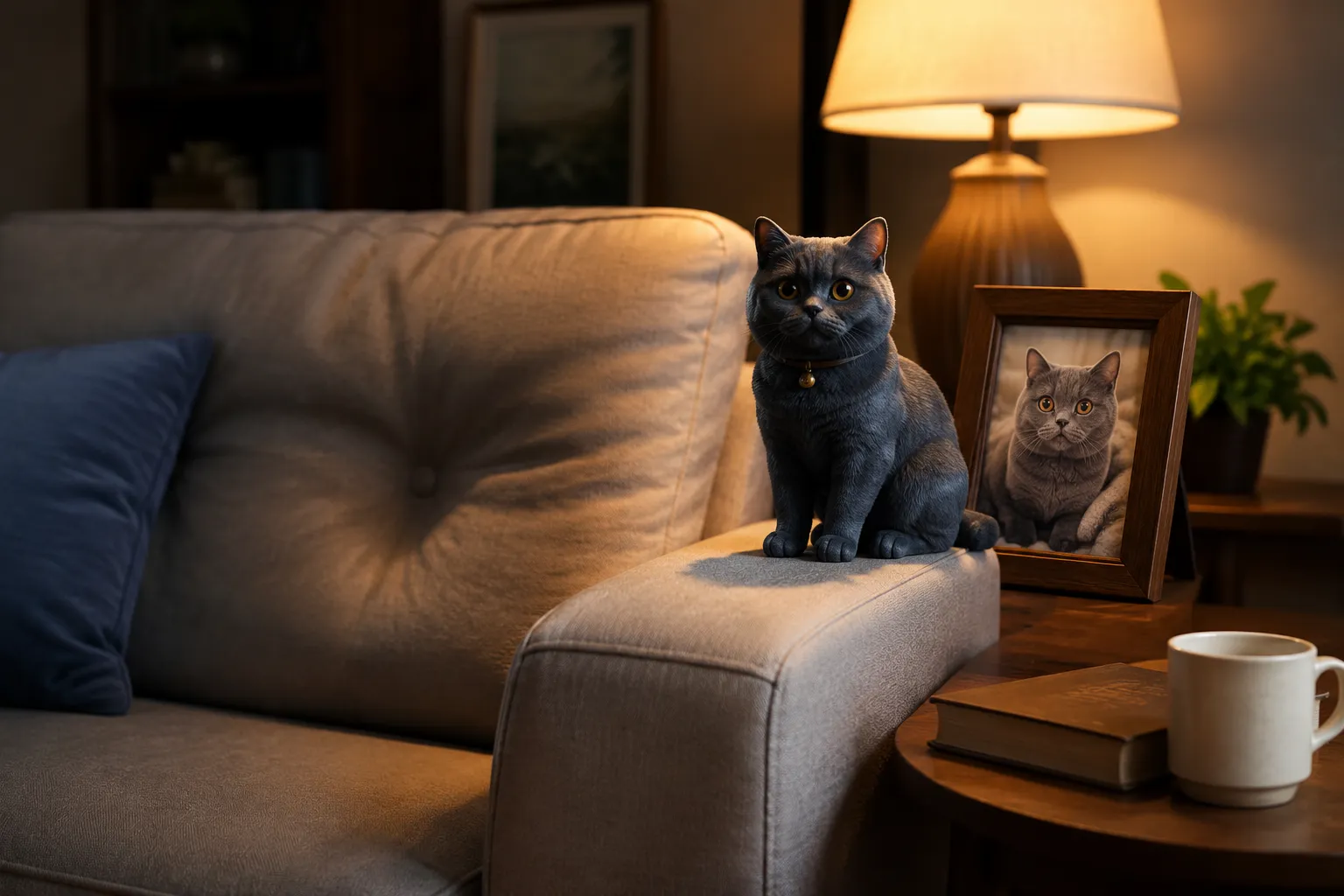
Why does that one couch cushion, now boxed up in the garage, still hold the exact dented shape of your British Shorthair? A British Shorthair memorial often starts right there — with a physical object your hands refuse to throw away, long after the cat who shaped it is gone.
Quick Takeaways
- Don't rush to "reclaim" their spot — the dent they left is grief's most honest anchor, not clutter to erase.
- Build a ritual around the place, not just the pet — territory-based mourning feels more natural for cats than photo shrines.
- Name the guilt out loud — feeling relief, resentment, or numbness after loss is neurologically normal, not a betrayal.
- Turn the empty spot into a gathering point — a candle, a favorite toy, or a custom pet figurine gives the family a shared focal point.
- Silence hits harder than you expect — plan for the missing sounds, because that's where the loss actually lives.
The Spot Was Never Just a Spot
Here's something we've noticed after working with thousands of grieving families: nobody grieves the cat in the abstract. They grieve the location. The warm weight on the left couch cushion. The specific window ledge. The corner of the bed by your feet.
And with British Shorthairs especially, that spot becomes almost sacred. Because this breed doesn't follow you room to room like a needy shadow. They pick a throne. They commit to it. That loaf-shaped silhouette pressed into the same cushion for eight, twelve, sixteen years — it's not a habit, it's an identity.
So when they're gone, the spot doesn't just look empty. It looks wrong.
There's real science under this, and it's worth knowing. Attachment theory, originally developed to explain the bond between infants and caregivers, applies remarkably well to the human-animal bond. Your brain built what psychologists call a "secure base" around your cat's predictable presence. Same chair. Same time. Same soft thud of them landing on the cushion at 6 p.m.
When that predictability vanishes, your nervous system reads it as a broken contract. You keep glancing at the spot because your brain is running a search query that returns no results — over and over.
"You don't miss the cat everywhere. You miss them in one specific place, at one specific volume."
That's why the standard advice — "give away their things, it'll help you move on" — often backfires. Stripping the spot bare doesn't close the loop. It just deletes the evidence that the loop ever existed.
Why British Shorthairs Leave a Bigger Empty Space
Let's be real about this breed for a second. British Shorthairs are quiet. Famously so. They're not the yowlers, not the ankle-weavers, not the cats who announce every entrance.
According to the American Kennel Club's overview of the breed, the British Shorthair is known for being easygoing, undemanding, and dignified — a cat that's present without being loud.
Which creates a strange grief. You'd think a quiet cat would leave a smaller hole. The opposite is true.
Because their whole thing was that steady, silent, gravitational presence. They anchored the room without making noise about it. So when they go, what disappears isn't a sound you'll consciously miss — it's a baseline you didn't know you were leaning on.
Cultural Mourning Traditions Have Been Doing This for Centuries
Here's the angle almost nobody writes about, and it's the one we find most useful. Humans have thousands of years of practice mourning through objects and places. We just never gave ourselves permission to apply it to a cat.
Think about it. Across cultures, grief has always been anchored to something physical:
- In Mexican tradition, the ofrenda (altar) holds photos, favorite foods, and objects the deceased loved.
- In many Jewish households, sitting shiva happens in a specific home, in specific chairs, for a defined period.
- Japanese butsudan (home altars) give the family a daily point of contact and small offerings.
- Irish and Celtic traditions built the wake around gathering in one place and telling stories.
Notice the pattern? Every single one uses a designated place plus a repeated action plus community. That's the actual machinery of healthy mourning. Not "time." Not "closure." A place, a ritual, and other people.
So the couch spot your British Shorthair claimed? It's already an altar. It's already a butsudan. You just haven't consciously named it yet.
"Grief without a ritual is just pain wandering around the house looking for somewhere to sit."
Personal Aside: We'll be honest — the first time a customer told us she'd left her cat's spot on the couch untouched for three months and felt "insane" about it, one of our team members quietly admitted they'd done the exact same thing with their childhood dog's dog bed. Kept it by the back door for a year. Nobody in the office thought that was strange. That's when we realized how many people are doing this in secret, half-convinced they're the only one.
The Difference Between a Shrine and a Trap
Okay, but here's the honest counterpoint, because we're not going to pretend this is simple.
There's a version of this that heals, and a version that quietly keeps you stuck. The difference isn't whether you keep the spot. It's whether the spot has a ritual attached to it or whether it's just frozen.
A frozen spot is a museum of pain. You walk past it, feel the pang, and keep the room exactly as it was because changing anything feels like a second death. That's the trap.
A ritual spot is active. You do something there. Light a candle on the anniversary. Leave the spot as the family's designated "remember them" corner. Put a small object there and actually interact with it.
The research on continuing bonds — a well-documented framework in grief psychology — supports this. Healthy grief isn't about severing the connection. It's about transforming it into something you can carry. A ritual does the transforming. A frozen room just preserves.
How to Build the Couch-Spot Ritual (An Actual Framework)
We've seen a lot of families stumble here because grief advice is usually so vague it's useless. "Honor their memory." Okay, how. Let's get specific.
This is the framework we've watched work best, adapted from those cultural traditions above but scaled down to a single cushion and a family who's hurting.
Here's a comparison of the common memorial approaches families consider, and how they actually land:
| Memorial Option | Effort | Emotional Weight | Best For |
|---|---|---|---|
| Leaving the spot untouched | Low | High but risky (can freeze grief) | The first few weeks only |
| Photo book or slideshow | Medium | Medium, screen-based | Families who process visually |
| Memorial garden / plaque | High | High, seasonal | Homeowners with outdoor space |
| Designated ritual corner | Low | High and active | Almost everyone, indoors |
| Custom 3D-printed figurine | Low (once ordered) | Very high, tactile | Families who need something to hold |
The two that consistently do the most healing work? The designated ritual corner and a tangible keepsake you can actually pick up. We'll come back to why the "pick up" part matters so much.
Step One: Declare the Spot, Don't Just Leave It
There's a real psychological shift between passively leaving the couch cushion alone and actively declaring it. Say it out loud to the family. "This is Winston's spot. We're keeping it as our remembering place."
Why it matters: Naming converts avoidance into intention. Your brain stops treating the spot as an unresolved error and starts treating it as a chosen memorial. Same cushion. Completely different neurological relationship.
Step Two: Add One Small Sensory Anchor
Pick a single object that lives in the spot now. A favorite crinkle toy. A small framed photo. A battery tea light you switch on during dinner.
The mistake most people make is turning it into a cluttered pile of everything the cat ever touched. Don't. One anchor. Cluttered shrines overwhelm the eye and dilute the ritual. One meaningful object does more emotional work than twenty.
Step Three: Attach a Repeated Micro-Action
This is the part everyone skips, and it's the most important. A ritual needs repetition, even tiny repetition.
- Light the tea light every Sunday.
- Say goodnight to the spot when you turn off the lights (yes, out loud, it's fine).
- On the monthly anniversary, the family shares one memory each in that corner.
Why it matters: Repetition is how grief metabolizes. Each small return to the spot lets your brain practice the connection in a safe, contained dose instead of ambushing you at random. This is basic neuroplasticity — repeated, low-stress exposure gradually rewires the raw pain into something more like tender remembrance.
Step Four: Make It a Family Thing, Not a Solo Vigil
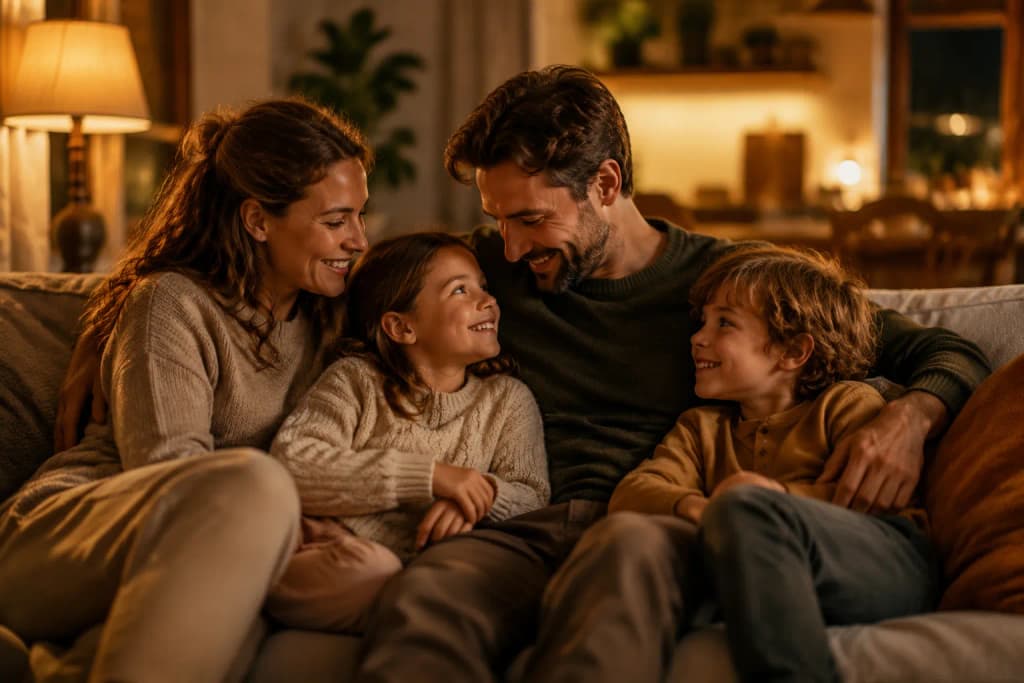
If you've got kids, a partner, roommates — bring them in. Family pet loss ritual works precisely because grief shared in a group is grief that doesn't isolate.
One family we worked with had their two kids each "tuck in" the cat's spot with a tiny blanket every night for a month. Sounds simple. But it gave the children a job in their grief, which is exactly what young kids need. Grief without a task is terrifying for a child. Grief with a small role is survivable.
The Sound You'll Miss Most Isn't the One You Expect
Let's talk about what actually ambushes people. Because it's rarely the big obvious stuff.
Everyone braces for the empty food bowl. The unused litter box. Those are visible, expected, and honestly you grieve them in advance a little.
What flattens people is the sound. Or rather, the missing sound.
With a British Shorthair, the audio signature is subtle but constant. The soft two-note thud when they hop down from the couch. The near-silent padding across hardwood. That low, rusty-hinge purr they saved for when you finally sat still. The tiny click of the cat flap. The 5 a.m. reminder chirp that breakfast was, in their opinion, overdue.
You stop hearing those sounds so long that you forget you're hearing them at all. Until they're gone. And then the house has a new frequency — a flat, dead-air quiet that your ears keep straining against, waiting for a thud that isn't coming.
"The hardest part of a quiet cat leaving is how loud the quiet gets."
Here's a concrete tip that helps more than people expect: name the missing sounds out loud with your family. "I keep waiting to hear him jump down." Saying it does two things. It validates that the silence is real and heavy, and it turns a private, disorienting ache into a shared, nameable experience. The isolation of grief lives in the sounds you miss alone.
Let's Talk About the Feelings Nobody Admits
We need to go somewhere uncomfortable now, because pretending grief is clean and noble helps no one.
That guilt you're carrying? Let's name it directly.
Maybe you feel guilty that on some level, you felt relief — that the vet bills stopped, that you're no longer syringe-feeding a cat who fought you every time, that you can travel again, that your carpet is finally clean. And then you hate yourself for feeling that relief.
Here's the truth, and we mean this: relief and love are not opposites. The relief you felt when their suffering ended, or when the exhausting caregiving finally stopped, doesn't shrink how much you loved them. It's evidence you were carrying something enormous. You don't feel relief at the end of a light load.
The guilt that comes chasing after that relief is one of grief's meanest tricks. It convinces you that a completely normal nervous-system response — the lifting of chronic stress, measurable in your actual cortisol levels dropping — is a moral failing. It isn't. Caregiver fatigue is real, and its release is not betrayal.
And if your relationship with the cat was complicated — if they scratched the kids, sprayed the furniture, hid from everyone for years, or you sometimes resented the whole situation — grieving them is even more disorienting. Complicated grief from a difficult relationship is still grief. You're allowed to mourn a cat you sometimes struggled to like. That tangle is human.
"Relief when their suffering ends isn't a lack of love. It's the proof of how much you were carrying."
The other one we hear constantly: the fear of forgetting. People panic that they'll lose the exact sound of the purr, the precise weight, the particular way this specific cat sat. This fear is why so many families reach for something tangible to hold onto. It's not morbid. It's your memory trying to protect what matters. More on that in a second.
Here's the range of "secret" grief emotions we see, and the honest reframe for each:
| What You Feel | How Common | The Reframe |
|---|---|---|
| Relief their care is over | Very common | Release of real caregiver stress, not betrayal |
| Guilt over euthanasia timing | Extremely common | You decided with love and incomplete information |
| Anger (at vets, at yourself, at them) | Common | Grief's energy needs somewhere to go |
| Fear of forgetting details | Nearly universal | Your memory protecting what it values |
| Numbness, no tears | More common than admitted | A valid nervous-system response, not coldness |
If you're stuck in the heavier end of this — the kind of grief that isn't softening at all after months — please know that's a real thing with a name. The Association for Pet Loss and Bereavement offers grief support resources, and there's zero shame in using them. We're a figurine company, not therapists, and some grief genuinely deserves a professional in the room.
Giving the Spot Something to Hold
So back to that fear of forgetting, because this is where the physical object earns its keep.
There's a reason cultures put statues on their altars and not just photographs. A photo is seen. An object is held. And touch does something to grief that looking never quite manages.
When you hold something with real weight and dimension, your brain engages differently than it does with a flat image on a shelf or a phone. There's a groundedness to it — a "here, in my hands, right now" quality that a photo can't replicate. This is why families keep dog tags, collars, a tuft of fur in a locket. The tactile connection is the point.
Some families plant a tree. Some do a photo book. Some keep the collar in a drawer. And increasingly, families come to us for a custom pet figurine that captures the exact loaf posture, the specific blue-gray coat, the round copper eyes that made a British Shorthair a British Shorthair.
Here's how we actually make them, because the process matters and there's a lot of confusion out there. Our master 3D artists digitally sculpt your cat from your photos — building the model detail by detail. Then that sculpt is precision 3D printed in full color, where the color is printed directly into the resin itself, voxel by voxel. It isn't a coat of color sitting on top; the pigment is the material.
The result has a vibrant, true-to-life finish with a subtle natural texture, sealed with a protective clear coat so it lasts. The blue-gray of a British Shorthair's coat, the plush density of the fur pattern, the exact set of the ears — reproduced in a piece you can actually pick up and hold in the spot they used to sit.
"We've learned that people don't want a perfect statue. They want the specific tilt of the head that only their cat did. That's the whole job."
— The PawSculpt Team
And that's the thing about placing a figurine in the claimed couch spot. The corner stops being an absence. It becomes a presence again — small, quiet, dignified. Very on-brand for the breed, honestly.
If you want to see how the full-color 3D printing process handles the tricky blue-gray coats and the plush texture British Shorthairs are known for, the details are all on PawSculpt's memorial keepsakes page.
What Photos Work Best (Practical Bit)
Since the fear of forgetting is often what pushes people to commission a figurine, let's make sure you get one that actually looks like your cat and not a generic gray blob.
- Eye-level shots beat top-down shots. Get the camera down to their level. It captures the real proportions of the face and body.
- Natural daylight, no flash. Flash flattens the coat and blows out those subtle color variations. A window on an overcast day is ideal.
- Include their signature pose. If they always sat in the loaf, send a loaf photo. The pose is half the personality.
- Multiple angles help. Front, side, and a three-quarter view give the artists what they need to build an accurate model.
- Sharp and close. Blurry or far-away photos force guesswork on markings and eye color.
For turnaround times, revision options, and the current guarantee, check the website directly — those details get updated and we'd rather point you to the accurate source than quote you something that's changed.
When Other Pets Are Grieving the Spot Too
One overlooked piece: if you've got another cat or a dog in the house, they clocked the spot too. And they may grieve it in ways that catch you off guard.
We've heard from families whose surviving cat started sleeping in the departed cat's exact spot for the first time ever — a spot they'd respected as off-limits for years. Others report the opposite: a surviving pet who avoids the area entirely, or who searches the house and vocalizes at odd hours.
Animals form attachments and register absence. They don't understand death, but they absolutely understand gone. Here's what tends to help:
- Keep routines steady. Feed, play, and sleep on the same schedule. Predictability is the fastest comfort for an anxious animal.
- Don't over-comfort the searching. Flooding an anxious pet with attention every time they vocalize can accidentally reward the distress. Calm, normal presence works better.
- Watch appetite and litter habits. A day or two of change is normal grief. Longer than that, call your vet — we're not medical folks and this crosses into their territory.
- Give it three to six weeks. Most surviving pets settle into the new normal within that window.
Why this matters for your own grief: watching another animal search for your cat can either deepen your pain or, strangely, comfort you — proof that the love was real and shared across the whole household. Let it be the second one if you can.
A Realistic Timeline (Because "Grief Takes Time" Is Useless Advice)
We're not going to insult you with "be patient, everyone's different." True, but useless. Here's what the arc actually tends to look like for families losing a long-term companion, based on what we see and what grief research broadly supports. Yours may differ, and that's fine.
| Phase | Rough Timeframe | What It Feels Like | What Helps |
|---|---|---|---|
| Raw shock | First 1-2 weeks | Numb, disoriented, the silence roars | Keep the spot, minimal decisions |
| Acute ambush | Weeks 2-8 | Random waves triggered by sounds/objects | Build the ritual, name the feelings |
| Reshaping | Months 2-6 | Pain softens into tender remembering | Transition frozen spot to active ritual |
| Integration | 6 months+ | They're carried, not lost | Keepsake becomes a warm presence |
Notice there's no "closure" box. Because closure is mostly a myth. You don't close the door on a sixteen-year presence. You just learn to carry them in a pocket that gets lighter over time. Some people integrate in four months, some in two years, and neither is doing it wrong.
"You don't get over them. You get better at carrying them."
The one thing we'll push back on hard: the idea that there's a deadline. Nobody gets to tell you the spot should be cleared by now, or that keeping a figurine on the couch after a year is "unhealthy." If it brings warmth instead of fresh pain, it's working. Full stop.
The Spot, Reconsidered
Go back to that cushion in the garage — the one holding the exact dented shape of a cat who committed to it for years.
You don't have to throw it out. And you don't have to freeze it in place either. You get a third option, the one every mourning culture in history figured out long before us: give the place a purpose, give the family a small repeated act, and give your hands something real to hold there.
Bring the cushion back inside if you want. Set it in the corner. Put one small thing on it — a candle, a photo, or a figurine that gets the head-tilt exactly right. Then do one tiny thing there, on a rhythm that's yours.
That's how a British Shorthair memorial stops being an empty space you keep flinching away from and becomes the warmest corner in the house. The spot was never just a spot. It was where the love sat. It still can be.
Tonight, when the house goes quiet and your ears reach for a soft thud that won't come, look at the corner instead. Say goodnight. That's the whole ritual. That's enough.
Frequently Asked Questions
Is it normal to feel relief after my British Shorthair passed away?
Completely normal, and far more common than people admit out loud. If you spent months on medication schedules, vet visits, or watching them decline, the lifting of that chronic stress registers as relief. It doesn't mean you loved them less. It means you were carrying a heavy load with love, and your nervous system is finally exhaling.
How long does pet grief usually last?
There's no fixed timeline, but most families move through raw shock in the first couple of weeks, ambush-style waves for a month or two, and a gradual softening over three to six months. Some take longer, especially after a very long bond. Longer grief isn't a malfunction, and there's no deadline you're failing to meet.
Should I leave my cat's favorite spot on the couch untouched?
Short-term, yes — leaving it is a natural and healthy instinct. The risk is letting it become a frozen museum you flinch past for years. The healthier move is to declare the spot a memorial corner, add one meaningful object, and attach a small repeated action. That converts avoidance into an active, healing ritual.
Why is my surviving pet acting differently since the loss?
Animals don't understand death, but they absolutely register absence. Surviving pets may search the house, vocalize at odd hours, sleep in the departed cat's spot, or avoid it entirely. Keep routines rock-steady and give it three to six weeks. If eating or litter habits change for more than a day or two, call your vet.
What photos should I send for a custom British Shorthair figurine?
Eye-level shots in natural daylight (no flash) capture the coat's true blue-gray tones best. Include their signature pose, especially the loaf, and send front, side, and three-quarter angles. Sharp, close photos let the 3D artists reproduce accurate markings, eye color, and proportions instead of guessing.
Is creating a memorial figurine morbid or unhealthy?
Not at all. Every mourning culture in history has used physical objects and altars to grieve. A tangible keepsake you can hold engages your brain differently than a photo, and it directly answers the fear of forgetting specific details. As long as it brings warmth rather than fresh pain, it's doing exactly what it should.
Ready to Celebrate Your Pet?
Every pet has a story worth preserving. Whether you're honoring a beloved British Shorthair who's crossed the rainbow bridge or celebrating your furry friend's unique personality, a custom PawSculpt figurine captures those details that make your cat one-of-a-kind — the loaf posture, the plush blue-gray coat, the exact head-tilt that was theirs alone. For a British Shorthair memorial that turns an empty couch spot back into a warm, dignified presence, a figurine you can actually hold gives your family something real to gather around.
Visit pawsculpt.com to learn more about our full-color 3D printing process, revision options, and quality guarantee.