
The One Change That Stops Your Geriatric Akita from Snapping at Younger Dogs in the House
"The old dog barks backward without getting up. I can remember when he was a pup." — Robert Frost
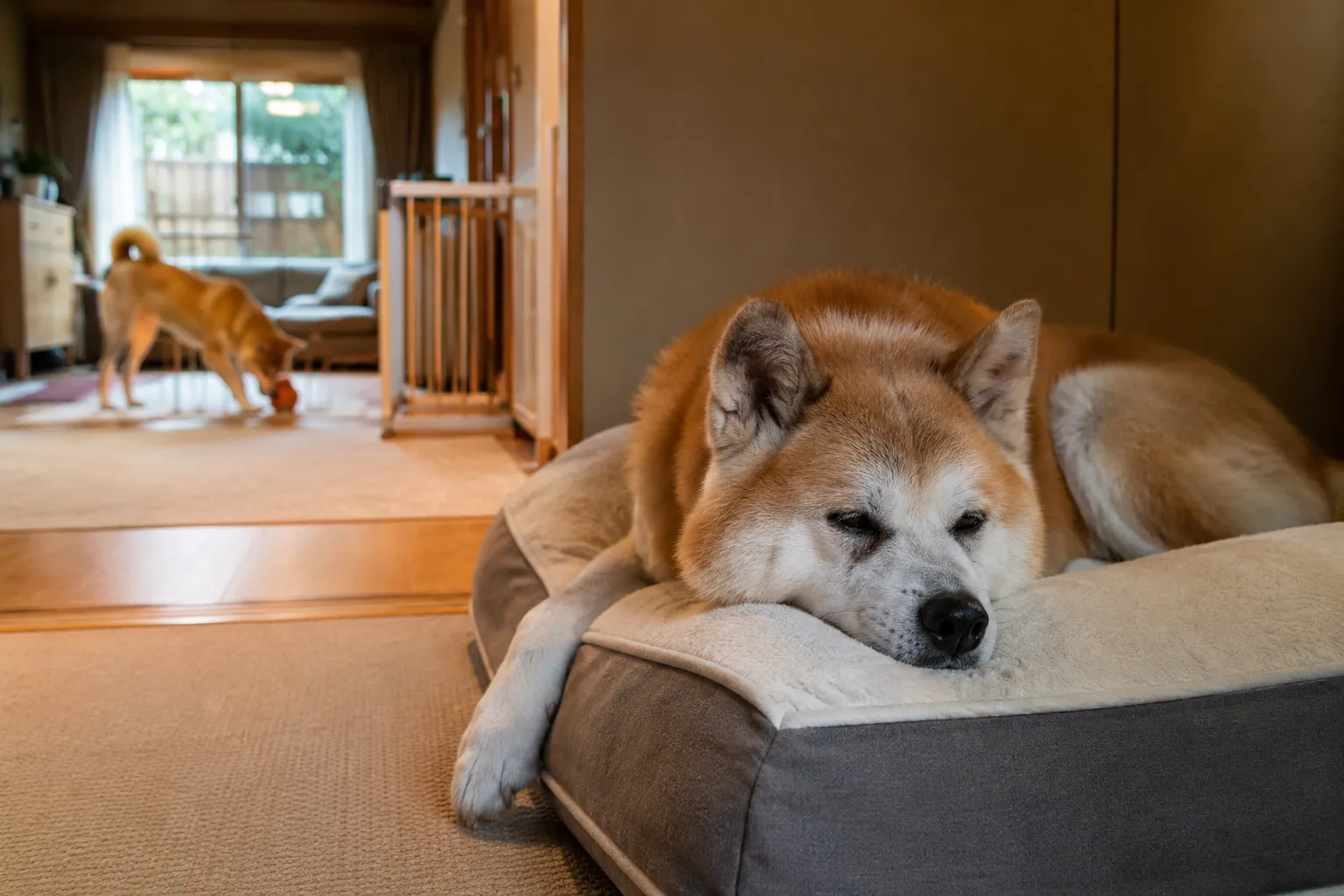
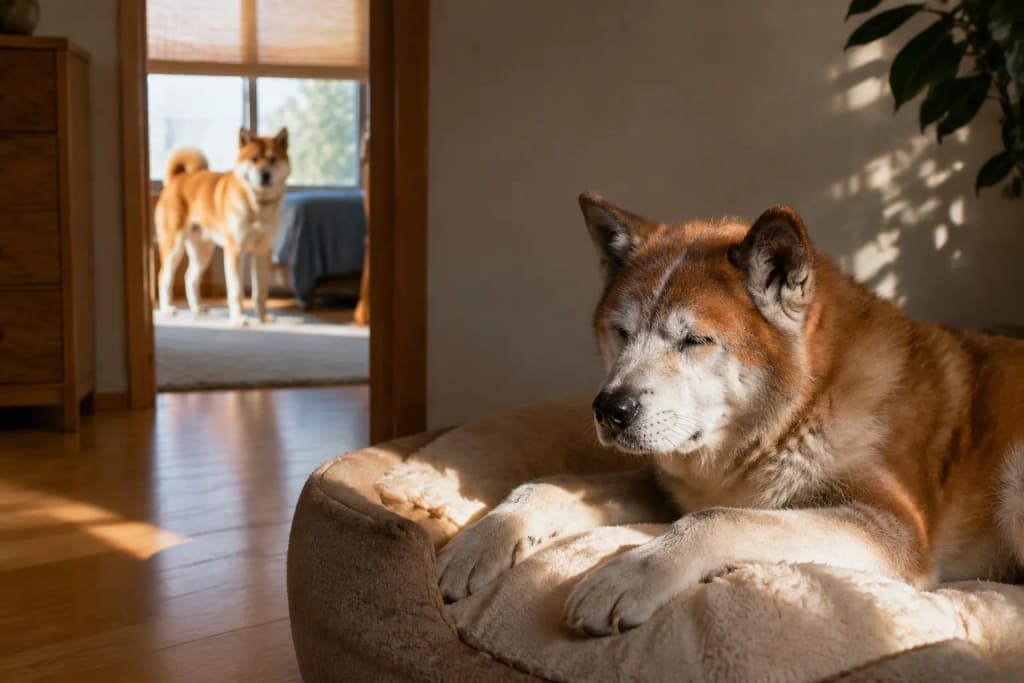
That couplet lands differently when your twelve-year-old Akita just lunged at your two-year-old Shiba from the bedroom doorway, and the sound that came out—that guttural, wet snarl—made everyone in the house freeze. Senior Akita behavior in a multi-dog household isn't what most training guides prepare you for.
Quick Takeaways
- Pain is the number-one trigger — geriatric snapping is almost always a pain response before it's a "dominance" issue
- The single biggest fix is spatial architecture — redesigning rest zones eliminates 80% of incidents within days
- Younger dogs aren't innocent bystanders — they're often violating micro-boundaries you can't see without knowing what to look for
- Preserving your senior Akita's dignity matters — celebrate their personality now with a custom 3D-printed figurine while their spirit still shines through
- Medication isn't failure — pain management changes behavior faster than any training protocol
The Myth That's Making Everything Worse
Here's what the first page of Google will tell you about multi-dog household aggression: manage it with "nothing in life is free" protocols, establish yourself as pack leader, separate and reintroduce slowly.
That advice isn't wrong. It's just catastrophically incomplete when you're dealing with a geriatric Akita.
Here's why. The Akita breed carries a specific behavioral architecture that most trainers—even good ones—don't fully account for. They're not Golden Retrievers who got grumpy. They're a breed with centuries of selection for same-sex aggression, resource guarding as a feature, and stoic pain masking that would make a Navy SEAL jealous.
So when your thirteen-year-old Akita suddenly starts snapping at the younger dog who's lived peacefully in the house for two years, the standard advice to "work on socialization" mises the point entirely.
The real question isn't "how do I fix my aggressive dog?"
The real question is: what changed in their body that made tolerance impossible?
"We've worked with hundreds of Akita families, and the pattern is always the same—the snapping starts weeks after the pain does."
— The PawSculpt Team
Why Your Geriatric Akita Started Snapping (It's Not What You Think)
Let me walk you through what's actually happening, because understanding the mechanism is the only way to fix it.
The Pain-Aggression Pipeline
A healthy adult Akita in a multi-dog home operates on a tolerance budget. They have a finite amount of social patience, and when they're feeling good physically, that budget is large enough to absorb the younger dog's nonsense—the play bows, the space invasions, the accidental bumps during zoomies.
Arthritis, spondylosis, hip dysplasia, dental disease, cognitive decline—any of these conditions shrinks that tolerance budget to nearly zero. Your Akita isn't suddenly mean. They're suddenly unable to afford the energy cost of being tolerant.
Here's the counterintuitive part that most people miss: the snapping often starts before you notice any limping or obvious pain signs. Akitas are notorious for hiding discomfort. The behavioral change IS the first symptom.
| Pain Indicator | What You See | What's Actually Happening |
|---|---|---|
| Snapping when approached from behind | "He's getting cranky" | Neck/spine pain makes turning painful |
| Growling on the dog bed | "She's resource guarding" | Getting up hurts, so she defends the spot |
| Lunging at the younger dog during meals | "Food aggression" | Jaw/dental pain makes eating stressful |
| Snapping during greetings | "He doesn't like her anymore" | Hip pain when the younger dog bumps him |
The Sound That Tells You Everything
Personal Aside: We'll be real with you—our team has listened to hundreds of customers describe the moment they knew something was wrong. It's almost always about sound. Not the sight of the snap, but the sound of it. A geriatric Akita's warning vocalization is different from a young dog's. It's lower, shorter, more guttural. One customer described it as "a sound I'd never heard him make in eleven years." That's the sound of pain talking.
If you're hearing a vocalization from your senior Akita that sounds new—deeper, more abrupt, almost like a bark that got cut short—that's not escalating aggression. That's a dog whose nervous system is firing pain signals and translating them into "get away from me NOW."
What the Younger Dog Is Actually Doing
Here's the other piece nobody talks about. Your younger dog isn't just an innocent victim of your grumpy senior. Dogs are exquisitely tuned to weakness, and younger dogs in multi-dog households often begin testing boundaries the moment they sense the older dog's physical decline.
This isn't malicious. It's canine social behavior operating exactly as designed. But it means your younger dog might be:
- Standing over the senior while they're lying down (spatial pressure)
- Blocking doorways and narrow passages (controlling movement)
- Initiating play at times when the senior is trying to rest
- Taking preferred resting spots the moment the senior gets up
- Making direct eye contact for longer durations (a challenge in Akita language)
You might not notice these micro-provocations because they look like normal dog behavior. They ARE normal dog behavior. But to a pain-compromised Akita with zero tolerance budget left, each one is an intolerable provocation.
The One Change: Spatial Architecture
Alright. Here's the actual fix. And I'm calling it "the one change" because while you'll need to address pain management too (we'll get there), restructuring your home's spatial layout is the single intervention that produces the fastest, most dramatic reduction in snapping incidents.
We're not talking about "separating the dogs." That's a band-aid. We're talking about designing your home so that conflict becomes physically impossible while still allowing both dogs to live full lives.
The Principle: Eliminate Forced Proximity
Every snap your geriatric Akita has directed at the younger dog happened in a specific physical context. Think about it:
- A doorway
- A hallway
- Near the food bowls
- On or near a dog bed
- At the foot of your bed (the bedroom is a massive trigger zone)
- Near you, on the couch
These are all bottleneck zones—places where two dogs are forced into closer proximity than the senior can tolerate. The fix isn't removing the dogs from these spaces. It's redesigning the spaces so proximity is always optional.
The Bedroom Protocol (Where Most Incidents Happen)
The bedroom is ground zero for geriatric Akita snapping, and here's why: it's where your senior dog is most vulnerable (sleeping, resting, in pain), most territorial (it smells like their person), and most likely to be startled by the younger dog's approach.
Step 1: Create a dedicated senior zone.
Place your Akita's bed in a corner or against a wall where they can only be approached from one direction. This eliminates the startle response from behind. Use a low visual barrier—even a storage ottoman or a baby gate positioned as a partial wall—so your senior can see the room but has a physical buffer.
Step 2: Establish a "no-fly zone" radius.
The younger dog should not be able to get within four feet of the senior's resting spot without passing through a barrier or making enough noise (crossing a textured mat, passing through a bead curtain, stepping on a crinkly surface) that the senior gets advance warning.
Step 3: Give the younger dog their own high-value space.
This is the part people skip. If you only restrict the younger dog's access to the senior, you create frustration. Instead, give the younger dog a space that's genuinely appealing—their own elevated bed, a window perch, a spot with a special chew toy that only lives there.
"A dog who has their own kingdom doesn't need to invade someone else's."
The Hallway and Doorway Fix
Narrow passages are where most snapping incidents occur because neither dog can create distance. The fix is elegant and simple:
- Stagger movement. Train a "wait" cue for the younger dog at every doorway. The senior always moves through narrow spaces first—not because of "rank," but because they move slower and need more time.
- Widen the path. Move furniture that creates bottlenecks. If your hallway has a console table that forces dogs to pass within inches of each other, relocate it.
- Add a passing lane. In wider hallways, place a runnerug one side. Dogs naturally choose different surfaces, creating organic separation.
The Feeding Architecture
Meals are high-arousal moments. For a pain-compromised Akita, the combination of hunger + jaw discomfort + another dog's proximity is a perfect storm.
| Old Setup | New Setup | Why It Works |
|---|---|---|
| Bowls in the same room,3 feet apart | Bowls in separate rooms, doors closed | Eliminates visual pressure during eating |
| Free-feeding (food always available) | Scheduled meals, picked up after15 min | Reduces guarding behavior around bowl location |
| Same feeding time, same routine | Senior fed first, 5 minutes head start | Allows slow, pain-free eating without competition |
| Water bowls shared | Multiple water stations throughout house | Prevents resource guarding of water access |
Personal Aside: One of our customers—a family with a fourteen-year-old Akita named Roku and a three-year-old Akita mix—told us they'd tried everything. Trainers, behaviorists, DAP diffusers. The snapping stopped within four days of implementing the spatial changes. Four days. Not because the pain went away, but because Roku never had to make the choice between tolerating discomfort and defending himself. The architecture made the choice for him.
Pain Management: The Foundation Under Everything
Spatial architecture stops the incidents. But pain management addresses the root cause. And here's where I need to be direct with you: if your geriatric Akita is snapping at other dogs, avet visit isn't optional. It's step one.
Not step three. Not "after we try training." Step one.
What to Ask Your Vet
Don't walk in and say "my dog is aggressive." That framing leads to behavioral recommendations when you need a pain workup. Instead, say:
"My senior Akita has started snapping at our other dog. I believe this may be pain-related. I'd like a full orthopedic and dental evaluation."
Request specifically:
- Full orthopedic exam (manipulation of all joints while the dog is relaxed or lightly sedated)
- Dental radiographs (tooth root abscesses are invisible from outside and incredibly painful)
- Spinal palpation (spondylosis is extremely common in geriatric Akitas)
- Blood panel (to rule out thyroid issues, which affect behavior)
- Trial pain medication (if nothing obvious is found, a 2-week NSAID trial can be diagnostic)
The American Kennel Club's guide to senior dog care emphasizes that behavioral changes in older dogs should always prompt a veterinary evaluation before behavioral intervention.
The Medication Question
Look, we're not vets. But we've heard from enough families to know that there's a stigma around medicating senior dogs for pain. People worry about side effects, about "drugging" their dog, about masking symptoms.
Here's the reality: an Akita in chronic pain who is snapping at housemates is not living a good life. Pain management isn't about making your life easier (though it will). It's about giving your dog back the tolerance budget they need to coexist peacefully.
Common options your vet might discuss:
- NSAIDs (carprofen, meloxicam) for inflammation
- Gabapentin for nerve pain
- Adequan injections for joint support
- Laser therapy or acupuncture for chronic pain
- CBD products (discuss with your vet—quality varies enormously)
Many families see behavioral improvement within 48-72 hours of starting appropriate pain medication. That speed of change tells you everything about what was driving the aggression.
The Younger Dog's Role: Training the Other Side
Here's something that'll sound counterintuitive: you need to train the younger dog more than the senior.
Your geriatric Akita isn't going to learn new coping mechanisms at twelve or thirteen. Their brain is less plastic, their patience is gone, and frankly, asking a pain-compromised senior to "work through" social stress is unfair.
But your younger dog? They can absolutely learn to:
- Read and respect distance signals (turning away, lip licking, whale eye)
- Offer space voluntarily when the senior stiffens
- Redirect their own energy to appropriate outlets
- Navigate the spatial architecture you've built
The "Invisible Fence" Protocol
This isn't about an actual invisible fence. It's about teaching your younger dog that the senior's body language IS a fence.
Phase 1 (Days 1-7): Every time the younger dog approaches the senior and the senior shows ANY tension signal (stiffening, hard stare, closed mouth, stillness), you calmly redirect the younger dog with a treat scatter away from the senior. No corrections. No "no." Just redirection and reward for moving away.
Phase 2 (Days 8-14): Begin marking the younger dog's voluntary choices to give space. When they notice the senior and choose to walk around rather than over, mark and reward. You're building a habit of spatial respect.
Phase 3 (Days 15-21): Introduce a verbal cue—something like "easy" or "give space"—that you pair with the redirection. Eventually this becomes a prompt the younger dog responds to before tension escalates.
Phase 4 (Ongoing): The younger dog begins self-regulating. They read the senior's body language and make space choices independently. This is the goal Not obedience—comprehension.
"The best-trained dog in a multi-dog home isn't the one who obeys commands. It's the one who reads the room."
What About the Senior's Training?
Minimal. Honestly Here's what reasonable to ask of a geriatric Akita:
- A reliable "place" cue that sends them to their safe zone (reward heavily)
- A positive association with the younger dog's presence at distance (counter-conditioning)
- That's it.
Don't ask them to "leave it" when they're in pain and being crowded. Don't ask them to "be nice." Don't punish the growl or the snap—that's their only remaining communication tool, and if you suppress it, you'll get a bite with no warning.
The Timeline: What to Expect
Geriatric dog training in a multi-dog household doesn't follow the same timeline as pupy training. Here's a realistic picture:
| Timeframe | What You Should See | Red Flag If... |
|---|---|---|
| Days 1-3 | Fewer incidents due to spatial changes | No reduction at all (pain may be severe) |
| Days 4-7 | Senior visibly more relaxed in their zone | Senior still tense even in safe space |
| Weeks 1-2 | Younger dog beginning to respect boundaries | Younger dog escalating attempts to access senior |
| Weeks 2-4 | Pain meds showing behavioral effect | No improvement despite medication (reassess diagnosis) |
| Weeks 4-8 | New normal establishing; incidents rare | Incidents increasing (something else is wrong) |
| Months 2-3 | Household feels calm; both dogs coexisting | Either dog showing new symptoms |
If you're not seeing improvement by week two with spatial changes AND pain management in place, go back to your vet. There may be a pain source that wasn't identified, or cognitive dysfunction may be playing a role (canine cognitive dysfunction syndrome affects up to 68% of dogs over fifteen).
The Emotional Weight Nobody Talks About
Let's pause the practical stuff for a moment.
If you're reading this article, you're probably exhausted. You love your senior Akita—you've loved them for a decade or more. And you love your younger dog too. And right now, your home doesn't feel like a home. It feels like a conflict zone where you're constantly managing, constantly vigilant, constantly bracing for that sound.
The guilt is real. You might be thinking:
- "Did I cause this by getting a second dog?"
- "Am I failing my senior by not giving them a peaceful retirement?"
- "Should I rehome the younger dog?"
- "Am I being selfish by keeping both?"
None of those thoughts make you a bad person. They make you a person who cares deeply about two animals with incompatible needs in this moment.
Here's what we'll tell you straight: rehoming is rarely necessary if you implement spatial architecture and pain management. The dogs don't need to be friends. They don't need to cudle. They need to coexist without conflict, and that's achievable goal for the vast majority of households.
But if you're in a situation where the senior's quality of life is declining regardless of intervention, or the younger dog is developing anxiety from the constant tension, those are conversations worth having with your vet and a certified animal behaviorist (look for CAB or DACVB credentials, not just "certified dog trainer").
Preserving Who They Are Right Now
One thing that strikes us—working with families who have senior Akitas—is how quickly people forget what their dog looked like in their prime. The broad chest, the curled tail held high, the specific way their ears sat when they were alert and confident.
Geriatric changes happen gradually. The muzzle grays. The weight drops. The posture shifts. And one day you look at photos from three years ago and think, "That's not even the same dog."
This is why so many of our customers at PawSculpt come to us during the senior years—not after loss, but during. They want to capture their Akita's essence while that essence is still visible. The way the coat pattern falls, the exact proportions of the face, the personality that shows in posture.
Our full-color 3D printing process reproduces those details directly in resin—every marking, every color gradient, every physical characteristic that makes your Akita uniquely yours. The color is part of the material itself, not applied afterward, which means it won't fade or chip the way painted pieces do.
It's not about grief. It's about recognition. It's about looking at a figurine on your shelf and seeing your dog—not a generic Akita, but YOUR Akita—captured in a moment of dignity.
When to Call in Professional Help
Not every situation resolves with spatial changes and pain meds. Here are the scenarios where you need a professional:
Call a veterinary behaviorist (DACVB) if:
- The senior has bitten (broken skin) rather than just snapped
- The younger dog is retaliating or escalating
- Either dog is showing signs of chronic stress (excessive panting, pacing, inability to settle)
- You've implemented changes for 3+ weeks with no improvement
- The senior is showing signs of cognitive dysfunction (disorientation, reversed sleep cycles, house soiling)
Call your regular vet immediately if:
- The snapping started suddenly (within days, not gradually)
- The senior is also showing appetite changes, lethargy, or vocalization when moving
- You notice any neurological signs (head tilt, circling, loss of balance)
A sudden behavioral change in a geriatric dog can indicate acute pain (disc herniation, internal issue) or even a brain tumor. Don't wait on this one.
The Counterintuitive Truth About Multi-Dog Households With Seniors
Here's the insight that most guides won't give you, because it's uncomfortable:
Your geriatric Akita may have always been barely tolerating the other dog. The snapping isn't new behavior emerging. It's old restraint disappearing.
Akitas are a breed that often merely tolerates other dogs rather than genuinely enjoying their company. A healthy adult Akita has the physical and cognitive resources to maintain that tolerance indefinitely. A geriatric Akita in pain does not.
This means the goal was never "get them to be friends again." The goal is "rebuild the conditions that made tolerance possible." And those conditions are:
- Physical comfort (pain management)
- Spatial security (architecture)
- Predictability (routine)
- Autonomy (the ability to choose distance)
When all four conditions are met, most geriatric Akitas return to their baseline of peaceful coexistence. Not joyful interaction—peaceful coexistence. And that's enough. That's actually the goal.
A Note on Cognitive Dysfunction
If your Akita is over eleven, there's a meaningful chance that cognitive decline is contributing to the behavioral change. PetMD's overview of canine cognitive dysfunction notes that the condition affects a significant percentage of senior dogs and can manifest as increased irritability, confusion, and altered social behavior.
Signs that cognitive dysfunction might be a factor:
- Snapping seems random (not triggered by proximity or specific situations)
- The senior appears confused about where they are or who the other dog is
- Sleep-wake cycle is disrupted (pacing at night, sleeping all day)
- House training regression
- Staring at walls or getting "stuck" in corners
If this sounds familiar, talk to your vet about cognitive support options. There are medications (selegiline), supplements (SAMe, omega-3s, medium-chain triglycerides), and environmental enrichment strategies that can slow progression.
Putting It All Together: Your First Week Plan
Day 1:
- Schedule vet appointment for pain evaluation
- Identify all bottleneck zones in your home
- Set up the senior's dedicated safe zone in the bedroom
Day 2:
- Rearrange feeding stations (separate rooms, closed doors)
- Add "early warning" textures near the senior's resting spots
- Begin treat-scattering redirections for the younger dog
Day 3:
- Remove furniture creating hallway bottlenecks
- Establish the doorway "wait" protocol for the younger dog
- Document all snapping incidents (time, location, trigger) for your vet
Days 4-7:
- Attendvet appointment; begin pain management if recommended
- Continue spatial protocols consistently
- Note any changes in frequency or intensity of incidents
Week 2:
- Assess progress; adjust spatial layout based on where incidents still occur
- Begin Phase 2 of younger dog training (marking voluntary space-giving)
- Follow up with vet on medication effectiveness
This isn't a quick fix. But it's a real one. And the families we've worked with—the ones who commit to the spatial architecture and address the pain—consistently report that their home feels like a home again within a month.
The Sound of Peace
You know what nobody tells you about solving multi-dog household aggression? It's not dramatic. There's no breakthrough moment where both dogs curl up together and you cry happy tears.
It's quieter than that.
It's the absence of that guttural snarl. It's the sound of your senior Akita sighing as they settle into their bed without tensing. It's the click of the younger dog's nails as they voluntarily walk the long way around. It's the sound of your own breathing slowing down because you're not bracing anymore.
That's what success sounds like. Not harmony—just peace.
Your senior Akita deserves a retirement defined by comfort, not conflict. And your younger dog deserves a home where they're not constantly walking on eggshells. Both things can be true. Both things can be achieved.
Start with the space. Address the pain. Train the younger dog. And give yourself grace—you're managing a genuinely difficult situation, and the fact that you're researching solutions means you're already doing better than most.
If you want to honor your senior Akita while they're still here—while that proud posture and those knowing eyes are still part of your daily life—consider capturing them as they are right now. A custom 3D-printed pet figurine preserves the details that time is slowly changing. Not as a memorial, but as a celebration of who they still are today.
Because that dog in the bedroom doorway, the one who snarled and scared everyone? That's still your dog. Still noble. Still loyal. Still worthy of being seen—and remembered—at their best.
Frequently Asked Questions
Why is my senior Akita suddenly snapping at my other dog?
The most common cause is undiagnosed pain. Arthritis, dental disease, spondylosis, and hip dysplasia all reduce your Akita's tolerance for social interaction. Because Akitas mask pain exceptionally well, the behavioral change often appears before any limping or obvious physical symptoms. A full veterinary pain workup should be your first step—before any behavioral intervention.
Should I punish my old dog for growling at the younger dog?
Absolutely not. The growl is communication, not misbehavior. It's your senior Akita's way of saying "I need space" or "that hurts." If you suppress the warning signals, you don't eliminate the discomfort—you just remove the dog's ability to communicate it. The next step after suppressed growl is a bite with zero warning. Instead, honor the growl by addressing what's causing it: pain and forced proximity.
How long does it take to stop multi-dog household aggression with a senior dog?
With spatial architecture changes implemented immediately and pain management started within the first week, most families report a significant reduction in incidents within 7-14 days. A stable new normal—where both dogs coexist peacefully with minimal management—typically establishes by weeks 4-8. If you're seeing no improvement by week three, reassess the pain diagnosis with your vet.
Is it normal for older Akitas to become aggressive with age?
Common, but not normal—and that distinction matters. "Common" means many people experience it. "Not normal" means it indicates something is wrong that can be addressed. Senior Akita behavior changes almost always trace back to pain, cognitive dysfunction, or sensory decline. Don't accept "he's just getting old and grumpy" as a diagnosis. Push for a thorough evaluation.
Should I rehome my younger dog if my senior Akita is snapping?
In the vast majority of cases, no. Rehoming should be a last resort after spatial changes, pain management, and younger-dog training have been fully implemented for at least 6-8 weeks without improvement. Most families find that their dogs don't need to be separated—they just need the conditions that make peaceful coexistence physically possible.
What is the best way to manage two dogs that can't get along in the same house?
Forget "management" as a long-term strategy—it's exhausting and unsustainable. Instead, redesign your home's spatial architecture so conflict becomes physically impossible. Dedicated zones, staggered movement through bottlenecks, separate feeding stations, and early-warning textures near rest areas create an environment where both dogs can live full lives without being forced into proximity that triggers conflict.
Ready to Celebrate Your Pet?
Your senior Akita's story isn't over—it's in one of its most meaningful chapters. Whether you're navigating the challenges of geriatric dog training in a multi-dog household or simply want to preserve the quiet dignity your Akita carries every day, a custom PawSculpt figurine captures the details that make them irreplaceable.
Visit pawsculpt.com to explore the process, see examples, and learn how our team brings your pet's likeness to life in full-color resin.