
What YourVet Isn't Telling You About Mid-Life Husky Anxiety Before Appointments (One Fix)
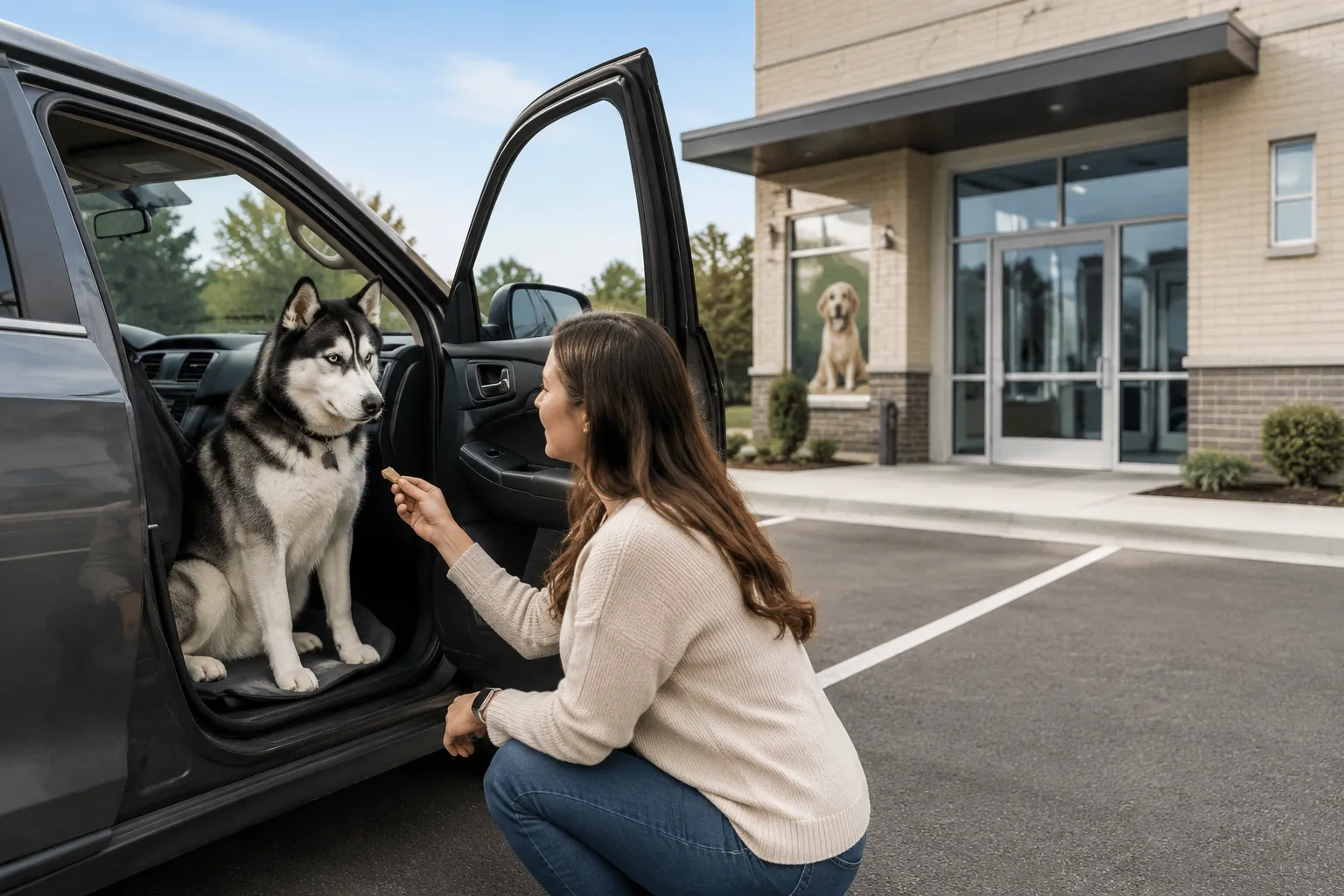
The carabiner clinks against the leash hook in the garage, and your husky—sprawled across the cool concrete one second ago—is suddenly upright, ears pinned, tail low. That fast. You haven't even found your keys, and the Husky vet visit anxiety has already filled the room like a cold front.
Quick Takeaways
- The anxiety starts in your garage, not the clinic — your husky reads the ritual long before the building.
- Mid-life is the tipping point — older dogs have more data points, so their predictions sharpen with age.
- Scramble the sequence — break the predictive chain of cues so "leash + car" stops meaning "vet."
- Your cortisol leaks down the leash — calm yourself first, because they smell the difference.
- Celebrate the dog, not just the diagnosis — many families mark their healthy years with custom pet figurines that freeze the prime of their pet's life.
Here's What the Vet Doesn't Have Time to Tell You
Look, your vet is good at medicine. That's the job. In a fifteen-minute appointment slot, the behavioral backstory of why your seven-year-old husky turned into a trembling, sixty-pound anchor in the parking lot is not what gets addressed. Nobody's hiding it from you on purpose. There's just no billing code for "let's unpack your dog's predictive anxiety architecture."
So here's the part that gets skipped.
By the time most owners notice the problem, they've already misdiagnosed it. They think the dog is scared of the vet. The needles, the cold table, the smell of antiseptic and other animals' fear. And sure, that's part of it. But that's not where the anxiety lives.
It lives in the chain of events that predicts the vet.
We've talked with thousands of pet families over the years—people sending us photos of their dogs at every life stage, often right before or right after a big appointment—and the same story surfaces constantly. "He was fine as a puppy. Now he loses it before we even leave." That shift, that mid-life turn, isn't random. It's the predictable result of a smart animal getting smarter about the worst day of its month.
"By the time your husky is shaking in the parking lot, the real damage was done in your hallway twenty minutes earlier."
This article is about that hallway. That garage. That moment with the carabiner. Because the fix you're actually looking for doesn't happen at the clinic at all.
Why Mid-Life Hits Different: The Anxiety You Didn't See Coming
Here's something that surprises a lot of seasoned owners: your dog's vet anxiety often gets worse with age, not better. You'd think familiarity would breed calm. More visits, more exposure, more "see, nothing bad happened." Right?
Wrong. And the reason is genuinely fascinating.
Your Husky Is a Pattern-Detection Machine
Huskies are working dogs bred to make rapid environmental assessments—to read terrain, weather, and the body language of the team around them. That intelligence doesn't switch off in the suburbs. It just gets pointed at you.
Every vet trip you've ever taken has quietly trained a neural pathway. Dogs learn through associative conditioning—the same mechanism Pavlov mapped over a century ago. A neutral cue (the jingle of keys) gets paired with an outcome (the dreaded appointment) enough times, and the cue alone triggers the full stress response. Elevated heart rate. Spiking cortisol (the body's primary stress hormone). The works.
A puppy has maybe two or three vet visits on record. Thin data. Weak prediction. But a mid-life husky? Seven years old, twenty-plus appointments deep? That dog has a rich dataset. The pattern is crisp. The prediction is confident. And confident predictions produce faster, stronger anxiety responses.
This is the counterintuitive truth most guides miss entirely: your dog isn't getting more fearful, it's getting more accurate.
The Sequence Is the Trigger, Not the Destination
Think about your actual pre-vet routine. It's probably more ritualized than you realize.
You check the time. You grab your phone and wallet. Maybe you skip the morning walk because you're saving the dog's energy for the trip. You pull the leash from a specific hook. You open the door to the garage. The car beeps. The back hatch lifts.
Your husky has clocked every single one of those steps. And here's the part that stings—they've sequenced them. They know that "no morning walk" plus "wallet in hand" plus "garage door" equals a destination that isn't the park.
"Dogs don't fear the vet. They fear the ten-minute prophecy that always comes true."
We had a customer—a retired paramedic, of all people, somebody who knows a thing or two about staying calm—tell us her husky started shaking the moment she put on a specific pair of shoes. The closed-toe ones she only wore to the clinic. The dog had reverse-engineered her footwear. That's not paranoia. That's a brilliant animal doing exactly what it was bred to do.
The One Fix: Scramble the Sequence
If the anxiety is built from a predictable chain of cues, then the fix is almost embarrassingly logical. You break the chain.
The technical name for this is counter-conditioning through pattern interruption, but you can just call it scrambling the sequence. The goal is to make your pre-departure cues stop reliably predicting the vet. When the prophecy stops coming true, the prophecy loses its power.
Here's the thing—most advice tells you to "make the vet fun" with treats and happy voices at the clinic. That's downstream. You're trying to reverse twenty bad associations with one bag of liver treats while your dog is already flooded with cortisol. It rarely works, and experienced owners know it.
The real leverage is upstream, in the days between appointments.
How to Actually Scramble It
The principle: do the scary cues constantly, but attach them to nothing scary. Decouple the trigger from the outcome.
- Pick up your keys ten times a day and do nothing. Jingle them, set them down, walk away. The keys must stop meaning anything.
- Take "trips to nowhere." Load your husky into the car twice a week and drive to a field, a friend's yard, a drive-through for a pup cup. The garage and the car must stop predicting the clinic.
- Wear the vet shoes on a Tuesday for no reason. Break the footwear tell. Break every tell you can identify.
- Decouple the skipped walk. If you normally skip the morning walk on vet day, start randomly skipping it on ordinary days too, so the absence stops being a signal.
Do this for three to four weeks before a non-emergency appointment and you'll often see a measurable difference. Not magic—the clinic itself still smells like the clinic—but the front half of the anxiety, the anticipatory dread that builds in your home, can drop dramatically.
A Morning in the Life
Picture a Saturday, soft gray light coming through the garage window, dust floating in the one bright shaft that lands on the concrete. You grab the keys. Your husky's ears flick—the old reflex—but you just clip the leash, load up, and drive eight minutes to an empty soccer field where he gets to sniff goose tracks for twenty minutes. No table. No needle. You drive home. He sleeps the whole afternoon, loose and heavy. You've just made a small, quiet deposit into an account that's been overdrawn for years.
That's the work. It's undramatic. It's also the only thing we've consistently seen move the needle for mid-life dogs.
The Mid-Life Dog Vet Prep Playbook
Scrambling the sequence is the foundation. But there's a layer of tactical mid-life dog vet prep that compounds the effect. These are the moves experienced owners stack on top.
Manage the Hormone Hangover
Cortisol doesn't clear instantly. After a major stress event, it can take a dog's body the better part of two to three days to return to baseline. This is why two stressful appointments close together create a brutal cycle—the dog never resets between them.
So when you schedule, build in buffer. Don't stack the dental cleaning consult and the vaccine booster in the same week if you can help it. Give the nervous system time to come down.
Time the Appointment Like a Pro
The first slot of the morning is gold. Fewer animals have cycled through the waiting room, so there's less accumulated fear-scent (dogs read the chemical residue of other dogs' stress). The staff is fresher. The wait is shorter. A shorter wait means less time for anticipatory anxiety to spiral in the lobby.
Ask for the first appointment after the lunch break, too—it's the other quiet window.
Use the Car as a Decompression Chamber
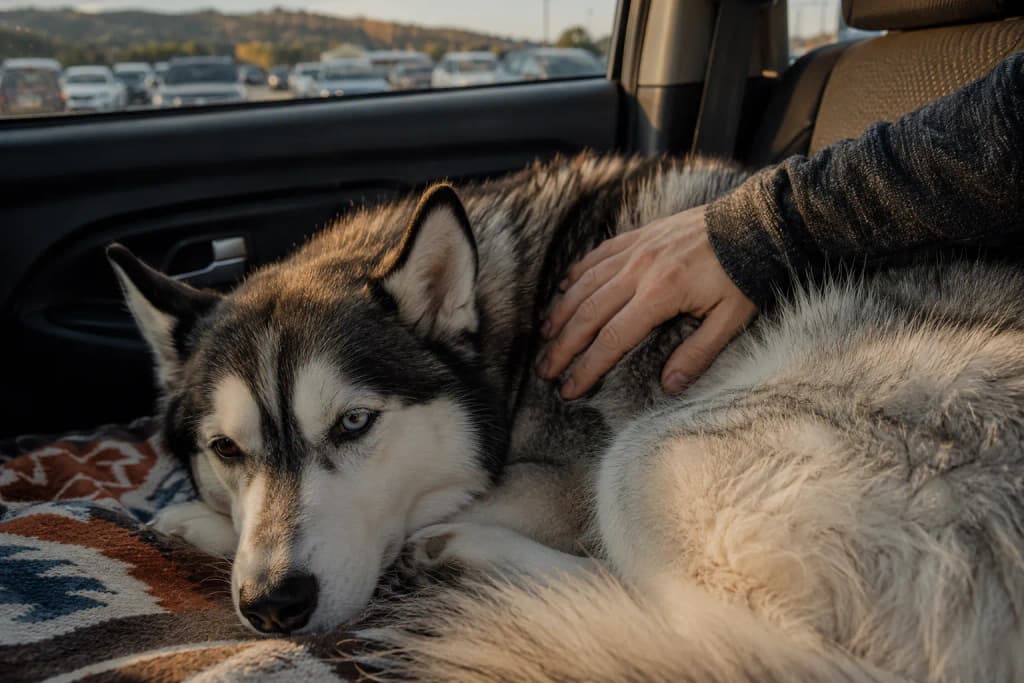
Arrive ten minutes early and stay in the car. Don't march straight into the lobby. Let your husky watch the parking lot through the window, settle, take in the environment on his terms. The American Kennel Club's guidance on reducing canine stress at the vet echoes this—gradual, low-pressure exposure beats flooding every time.
Below is a quick reference for how to sequence your prep across the weeks leading up to a visit.
| Timeframe | What to Do | Why It Matters |
|---|---|---|
| 3-4 weeks out | Scramble cues daily (keys, car, shoes) | Breaks the predictive chain at its root |
| 1-2 weeks out | Add 2 "trips to nowhere" per week | Rebuilds the car as a neutral or positive space |
| 3 days out | Avoid other major stressors | Keeps baseline cortisol low going in |
| Day of | Book early slot, stay in car to decompress | Minimizes fear-scent and lobby wait time |
| After | 48-72 hrs of calm, low-demand recovery | Lets the stress hormones fully clear |
The Mistake Almost Everyone Makes
Here's the one that gets even savvy owners. They comfort the dog at exactly the wrong moment.
When your husky starts trembling and you crouch down, soften your voice, and stroke him while murmuring "it's okay, it's okay"—you feel like a good owner. But to a dog reading your tone and body language, you've just confirmed that something is worth being afraid of. You've validated the prediction.
What actually helps more than soothing is staying boring. Neutral posture. Normal breathing. Matter-of-fact energy. You're the calm in the room, not a mirror for the panic. Dogs co-regulate off our nervous systems—a phenomenon researchers have measured in synchronized cortisol levels between dogs and their owners. Your calm is contagious. So is your dread.
Reduce Dog Stress at the Vet: It Starts With Your Own Pulse
This is the part that's hard to hear, so we'll just say it straight. A big chunk of your dog's anxiety is yours, borrowed.
There's solid research on emotional contagion between humans and dogs. Studies on the human-animal bond, including work cataloged by the National Institutes of Health, point to dogs detecting our stress through scent, cortisol changes, micro-expressions, and the tension in our hands on the leash. Your husky doesn't need to understand the word "vet." He just needs to feel your shoulders climb toward your ears as you pull into the lot.
"Your dog can't read the appointment reminder on your phone. But he can read your jaw."
So before you even start the dog's prep, run your own.
The Owner's Two-Minute Reset
Before you load up, do this. Box breathing—in for four, hold for four, out for four, hold for four—for two minutes. Drop your shoulders. Unclench your jaw. Loosen your grip on the leash so it hangs in a relaxed J-shape instead of a taut line.
That slack leash is doing more than you think. A tight leash transmits tension directly into your dog's body, a constant physical signal that you're braced for something. Let it hang. Let your husky feel that you, the leader of this little pack, are not worried.
This is the heart of real experienced owner vet tips: the advanced move isn't a new gadget or supplement. It's recognizing that you are the most powerful anxiety signal in your dog's world, and learning to manage your nervous system first.
"We've watched a thousand dogs through a camera lens, and the calm ones almost always have a calm person holding the leash. Regulation flows downhill."
— The PawSculpt Team
When the Mid-Life Visit Is the Hard One
We have to be honest about something. Sometimes the mid-life appointment isn't a routine booster. Sometimes it's the bloodwork that comes back wrong, the lump that needs a second look, the first appointment where the word "senior" enters the conversation a little too early.
That's a different kind of dread, and no amount of cue-scrambling fixes it. We're not vets, and for anything medical you trust your veterinary team completely. But emotionally? This is often the season when families start thinking differently about time.
When a mid-life diagnosis lands, a lot of pet parents suddenly want to hold onto now—the strong, healthy, in-his-prime version of their dog, not the version they're afraid is coming. We've heard this in countless customer notes. "I want to remember him like this, while his coat is still full and his eyes are still bright."
That's part of why families come to us during the healthy years, not just after a loss. A museum-quality 3D pet sculpture captures the husky at the peak of his life—the exact tilt of the ears, the mismatched eyes, the specific swirl of the mask on his face—rendered in full color so the markings are true to life. It's not about anticipating grief. It's about honoring vitality while it's right in front of you.
What to Expect If You Want to Capture This Chapter
Since we keep getting asked, here's the honest, no-spin version of how this works—and how it's different from what most people assume.
We do not paint figurines. There are no brushes involved, no acrylics, no waiting for anything to dry. Your husky is digitally sculpted by master 3D artists and then precision 3D printed in full color, where the color is printed into the resin itself, voxel by voxel. The pigment isn't a coating on the surface; it's part of the material. The only manual step is a protective clear coat that adds durability and a soft sheen.
The result has a real, honest texture—a fine natural grain from the printing process, not a slick mass-produced plastic look. It feels like an object with a story, because it is one.
What makes or breaks the final piece is your photos. Here's what actually works:
| Photo Element | What Works Best | Common Mistake |
|---|---|---|
| Lighting | Soft, natural daylight; near a window | Harsh flash that flattens the coat |
| Angles | 3-4 shots: front, both sides, face | One blurry phone pic from above |
| Eye level | Camera down at the dog's height | Shooting down from standing |
| Markings | Clear view of unique masks, spots, eyes | Shadows hiding the face pattern |
| Expression | The dog's natural, relaxed face | Forced, stiff posing |
For specifics on turnaround, revisions, and the quality guarantee, those details live on the website and we'd rather point you to the current info than quote something that changes. You can explore the full process and browse examples of custom pet figurines whenever you're ready.
Why People Choose This During the Anxious Years
There's a quiet psychological thread here worth naming. Anxiety—both yours and your dog's—tends to live in the future. The dreaded appointment. The result you're afraid of. The clock you can hear ticking.
A tangible keepsake does something interesting to that anxiety. It anchors you in the present. It says this dog, right now, is whole and here and yours. For a lot of families navigating the stressful mid-life vet season, that anchor matters more than they expected.
"Anxiety lives in the future. A figurine on the shelf pulls you back to the dog in front of you."
The Things Nobody Puts in the Brochure
A few more hard-won truths, the kind that come from being in the trenches rather than reading the pamphlet.
Sedation isn't failure. Some mid-life huskies, especially ones with a genuinely bad history, do better with a vet-prescribed pre-visit medication. Owners agonize over this like it's giving up. It isn't. Reducing a dog's terror is good medicine, full stop. Talk to your vet.
One bad visit can undo months. This is why the scrambling work is fragile and worth protecting. A single traumatic appointment—a painful procedure, a rough handling moment—can re-cement the whole association. If a visit goes badly, don't despair, but do double down on the trips-to-nowhere afterward to dilute it.
Your husky's "stubbornness" is often fear. The breed gets labeled dramatic and difficult. A lot of what reads as stubborn refusal at the vet door is a flooded nervous system that literally cannot process commands. A scared brain doesn't do obedience. Lower the fear, and the "stubbornness" tends to evaporate.
Consistency beats intensity. Ten seconds of jingling keys every day for a month does more than one big elaborate training session. The nervous system learns through repetition, not effort.
Here's the throughline of everything above: your mid-life husky isn't broken, and neither are you. You've got a brilliant animal that learned a painful pattern, and a fixable problem that lives mostly outside the exam room. The clinic was never really the point. The garage was.
Coming Back to the Garage
Picture that same garage again. Same gray light, same shaft of sun on the concrete, same carabiner on the hook.
But this time, when you reach for the keys, your husky lifts his head and just... watches. Ears soft. No bracing. Because the keys haven't meant the vet in weeks—they've meant a field, a pup cup, a window full of moving things. The prophecy stopped coming true, and the dread had nowhere to live.
You clip the leash. The line hangs loose in a relaxed curve, because your shoulders are down and your jaw is unclenched and the calm is flowing downhill the way it's supposed to.
That's the whole fix. Not a gadget. Not a miracle supplement. Just the patient, unglamorous work of teaching a smart dog that the future isn't always the thing he was afraid of.
Start this week. Pick up your keys, set them down, and walk away. Do it again tomorrow. And while you're at it, look at your husky in this exact chapter—strong, alert, fully himself—and decide whether this is a version of him worth keeping somewhere more permanent than memory. The anxious years and the good years are the same years. Don't let the dread eat them.
Frequently Asked Questions
Why does my husky's vet anxiety get worse as he gets older?
It feels backwards, but it makes sense once you see the mechanism. A puppy has only a few vet visits on record, so its prediction is weak. A mid-life husky has twenty-plus appointments logged and has reverse-engineered your entire pre-visit routine. The anxiety isn't intensifying because your dog is more fragile—it's because the pattern is now crisp and the prediction is confident.
What's the one fix for husky vet visit anxiety that actually works?
Scramble the predictive sequence. Your dog reads a chain of cues—keys, car, garage, skipped walk—that reliably predict the clinic. Break that chain by performing those cues constantly while attaching them to nothing scary: pick up keys and walk away, take "trips to nowhere," wear your vet shoes on a random Tuesday. When the cues stop predicting the vet, the anticipatory dread loses its fuel.
How early should I start mid-life dog vet prep before an appointment?
Aim for three to four weeks of daily practice before a non-emergency visit. The nervous system rewires through repetition, not intensity, so ten seconds of cue-scrambling every day outperforms one elaborate training afternoon. For the appointment itself, book an early slot and let your dog decompress in the car before going in.
Can my own stress really make my dog's vet anxiety worse?
Absolutely, and it's one of the most overlooked experienced owner vet tips. Dogs detect our stress through scent, cortisol shifts, and the tension in our hands on the leash—a well-documented emotional contagion effect. A tight leash and a clenched jaw transmit dread straight into your dog. Reset your own nervous system first; your calm is just as contagious as your worry.
Is it normal for a husky to shake or freeze before we even leave the house?
Yes, and it's a sign your dog has sequenced your routine, not a sign something's medically wrong. The freezing or trembling is anticipatory anxiety triggered by predictive cues. That said, if the behavior is sudden, severe, or paired with other changes, check with your vet to rule out a physical cause.
Ready to Celebrate Your Pet?
Every pet has a story worth preserving. Whether you're navigating the stressful mid-life vet season or simply celebrating your husky's bright-eyed, full-coated prime, a custom PawSculpt figurine captures the details that make your dog one-of-a-kind—the mismatched eyes, the exact swirl of the mask, the personality you'd know anywhere. Easing your Husky vet visit anxiety is about anchoring in the present, and so is holding onto this chapter while it's right in front of you.
Visit pawsculpt.com to learn more about our full-color 3D printing process, flexible revisions, and quality guarantee.