
5 Enrichment Changes Your Geriatric Maine Coon Needs This Week — Before Cognitive Decline Sets In
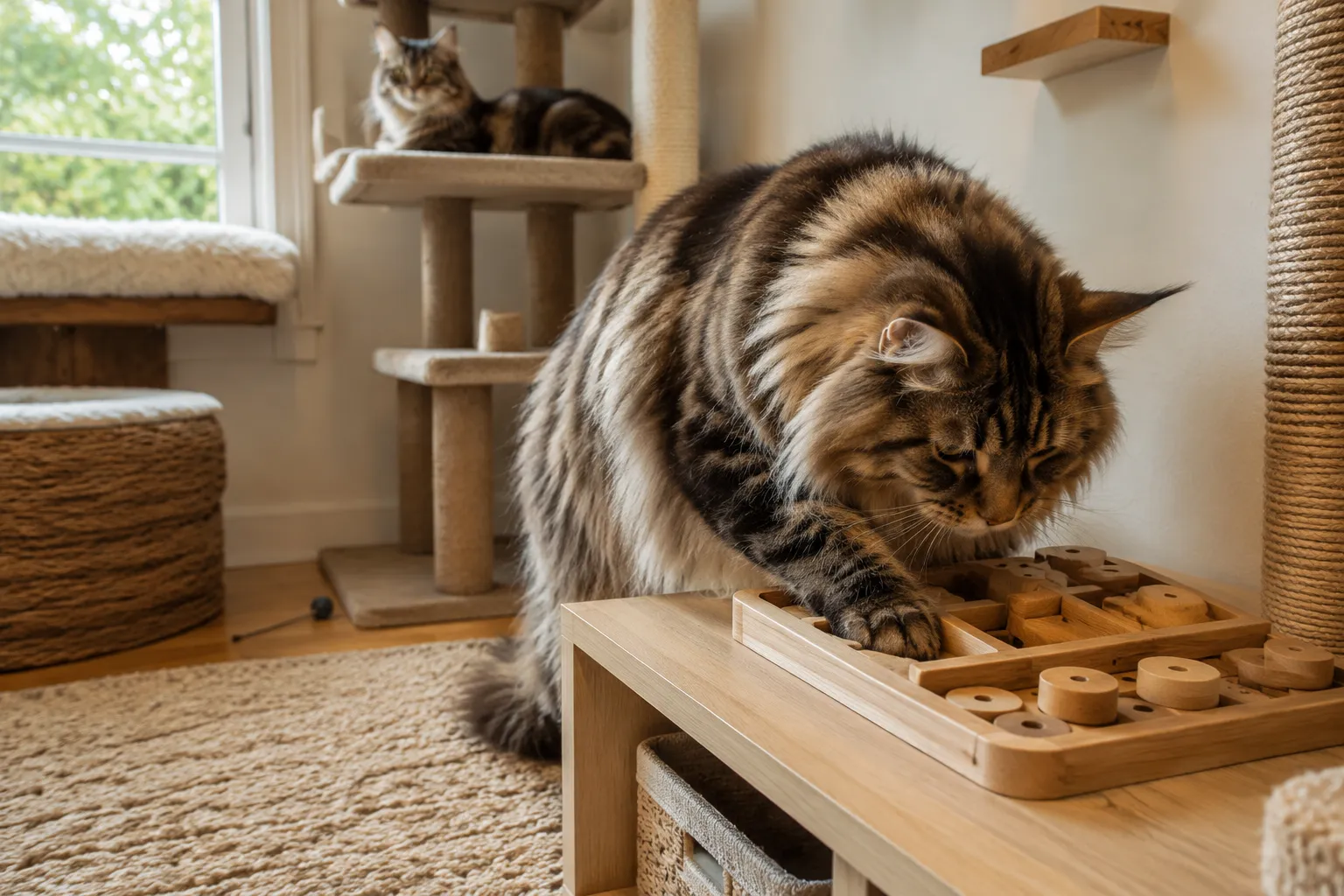
She was halfway down the hallway when she noticed it—her 14-year-old Maine Coon, Atlas, sitting motionless in front of the linen closet, staring at the door hinge like it held some ancient secret. Not sleeping. Not groming. Just... staring. That blank gaze is the first visual cue most owners miss when senior Maine Coon care shifts from routine maintenance to urgent cognitive intervention.
Quick Takeaways
- Cognitive decline in geriatric cats starts 2-3 years before obvious symptoms — the "staring episodes" are already mid-stage
- Vertical enrichment matters more than horizontal space — but the geometry changes completely after age 12
- Scent rotation is the single most underused tool for geriatric cat enrichment in multi-cat homes
- Preserving your senior cat's personality now — through photos, videos, or a custom 3D-printed figurine — becomes irreplaceable once cognitive changes accelerate
- Food puzzles need to get easier, not harder — the opposite of what most enrichment guides recommend
Why Most Geriatric Cat Enrichment Advice Gets It Backwards
Here's the thing most guides won't tell you: the standard enrichment playbook—more stimulation, harder puzzles, novel toys—is designed for cats in cognitive prime. For a geriatric Maine Coon (typically 12+ years, though some show changes as early as 10), that playbook can actually accelerate stress-related cognitive decline.
The counterintuitive insight? Your senior Maine Coon needs enrichment that feels familiar but arrives differently. Not new challenges. Familiar rewards through slightly altered pathways.
Think of it like this. A 75-year-old human doesn't benefit from being dropped into an escape room. But a morning crossword with a new theme? That's the sweet spot. Same cognitive muscle, different angle of approach.
We've worked with thousands of pet families over the years, and the ones with geriatric Maine Coons consistently report the same pattern: their cat seemed "fine" until suddenly they weren't. The truth is, feline cognitive dysfunction syndrome (CDS) operates on a gradient so subtle that most owners only notice once40-60% of cognitive function has already shifted.
The five changes below aren't aspirational. They're this-week urgent.
Change #1: Restructure Vertical Space for "Confidence Climbing"
Maine Coons are vertical thinkers. Always have been. That cat tree your boy has scaled since kitenhood? By age 13, it's become either a source of quiet anxiety or—worse—a fall risk he's too proud to avoid.
The Problem Nobody Talks About
Most cat owners notice their senior Maine Coon "doesn't jump as much anymore" and assume it's arthritis. Sometimes it is. But often, it's a depth perception shift that makes the gap between platforms look uncertain. The cat isn't in pain—they're unsure. And uncertainty, repeated daily, erodes cognitive confidence faster than any physical limitation.
What to Do This Week
Strip the cat tree back to basics. Here's the framework:
| Platform Height | Gap Between Levels | Surface Width | Geriatric Modification |
|---|---|---|---|
| 0-18 inches | N/A (ground level) | 18"+ wide | Add non-slip mat, heated pad |
| 18-36 inches | Max 10" vertical gap | 16"+ wide | Install intermediate step |
| 36-54 inches | Max 8" vertical gap | 14"+ wide | Add side rail or wall bracket |
| 54"+ inches | Not recommended | — | Remove or block access |
The key metric: no single jump should exceed 8 inches vertically for a cat over 13. That's roughly half what most cat trees demand.
But here's where enrichment enters. Don't just make it easier—make the easy path interesting. Place a single treat on the second platform. Not a puzzle. Not a challenge. Just a reward for choosing to move upward. Rotate the treat type daily (freeze-dried chicken Monday, salmon Tuesday). The novelty is in the scent, not the difficulty.
"The best enrichment for a senior cat isn't harder. It's gentler and more surprising."
One family we worked with had a15-year-old Maine Coon named Duchess who'd stopped using her six-foot tree entirely. They added foam stair-step inserts between each level—basically halving every gap—and within three days, Duchess was sleeping on the third platform again. Not because she couldn't reach it before. Because she wasn't sure she could.
Confidence is cognitive currency for geriatric cats. Every successful small climb deposits into that account.
Change #2: Implement Scent Rotation Protocol (The Most Overlooked Tool in Multi-Cat Households)
If you share your home with multiple cats, your senior Maine Coon is processing an enormous amount of olfactory data every single day. Younger cats mark. Territories shift. And your geriatric cat—whose sense of smell may be duling—is working overtime to keep the social map updated.
This is exhausting. And it's invisible.
Why Scent Matters More Than Toys After Age 12
The feline brain processes scent through the olfactory bulb, which connects directly to the hippocampus—the memory center. When researchers at Ohio State University's Indoor Pet Initiative studied environmental enrichment in senior cats, scent-based stimulation showed the strongest correlation with maintained cognitive function. Stronger than physical play. Stronger than food puzzles.
Yet almost nobody does it deliberately.
The Scent Rotation Protocol
Here's what to implement this week:
- Designate three "scent stations" in areas your Maine Coon frequents (not shared territory—their spots)
- Rotate a single novel scent every 48 hours using a cotton pad inside a perforated container
- Use only cat-safe scents: silver vine, valerian root, tatarian honeysuckle, dried catnip (rotate between these four)
- Track response for 30 seconds after introduction—sniffing, chin-rubbing, or flehmen response all indicate engagement
The 48-hour rotation is critical. Shorter intervals create overstimulation. Longer intervals lose the novelty benefit.
The Multi-Cat Household Complication
In homes with younger cats, your senior Maine Coon may have already ceded scent-marking territory. This is a quiet surrender that looks like "mellowing out" but is actually social withdrawal driven by cognitive fatigue.
The fix: create at least one scent station in a location only your senior can access. A high shelf with easy ramp access. A gated room. Somewhere the younger cats don't dominate.
| Scent Type | Engagement Rate (Senior Cats) | Duration of Interest | Best For |
|---|---|---|---|
| Silver vine | ~80% of cats respond | 10-15 minutes | Cats unresponsive to catnip |
| Valerian root | ~50% respond | 5-8 minutes | Evening relaxation |
| Tatarian honeysuckle | ~75% respond | 8-12 minutes | Sustained gentle interest |
| Dried catnip | ~65% of seniors respond | 3-5 minutes | Quick stimulation burst |
Worth noting: silver vine consistently outperforms catnip in senior cats. If your Maine Coon "grew out of" catnip years ago, silver vine often reignites that response. It activates through a different compound (actinidine vs. nepetalactone), so catnip tolerance doesn't apply.
Change #3: Downgrade Food Puzzles to "Food Discoveries"
This is where we break from conventional enrichment wisdom most dramatically.
Every cat enrichment guide on the internet will tell you: food puzzles prevent cognitive decline. Increase difficulty over time. Challenge your cat's problem-solving abilities.
Myth vs. Reality
Myth #1: Harder food puzzles = more cognitive benefit for senior cats.
Reality: After age 12, frustration from unsolvable puzzles triggers cortisol spikes that actively damage hippocampal neurons. The cognitive "workout" becomes cognitive damage when the cat fails repeatedly.
Myth #2: If your senior cat walks away from a puzzle, they're "not food motivated enough."
Reality: They walked away because they assessed the energy-to-reward ratio and determined it wasn't worth the cognitive expenditure. That's not laziness—it's an intelligent conservation strategy from a brain managing limited resources.
Myth #3: Cats need to "work for their food" to stay mentally sharp.
Reality: What maintains cognitive function isn't difficulty—it's the act of searching and finding. The discovery, not the puzzle-solving, activates the reward pathway that protects against CDS.
The "Food Discovery" Framework
Replace puzzle feeders with scatter feeding in predictable zones with unpredictable micro-locations.
Translation: your Maine Coon knows food appears in the living room area (predictable zone). But today it's behind the plant pot. Tomorrow it's on the windowsill ledge. The day after, it's tucked beside the bookshelf leg.
The search is easy. The location is novel. The reward is guaranteed.
This is the cognitive equivalent of a gentle daily walk versus a grueling obstacle course. Both count as exercise. Only one is appropriate for a 14-year-old body and brain.
Specific protocol for this week:
- Choose3-5 locations within a 10-foot radius of your cat's primary resting spot
- Place 4-6 kibles (or small treat pieces) in ONE location each morning
- Rotate locations daily in a non-repeating pattern
- Ensure your cat can find the food within 2 minutes of searching (if they can't, you've hidden it too well)
- Observe: ears forward, whiskers fanned, deliberate movement = engaged cognition
"We've seen families heal by holding something tangible. Grief needs an anchor—but so does joy. Capture your senior cat while their personality still shines through."
— The PawSculpt Team
That quote connects to something we see regularly. Families reach out to us wanting to memorialize a cat who's already deep into cognitive decline, and the photos they have don't capture who that cat was. The bright eyes. The particular tilt of the head. If your Maine Coon is 12+, now is the time to photograph them in their element—engaged, alert, curious. Those images become the reference material for everything from custom memorial figurines to your own memory archive.
Change #4: Redesign Light Exposure for Circadian Anchoring
Here's something almost no one discusses in the context of cat cognitive decline prevention: light.
Geriatric cats—Maine Coons especially, given their northern-breed heritage—are exquisitely sensitive to photoperiod changes. Their circadian rhythm, already drifting with age, can decouple entirely from the household's day-night cycle. The result? Nightime yowling. Daytime sleeping that extends past 18 hours. Disorientation at dusk.
These aren't behavioral problems. They're circadian collapse.
The Visual Science
A cat's retina contains fewer cone cells than a human's but significantly more rod cells. In a geriatric cat, rod cell density decreases—meaning their ability to detect low light diminishes. The practical effect: your senior Maine Coon may not be registering "daytime" unless they're in direct, bright light.
A dim living room that feels perfectly lit to you might register as perpetual twilight to a 14-year-old cat.
This Week's Light Protocol
Morning (within 1 hour of your wake time):
- Open all blinds in your cat's primary territory
- If natural light is insufficient (northern climates, basement apartments), use a 5000K daylight bulb within 3 feet of their morning resting spot
- Duration: minimum 30 minutes of bright exposure
Miday:
- Ensure at least one sun patch is accessible (move furniture if needed to create a direct-light resting spot)
- The warmth matters as much as the brightness—senior cats thermoregulate poorly, and warmth signals "active hours" to the brain
Evening (2 hours before your bedtime):
- Dim lights progressively
- Switch to warm-toned bulbs (2700K or lower) in your cat's evening territory
- Eliminate screen glare in their resting areas (TV light at night disrupts feline melatonin production)
Night:
- Near-total darkness in sleeping areas
- One dim nightlight (amber/red spectrum only) near the litter box for navigation—blue or white nightlights suppress melatonin
| Time of Day | Light Temperature | Intensity | Purpose |
|---|---|---|---|
| Morning (first hour) | 5000-6500K (cool/bright) | High | Reset circadian clock |
| Midday | Natural sunlight | Moderate-high | Maintain alertness |
| Evening (-2hrs bedtime) | 2700K (warm) | Low-moderate | Signal wind-down |
| Night | Amber/red only | Minimal | Navigation without disruption |
The standout insight here: most nightime vocalization in geriatric cats isn't pain or dementia—it's circadian confusion. The cat's internal clock says "miday" while the house says "2 AM." They vocalize because they're disoriented, not distressed. Fix the light cycle, and in many cases, the yowling resolves within 5-10 days.
We'll be real—this isn't a guaranteed fix. Cats with advanced CDS may have permanent circadian damage. But for cats in early-to-mid cognitive shift, light management is the single highest-impact, lowest-cost intervention available. And almost nobody recommends it.
Change #5: Introduce "Passive Social Enrichment" in Multi-Cat Homes
The final change is the most nuanced, and it's specifically critical for multi-cat household senior care.
Your geriatric Maine Coon still needs social connection. But the type of social interaction that benefits them has fundamentally changed. Active play with younger cats? That's now a stressor, not a benefit. Being gromed by a bonded companion? Still valuable—but only if it's on their terms.
What "Passive Social" Actually Means
Passive social enrichment is the cognitive benefit a cat receives from observing social activity without participating in it. Think of it as the feline equivalent of sitting in a café, watching people, sipping coffee. You're not interacting. But you're not alone. And your brain is gently processing social information at a comfortable pace.
For your senior Maine Coon, this looks like:
- A resting spot with clear sightlines to household activity (but elevated or enclosed enough to feel safe)
- Being in the same room as other cats without direct interaction pressure
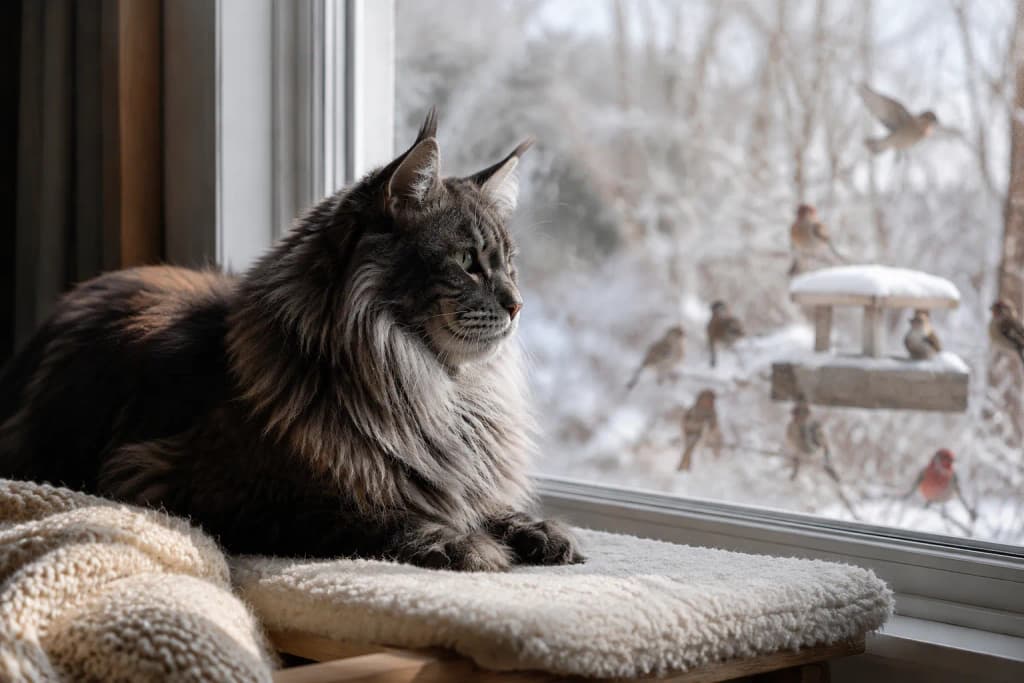
- Watching birds, squirrels, or outdoor cats through a window (the original "cat TV")
- Hearing familiar household sounds—conversation, cooking, music—without being in the center of it
The Critical Mistake in Multi-Cat Homes
Most well-meaning owners do one of two extremes:
- Force integration: Keeping the senior cat in the thick of household activity, assuming isolation would be "sad"
- Complete separation: Giving the senior cat their own room, cutting them off from all social stimulation
Both are wrong. The sweet spot is proximity without pressure. Your Maine Coon should be able to see and hear the household but retreat instantly without navigating past younger cats.
Implementation This Week
- Identify your senior cat's preferred observation post (where do they already choose to watch from?)
- Ensure that spot has: clear sightlines, easy escape route, elevated position (even12 inches off the ground counts), soft bedding
- Add a visual barrier they can duck behind—a box with a cut-out entrance, a draped blanket over a chair—so they control their visibility
- Do not move younger cats away from the area. The goal isn't to clear the room. It's to give your senior the choice of engagement level.
"A senior cat watching the world from a safe perch isn't withdrawn. They're curating their experience."
One order that stuck with us at PawSculpt: a customer sent photos of her 16-year-old Maine Coon, Oliver, perched on a kitchen stool—his "observation throne," she called it. He'd watch the household from that spot for hours. She wanted his figurine posed exactly that way: alert, regal, watching. Not playing. Not sleeping. Watching. Because that was who he'd become in his senior years, and she recognized it as its own kind of beauty. That's the kind of detail our 3D artists capture in full-color resin—the posture, the gaze, the specific way your cat holds themselves in their most characteristic moment.
The Timeline You're Actually Working With
Let's talk honestly about what geriatric cat enrichment is buying you.
Feline cognitive dysfunction is progressive. It doesn't reverse. What these five changes do is:
- Slow the rate of decline by maintaining neural pathway activity
- Extend the "good window" where your cat is still recognizably themselves
- Reduce secondary symptoms (anxiety, vocalization, litter box issues) that often lead to premature euthanasia decisions
The research from the ASPCA's senior cat care guidelines suggests that environmental enrichment can extend quality cognitive function by months to years—but only when implemented before significant decline is visible.
That's why "this week" isn't hyperbole in the title. If your Maine Coon is 12+ and you're noticing any of these:
- Staring at walls or into corners
- Getting "stuck" in rooms they know well
- Vocalizing at odd hours
- Reduced grooming (especially the back half of their body)
- Changes in social behavior with other household cats
...the window for maximum intervention benefit is now. Not next month. Not after the nextvet visit. This week.
What This Looks Like Month by Month
| Month | Expected Changes | What to Watch For |
|---|---|---|
| Month 1 | Increased engagement with scent stations, resumed climbing | More alert expression, return to observation posts |
| Month 2 | Stabilized sleep-wake cycle, reduced nightime vocalization | Consistent morning activity pattern |
| Month 3 | Maintained food discovery interest, stable social behavior | No new withdrawal from household activity |
| Month 6+ | Plateau of current function (this IS success) | Absence of rapid decline markers |
Success here doesn't look dramatic. It looks like nothing changing. Your cat staying themselves for longer. That's the win.
The Emotional Reality Nobody Prepares You For
Look—we work in the pet memorial space. We see the other end of this story every day. And the thing families tell us most often isn't "I wish I'd done more enrichment." It's "I wish I'd paid more attention to who they were before things changed."
Cognitive decline in cats is a slow fade. The personality doesn't vanish overnight. It dims. The particular chirp your Maine Coon makes when you open the treat bag—it gets quieter, then less frequent, then gone. The way they headbutt your hand at exactly6:15 every morning—it shifts to6:30, then becomes inconsistent, then stops.
These aren't dramatic losses. They're the kind you only notice in retrospect.
So while you're implementing these five changes—while your cat is still engaged, still curious, still them—document it. Video the chirp. Photograph the headbutt. Capture the specific way they drape themselves over the arm of the couch with that particular Maine Coon sprawl.
Not because you're preparing for loss. Because you're honoring what's here right now.
And if you want something more permanent than a phone gallery—something you can hold, something with weight and texture that captures the specific amber of their eyes and the exact pattern of their taby markings—that's what full-color 3D printing technology was made for. The color is printed directly into the resin, voxel by voxel, so every stripe and whisker placement is preserved exactly as your cat looks today. Visit pawsculpt.com to see how the process works.
But that's a choice for when you're ready. The enrichment changes? Those are for right now.
Putting It All Together: Your This-Week Checklist
Don't try to implement all five changes on Monday. That's a recipe for overwhelm—yours and your cat's. Here's the sequence that works:
Days 1-2: Light protocol. Costs nothing. Requires only opening blinds and diming evening lights. Immediate circadian benefit.
Days 3-4: Scent rotation. Order silver vine and valerian root (available on most pet supply sites). Set up first scent station.
Day 5: Vertical space audit. Measure gaps between platforms. Order foam steps or ramp inserts if needed. Remove access to dangerous heights.
Days 6-7: Food discovery transition. Stop using puzzle feeders. Begin scatter feeding in rotating locations.
Ongoing: Passive social enrichment. This isn't a single action—it's a spatial philosophy. Observe where your cat choses to be, then optimize that spot.
The total time investment? About 10 minutes per day once systems are in place. The cognitive return on that investment is disproportionately large.
Your Maine Coon spent their younger years being magnificent—scaling bookshelves, chirping at birds, presiding over the household like a 20-pound monarch. The goal of geriatric cat enrichment isn't to make them young again. It's to let them be old with dignity, engagement, and the full texture of their personality intact for as long as biology allows.
Start this week. They're worth it.
Frequently Asked Questions
At what age do Maine Coons become geriatric?
Maine Coons are generally considered geriatric at 12+ years, though individual variation is significant. Some cats show early cognitive shifts as young as 10, particularly if they've had limited environmental enrichment throughout life. Your vet can help identify where your specific cat falls on the aging spectrum through cognitive assessments and bloodwork.
How can I tell if my senior cat has cognitive decline?
The earliest signs are subtle: staring at walls or door hinges, hesitating in doorways they've walked through thousands of times, slight changes in vocalization patterns, and reduced interest in previously engaging activities. By the time you notice obvious disorientation or litter box issues, decline is already moderate. The "staring episodes" are your early warning system.
Are food puzzles good for senior cats?
This is where conventional wisdom gets it wrong. Complex food puzzles that were beneficial at age 5 can become stress-inducing at age 13. The cognitive benefit comes from searching and finding, not from solving mechanical challenges. Switch to scatter feeding in rotating locations—easy discovery, guaranteed reward, novel micro-locations.
How do I provide enrichment for a senior cat in a multi-cat household?
Focus on passive social enrichment: safe observation posts with clear sightlines, dedicated scent stations in territory your senior controls, and easy escape routes that don't require navigating past younger cats. The goal is proximity without pressure—your senior cat should choose their engagement level moment to moment.
Can environmental enrichment actually reverse cognitive decline in cats?
Honestly, no. Feline cognitive dysfunction is progressive and doesn't reverse. But enrichment can meaningfully slow the rate of decline and extend the window where your cat is still recognizably themselves. Research suggests months to years of extended quality function when interventions begin early—before obvious symptoms appear.
Why does my old cat yowl at night?
In most cases, nighttime vocalization in geriatric cats isn't pain or "dementia screaming"—it's circadian disorientation. Their internal clock has decoupled from the actual day-night cycle, so at 2 AM their brain registers "midday." Structured light exposure (bright mornings, dim evenings, amber-only nightlights) can resolve this within 5-10 days for cats in early-to-mid cognitive shift.
Ready to Celebrate Your Pet?
Your senior Maine Coon's personality—the regal gaze, the specific way they hold court from their favorite perch, the exact pattern of their coat in afternoon light—deserves to be preserved while it's still vivid. A custom PawSculpt figurine captures those details in full-color resin, printed voxel by voxel to match your cat's unique markings and posture. It's senior Maine Coon care expressed as art: a tangible anchor to who they are right now.
Visit pawsculpt.com to learn more about our process and guarantees