
The Science of UV Curing: Why Your Figurine Won't Fade Like a Photo
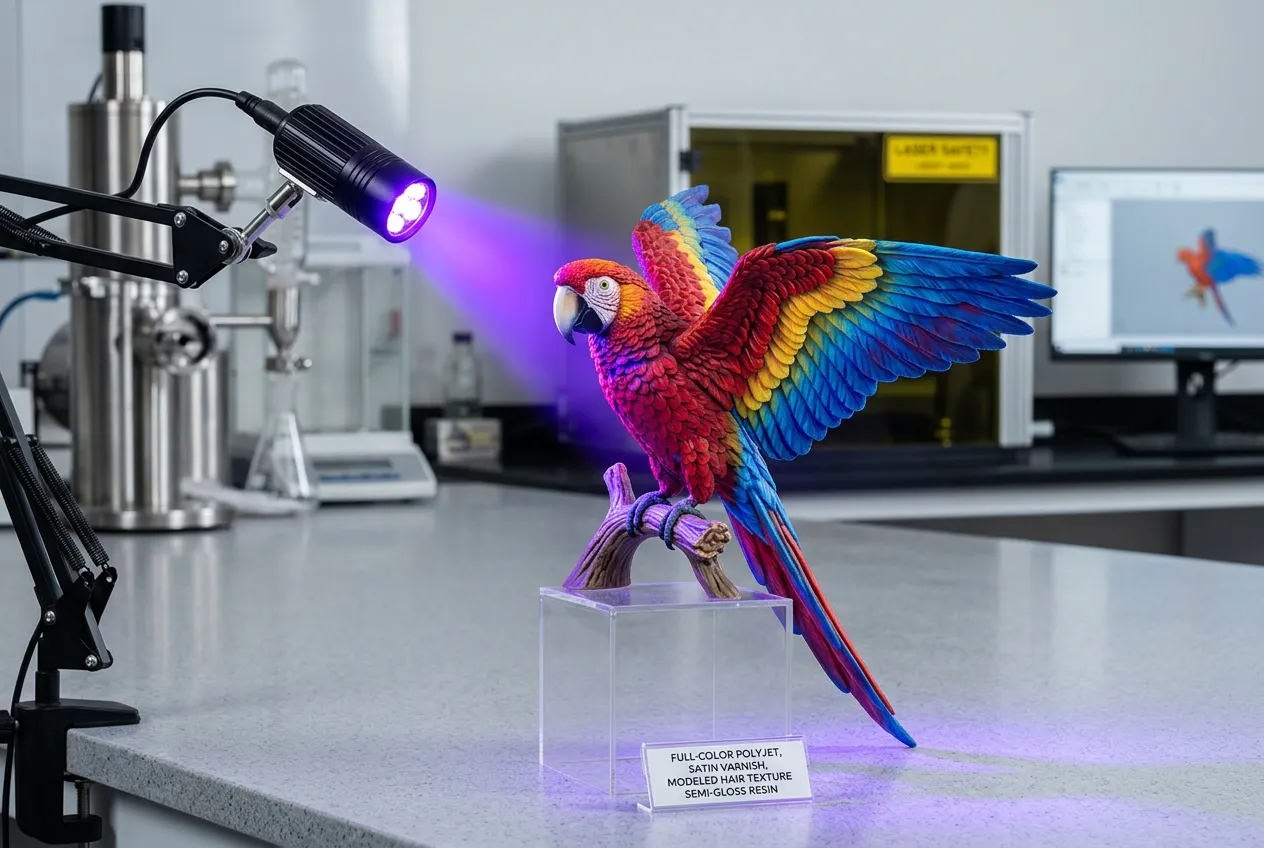
The smell of ozone and warm resin is unmistakable to anyone who’s spent time on a production floor—it’s the scent of chemistry becoming memory.
Quick Takeaways
- UV-cured resin is chemically distinct from air-dried paints, offering superior bond strength at a molecular level.
- Sunlight is the enemy of all pigment, but a proper clear coat acts as SPF 50 for your figurine.
- Vibrant full-color printing embeds color inside the material, preventing the chipping common with hand-painted surfaces.
- Heirloom quality requires protection, which is why PawSculpt’s process includes a specialized UV-resistant sealant.
The Chemistry of Permanence: Why Resin Isn't Paint
Most people think of color as a layer. You paint a wall, you dye a shirt, you print a photo on paper. In those examples, the color sits on top of a substrate. If you scratch the wall, you see the drywall underneath. If you leave the photo in the sun, the ink sitting on the surface breaks down.
In the world of industrial additive manufacturing—specifically the full-color 3D printing technology we use at PawSculpt—color isn't a layer. It is the object.
When we print a figurine, we aren't creating a white shape and then coloring it. We are jetting millions of microscopic droplets of photopolymer resin. Some droplets are structural (white or clear), and some contain pigment (cyan, magenta, yellow, black). These droplets mix instantly before being blasted with high-intensity UV light.
This is the critical difference: The color is cured into the solid matrix of the figurine.
"True durability isn't about how hard a material is; it's about how well the chemistry holds together under stress."
Think of a hand-painted miniature. The paint relies on mechanical adhesion—it's just gripping the surface texture. If the humidity shifts, the underlying material expands, but the paint might not. That's when you get cracking or flaking. With full-color resin printing, there is no "underlying material" separate from the color. They are one and the same.
The "Vampire Effect": Understanding UV Light
As engineers, we have a complicated relationship with Ultraviolet (UV) light. We love it because it cures our resin instantly, turning liquid into a durable solid. We hate it because, over decades, it destroys almost everything it touches.
We call this the "Vampire Effect." The same energy source that gives the figurine life (curing) can eventually drain it (fading).
Here is the reality of light degradation that most collectible companies won't tell you:
| Light Source | Intensity | Risk Level | Time to Visible Fade (Unprotected) |
|---|---|---|---|
| Direct Sunlight | High UV | Extreme | 6-12 Months |
| Indirect Window Light | Moderate UV | Moderate | 3-5 Years |
| Standard LED/Incandescent | Low/No UV | Safe | 50+ Years |
| Museum Glass Case | Filtered | Safest | Indefinite |
The Photopolymer Paradox
Resin prints are technically "photopolymers." This means they react to light. Even after the figurine comes out of the printer, the chemical reaction is mostly done, but not completely dead.- Over-curing: The UV from the sun continues to harden the resin. While this sounds good, it actually makes the material brittle. Eventually, it can develop micro-cracks.
- Yellowing: The clear or white base components of the resin can oxidize and turn yellow, muddying the vibrant colors of your pet's fur.
This is why we never ship a "raw" print. The post-processing phase is just as critical as the printing itself.
The Secret Weapon: Clear Coat Science
You might read about "hand-painted" figurines where the artist uses a spray can of varnish from a hobby store. That works fine for a Warhammer miniature that stays in a box. But for a memorial piece meant to sit on a mantle for thirty years, shop-bought varnish doesn't cut it.
At PawSculpt, we treat the clear coat application as an engineering step, not an artistic flourish.
We use industrial-grade UV-resistant clear coats. Think of this as permanent sunscreen for your figurine. This coating does three specific things:
- UV Blocking: It contains chemical absorbers that soak up UV radiation before it hits the pigments in the resin.
- Oxygen Barrier: It seals the surface from the air. Oxidation is the silent killer of color vibrancy; by cutting off the oxygen supply, we lock in the saturation.
- Sheen Unification: 3D printing, by nature, creates a matte, slightly textured surface (often called "voxel grain"). A clear coat wets out this surface, deepening the blacks and making the coat colors pop—much like how a wet stone looks more colorful than a dry one.
"We've seen families heal by holding something tangible. Grief needs an anchor, and that anchor needs to last."
— The PawSculpt Team
Durability vs. brittleness: The Trade-off
I want to be transparent about the physical properties of full-color resin. There is a misconception that "high quality" equals "indestructible." That’s not how materials science works.
Rubber is indestructible, but it can't hold detail. Steel is strong, but it can't capture the translucency of a dog's eye.
Full-color resin is a ceramic-like material. It is rigid, heavy, and cold to the touch. This gives it a premium, substantial feel—it doesn't feel like a cheap plastic toy. However, rigidity comes with a trade-off: impact resistance.
The Drop Test Reality
If you drop a PVC (plastic) toy, it bounces. If you drop a ceramic vase, it shatters. Your PawSculpt figurine sits somewhere in the middle, but closer to the ceramic side.- Compression Strength: Very high. You can squeeze it, stack books on it, and it holds its shape perfectly.
- Tensile Strength: Moderate. It won't pull apart easily.
- Impact Strength: Low. A fall from a shelf onto a hardwood floor will likely result in a break, usually at the thinnest points (ears, tails, or ankles).
We design for this digitally. When our artists are sculpting your pet from photos, they aren't just looking at likeness; they are looking at structural integrity. We might slightly thicken a fragile greyhound tail or ensure a cat's paw is fully planted to create a stable base. But gravity is undefeated. These are art pieces, not action figures.
How to Preserve Your Figurine for Decades
We have engineered the material and the coating to last. The final variable in the equation is the environment. Over the years, we’ve tracked which figurines stay pristine and which ones age prematurely.
Here is the protocol for maximum longevity:
1. The "Museum Rule" for Placement
Avoid the "spotlight." We often want to put our beloved pets in the brightest spot in the room, but direct UV is the only thing that can penetrate our clear coat over time.- Best spot: A bookshelf on a wall perpendicular to windows, or a mantle that doesn't get direct sun beams.
- Worst spot: A dashboard, a sunroom windowsill, or directly under a halogen lamp.
2. Cleaning Without Chemistry
This is where most people accidentally ruin their keepsakes. They grab the Windex or the Clorox wipe. Don't do it. Solvents (alcohol, ammonia, acetone) can eat through the clear coat. Once that coat is compromised, the resin is vulnerable.- The Fix: Use a dry, soft microfiber cloth (like for glasses) to dust it. If you absolutely must clean a smudge, use a tiny amount of water. That's it.
3. Temperature Stability
Resin expands and contracts with heat. It's microscopic, but over years, constant cycling can cause stress fractures.- The Fix: Don't place the figurine directly above a fireplace that gets used often, and don't leave it in a car. Room temperature is the sweet spot.
Why "Perfect" Isn't the Goal (Authenticity Is)
In mass manufacturing, the goal is uniformity. Every molded plastic dog looks exactly the same. In our process, we embrace the nuance of the technology.
Because we print in layers—often 25 to 50 microns thick—you might see faint "strata" lines if you look under a magnifying glass. You might see a tiny "support scar" on the belly where we had to anchor the model during printing.
A lot of companies try to sand these away until the model looks like injection-molded plastic. We don't go that far. We clean the model, absolutely. We remove the supports and smooth the surface. But we believe the slight texture of the print adds to the visual depth of the fur. It catches the light in a way that perfectly smooth plastic doesn't.
It’s a balance between digital precision and physical reality.
"A photo captures a split second. A figurine captures a presence."
When you hold the figurine, you are holding a piece of advanced engineering. It’s a convergence of digital artistry, chemical bonding, and optical physics. But more importantly, it’s a vessel for memory that is built to endure.
Frequently Asked Questions
Will the colors fade if I keep the figurine indoors?
Indoors, fading is extremely minimal. Because we use a high-grade UV-resistant clear coat, the pigments are protected from ambient light. If kept out of direct, harsh sunlight (like a windowsill), the colors will remain vibrant for decades. Standard indoor lighting, like LEDs, is perfectly safe.Is the resin toxic to touch?
No. Once the figurine has gone through our post-processing—cleaning, UV curing, and clear coating—the material is chemically inert and safe to handle. However, please remember these are collectibles, not toys. They should be kept away from small children and pets, not because of toxicity, but because they can break and create small parts.Can I put my figurine in an aquarium?
We do not recommend this. While the resin is water-resistant, it is not waterproof for long-term submersion. Over weeks or months, water can penetrate the microscopic layers, causing swelling or delamination. Furthermore, the resin and coatings are not certified as aquarium-safe and could be harmful to fish.What happens if I drop it and it breaks?
Because fully cured resin is rigid, it breaks cleanly, much like ceramic or glass. The good news is that clean breaks are easy to repair with a tiny dot of standard Super Glue (cyanoacrylate). If the damage is severe, reach out to us—we understand accidents happen and can often help with a replacement.Ready to Celebrate Your Pet?
Every pet has a story worth preserving. Whether you're honoring a beloved companion who's crossed the rainbow bridge or celebrating your furry friend's unique personality, a custom PawSculpt figurine captures those details that make your pet one-of-a-kind.
Free instant AI preview • 3D artist preview within 7 days • 5 free revisions