
The Week the House Went Quiet: Helping Young Kids Honor a Cavalier's Empty Bed

Morning light spills across the garden, and your six-year-old is calling a name into the hedges—the Cavalier's name, the one that used to arrive with a jingle of tags and a scramble of paws on the patio stones. Nothing answers. Helping children grieve pet loss often begins with a sound that never comes.
Quick Takeaways
- Name the loss plainly — children handle honest words like "died" better than soft euphemisms.
- Keep the empty bed for a while — a physical anchor helps kids process absence at their own pace.
- Build a small ritual in week one — a candle, a drawing, a spoken goodbye gives grief somewhere to go.
- Turn memory into something they can hold — tangible keepsakes like custom pet figurines give small hands a way to stay close.
- Watch for grief in disguise — bedwetting, clinginess, and anger are common and normal in young kids.
The First Week Is a Study in Sound
Here's something we've noticed after working with thousands of grieving pet families: people describe the first week of loss almost entirely through sound. Not sight. Sound.
The absence of nails clicking on hardwood at 6 a.m. The missing sigh from under the dinner table. The doorbell that no longer triggers a symphony of barking. A house doesn't feel empty because a room is empty—it feels empty because the soundtrack stopped.
For a Cavalier King Charles Spaniel, that soundtrack is particularly specific. This is a breed bred for centuries to be a companion, a lap-warmer, a shadow. According to the American Kennel Club's breed profile, Cavaliers are famous for following their humans room to room. So when they're gone, the silence doesn't stay in one place. It moves through the whole house, room by room, the same way she used to.
A family we worked with last year—we'll call them the Marches—lost their Cavalier, Poppy, after nine years. What their mother remembered most wasn't the vet's office or the goodbye. It was the third morning, when her daughter came downstairs and stood very still in the kitchen, head tilted, listening. "I keep waiting to hear her," the little girl said. Not see her. Hear her.
That instinct to listen is grief in its earliest, purest form. And for young children, it can last far longer than we expect.
"A house doesn't feel empty because a room is empty. It feels empty because the soundtrack stopped."
Why the First Seven Days Set the Tone
The first week of family pet loss matters more than most parents realize—not because you need to "fix" anything, but because children are watching how you handle it. You are, whether you like it or not, teaching them their very first lesson about mortality.
That's a heavy sentence. Let it sit for a second.
Long before a child faces the death of a grandparent, they often face the death of a pet. It's rehearsal for the biggest, hardest truth of being human. And how you narrate that first week becomes the template they'll reach for later, sometimes decades later.
So the pressure you feel? It's real. But the goal isn't to grieve perfectly. It's to grieve honestly, out loud, in a way a child can witness and imitate.
What Young Children Actually Understand About Death
Most guides tell you to "be honest with your kids." True, but incomplete. The real challenge is that children under seven understand death in ways that will genuinely surprise you—and can accidentally break your heart at the dinner table.
Here's the counterintuitive part. Very young children often don't grasp that death is permanent. This isn't a flaw in your explanation. It's developmental. A four-year-old may nod solemnly when you explain that Poppy died, then ask twenty minutes later if she's coming back for their birthday.
That's not the child ignoring you. That's a brain that literally cannot yet hold the concept of "never again."
The Language That Helps (and the Language That Hurts)
The instinct to soften is powerful. We reach for gentle phrases: "put to sleep," "went away," "we lost her." Please, be careful here.
Telling a child a pet was "put to sleep" can create a genuine fear of bedtime, of naps, of anyone sleeping. Saying the dog "went away" can spark a quiet, corrosive belief that the pet chose to leave—or worse, that people who leave might not come back either.
The clearest guidance from child grief specialists, including resources from the Association for Pet Loss and Bereavement, points toward plain, concrete words. "Her body stopped working, and she died. She won't be coming back, and that's why we're so sad."
It feels almost brutal to say. It isn't. Children find enormous relief in clarity. Ambiguity is what frightens them.
"Children don't need us to make death smaller. They need us to make it understandable."
Grief Wears Strange Costumes in Little Kids
Adults cry. Children regress.
Don't expect your five-year-old to sit down and process feelings like a tiny therapist. Grief in young children shows up sideways—as a costume, not a face. A recently potty-trained toddler may start having accidents again. A cheerful kid becomes clingy and won't sleep alone. Some children get angry, snapping "I don't even care!" precisely because they care more than they can say.
One of the most useful things we can tell parents: the child screaming "It's not fair!" and slamming a door is often the one grieving most intensely. Anger is grief with nowhere to go.
Here's a table our team put together based on patterns families share with us, cross-referenced with common developmental guidance. Use it as a rough map, not a rulebook.
| Age Range | How They Understand Death | Common Grief Signs | What Helps Most |
|---|---|---|---|
| 2–4 years | Sees death as temporary, reversible | Regression, clinginess, repeated questions | Simple honesty, routine, physical comfort |
| 5–7 years | Beginning to grasp permanence; may feel responsible | Magical thinking, guilt, anger, sleep issues | Reassurance they're not to blame, rituals |
| 8–11 years | Understands death is final and universal | Withdrawal, curiosity about biology, worry | Honest facts, involvement in memorials |
| 12+ years | Adult-like understanding, existential questions | Mood swings, private grief, deep sadness | Space, respect, being treated as a participant |
Notice the 5–7 row. That column that says "may feel responsible." That's the one that catches parents off guard.
The Guilt Nobody Warns You About—Yours and Theirs
Let's talk about the feeling that sits underneath so much pet loss and almost never gets said out loud.
Guilt.
Your child may quietly believe they caused it. Maybe they forgot to fill the water bowl once. Maybe they yelled at the dog that morning. Young children live in a magical-thinking world where their actions and the universe are tangled together, and they can carry a secret conviction that their bad behavior killed the pet.
If your child seems unusually withdrawn, gently ask: "Do you think this was your fault in any way?" You may be stunned by the answer. Naming that fear and dismantling it—"Nothing you did caused this, not even a little"—can lift a weight they didn't have words for.
And then there's your guilt.
If You Chose Euthanasia, Read This
Many Cavaliers face the same heartbreak at the end: mitral valve disease, a heart condition the breed is especially prone to. Families often reach a point where they have to make the hardest decision a pet parent can make. And afterward, the second-guessing arrives like a tide.
Did we do it too soon? Did we wait too long? Was she ready, or did we give up?
That relief you felt when her labored breathing finally stopped—the small, shameful exhale of it's over—doesn't make you cruel. It makes you someone who loved her enough to prioritize her comfort over your own desperate wish to keep her here. The guilt that chases that relief is one of grief's cruelest tricks. It punishes you for the very love that made the decision right.
You did a merciful thing. Hold onto that, especially when your child asks why, and you have to find words for a choice you're still forgiving yourself for.
"Relief and grief can live in the same breath. Feeling both doesn't divide your love—it proves it."
The Empty Bed Is a Teacher, Not a Wound
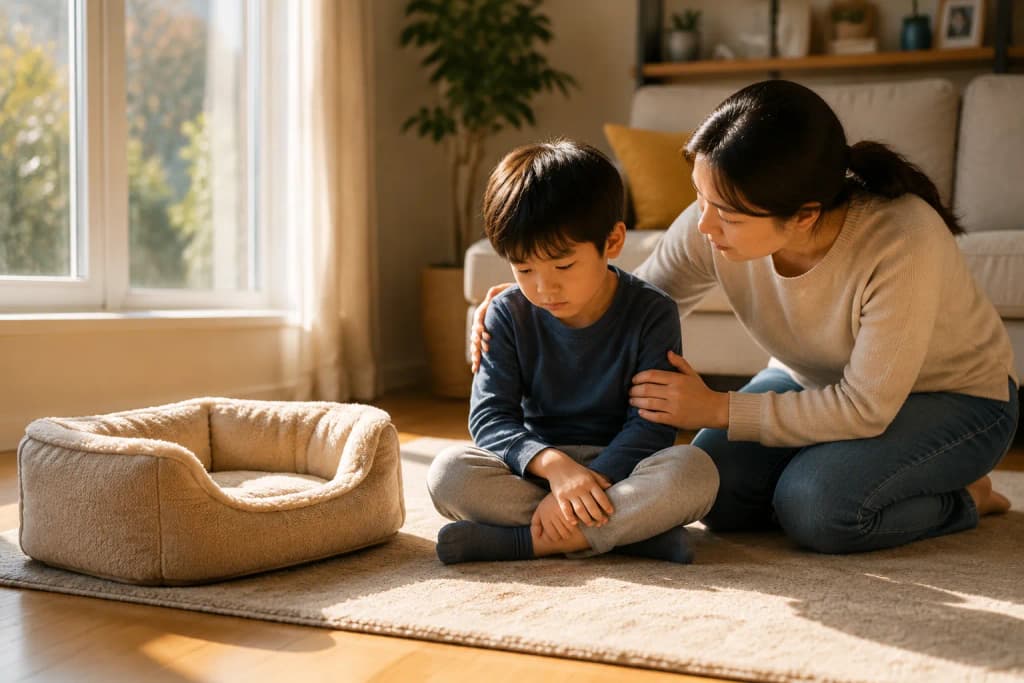
Every parent faces the same small, brutal decision within the first few days: what do you do with the bed?
The dog bed by the garden door. The water bowl. The half-chewed toy under the couch. The instinct is to clear it all away quickly, to spare the children the reminder. We understand that instinct. We'd gently push back on it.
Don't Rush to Erase the Evidence of a Life
Removing everything overnight sends an unintended message: that we deal with loss by making it disappear. That the goal is to forget as fast as possible.
Instead, consider leaving the bed where it is for a while. Let it be a gathering place. In the March household, Poppy's bed stayed by the garden door for nearly three weeks. The children would sit beside it, sometimes talk to it, sometimes just rest a hand on the cushion. It became less a wound and more a meeting point—a place where they could go to feel close.
There's no correct timeline. Some families keep the bed a week, some a month. The key is letting the children signal when they're ready, rather than deciding for them in a burst of protective haste.
A First-Week Ritual, Step by Step
Children thrive on ritual. Ritual gives shapeless grief a container. Here's a simple sequence you can do within the first seven days, ideally in a spot that mattered—like the garden where she used to sniff every corner.
- Gather at the bed or a favorite spot. Bring the whole family, even the youngest.
- Let each person say one thing they loved. A memory, a sound, a habit. "I loved how she snored." "I loved her ears."
- Give the children a physical task. Lighting a candle, planting a bulb, placing a stone. Small hands need something to do with big feelings.
- Say the goodbye out loud. Actually speak it. "Goodbye, Poppy. Thank you." Words spoken aloud land differently than words merely thought.
- End with a promise to remember. This directly addresses the fear we'll talk about next.
The "so what" here is simple: ritual converts passive helplessness into active honoring. It hands a grieving child a job. And a job, for a child drowning in feelings they can't name, is a life raft.
The Fear of Forgetting—and Why It Hits Kids Hardest
This is the emotional nuance almost no article addresses, and it's the one we hear most.
Young children are terrified of forgetting.
They don't have the archive an adult carries. An adult holds nine years of a dog's life in memory. A five-year-old holds maybe a year or two of clear recollection, and some deep part of them knows it's already slipping. A week after the loss, a child might tearfully confess the thing that truly haunts them: "I'm scared I'll forget what she sounded like."
Not what she looked like. What she sounded like. That specific bark at the mail carrier. The particular jingle of her tags on the stairs. The soft grumble as she circled her bed three times before flopping down.
Fight Forgetting With Texture, Not Just Photos
Here's what our team has learned from thousands of memorial projects: photographs preserve the surface, but they don't preserve texture. A photo captures a moment of light. It doesn't capture the weight of a dog in your lap or the shape of her at rest.
This is where memory needs an anchor—something three-dimensional, something a small hand can actually hold when the ache gets sharp at bedtime.
Families reach for this in different ways. Some make a memory box with the collar and a tuft of fur. Some record themselves describing the dog's sounds so the kids can play it back. Some plant a garden that grows and changes and stays. And increasingly, families choose to preserve their pet's exact form through a tangible keepsake they can keep on a nightstand for years.
That instinct—to make grief hold still in something you can touch—is ancient. The Egyptians entombed their cats with gold. We tell ourselves we've evolved past that. But have we, really? The impulse to shape memory into matter, to fight impermanence with something solid, may be one of the oldest human acts there is.
"We've learned that children don't grieve what they can hold. They grieve what's slipping away. Give them something solid, and you give them a place to put the love."
— The PawSculpt Team
How a Figurine Becomes a Coping Tool for a Child
There's a practical psychology at work with a physical keepsake, especially for children. A figurine of the exact dog—her exact markings, that Blenheim chestnut-and-white coat, the particular set of her ears—becomes what child therapists call a transitional object. Something a child can hold, talk to, carry to bed.
When your daughter is scared she'll forget Poppy's face, she doesn't have to reach for a screen. She reaches for a small, solid version of the dog she loved, sitting right there on her shelf.
At PawSculpt, we create these through full-color 3D printing—the color is printed directly into the resin, voxel by voxel, so a Cavalier's distinctive coat pattern is reproduced in the material itself, not layered on top. Our master 3D artists digitally sculpt each piece from your photos, then it's precision-printed and finished with a protective clear coat for durability and a gentle sheen. The result has a natural, authentic texture—fine grain and all—that feels real in a child's hands, because it's meant to be held, not just displayed.
We're not suggesting an object replaces the grieving process. Nothing does. But when a five-year-old is lying awake, frightened that the memory is fading, having something real to hold changes the shape of that fear.
Comparing Memorial Options for a Grieving Family
There's no single right way to memorialize a pet, and what works for a household with a teenager won't be what works for one with toddlers. Below is an honest comparison our team assembled, including the tradeoffs—because pretending every option is perfect helps no one.
| Memorial Option | Effort Level | Best For Kids Who... | Emotional Staying Power |
|---|---|---|---|
| Memory box (collar, fur, tags) | Low | Need to touch familiar objects | High, but fades as items age |
| Planted garden or tree | Medium | Like watching things grow | High, grows over years |
| Photo book or slideshow | Medium | Are visual, love storytelling | Medium; screens feel distant |
| Custom 3D-printed figurine | Low (we do the work) | Fear forgetting; need to hold | Very high; endures for years |
| Paw print cast or clay imprint | Low | Want a physical trace | High; simple and tactile |
Notice we didn't rank one as "the best." A garden and a figurine do completely different emotional jobs—one grows and changes, honoring the passage of time; the other holds still, honoring the form you don't want to lose. Many families do both.
What to Expect If You Choose a Figurine
If you're considering a keepsake like a Cavalier King Charles memorial figurine, here's the honest, practical picture—without inventing specifics that change over time.
- Photos matter more than you'd think. The best source images are well-lit, taken at the dog's eye level, and show her natural markings clearly. A few angles help our 3D artists capture her true proportions.
- Personality beats perfection. A slightly blurry photo of her doing her signature head-tilt is often more valuable than a crisp, stiff portrait. We're capturing who she was, not a passport photo.
- Involve the child in choosing the pose. Ask your kid: "How do you want to remember her? Sleeping? Sitting? With her favorite toy?" This turns the child into a participant in the memorial, which is itself healing.
For current details on our process, previews, revisions, and guarantees, it's best to visit pawsculpt.com directly, since those specifics evolve. What doesn't change is the goal: to reproduce the details that made your dog unmistakably her.
Returning to the Marches, Some Months Later
We checked in with the March family a while after Poppy's figurine arrived. Their daughter, the one who'd stood in the kitchen listening for a sound that would never come, had claimed the piece for her bedroom shelf.
Her mother told us something we think about often. The little girl had stopped listening for Poppy in the mornings. Not because she'd forgotten—but because she no longer felt she had to catch the memory before it escaped. It was already caught. It was sitting on her shelf, chestnut ears and all, in a form she could pick up whenever the missing got loud.
That's the quiet gift of a tangible memorial. It doesn't end grief. It gives grief a home, so it stops chasing the child through every empty room.
"Grief isn't something children outgrow. It's something they learn to carry—and small hands carry best what they can hold."
When to Worry, and When to Simply Wait
We're a team of pet lovers and 3D artists, not child psychologists, so please take this as observation rather than clinical advice. Most children move through the sharpest grief within the first several weeks, with waves that resurface around birthdays, holidays, or the anniversary.
But some signs suggest a child needs more support than a family ritual can provide:
- Grief that intensifies rather than eases after six to eight weeks
- Refusal to attend school or persistent, severe sleep disruption
- Talk of wanting to join the pet, or expressions of not wanting to be alive
- Complete emotional shutdown—no sadness, no anger, nothing
If you see these, please reach out to your pediatrician or a child grief counselor. There's no shame in it. Sometimes the most loving thing a parent can do is admit the situation is bigger than the tools at home. For grief resources and support hotlines, the Association for Pet Loss and Bereavement is a genuinely helpful starting point for families.
The Sibling Nobody Mentions: Your Other Pets
One overlooked piece of the first week—if you have another dog, watch them too. Cavaliers are deeply bonded animals, and a surviving pet often grieves audibly. They pace. They wait by the door. They vocalize at odd hours, a sound your children will notice immediately.
Explaining that "Max misses her too, that's why he's crying at night" does two things at once. It validates your child's grief by showing it's shared. And it gives them a caretaking role—comforting the surviving pet—that channels their own sadness into tenderness. That's not a distraction from grief. It's grief doing exactly what it's supposed to do: turning back into love.
Bringing the Week Full Circle
Go back to that first morning. Your child, standing in the garden, calling a name into the hedges. Waiting for the jingle of tags that doesn't come.
The goal of this whole difficult week was never to make that sound return. It can't. The goal was to help your child understand that the love behind the sound doesn't need the sound to survive. It can live in a lit candle, a planted bulb, a spoken goodbye, a small solid figure on a shelf that holds the exact shape of her ears.
Here is the thing we most want you to leave with. In helping children grieve a pet, you are not protecting them from loss—you can't, and trying to will only teach them to hide from it. You're teaching them that love outlasts absence, that memory can be given a home, and that the people we lose stay with us in the textures we keep.
So tonight, sit with your child by the empty bed one more time. Let them talk. Let them cry, or not. And when they ask, as they will, whether it's okay to be happy again someday, tell them the truest thing you know: that remembering Poppy and being happy are not enemies. One makes room for the other.
The house went quiet this week. But quiet, it turns out, is just the space where we learn to listen differently.
Frequently Asked Questions
How do I explain a pet's death to a young child?
Use plain, concrete language rather than euphemisms. Phrases like "put to sleep" or "went away" can accidentally create fears around bedtime or abandonment. Instead, say something like "Her body stopped working and she died, and she won't be coming back." It feels blunt, but children find honesty far less frightening than ambiguity.
Should I remove my pet's bed and belongings right away?
There's no need to rush. Clearing everything overnight can send the message that we cope with loss by erasing it. Many families find that leaving the bed in place for a few weeks turns it into a gathering spot where children can sit, talk, and feel close. Let your child's readiness guide the timing.
Is it normal for my child to feel guilty after losing a pet?
Very much so. Children between roughly five and seven often live in a world of magical thinking, where they believe their actions can cause big events. A child may secretly think a forgotten water bowl or a moment of yelling caused the death. Gently asking "Do you think this was your fault?" and reassuring them it wasn't can release a burden they couldn't name.
How long does pet grief last in children?
Most children move through the most intense grief within several weeks, though waves often return around birthdays, holidays, and anniversaries. If your child's grief seems to deepen rather than ease after six to eight weeks, or if you notice school refusal, severe sleep problems, or emotional shutdown, it's worth consulting your pediatrician or a child grief counselor.
How can a memorial keepsake help a grieving child?
Children are often terrified of forgetting—especially the sounds and physical presence of their pet. A tangible keepsake acts as a transitional object, something a child can hold or keep by their bed. A custom pet figurine that captures the pet's exact markings gives a child something solid to reach for when the memory feels like it's slipping.
What photos work best for a custom Cavalier figurine?
Clear, well-lit photos taken at the dog's eye level are ideal, showing their natural markings and coloring. A few different angles help our 3D artists capture accurate proportions. Honestly, a slightly imperfect photo showing your dog's signature head-tilt often matters more than a stiff, posed portrait, because personality is what makes the piece feel truly like them.
Ready to Celebrate Your Pet?
Every pet has a story worth preserving. Whether you're honoring a beloved Cavalier who's crossed the rainbow bridge or celebrating a furry friend's unique personality, a custom PawSculpt figurine captures the details that make your pet one-of-a-kind—those distinctive markings, that particular tilt of the head. When you're helping children grieve a pet, having something real to hold can turn the ache of an empty bed into a place where love gets to stay.
Visit pawsculpt.com to learn more about our full-color 3D printing process, preview turnaround, revision options, and quality guarantee.