
The Untouched Food Bowl: Finding Your Support Circle a Year After Losing a Sphynx
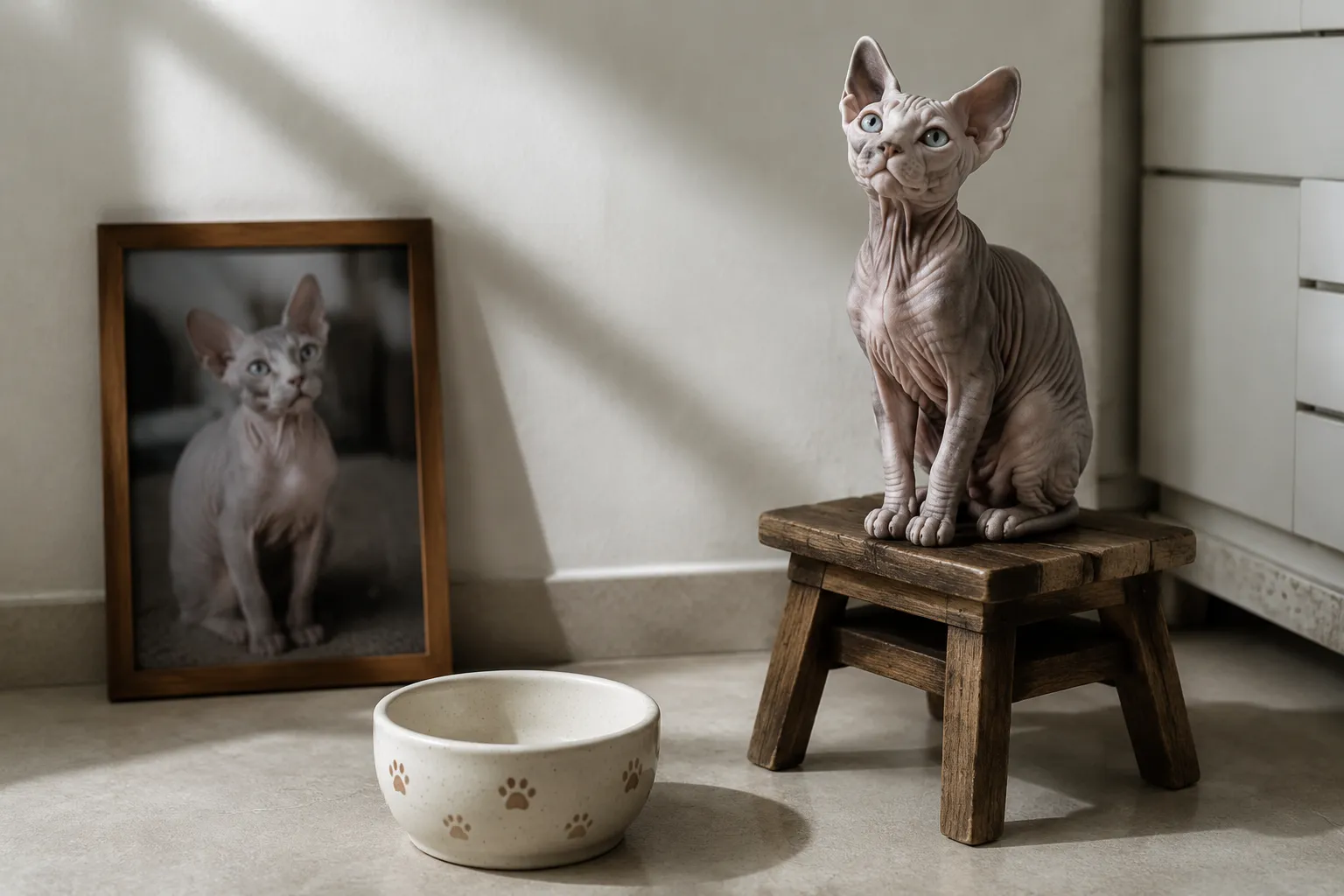
A year ago, the attic light caught the shine of a heated cat bed, still dented from a warm, hairless body that had claimed it as a throne. Today that same beam falls on dust. If you're still searching for sphynx cat loss support twelve months out, you already know the truth nobody warned you about: the ache doesn't expire on schedule.
Quick Takeaways
- The first anniversary reactivates grief on purpose — your nervous system files trauma by date, so plan for it.
- Sphynx grief carries a hidden weight — the bond is more physical, so the absence feels more physical too.
- A support circle isn't found, it's built — map it in three tiers before you need it.
- Naming the "ugly" emotions shrinks them — guilt, relief, and fear of forgetting are normal, not shameful.
- Tangible anchors help the mind hold on — some families find comfort in custom memorial keepsakes that preserve a pet's exact markings and posture.
Why the First Anniversary Hits Harder Than Month Three
Here's something most grief articles skip entirely: your brain is a date-keeper. It doesn't file loss as a slow fade. It files it as a coordinate — a specific slant of light, a season, a temperature in the air. So when the calendar circles back to that coordinate, your body often reacts before your conscious mind catches up.
Grief counselors call this the anniversary reaction. The Association for Pet Loss and Bereavement describes it as a predictable resurfacing of acute grief around meaningful dates. It's not backsliding. It's not you "failing to heal." It's your memory system doing exactly what it evolved to do.
We've talked with hundreds of pet families over the years, and the pattern is remarkably consistent. Month one is fog. Months two through five are the slow, exhausting work of rearranging a life around a hole. And then, somewhere around month eleven, something strange happens.
The light starts to look familiar again.
If your sphynx passed in late autumn, the first cold snap of the next autumn can knock the wind out of you in a grocery store parking lot. The angle of the afternoon sun through a window — the exact gold it turned when your cat used to stretch across the sill soaking up heat — becomes a trapdoor. You didn't plan to fall through it. You just did.
"Grief doesn't run on a calendar you control. It runs on the one your heart quietly memorized."
So what does this mean for you, practically? It means you stop treating the anniversary as an ambush and start treating it as a weather event you can see coming. You can't stop the storm. But you can bring an umbrella, clear your schedule, and tell the people around you that a hard day is on the radar.
A Simple Timeline of What Many Families Experience
Every grief is individual, and yours won't match this exactly. But patterns help us feel less alone, so here's a general map of the first year based on what we've seen and what pet-loss counselors describe.
| Timeframe | What Often Surfaces | What Tends to Help |
|---|---|---|
| Weeks 1–2 | Numbness, disbelief, autopilot | Let people bring food; skip big decisions |
| Weeks 3–8 | Sharp, unpredictable waves | Keep one small daily anchor (a walk, a candle) |
| Months 3–6 | Quieter but deeper sadness | Talk it out; a support group starts to help here |
| Months 7–10 | Emerging "new normal," occasional guilt | Permission to have good days without shame |
| Months 11–13 | Anniversary reaction resurfaces | Plan a ritual; lean on your circle intentionally |
Notice that the graph isn't a straight line down. It's a jagged descent with a spike near the end. That spike is normal. The mistake most people make is interpreting it as proof they've made no progress — when really, it's just the date doing its job.

The Emotions Nobody Warns You About (And Why They're Normal)
Let's talk about the feelings that don't make it onto sympathy cards.
Because here's the thing: the surface story of pet loss is sadness. Simple, clean, socially acceptable sadness. But if you're honest with yourself a year out, the real emotional landscape is messier than that. It has ugly corners. And those corners are exactly where the isolation grows, because they're the parts you're afraid to say out loud.
The Fear of Forgetting
This one catches people off guard around the one-year mark specifically.
You wake up one morning and you can't quite remember the precise sound your sphynx made — that odd, chirpy, almost-conversational trill so many of them have. It was so familiar you never thought to record it. And now there's a flicker of panic, because if the sound is fading, what else is going away?
This fear is not a betrayal of your love. It's a function of memory. Sensory memories are the first to blur because the brain doesn't archive them like photos; it reconstructs them each time, and the reconstruction gets grainier with every year the original recedes.
Many pet owners feel a private terror that "moving on" means the details will dissolve until only a vague warmth remains. This is more common than you'd think, and it's the single biggest reason people reach for something tangible around the anniversary. Not because they're clinging. Because they're trying to give a slippery memory something solid to hold onto.
"The fear that you'll forget them is really the fear that you'll stop loving them. You won't. Love just changes shape."
The Guilt That Hides Underneath the Grief
Now the harder corner.
That decision you replay at 2 a.m. — the timing of the euthanasia, the treatment you tried or didn't try, the last vet visit where you thought you had more time — a year later, guilt has a way of getting louder, not softer. It's almost as if the initial shock protected you, and now that the shock has worn off, the second-guessing has room to move in.
If you find yourself thinking I should have known sooner or I let them suffer one day too long or even I ended it one day too soon — you are experiencing one of the most universal, least-discussed parts of pet grief. Regret about medical decisions and second-guessing euthanasia timing are so common that vets have a name for the exhaustion it causes.
Here's what actually helps more than reassurance: facts. You made the best decision available with the information you had at the time. You could not act on information from the future. That's not a comforting cliché — it's just logically true. Hindsight feels like knowledge, but it's a trick of memory that hands you data you never actually possessed in the moment.
And that flicker of relief you may have felt when the suffering finally ended? The one that made you feel like a monster? It doesn't mean you wanted them gone. It means you loved them enough to want their pain gone more than you wanted your own comfort of keeping them near. Relief and grief can occupy the exact same breath. That's not a contradiction. That's love doing math it hated to do.
Feeling Judged — The Sphynx Owner's Extra Burden
Sphynx owners carry a specific, lonely version of this that most cat and dog people never face.
You've probably heard it. "It was just a cat." Or worse, from someone eyeing a photo: "Wasn't that the weird hairless one?" When your grief for an unusual-looking animal gets met with a raised eyebrow, it teaches you to grieve in private. To keep your voice steady at work. To not mention that you still can't move the heated blanket off the couch.
This social dismissal is real, and it compounds the isolation in a measurable way. When the world doesn't recognize your loss as legitimate — a phenomenon grief researchers call disenfranchised grief — you lose access to the normal rituals of comfort. Nobody sends a card. Nobody asks how you're holding up. So you conclude, wrongly, that your grief is too big for how "small" the loss supposedly was.
It wasn't small. And the intensity you feel isn't disproportionate. Which brings us to something specific about sphynx cats that explains a lot.
What a Sphynx Leaves Behind Is Different — And Here's Why
This is the part you won't find in the first five articles about pet loss, because most of them are written about pets in general. Sphynx grief has its own physics.
Think about what made your sphynx unique in daily life. They weren't a cat who tolerated you from across the room. Sphynxes are heat-seekers by biological necessity — with no coat to trap warmth, they gravitate to the warmest surface available, which is very often you. Under the covers at night. Pressed against your neck. Curled in the crook of an arm like a living hot-water bottle with an opinion.
So the absence isn't abstract. It's thermal. It's the specific cold spot in the bed where a small furnace used to be. It's the shoulder that no longer has a warm weight on it while you read. Dog and shorthair-cat owners grieve a presence; sphynx owners often grieve a temperature.
"You didn't just lose a pet. You lost the warmth that made a cold house feel occupied."
Then there's the food bowl — the title image of this whole experience. Sphynx cats run hot metabolically because they burn calories staying warm, which means they eat more, and more often, than most cats. Their bowl was rarely empty for long. It was a busy little station in your kitchen. So when it goes untouched, the stillness of that bowl is louder than it would be for almost any other breed. A full, quiet bowl in the morning is a small daily earthquake.
Here's the counterintuitive insight most people miss: the depth of your grief is not a mystery to be ashamed of — it's the mathematically predictable result of an unusually physical bond. You spent more hours in direct skin-contact with this animal than most people spend with their pets in a lifetime. Of course the withdrawal is severe. You're not overreacting. You're reacting exactly in proportion to what was there.
Understanding this matters because it reframes the guilt of "why am I still this sad?" into something clearer: you are sad in exact proportion to the closeness. And that closeness was real.
Myth vs. Reality
A few beliefs float around pet-loss circles that deserve to be dragged into the light and busted.
Myth: "If you're still grieving after a year, something is wrong with you."
Reality: The one-year mark commonly intensifies grief temporarily thanks to the anniversary reaction. Ongoing grief isn't pathology — it's the tax on having loved deeply. Prolonged, functionally disabling grief is a separate clinical matter worth discussing with a professional, but simple sadness at twelve months is textbook normal.
Myth: "Getting a new pet would be an insult to the one you lost."
Reality: Loving another animal doesn't overwrite the first. The human heart isn't a hard drive with fixed storage. Many families find that opening their home again honors the love that taught them how to care in the first place — though the anxiety about "replacing" them is real and worth sitting with, not rushing.
Myth: "A support group is only for the first few weeks."
Reality: Some of the most valuable support-group participation happens around anniversaries, precisely when everyone else assumes you're "over it." The people who understand month eleven are gold.
Building Your Support Circle: A Practical Blueprint
Okay. Enough about the terrain. Let's talk about what to actually do, because you asked for support, and support is a thing you build with your hands, not a mood you wait to arrive.
The mistake most grieving people make is treating support as a single thing — one friend, or one group, expected to carry everything. That overloads the one source and then it collapses. What works better is a three-tier system, where different needs get routed to different places. Think of it like triage.
Tier 1: The Inner Ring (For Raw Days)
These are the one or two people who don't need you to be okay. You don't perform for them. You can send a text at 11 p.m. that just says bad night and they'll know.
Most people have fewer of these than they think, and that's fine — you only need one or two. The action here is specific: identify them by name before the anniversary, and tell them the date is coming. Don't make them guess. Say, "The 14th is a year since I lost her. I might be a mess. Can I text you that day?" People almost always say yes. They just need to be asked.
Tier 2: The Understanding Community (For Being Seen)
This is where a pet loss support group earns its keep. The magic of a group isn't advice — it's recognition. It's the first time someone nods when you describe the untouched bowl and you realize you're not insane.
You have real options here, and they're not equal:
- In-person groups through local veterinary schools, humane societies, or hospice organizations. Best for people who need human presence and eye contact.
- Online forums and communities like the resources hosted through APLB's pet loss support pages. Best for odd hours, or if leaving the house feels impossible.
- Breed-specific groups, which matter enormously for sphynx owners. A room full of people who get why the hairless-cat bond is different beats a general group where you have to explain the basics first.
Here's a comparison to help you choose where to spend your limited emotional energy:
| Support Option | Best For | Effort Required | What It Uniquely Offers |
|---|---|---|---|
| Inner-ring friend | Raw, unfiltered moments | Low | Zero explanation needed |
| In-person group | Feeling human presence | Medium–High | Eye contact, ritual, structure |
| Online community | Odd hours, isolation | Low | 24/7 access, anonymity |
| Breed-specific group | Sphynx-specific grief | Medium | No need to justify the bond |
| Grief counselor | Stuck or worsening grief | High | Clinical tools, safe space |
Tier 3: The Professional Backstop (For When You're Stuck)
If the grief isn't softening at all, if it's interfering with eating, sleeping, or basic functioning many months in, that's the signal to loop in a licensed grief counselor — ideally one familiar with pet loss. We're not therapists, so we'll say this plainly: there's no medal for white-knuckling through complicated grief alone. Getting help early is the efficient move, not the weak one.
"We've watched grief go quiet not when people forget, but when they finally have something to hold. The mind needs an anchor it can touch."
— The PawSculpt Team
A Practical Anniversary Ritual You Can Actually Do
The anniversary is coming whether you prepare or not. So prepare. A planned ritual gives the day a shape, which keeps it from becoming a formless, ambushing dread. Structure is a kindness you give your future self.
Here's a simple framework. Adapt freely — the point isn't ceremony, it's intention.
- Clear the calendar the day before, not the day of. The anticipatory dread of anniversary-eve is often worse than the day itself. Protect that evening.
- Choose one sensory anchor to revisit on purpose. A photo, a favorite blanket, that heated bed from the attic. Approaching the memory deliberately is far gentler than getting ambushed by it in a checkout line.
- Do one small physical act. Light a candle at the time they passed. Fill the bowl one last time and then, when you're ready, put it away with intention rather than leaving it to haunt you. The action gives the grief somewhere to go.
- Connect with one person from your circle. Not to be fixed. Just to be witnessed.
- Say the thing out loud. Their name. What you miss. The chirp you were afraid you'd forgotten. Speaking it re-strengthens the memory trace — literally, neurologically. You're not wallowing. You're preserving.
The "so what" here is important: rituals aren't superstition. They're a well-documented way the human mind processes transition. A ritual converts a passive, dreaded date into an active, chosen event — and that shift from passive to active is where a surprising amount of relief lives.
Where a Tangible Keepsake Fits
Remember that fear of forgetting we talked about? This is where it gets practical.
Some families plant a tree. Some assemble a photo book. Some tuck a paw-print impression into a shadow box. And increasingly, pet parents choose a physical figurine that captures their companion's exact posture and markings — the thing photos flatten and memory blurs.
For sphynx owners specifically, this hits differently, because a sphynx's whole visual identity lives in details that are hard to hold onto: the specific fold pattern of the skin, the wrinkle map on the forehead, the particular set of those enormous ears, the coloring that a coat would otherwise hide. This is where PawSculpt comes in — the figurines are digitally sculpted by master 3D artists and then precision 3D printed in full color, so your cat's real markings and proportions are reproduced directly in the resin rather than approximated. The color is part of the material itself, sealed under a protective clear coat, which is why the finish looks authentic rather than glossy-plastic.
We'll be real about what this is and isn't. It won't warm the bed. It won't chirp. It isn't a replacement, and anyone selling it as one is selling you something else. What a well-made 3D pet sculpture can do is give the slippery, fading sensory memory a fixed point in the physical world — something your hand can find on a shelf when your mind can't quite reconstruct the shape of those ears anymore. For a lot of families, that's exactly the anchor the one-year mark calls for.
"A keepsake doesn't bring them back. It just makes sure the memory has somewhere to live."
When the Support Circle Includes a Surviving Pet
One thing that's easy to overlook a year in: if you have another animal at home, they've been grieving on their own timeline too — and it doesn't always match yours.
Sphynxes are intensely social and often bond hard with a companion animal. A surviving pet may have gone through its own withdrawal — searching the house, sleeping in the wrong spots, going off food for a stretch. By the anniversary, most have adjusted, but some carry a lingering low-grade change in behavior that owners misread as unrelated.
The practical move: on the anniversary, give the surviving pet fifteen minutes of dedicated, undistracted attention — floor-time, a favorite toy, whatever they love. It's not sentimental. It's useful. It reinforces their security on a day when your own energy is scattered and easy for a sensitive animal to pick up on. Grieving together, in whatever way an animal can, is its own quiet form of support.
If a surviving pet's behavior shifted dramatically and never came back, that's worth a vet conversation. We're not vets, so for anything that looks like a real health or behavioral decline, PetMD's pet loss and grief resources or your own veterinarian are the right call.
The Untouched Bowl, One Year On
Circle back with me to that attic, and that beam of light on the dented bed.
A year ago the dust wasn't there yet. The bed was warm. The bowl was busy. And you probably couldn't have imagined standing here twelve months later still feeling the specific cold of a shoulder that lost its warm weight.
Here's what a year actually teaches you, if you let it: the goal was never to stop missing them. That was always the wrong target. The goal is to change your relationship with the missing — to move it from an ambush to something you can hold, look at, and set back down. That's not moving on. That's carrying them differently.
So this week, do the small, concrete thing. Name your two inner-ring people and warn them the date is coming. Find one pet loss support group — breed-specific if you can — and just read the posts if that's all you can manage. Plan the candle. Fill the bowl one last time, on your terms, and then put it somewhere gentle.
The dust in the attic isn't the end of the story. It's just proof that time kept moving. You get to decide what you carry with you as it does. And a year of sphynx cat loss support, gathered one small action at a time, turns out to be exactly how the warmth comes back — not in the bed, but in you.
Frequently Asked Questions
Is it normal to still grieve my pet a year later?
Yes, and the timing you're noticing is real. The first anniversary commonly reactivates acute grief through what counselors call the anniversary reaction — your memory system is keyed to dates and seasons. Ongoing sadness at twelve months isn't backsliding or dysfunction. It's the predictable cost of a deep bond.
Why does losing a sphynx cat feel more intense than people expect?
Because the bond is unusually physical. With no coat, sphynxes seek out body heat constantly and spend enormous amounts of time in direct skin contact with their people. The absence isn't abstract — it's the literal missing warmth in a bed or on a shoulder. Your grief is in exact proportion to a closeness that was genuinely more physical than most pet relationships.
How do I find the right pet loss support group?
Start with local veterinary teaching hospitals, humane societies, and hospice organizations for in-person options. For flexibility, online communities like those hosted through the APLB are available at any hour. If you can find a breed-specific group, take it — being with people who instantly understand the sphynx bond means you skip the exhausting work of justifying your grief.
Is it normal to feel guilty about when I chose euthanasia?
Extremely normal, and it often gets louder around the one-year mark, not quieter. Here's the logical truth worth holding onto: you acted on the information available to you at the time. Hindsight feels like knowledge, but it's memory handing you data you never actually had in the moment. You did the best you could with what you knew.
What if getting a new pet feels like a betrayal?
That anxiety is common and worth sitting with rather than rushing past. But love isn't a fixed quantity that gets used up. Welcoming another animal doesn't erase or diminish the one you lost — many families find it honors the love that taught them how to care in the first place. There's no correct timeline, only yours.
How do I keep from forgetting the little details?
Revisit sensory memories deliberately instead of avoiding them, say their name and describe them out loud (which strengthens the memory trace), and keep a tangible anchor. A photo, a recording, or a full-color figurine that captures their exact markings gives a fading memory a fixed point your hand can find even when your mind can't.
Ready to Honor Your Sphynx?
The details that made your sphynx unmistakably them — the wrinkle map, those enormous ears, the exact coloring a coat would have hidden — deserve to be preserved as clearly as you remember the warmth of them. As part of your journey through sphynx cat loss support, a custom PawSculpt figurine gives that fading memory a solid place to live, digitally sculpted by master 3D artists and precision 3D printed in full color so every marking is reproduced directly in the resin.
Visit pawsculpt.com to explore our full-color 3D printing process, flexible revisions, and quality guarantee.