
Walking Off the What-Ifs: An Art Lover's Guide to Grieving a Border Collie Lost Abroad
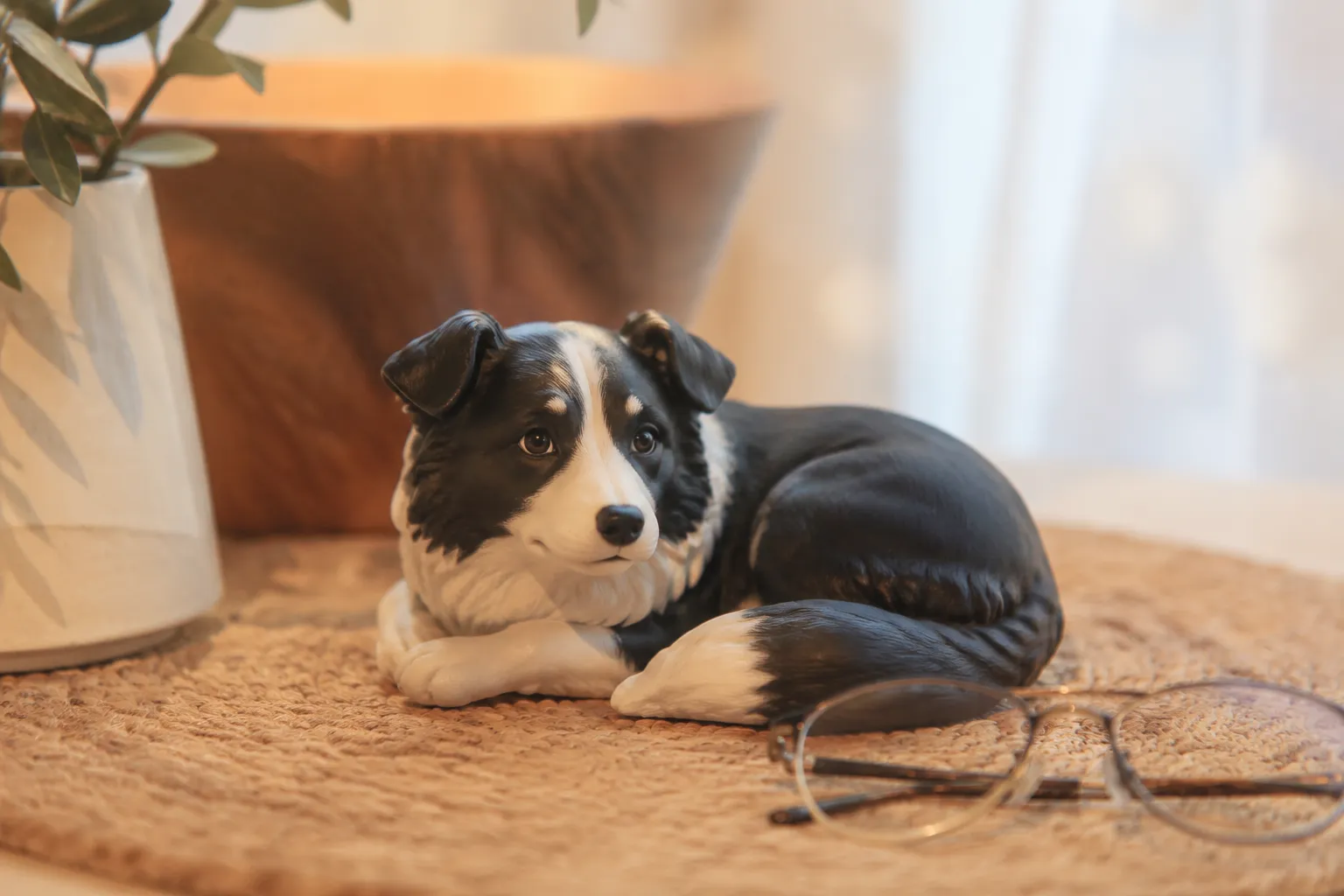
A border collie named Chaser learned 1,022 words before she died, more than any dog ever formally tested. So when you're grieving a border collie, the ache has a particular shape: the cold kitchen tile where two front paws used to wait, now holding no weight at all.
Grieving a border collie lost abroad means grieving both the dog and the distance. The most effective path is to name the bargaining "what-ifs" as a normal grief stage, build a small daily ritual around a physical keepsake, and release the belief that being far away means you failed them.
Quick Takeaways
- The "what-ifs" are bargaining, not truth — your mind rewrites the past to feel less powerless.
- Distance grief is its own wound — being abroad when they died does not mean you abandoned them.
- Teens grieve sideways — expect anger and withdrawal more than tears, and don't force the conversation.
- Anchor the bond in something you can hold — rituals and memorial pet figurines give grief a physical place to land.
Why a Border Collie's Mind Makes the Grief Louder
Here's something we've noticed across thousands of pet families: the smarter and more work-driven the dog, the more tangled the grief tends to be. Border collies sit at the far end of that spectrum. The American Kennel Club describes the breed as intensely intelligent and energetic, a dog bred to make decisions on a hillside two hundred yards from its handler.
That means your border collie didn't just live in your house. He ran it. He timed your mornings, herded you toward the door for the walk, dropped a ball on your keyboard at 4 p.m. because that was the contract.
When that mind goes quiet, the loss is structural. You're not only missing a companion. You're missing the organizing intelligence that shaped the rhythm of your day.
So the first thing worth understanding: if your grief feels disproportionate, disorienting, almost administrative in how it keeps ambushing you at specific times, that's not weakness. That's a working relationship ending. The 4 p.m. hour will feel strange for a while. The texture of it, the sudden slack where a warm body used to press against your shin, takes weeks to renegotiate.
"The ball is still under the couch. Nobody has vacuumed there in a month, because moving it feels like agreeing he's gone."
Pet Loss During Travel: The Cruelty of Not Being There
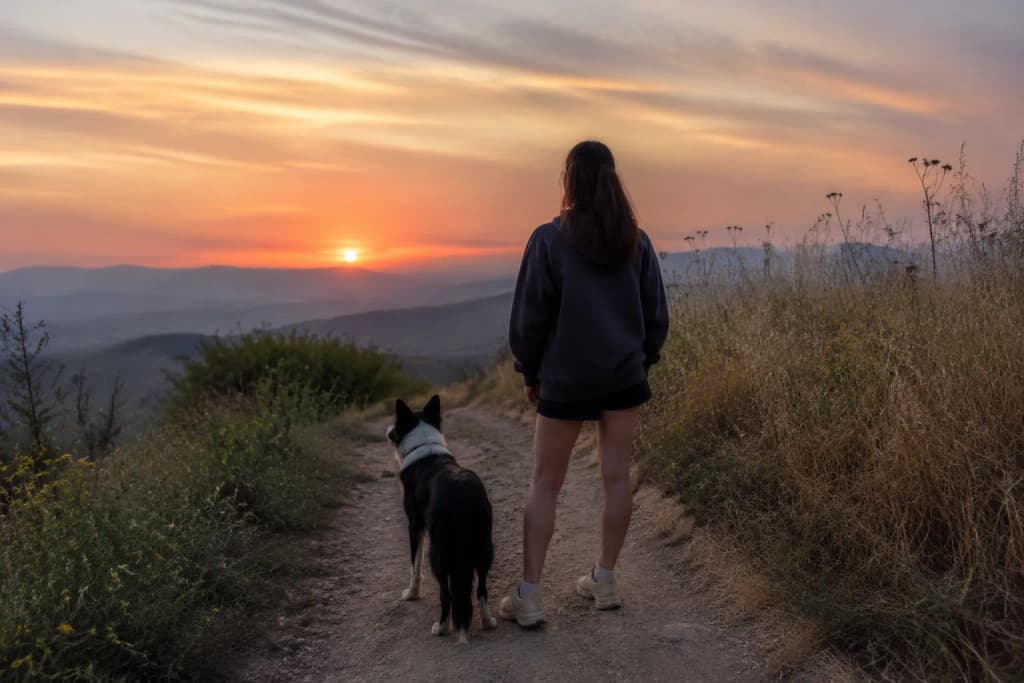
Some grief carries a second passenger. If your border collie died while you were abroad, or the loss happened somewhere far from home, there's a specific fracture that generic grief articles skip entirely.
We worked with a customer who got the call in a hotel room in Lisbon, eight time zones from the emergency vet. Her dog had been with a sitter. By the time the phone rang, the decision had already been made without her. She told us the worst part wasn't the loss. It was the six hours of flight home knowing he was already gone and she was still moving toward a place he no longer occupied.
Pet loss during travel breeds a particular guilt: the belief that your absence was a betrayal. That if you'd been home, you'd have caught the symptom sooner, made a different call, held him at the end.
Let's be precise about that, because precision helps here. Presence at the moment of death does not determine the quality of a life. A dog's fourteen years of security, walks, warm floors, and belonging are not erased by your geography in the final afternoon. The bond was a spiritual contract signed over thousands of ordinary days, not a single one.
That doesn't make the ache logical. It makes it human. But the story you tell yourself in that hotel room, the one where distance equals abandonment, is a distortion grief manufactures. You can name it as a distortion without needing to fully believe the correction yet.
A practical grounding when you're far away
If the loss finds you abroad, three concrete actions tend to help in the first 72 hours, which are usually the hardest:
- Ask for a photo or a witness account of a calm final moment, if one exists. Grief fills silence with worst-case imagery; a real detail interrupts that.
- Perform a small ritual where you are. Light a candle in the hotel window. Mark the time in the local place. You were somewhere real when it happened; let that place hold a piece of the goodbye.
- Delay the big decisions. Do not decide about ashes, memorials, or the empty crate from another continent at 2 a.m. Those choices keep.
The Bargaining Stage of Pet Grief Runs Backward
Most people learn the five stages of grief as a forward-moving line. Bargaining gets described as pleading with the universe: please let the test come back clean. That's the version that happens before a loss.
Here's the part that surprises people. After the loss, the bargaining stage of pet grief doesn't try to change the future. It tries to rewrite the past. It's the "what-if" machine running on a loop.
What if I'd noticed the limp in March. What if I'd flown home a day earlier. What if I'd fed the raw diet, or not fed the raw diet, or gone to the specialist in the next county.
This is the emotional engine behind the whole "walking off the what-ifs" idea. You cannot out-think the what-ifs at the desk. Border collie people know this instinctively: the mind untangles when the body moves. A long walk, the same route you used to take together, does more for backward-bargaining than an hour of trying to reason it away.
The counterintuitive insight is this: the what-ifs are not really questions. They're a bid for control over something that was never controllable. Your brain would rather believe I could have prevented this than sit with this happened and I was powerless. Guilt feels more bearable than helplessness. So it manufactures guilt on purpose.
Here's a map of how the stages actually tend to move for pet loss, based on what grief counselors describe and what we've observed in the families we serve:
| Stage | What it sounds like | Typical window | What actually helps |
|---|---|---|---|
| Shock / numbness | "It doesn't feel real." | First 3-7 days | Basic routine, food, sleep. No big decisions. |
| Backward bargaining | "What if I'd been home?" | Weeks 1-8, recurring | Movement, naming it as a distortion, walking the old route |
| Anger | "Why him, why now?" | Variable, often hidden | Physical outlet, permission to feel it without guilt |
| Depression / longing | "The house is wrong." | Months 1-6 | Ritual, connection, a physical anchor for the bond |
| Reconnection | "I can smile at his photo." | No fixed deadline | Continuing the bond, not "closing" it |
Grief counselors are clear that these overlap and loop. You do not graduate. The Association for Pet Loss and Bereavement offers grief chat rooms specifically because reconnection happens in community, not on a schedule.
"We've learned that grief needs an anchor. Families don't heal by letting go of the bond. They heal by finding a place to put it."
— The PawSculpt Team

Counter-Point: Why "Closure" Might Be the Wrong Goal
Most grief advice pushes you toward closure. Move the food bowl, donate the toys, get a new puppy, turn the page. And for some people, at some point, that clearing-out genuinely helps.
But we want to be honest about the tradeoff, because the "closure" script fails a lot of pet owners, and it fails border collie owners in particular.
Modern bereavement research leans on a framework called continuing bonds: the idea that healthy grief often means maintaining a transformed relationship with the one you lost, not severing it. You're not trying to reach a day when the dog no longer matters. You're trying to reach a day when the love outweighs the sting.
So if you're not ready to move the leash, don't. If keeping his collar in your pocket for a month gets you through the airport, keep it there. The pressure to "achieve closure" often adds a second layer of shame on top of grief, the sense that you're doing it wrong, taking too long, embarrassing the people around you with the size of your sadness.
You're not doing it wrong. A bond that took years to build is allowed to take a long time to metabolize. The goal is not an empty house. The goal is a bearable presence.
Family Pet Loss with Teens: The Grief That Hides
If there are teenagers in the house, brace for grief that doesn't look like grief.
Family pet loss with teens rarely presents as crying at the dinner table. It shows up as a slammed door, a shrug, headphones that stay in longer than usual, a flat "I'm fine" that clearly isn't. For many teens, the family dog was the one member of the household who never judged them, never asked about grades, just waited on the bed. Losing that in the middle of an already turbulent developmental stage can feel unspeakable, literally. They don't have the words yet.
The mistake most parents make is pushing for a Conversation with a capital C. Sitting the teen down, asking them to "share their feelings," reading the discomfort as avoidance.
What works better is sideways access. Grief moves more freely when it isn't being watched.
- Grieve out loud yourself. When teens see a parent cry without falling apart, they learn sadness is survivable. Your visible grief gives them permission.
- Offer a task, not a talk. "Will you help me pick the photo for the frame?" invites participation without demanding vulnerability. Teens often open up mid-activity, side by side, never face to face.
- Let anger be grief. If your teen gets irritable or picks fights, resist the urge to correct it immediately. Anger is often the only socially safe emotion they have for loss. Name it gently: "It's okay to be mad that he's gone."
- Don't rush a replacement. Bringing home a new puppy to "cheer everyone up" can read to a teen as their friend being erased and swapped out. Ask first.
One family we worked with told us their sixteen-year-old wouldn't say a word for two weeks. Then he quietly asked if his border collie's figurine could go on his shelf instead of the living room. That was the whole conversation. It was also more than enough.

Building a Sacred Space You Can Actually Touch
Grief is abstract. Loss is a nothing where a something used to be. And the human nervous system struggles to mourn an absence. This is why nearly every culture, across thousands of years, built physical rituals around death. Headstones, altars, shrines. Something to visit. Something with weight in the hand.
You can build a small version of that at home. Not a shrine that dominates the room, just a sacred space: a windowsill, a shelf, a corner. A place where the bond lives on purpose instead of ambushing you from everywhere at once.
The tactile part matters more than people expect. There's a reason the food bowl and the collar are so hard to touch, and also so hard to put away. Texture is memory. The specific coarseness of a border collie's double coat, that rough outer layer over the soft underneath, gets stored in your hands, not your head. Grief lives in the fingertips.
Here's how common memorial choices compare, honestly, including the tradeoffs:
| Memorial option | Effort | Physical presence | Best suited for |
|---|---|---|---|
| Memorial garden / tree | High, seasonal | Outdoor, living | People who grieve through tending |
| Photo book | Medium | Flat, tuck-away | Storytellers, families with many photos |
| Paw-print or ink keepsake | Low | Small, intimate | Those who want something to carry |
| Commemorative tattoo | One-time, permanent | On the body | People who want the bond literally on them |
| Sculpted figurine | Low for you | 3D, holdable | Those who need weight and presence in the room |
There's no correct answer. Some families plant a tree they can watch change with the seasons. Others want something the shape of the dog, something with mass, that sits at eye level and holds the specific tilt of his head.
That's the space a studio like PawSculpt fills. We're a sculpted portrait studio: our master 3D artists digitally model your pet from your photos, capturing his posture, his expression, the particular set of his ears, then bring it to life through full-color 3D printing in resin. The color is printed into the material itself, voxel by voxel, so a border collie's black-and-white split, the freckled muzzle, the asymmetry that made him him, comes through in the figure. The only manual step is a protective clear coat for sheen and durability.
We're careful about one promise, and we'd rather be honest than oversell: a figurine is a portrait, not a photocopy. It's an artist's interpretation of your dog's character, not a photographic clone of every hair. What it gives you is weight. A 3D sculpted keepsake you can pick up, turn in your hands, set on a teenager's shelf. If you want to see how your own dog would translate before deciding anything, there's a free instant AI preview on the site, and the artist's 3D preview follows within seven days of a deposit. Delivery typically runs 27-40 days in the US.
Frequently Asked Questions
Is it normal to feel guilty after losing a pet while I was traveling?
Completely normal, and more common than most people admit. The mind equates absence with abandonment, but presence at the final moment doesn't define the quality of a life. Years of security and belonging aren't undone by where you happened to be that afternoon. The guilt is grief looking for something to hold.
What exactly is the bargaining stage of pet grief?
Before a loss, bargaining pleads with the future. After a loss, it turns backward into the "what-ifs," replaying decisions you might have made differently. It isn't really a set of questions. It's your brain choosing guilt over helplessness, because feeling responsible hurts less than feeling powerless.
How do I help my teenager grieve our family pet?
Don't force a sit-down talk. Grieve visibly yourself so they learn sadness is survivable, and offer a shared task like choosing a photo or a spot for a keepsake. Let irritability be part of it. Anger is often the only emotion that feels safe to a teen in mourning.
How long does grieving a border collie take?
There's no deadline, and anyone who gives you a number is guessing. The first few days and roughly the first two months tend to be the sharpest. After that, grief loops rather than resolving. The aim isn't to reach a day the dog no longer matters, but a day the love outweighs the sting.
Is a memorial figurine worth it, or is that just for some people?
It depends on how you grieve. If a flat photo feels like enough, it is. If you keep reaching for something with weight and shape in the room, a physical keepsake can give the bond a home. You can compare options honestly on the pet portrait and pricing page before deciding.
Ready to Celebrate Your Pet?
Every pet has a story worth preserving. Whether you're honoring a beloved companion who's crossed the rainbow bridge or celebrating your furry friend's unique personality, a custom PawSculpt figurine — a sculpted portrait, not a photocopy — captures the character that makes your pet one-of-a-kind. For anyone grieving a border collie and searching for a place to put the love, a keepsake you can hold gives that bond a lasting home.
Start with a free instant AI preview, see your artist's 3D preview within 7 days of a deposit, and every order ships insured, tracked, and carefully packed.