Why Your Guinea Pig Deserves a Bust: 3 Historical Reasons to Elevate 'Small Pets' to High Art
When you stumble across that dusty, empty cage tucked in the corner of the attic, do you feel the sudden, heavy absence of the tiny heartbeat that once occupied it? The sunlight catching on a discarded water bottle nozzle can trigger a memory so sharp it physically hurts—the phantom sound of a "wheek" that no longer exists in this realm.
Quick Takeaways
- History honors small souls — ancient cultures revered guinea pigs as spiritual conduits, not just pets.
- Grief has no size limit — the intensity of your loss often outweighs the physical size of the animal.
- Rituals require totems — a physical object anchors the spirit of the pet in your living space.
- Art grants immortality — a custom figurine transforms a fleeting life into a permanent legacy.
The Weight of a Small Soul
There is a pervasive, unspoken hierarchy in the world of pet ownership that dictates how much space a creature is allowed to occupy in our hearts. Dogs and cats sit at the top, their passing met with sympathy cards and days off work. But for those who care for the "pocket pets"—the guinea pigs, the rats, the hamsters—the grief is often met with a confusing silence or, worse, dismissal.
You might feel a heavy shame about the intensity of your grief. You might catch yourself whispering, "It was just a guinea pig," trying to minimize the devastation you feel to match societal expectations.
This is a spiritual error.
The size of the body does not dictate the potency of the spirit. In fact, many who walk the path of animal companionship know a counterintuitive truth: smaller animals often carry a more concentrated spiritual charge. Because their lives are so brief, burning bright and fast, their connection to us is distilled. They do not have the luxury of a fifteen-year narrative; they have a few precious years to teach us about absolute trust, the joy of a fresh vegetable, and the comfort of a warm weight on a chest.
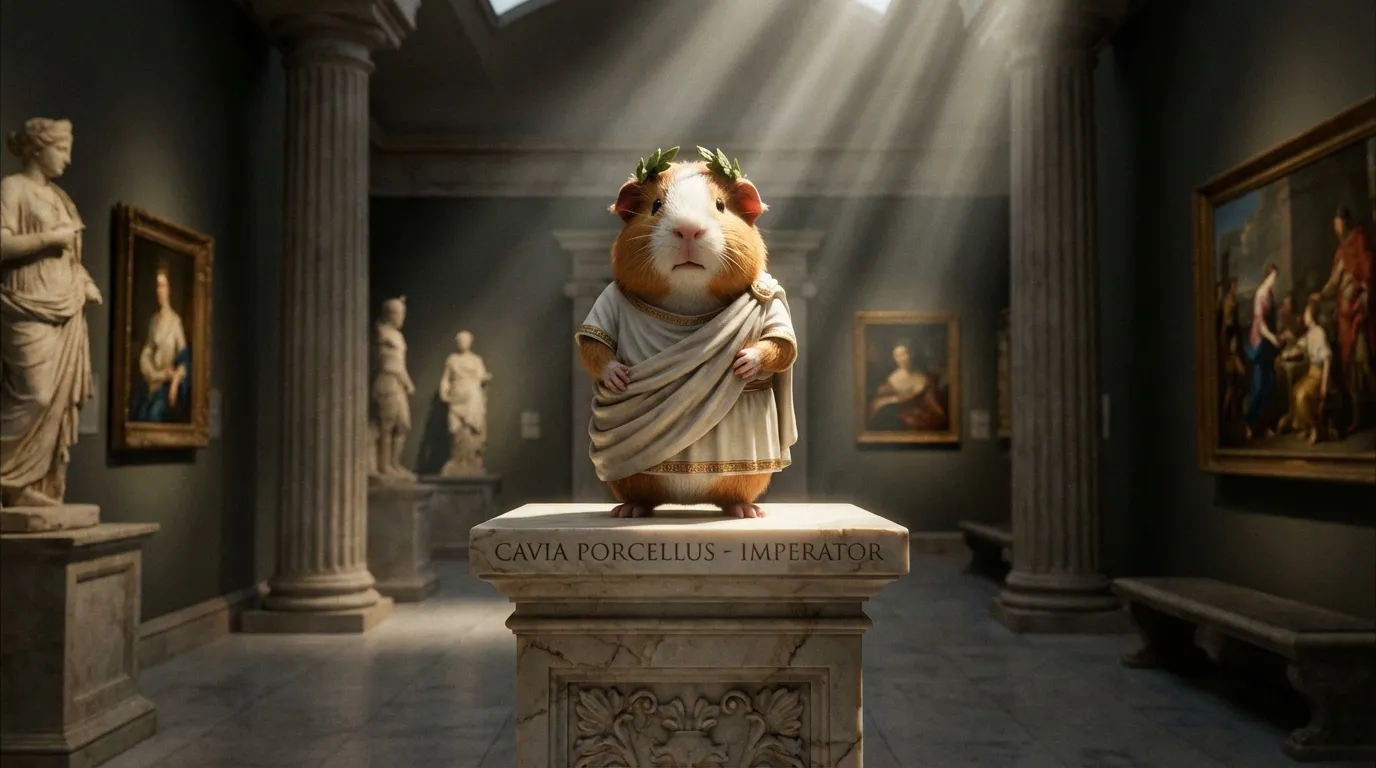
Creating a "bust" or a high-quality artistic tribute for a guinea pig isn't silly. It is a ritual act of defiance against the idea that these lives are disposable. It is a way to say, "This soul mattered."
1. The Moche Wisdom: Guinea Pigs as Spiritual Conduits
If you feel foolish for wanting to immortalize your guinea pig in art, look to the Andes. Long before the concept of a "pet store" existed, the Moche culture (flourishing from 100 to 700 AD in Peru) understood the guinea pig—or cuy—as a being of immense significance.
While often a food source, the cuy also held a liminal space between the worlds. In traditional Andean medicine (Curanderismo), which survives to this day, guinea pigs are viewed as diagnostic tools for the soul. It is believed that these animals have a unique energetic porosity; they can absorb the "susto" (fright) or negative energy from a human.
The Counterintuitive Insight:
Your guinea pig wasn't just eating hay; they were likely functioning as an energetic sponge for your household. Did you ever notice how holding them during a panic attack or a moment of deep sadness seemed to ground you instantly? That wasn't just fur texture; that was a spiritual service.
The Moche created intricate ceramic vessels depicting guinea pigs. These weren't discarded toys; they were art. By creating a likeness of the animal, they honored its role in the cycle of life and death. When you commission a bust or a figurine today, you are tapping into this ancient lineage. You are acknowledging that this creature was a healer in your home, a small shaman in a fur coat who absorbed your stress and gave back only gentle squeaks of affection.
2. The Dutch Golden Age: The Dignity of Minute Detail
Fast forward to the 17th century. The Dutch Golden Age painters were obsessed with the sanctity of the everyday. They believed that God was in the details—the peel of a lemon, the sheen of a silk dress, and yes, the fur of a small animal.
Painters like Gerrit Dou or Henriëtte Ronner-Knip didn't just paint kings. They painted the intimate, quiet moments of domestic life where animals were central. In these works, a small animal isn't a prop; it is a subject worthy of the same lighting and composition as a duke.
Why this matters for your memorial:
We often take photos of our guinea pigs on our phones—blurry, bad lighting, usually from above. But a true artistic rendering, like a 3D-printed sculpture, changes the perspective. It captures the dignity of the animal.
"Art doesn't just copy what we see; it clarifies what we felt."
When we look at a guinea pig, we see the twitch of the nose, the specific rosette pattern of their fur, the intelligence in their dark eyes. A bust freezes that dignity. It elevates the animal from "cute" to "sovereign." It reminds anyone who enters your home that this being had a personality, a preference, and a presence that commanded respect.
Visualizing the Shift in Perspective
| Memorial Type | Emotional Impact | Spiritual Function |
|---|---|---|
| Phone Photo | fleeting, digital, often lost in the cloud | documentation of a moment |
| Generic Garden Stone | impersonal, weathered, distant | marks a location, but not a personality |
| Custom 3D Figurine | tangible, precise, permanent | anchors the spirit in the physical realm |
3. Victorian Mourning: The Need to Hold
The Victorians are often mocked for their morbidity, but they understood something we have forgotten: Grief is tactile.
When a loved one died in the 19th century, the bereaved didn't just want a memory; they wanted something to touch. They made jewelry from hair; they cast death masks; they even used taxidermy to preserve beloved pets. While taxidermy can feel macabre to the modern sensibility, the intention behind it was pure: the need to maintain a physical presence in the room.
The "Phantom Weight" Phenomenon:
After a guinea pig passes, the most painful sensation is often the "lightness" of your hands. You are used to the specific weight of them. You are used to the texture of their fur against your neck.
A digital photo cannot solve the problem of empty hands.
This is where modern technology bridges the gap between Victorian sentiment and current aesthetics. We no longer need to resort to taxidermy. We can use advanced imaging and crafting to create a totem that feels substantial.
At PawSculpt, we have seen this repeatedly. The moment a pet parent unboxes a figurine, they don't just look at it—they touch it. They run a finger over the ears. They hold the weight of it. It is a grounding ritual. It satisfies the primal, biological need to care for the physical form of the one we loved.
The Modern Totem: How Technology Captures Spirit
If we accept that a guinea pig deserves a bust—for historical, spiritual, and emotional reasons—the question becomes how.
In the past, you would need to hire a sculptor to sit with your pet for hours, creating a clay model. Today, the process is an alchemy of digital artistry and engineering. But it is crucial to understand the medium.
Understanding the Medium:
Many people assume custom figurines are hand-painted, subject to the shaky hand of an artist who might get the eye color wrong. But the technology we utilize at PawSculpt is different. We use full-color 3D printing.
This means the color isn't a layer of paint sitting on top of plastic; the color is built into the resin itself, voxel by voxel (a voxel is a 3D pixel). This allows for the recreation of complex fur patterns—agouti coloring, roan blends, the specific gradient of a nose—that a paintbrush simply cannot replicate with the same fidelity.
"We've seen families heal by holding something tangible. Grief needs an anchor, especially when the life lost was so small."
— The PawSculpt Team
The result is a piece that isn't just a "likeness"—it's a presence. It captures the light in the eyes, which is often where owners feel the "soul" resides.
Overcoming the "Just a Rodent" Stigma
Let's address the elephant in the room—or rather, the guinea pig. You may be hesitating to commission a piece of art because you fear judgment. You fear a friend coming over, seeing a beautiful bust on your mantle, and saying, "Is that... your dead hamster?"
Here is the spiritual truth:
The judgment of others is a reflection of their own disconnection from the web of life.
Those who judge the grief over a small animal are often those who measure value by utility or lifespan. They are operating on a transactional level. You are operating on a relational level.
When you display a bust of your guinea pig, you are curating your space to reflect your values. You are declaring that your home is a place where innocence is honored. You are creating a sacred space.
Signs You Need a Physical Tribute
How do you know if a figurine is the right step for your healing journey?
- The "Shrine" Impulse: You haven't moved their cage, or you've kept their favorite hidey-house on a shelf. You are already creating a shrine; a figurine gives it a focal point.
- Fear of Forgetting: You panic that you are forgetting the exact pattern of their fur or the way their ears looked.
- The Need to Talk: You find yourself talking to the empty air where they used to be. A figurine gives you a "who" to direct that energy toward.
- Complicated Grief: If your pet died suddenly or if you had to make a difficult euthanasia decision, the guilt can be overwhelming. A tribute is an act of atonement and love.
Creating the Ritual
Once you have the figurine, do not just place it on a shelf and forget it. Integrate it into your life. This is how the object becomes a "vessel" in the spiritual sense.
- The Morning Greeting: Touch the figurine when you wake up. Acknowledge the bond.
- The Seasonal Shift: Place fresh flowers or seasonal vegetables (that they would have loved) near the bust.
- The Storytelling: When new people come into your life, use the bust to tell them about the friend you once had. "This was Barnaby. He loved parsley and hated loud noises."
By keeping their name and their image in circulation, you grant them a form of immortality. You elevate them from "small pet" to "ancestral spirit."
Frequently Asked Questions
Is it normal to grieve a guinea pig as much as a dog?
Absolutely. Grief is measured by the depth of attachment, not the species. Small animals often rely on us entirely, creating a profound bond of trust. Because their lives are contained entirely within our care, the sense of responsibility—and the subsequent loss—can be incredibly intense.How do I get a custom figurine if I don't have perfect photos?
We know that guinea pigs rarely sit still for portraits. Our digital artists are skilled at reconstructing details. We can work with multiple imperfect photos—a video clip, a blurry side profile, a top-down view—to build a cohesive 3D model. We use your descriptions to fill in the gaps that the camera missed.What is the difference between hand-painted and full-color 3D printing?
Hand-painted figures rely on brushwork, which can sometimes look "crafty" or obscure the fine texture of fur. Full-color 3D printing embeds the color into the resin itself. This allows for hyper-realistic fur patterns, soft gradients, and complex markings (like brindle or roan) that are nearly impossible to achieve with a brush.Can I include my guinea pig's favorite toy in the figurine?
Yes. Because the sculpting is done digitally before printing, we can incorporate accessories, favorite vegetables, or specific poses. If your piggie always slept with their chin on a specific wooden block, we can include that to make the tribute authentic to their life.Ready to Celebrate Your Pet?
Every pet has a story worth preserving, regardless of how small their footprint was. Whether you're honoring a beloved companion who's crossed the rainbow bridge or celebrating your furry friend's unique personality, a custom PawSculpt figurine captures those details that make your pet one-of-a-kind.
Free instant AI preview • 3D artist preview within 7 days • 5 free revisions