
How We Scale a Great Dane Into a Figurine Without Losing a Single True Detail
Her paws hit the wet sand first, then the rest of her came barreling in—all hundred and forty pounds of Great Dane—and you stood there laughing, phone raised, already wondering if a moment that big could ever become a Great Dane figurine small enough to sit on your desk.
Quick Takeaways
- Giant breeds are harder to shrink than small ones — their scale is the personality, and that's easy to lose.
- Photos beat memory every time — 8 to 12 angles in flat light tell us more than one perfect portrait.
- We don't shrink everything equally — certain details get protected while others soften, on purpose.
- Color lives inside the resin, not on top — our full-color 3D printing process prints markings voxel by voxel, no brushes involved.
Why a Great Dane Won't Behave Like Any Other Dog We Scale
Here's something most figurine guides skip entirely: the breed that's hardest to miniaturize isn't the fluffy one with a thousand hairs. It's the giant.
A customer once sent us a video of her Dane, Magnus, walking across a hardwood floor. You could hear it before you saw it—that slow, heavy click of nails, the pause, the deep sigh as he folded himself onto a bed clearly built for a Labrador. That sound is the dog. And sound doesn't scale into resin. So we have to find another way to carry the weight of him.
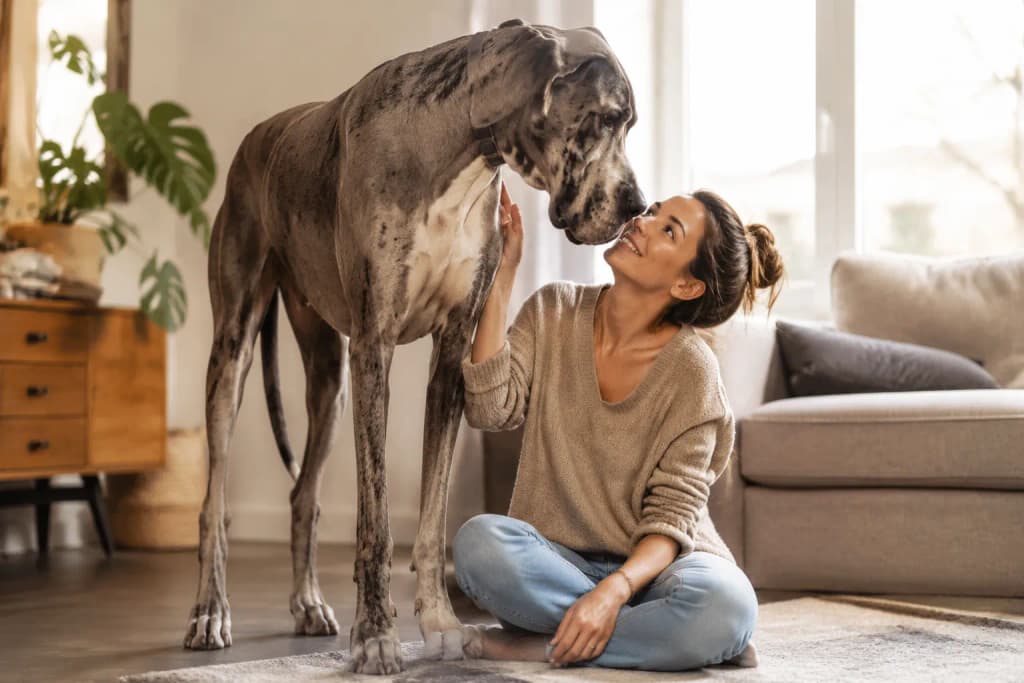
When you scale a Great Dane down to a six-inch model, you're fighting a problem of perception. Our brains store a reference for "massive." We know what a Dane feels like standing next to us, hip-high, leaning in with that whole-body trust they have. Shrink that down naively—just press the "reduce 80%" button—and the figurine reads as a generic large dog. The mass evaporates.
"A Great Dane isn't big. He's a presence. Our job is to print the presence, not just the proportions."
— The PawSculpt Team
So the real work of large breed scaling starts before any software opens. It starts with deciding what makes this specific dog feel like this specific dog, and protecting those things ruthlessly while letting less important details relax.
The proportions that lie to you
Great Danes have deceptive anatomy. According to the American Kennel Club breed standard, they're built for a balance of elegance and strength—a long, clean neck, a deep chest, and surprisingly fine bone for their size. People think Danes look bulky. They don't. They look tall and squared-off, almost architectural.
The mistake an inexperienced sculptor makes is adding bulk to communicate size. Wrong instinct. A Dane's size comes from height and the length of the leg, the depth of the brisket (the chest between the front legs), and the way the head sits high and proud. Beef up the body and you've made a Mastiff.
We've learned to chase the silhouette first. If the outline of the figurine reads as Dane from across the room, the rest can follow.
From Beach Photos to a Digital Sculpt
Let's get practical, because this is where you actually have control.
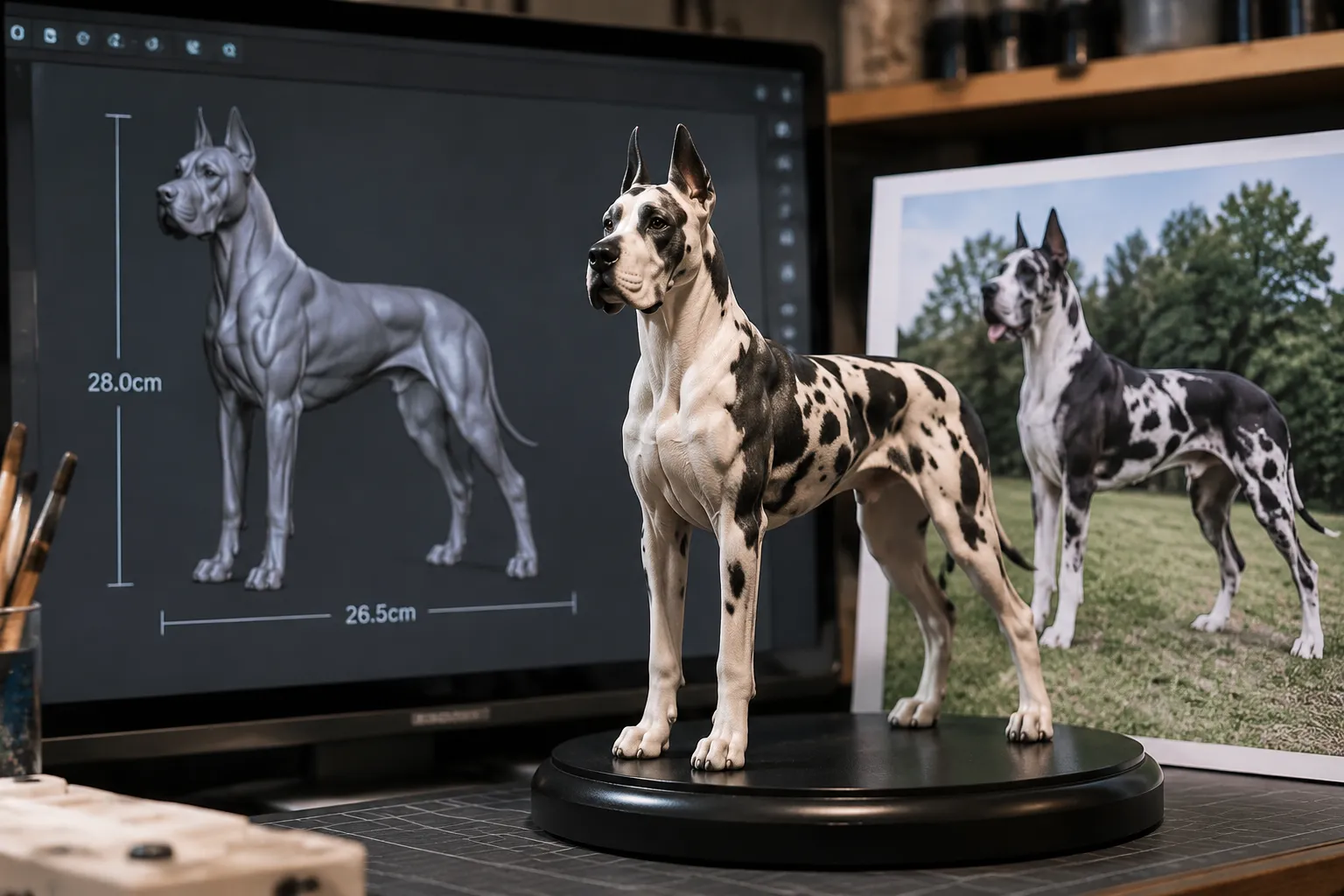
Everything we build starts as a digital sculpt—a 3D model our artists hand-model in software like ZBrush and Blender. Think of it as clay that lives on a screen. We push, pull, and refine the form digitally, then that model gets sent to a printer. Nobody carves anything physical. The skill is in the digital sculpting and in the reference work that feeds it.
And the reference work depends entirely on you.
What photos actually help us
The single best thing you can do for 3d sculpt detail accuracy is send more angles than you think we need. One gorgeous, soft-focus portrait is lovely for your wall and nearly useless for us. We're not copying a photo. We're rebuilding a three-dimensional animal, and we need to understand the form from all sides.
Here's what works, and why each angle earns its place.
| Angle / Shot | Why We Need It | Quick Tip |
|---|---|---|
| Direct side profile | Defines the silhouette and topline | Get level with the dog, not above |
| Straight-on front | Captures chest width and head shape | Watch for lens distortion up close |
| 45° three-quarter | Shows how planes of the face connect | The most useful single angle |
| Top-down head | Reveals skull width and ear set | Stand over a sitting dog |
| Close-up of markings | Locks in color boundaries and patches | Flat, even light—no harsh sun |
| Full body standing | Establishes leg length and stance | Side-on, all four legs visible |
The beach, honestly, is a tricky place to shoot reference. That bright open light throws hard shadows that hide the very contours we're trying to read. Flat, overcast light is a sculptor's best friend—it shows form without drama. So that golden-hour shot with the sun blazing behind your dog? Beautiful memory, hard reference. Send it anyway, but pair it with something shot in the shade.
"The photo you love most is rarely the photo we need most. Send both. We'll thank you."
The proportional check that catches everything
Before we commit to a sculpt, we run what we call a proportional check. We lay reference photos side by side and measure relationships—head length against neck length, leg height against body depth, the distance between the eyes. Dogs of the same breed vary wildly, and these ratios are how we capture your dog instead of a textbook Dane.
This matters more for Great Danes than almost any breed. Why? Because their long, fine lines mean a small proportional error gets amplified. Make the neck five percent too thick and suddenly your elegant Dane looks stocky. We're watching the numbers, but we're really watching the feeling.
The Scaling Math Nobody Talks About
Now the counterintuitive part. The part you won't find in the first five Google results.
You'd assume that scaling down means scaling everything down by the same amount. Reduce the whole dog to 12% of life size and you're done, right? That's exactly what produces a lifeless model.
Here's the thing: physical detail and perceived detail are not the same. When you shrink a Great Dane to figurine size, real-world features cross a threshold where they simply disappear. The fine wrinkle above a brindle Dane's eye might be half a millimeter at true scale. Shrink it to model size and it's smaller than the resin can resolve—and smaller than your eye can catch. Gone. And with it goes some of the soul.
So we cheat. Deliberately, knowingly, with the experience of having done this thousands of times.
Selective detail preservation
We protect the features your eye searches for and let the rest soften. On a Dane, the eyes get attention—they're expressive and they anchor recognition. The ear set and shape matter enormously (cropped or natural changes the whole read of the head). The jowl line, the slight loose skin under the throat, the brindle striping if he has it. These we hold onto, sometimes nudging them slightly larger than literal scale so they still register at six inches.
Meanwhile, individual hairs? A Dane's coat is short and tight, so we suggest its sheen and direction through subtle surface flow rather than carving strands that would just turn to mush at this size and print as noise. More detail is not more accuracy. Past a point, it's the opposite.
This is the single biggest misunderstanding people have about scaling a giant breed. They worry we'll lose detail. The real risk is that we'd keep too much of the wrong detail and bury the dog under it.
| Feature | Scaling Approach | Reasoning |
|---|---|---|
| Eyes & expression | Protect, slightly emphasize | Primary anchor for recognition |
| Ear set & shape | Hold true to reference | Defines the head's character |
| Brindle / patch markings | Preserve boundaries exactly | Color identity, prints directly in resin |
| Coat texture | Suggest, don't carve | Strands become noise at small scale |
| Fine facial wrinkles | Simplify into major folds | Sub-millimeter detail won't resolve |
| Stance & weight | Exaggerate ground contact | Communicates the dog's mass |
Where the weight goes
Remember Magnus and that floor-shaking presence? Here's how we put it back in. We exaggerate the contact with the ground—how the paws spread slightly, how the weight settles into a hip when he stands. We deepen the chest a touch. We keep the head high. These cues tell your brain heavy even though the figurine weighs ounces.
It's the same trick a good caricature artist uses, just dialed way down so you'd never call it a caricature. We're not distorting your dog. We're translating him into a smaller language so he still says the same thing.
Inside the Full-Color 3D Print
Once the sculpt is approved, the digital model goes to the printer. This is where a lot of people's mental picture is wrong, so let's clear it up.
PawSculpt uses full-color 3D printing—technology in the family of PolyJet and multi-jet processes where the color is laid down as the model builds, voxel by voxel. A voxel is just a 3D pixel, the smallest unit of the print. Your dog's brindle, his white chest blaze, the warm fawn of his coat—all of that is printed directly into the resin material itself. The color isn't a coat on the surface. It's baked into the structure.
That means no hand-painting. No brushes. No acrylics drying overnight. The machine reads our digital model—which carries both shape and color information—and produces a fully colored object in one build. It's a genuinely different craft from the painted-miniature world, and in our opinion it's a better fit for capturing a real animal's coat, because the color follows the form exactly instead of being applied over it.
Orientation and why it matters
Before printing, we decide how to orient the model on the build platform—which way is "up" as it prints in layers. This is one of those shop-floor decisions that separates a clean result from a flawed one.
Every 3D print needs supports—temporary scaffolding that holds up overhanging parts while they cure, since you can't print a Dane's outstretched leg into thin air. Wherever a support touches the model, it can leave a tiny mark when removed (we call these support scars or pitting). So we orient the model to push supports toward hidden areas—the underside of the belly, the inside of the legs—and away from the face and other surfaces your eye lands on first.
For a tall, leggy breed like a Dane, orientation is a real puzzle. Those long legs are fragile during the build and prone to small shifts. We often tilt the model at an angle rather than printing it bolt upright, balancing support contact against the strength of delicate parts. There's always a tradeoff. More supports mean more cleanup marks but safer geometry. Fewer supports risk warping or a failed leg.
Layer height, hollowing, and the little drain hole
A few process details a true practitioner would mention:
- Layer height is the thickness of each printed slice, often in the 25 to 50 micron range (a micron is a thousandth of a millimeter) for detail work like this. Thinner layers mean smoother surfaces and finer detail, but slower prints. We pick a height that resolves the features we chose to protect.
- Hollowing the model saves material and reduces internal stress that can cause warping—where a part subtly twists or pulls as it cures. A solid chunk of resin is more likely to deform than a smart hollow shell.
- When we hollow, we add a small, discreet drain hole so uncured liquid resin can escape from inside. Trapped resin can later leak, cure unevenly, or cause a slow bulge. That tiny hole, usually tucked under the base, is the mark of someone who's been burned before.
This is the heart of the custom dog model process—dozens of small, deliberate choices that you'll never see, all aimed at one thing: a figurine that holds up and looks right.
Post-Processing: Where a Print Becomes a Keepsake
A model coming off the printer isn't finished. It's raw. And how it's handled here decides whether you get a treasure or a letdown.
The steps, in order
- Washing removes any residual uncured resin from the surface. Skip or rush this and you get a tacky finish or a hazy film called bloom.
- Curing uses UV light to fully harden the photopolymer resin (a light-sensitive plastic). This is a Goldilocks step—under-cure and the model stays soft and weak, over-cure and it can grow brittle and prone to cracking. Experience is knowing exactly when to stop.
- Support removal is delicate work, especially around a Dane's thin legs. We remove the scaffolding carefully and gently sand any contact points smooth.
- Clear coat application is the only manual finishing step. We apply a protective clear varnish that seals the surface, adds a natural sheen, and shields the embedded color from UV fading over time.
That clear coat is worth dwelling on, because people assume the "finish" is where we'd paint. We don't. The color was already there, printed into the resin. The clear coat simply protects what the printer produced and gives it that soft, lifelike luster—not a glassy plastic shine, but something closer to a healthy coat.
"We don't paint the dog. We print the dog, then protect him. The color was always part of him."
Quality control under raking light
Our last check is one of the oldest tricks in the trade. We hold the finished figurine under raking light—a light source angled low across the surface, almost parallel to it. This throws every tiny imperfection into sharp shadow: a leftover support pit, an uneven spot, a surface ripple. Under flat light these hide. Under raking light they confess.
We also run dimensional and symmetry checks. Are the eyes level? Does the left side match the right where it should? Is the stance balanced so the figurine sits flat without rocking? For a tall model, balance is non-negotiable—a Dane figurine that tips over isn't a keepsake, it's a frustration.
| Stage | What Happens | Why It Matters to You |
|---|---|---|
| Digital sculpt | Artist models your dog in 3D | This is where likeness is born |
| Proportional review | Ratios checked against your photos | Captures your dog, not a generic Dane |
| Full-color print | Color printed into resin, layer by layer | Markings reproduced without paint |
| Support removal & sanding | Scaffolding cleaned off, points smoothed | Determines surface cleanliness |
| Clear coat | Protective varnish applied by hand | Seals color, adds lifelike sheen |
| QC under raking light | Final inspection for flaws & balance | Catches what normal light hides |
We won't pretend every print is perfect on the first pass. Sometimes a leg shifts, a support scar lands somewhere stubborn, or the curing isn't quite right. When that happens, we reprint. That's the honest reality of additive manufacturing—it rewards patience and punishes shortcuts.
A Counter-Point: When a Figurine Isn't the Right Call
We'd be doing you a disservice if we only sold you on this.
A figurine is a wonderful way to hold onto a dog. But it isn't the only way, and for some people it isn't the best way. If what you miss most about your Dane is that sound—the nails on the floor, the groan as he lay down, the snore that filled a whole room—then a silent object on a shelf might not scratch that itch. A video compilation with sound might serve you better. Some families find more comfort in a memorial garden, a photo book, or a paw-print casting that carries actual physical contact with their dog.
And here's an honest limitation of scaling a giant breed specifically: a six-inch model can never convey true size. You'll always know, holding it, that the real Magnus was thirty times this. For some people that gap is poignant and beautiful. For others it's a small ache. Only you know which you are.
We've also had customers tell us they weren't ready. They ordered too soon after a loss, and the figurine arrived while the grief was still raw, and it was hard. There's no rule that says you must memorialize right away. Grief has its own clock. If you're feeling pressure, that pressure isn't coming from us.
What a figurine does beautifully—what almost nothing else does—is give you something to hold. Something three-dimensional you can pick up, turn over, set where you'll see it every morning. For a lot of pet parents, that physical presence is exactly the anchor they needed. If that's you, wonderful. If it's not, that's wonderful too.
What to Expect When You Order
We won't quote you exact timelines or prices here, because those shift and we'd rather you get current details straight from the source. You can find the specifics, including how revisions and guarantees work, over on our custom pet figurine service page.
What we can describe is the rhythm of it. You send photos. Our artists build the digital sculpt and share a preview. You look it over—does the head feel right, are the markings placed correctly, does it look like your dog? This is your moment to speak up. Adjustments at the digital stage are easy; we're still working in that on-screen clay. Once you approve, the model goes to print, through post-processing, and into your hands.
A few things that genuinely help the process go smoothly:
- Send photos from the same life stage. Mixing puppy and senior shots confuses the likeness.
- Tell us what you love about him. The way he tilts his head, the spot where his fur whorls. We sculpt with that.
- Mention ears clearly. Cropped or natural matters enormously on a Dane and isn't always obvious from photos.
- Be honest at preview. "Almost, but his eyes were kinder" is the most useful feedback there is.
If you've got questions before you start, the PawSculpt FAQ covers most of them, and you can always reach our team directly.
Caring for Your Finished Figurine
Resin is durable but not invincible. A little care keeps your figurine looking right for years.
- Keep it out of direct, prolonged sunlight. The clear coat resists UV, but no material is immune to years of harsh sun. A bright shelf is fine; a south-facing windowsill in full glare, less so.
- Dust with a soft, dry brush or microfiber cloth. For a tall Dane model, support the legs while you clean—don't push sideways on them.
- Avoid harsh chemical cleaners. They can dull or cloud the clear coat. A barely-damp cloth handles anything stubborn.
- Give it a stable spot. Tall figurines have a higher center of gravity. A shelf where it won't get knocked is worth choosing deliberately.
None of this is demanding. Treat it roughly like you'd treat a nice framed photo, and it'll outlast the shelf it sits on.
Frequently Asked Questions
How do you keep a Great Dane figurine accurate when you scale it down so much?
We don't scale every feature by the same amount. The features your eye uses to recognize your dog—eyes, ear set, markings, expression—get protected and sometimes slightly emphasized, while fine details that would turn to noise at small size get softened. We also exaggerate stance and ground contact to communicate the dog's mass, since a six-inch model can't show real size on its own.
What photos give you the best chance of a great likeness?
More angles than you'd expect. We ask for 8 to 12 shots: a level side profile, a straight-on front, a couple of 45-degree three-quarter views, a top-down look at the head, a full-body standing shot, and close-ups of any markings. Flat or overcast light is ideal because it reveals contour without harsh shadows hiding the form.
Are the figurines hand-painted?
No, and this surprises a lot of people. We use full-color 3D printing, where the color is printed directly into the resin as the model builds, voxel by voxel. There are no brushes or acrylics involved. The only manual finishing step is applying a clear protective coat that seals the color and gives a natural, lifelike sheen.
Why is a Great Dane harder to capture than a small breed?
Because a Dane's whole identity is its scale and presence, and presence doesn't shrink. Naive scaling produces a model that reads as any old large dog. The skill is in deliberately preserving the cues—long elegant lines, high proud head, deep chest, weighted stance—that tell your brain "this is a giant" even at figurine size.
How long does the whole process take, and can I make changes?
Timelines vary, so check our website for current turnaround. The rhythm, though, is consistent: you send photos, we build a digital sculpt and share a preview, and you give feedback before anything prints. Changes are easiest at that digital stage, so speak up freely. Once you approve, it goes to print and post-processing.
Will the colors fade over time?
The color is embedded in the resin rather than sitting on the surface, and we finish each piece with a UV-resistant clear coat, so fading is well guarded against. Keep it out of prolonged direct sunlight and it should hold its color for many years.
Ready to Celebrate Your Pet?
Every pet has a story worth preserving. Whether you're honoring a gentle giant who's crossed the rainbow bridge or celebrating the goofy, floor-shaking presence of the Dane currently leaning his whole weight against your leg, a custom Great Dane figurine from PawSculpt captures the details that make him unmistakably yours—from his ear set to the exact placement of his markings, printed in full color right into the resin.
Visit pawsculpt.com to learn more about our process, preview turnaround, revisions, and quality guarantee.