How to Photograph a Wiggly Pug for a Resin Sculpt That Captures Every Wrinkle
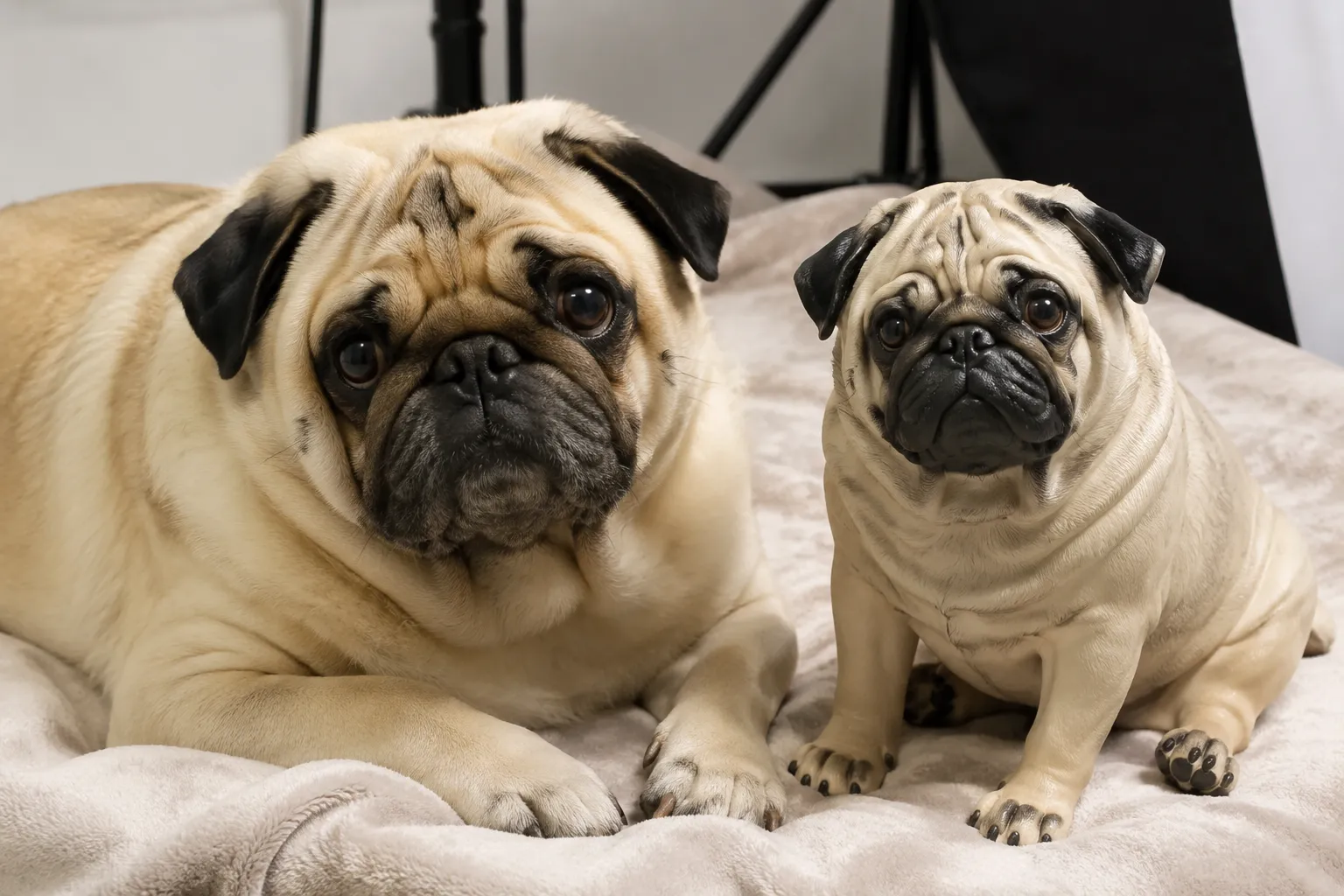
Golden hour on the trail, and there he is—a fawn pug frozen mid-trot, one paw lifted, the low sun catching every fold above his brow. You raise your phone to photograph your pug for a figurine, and he turns his head. Blurred again.
Quick Takeaways
- Shadow is your friend, not your enemy — side lighting reveals the wrinkle depth a sculptor actually needs.
- Shoot at pug eye level — a low angle shows the true topology of that flat, folded face.
- Capture 8–12 angles, not one perfect portrait — sculptors build in 3D and need every side.
- A wiggly pug calls for burst mode and bribery — treats held above the lens buy you two clean seconds.
- Great reference photos become a lasting keepsake when paired with the right custom pet figurines made from full-color 3D printing.
The Pug Face Is a Landscape, and You're the Cartographer
Here's the thing most photo guides get wrong. They treat a pug like any other dog—get a cute shot, make sure it's in focus, done. But a pug isn't just a dog with a smushed face. A pug is a topographical map. Every wrinkle is a ridge, every fold a valley, and the shadow that pools in the crease above his nose is doing more storytelling than his eyes.
We've worked with thousands of pet families, and pugs come up in a conversation we have almost weekly. Owners send in a beautiful, sunlit portrait—the kind that gets likes—and our sculptors gently ask for more. Because a flattering photo and a useful photo are rarely the same thing.
When you're photographing a pug for a figurine, you're not making art. You're gathering data. You're the cartographer, and those wrinkles are the terrain you need to record before the light shifts.
"Every wrinkle is a sentence in a life story. Our job is to make sure none of them get lost in translation."
— The PawSculpt Team
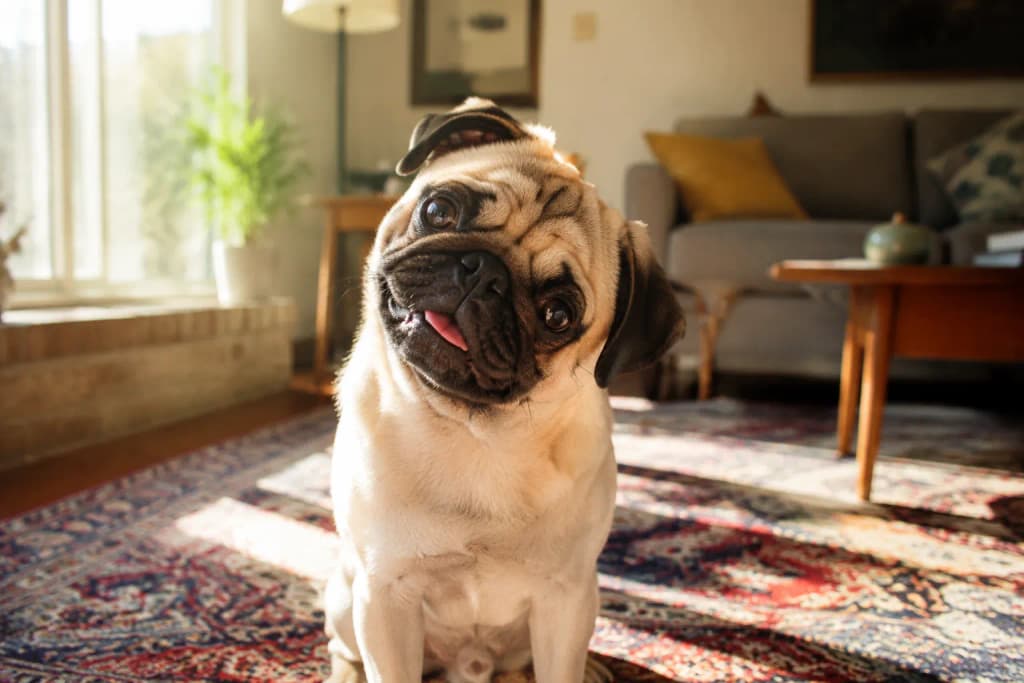
Brachycephalic breeds—that's the technical word for the flat-faced dogs like pugs, French bulldogs, and Boston terriers—present a specific challenge. Their features are compressed into a small vertical plane. The muzzle that would give a Labrador clear front-to-back depth just isn't there. So the information a sculptor uses to build a three-dimensional face has to come from somewhere else: the folds, the shadows, and the way light rakes across the skin.
And that changes everything about how you should shoot them.
Why the "cute" photo fails the sculptor
Think about the last adorable pug photo you saw. Soft, even light. The dog looking straight at the camera. Big glossy eyes. It melts your heart.
Now imagine handing that to someone whose job is to rebuild that face in three dimensions. They can see the front. They cannot see how far the nose projects. They can't tell if that brow fold wraps around the side of the head or stops short. The even lighting that made the photo pretty has erased the shadows—and the shadows were the depth map.
This is the counterintuitive truth at the heart of pug photography: the flattering photo and the accurate photo pull in opposite directions. Flat light flatters. Directional light informs. You want the informative one.
Reading Wrinkles Like a Sculptor Reads Them
Before you lift the camera, it helps to understand what a digital sculptor is actually looking at when your photos land on their screen.
At PawSculpt, the process starts with an artist hand-modeling your pet in 3D software—programs like ZBrush and Blender, the same tools used for film and game characters. They're not tracing your photo. They're building a virtual clay form, pushing and pulling digital surfaces until the geometry matches the animal in your images. Then that finished digital model gets precision 3D printed in full color, with the pigment baked directly into the resin during printing. No brushes touch it. The color is the material.
But all of that depends on one thing: whether the reference photos gave the sculptor enough to read the face correctly.
The three wrinkle families every pug has
When our team studies a pug, we're mentally sorting the folds into groups, because each behaves differently under light and each needs its own reference angle.
- The nose rope and brow folds — the signature horizontal creases above the muzzle. These read best with light coming from the side, so the crease casts a thin line of shadow.
- The cheek and jowl folds — softer, looser skin that shifts with expression. You need a three-quarter angle to see how they drape.
- The ear-set and neck folds — often forgotten, but they define the silhouette. A profile shot captures these better than any front-on portrait.
So what? Because if you only shoot straight-on, you hand the sculptor two of three families and leave them guessing on the rest. And a pug reconstructed from guesses looks like a pug, not your pug.
"A pug photographed only from the front is half a story. The face lives in the folds you can't see head-on."
Light Is the Whole Game
We promised we'd lean into this, and we mean it. Light is not a setting you flip on. For a wrinkled face, light is the difference between a sculpt that captures your dog and one that captures a generic tan blob with a curly tail.
Picture two versions of the same pug. In the first, harsh noon sun hits him from directly overhead. The wrinkles vanish into flat washes of light, and dark pits swallow his eyes. In the second, he's turned so soft late-afternoon light rakes across his face from the side—now every fold throws a delicate shadow, the brow creases stand up in relief, and you can actually read the surface.
Same dog. Same phone. Completely different amount of usable information.
The raking light trick (borrowed from our own quality control)
Here's an insider move. On our shop floor, when we inspect a finished figurine for surface flaws, we use raking light—a light source held at a low, shallow angle so it skims across the surface. It exaggerates every bump and dip. Any imperfection throws a shadow and reveals itself instantly.
You can use the exact same principle to photograph a pug's wrinkles.
Position your light source—a window works beautifully—so it comes from the side rather than the front. The low, glancing light will make the folds pop into three dimensions. What you're doing is turning your dog's face into a landscape at sunset, where every ridge casts a long shadow. That's the depth data a sculptor craves.
The best natural light for a fawn versus a black pug
Coat color changes the equation, and this trips people up.
A fawn pug has a light coat with a dark mask. In bright light, the pale body can blow out to featureless white while the black face detail survives. So slightly underexpose—let the body go a touch darker—to protect the mask and wrinkle detail.
A black pug is the opposite problem. Dark coats eat light and turn into a shadow with two eyes floating in it. Black pugs need more light, and often benefit from a second soft source (even a white wall bouncing sunlight back) to lift the shadows enough that the fur's subtle sheen and the fold geometry become visible.
Here's a quick reference we put together for the most common situations.
| Lighting Setup | Best For | What It Reveals | Watch Out For |
|---|---|---|---|
| Side window light (soft) | All pugs, wrinkle depth | Fold shadows, true topology | Turn dog so light rakes the face |
| Overcast daylight outdoors | Black pugs | Even sheen, no harsh pits | Can flatten fine creases—add an angle |
| Golden hour on a trail | Fawn pugs | Warm mask detail, silhouette | Fading fast; shoot in bursts |
| Direct noon sun | Almost nothing | Flat washes, black eye pits | Avoid for reference photos |
| Indoor with white-wall bounce | Black pugs, low light | Lifted shadows, visible geometry | Keep phone flash OFF |
Kill the flash. We can't say this loudly enough. Your phone's flash comes from right beside the lens, which is the single worst direction for showing depth. It flattens the face and creates the dreaded green-eye or red-eye reflection. Flash is the enemy of the wrinkle.
Angles: Solving the Brachycephalic Depth Problem
Now to the part almost every owner underthinks. Angles.
A sculptor building in 3D is essentially trying to wrap a surface all the way around your dog's head. Imagine you're going to shrink-wrap the face in your mind. To do that, you need to have seen every part of the surface, from enough directions that there are no blind spots.
For a normal-muzzled dog, a front, both profiles, and a three-quarter often does it. For a brachycephalic face, you need more, because the compressed geometry hides so much. Those brow folds might tuck under and around in ways that a three-quarter view completely conceals.
The angle checklist we wish everyone followed
Shoot these, and shoot them at your pug's eye level—not from up above, which foreshortens the face and lies about proportions.
- Straight front, camera level with the eyes, whole face in frame.
- Left profile and right profile, showing the ear set and nose projection.
- Left three-quarter and right three-quarter (halfway between front and profile).
- From above at 45 degrees, looking down at the brow to map how the top folds sit.
- From slightly below, catching the jowls and underjaw.
- A clean full-body shot in a natural stance, for proportions and posture.
- Detail close-ups of the tail curl, ear shape, and any unique markings.
That's the difference between a figurine that resembles your pug and one that makes your mother-in-law gasp because it's clearly him.
The mistake most people make is sending five photos, all from the same head-on angle, taken across five different days. The lighting changes, the expression changes, and the sculptor ends up reconciling five slightly different dogs. Better to spend fifteen focused minutes capturing the full set in one consistent lighting session than to scrape together a random camera roll.
Here's a table of what actually earns its place in a reference set.
| Photo Type | Why Sculptors Need It | Common Mistake |
|---|---|---|
| Eye-level front | True facial proportions | Shooting down from standing height |
| Both profiles | Nose projection, ear placement | Only sending one side |
| Three-quarter views | How folds wrap around the head | Skipping these entirely |
| Full-body stance | Posture, leg proportion, tail | Cropping too tight |
| Markings close-up | Accurate color placement in print | Blurry or dim detail shots |
| Consistent lighting | One coherent subject to model | Mixing photos from different days |
Catching the Wiggle Without Losing Your Mind
Let's be real. Everything above assumes your pug will hold still, and pugs did not sign that contract.
A pug on a walking trail is a small engine of enthusiasm. He wants to sniff the fern, greet the retriever, roll in the questionable patch of grass. The instant you crouch with a phone, he decides your face is the most interesting thing in the county and charges it. Focus lost. Frame lost. Dignity lost.
This is where technique beats patience. Waiting for a wiggly dog to "calm down and pose" is a fool's errand. You work with the wiggle instead.
The practical wiggle-management toolkit
- Burst mode is non-negotiable. Hold the shutter and fire 15–20 frames in two seconds. Out of a burst, you'll almost always get one tack-sharp keeper. One good frame out of twenty is a great trade.
- Bribe at the lens. Hold a treat or a squeaky toy directly above your phone. The dog looks at the camera while you fire. His attention becomes your composition tool.
- Recruit a second human. One person handles treats and attention, the other shoots. Solo pug photography is a special kind of suffering.
- Shoot after exercise, not before. A pug who's had ten minutes of trail time is a pug who'll pause for a breather—which is your window. (Brachycephalic dogs overheat easily, so keep sessions short and skip hot midday air. The American Kennel Club has solid guidance on keeping flat-faced breeds cool and safe.)
- Get low and stay low. Kneel or lie down. When you're at his level, he's less likely to rush the camera because you're not looming.
One family we worked with described their pug as "a potato with opinions" and swore she'd never sit still. They ended up with the sharpest reference set we'd seen that month—all because dad held a slice of hot dog above the lens while mom fired bursts. Sixty photos, twelve keepers, one very good figurine.
So what? Because the sharpness of your reference photos directly limits how much wrinkle detail can be reconstructed. A blurry fold is a fold the sculptor has to invent. Burst mode isn't a nice-to-have. It's the single biggest quality lever a pug owner controls.
"You can't sculpt what the camera didn't catch. Sharp photos aren't vanity—they're the raw material of memory."
From Your Camera Roll to Full-Color Resin
This is the part we love explaining, because most people have no idea what happens after they hit "submit" on their photos. Understanding it also makes you a better photographer, since you'll finally see why we ask for what we ask for.
Step one: photo-to-sculpt
Your images go to a digital sculptor who studies them the way a portrait artist studies a face. They check proportions across your different angles—does the head width in the front shot agree with the depth in the profile? They trace the flow of the coat and the placement of every major fold. Then they build the form in 3D software, essentially digital clay they can push, pull, and refine from every direction.
This is where your multi-angle set pays off. The more sides they've seen, the less they have to guess. A pug is especially demanding here because those compressed features leave little room for error—get the brow-to-nose distance slightly wrong and it stops looking like your dog.
Step two: full-color 3D printing
Once the digital model is approved, it goes to print. PawSculpt uses full-color resin 3D printing—technology in the PolyJet/MJF family, where the machine builds the figurine layer by microscopic layer and prints the color directly into the resin as it goes. The pigment isn't a coating on the surface. It's embedded in the material itself, voxel by voxel (a voxel is just a 3D pixel—a tiny cube of colored material).
That's a genuinely different beast from older methods. There's no white model that gets colored later. There's no painting step at all. Your pug's fawn coat, black mask, pink tongue, and the exact placement of that little chest patch are all reproduced by the printer as part of the physical build.
Layer heights in resin printing typically land somewhere in the 25–50 micron range (a micron is a thousandth of a millimeter—finer than a human hair). That resolution is what lets the print hold fine surface detail like the edges of a fold. It's excellent, though it has its own character: fine layer grain, a slightly different texture than a smooth injection-molded toy. Authentic, not plastic-perfect.
Step three: post-processing and clear coat
Fresh off the printer, a resin part isn't finished. Here's the shop-floor reality:
- Washing removes uncured resin from the surface.
- Curing under UV light hardens the photopolymer to full strength. Under-cure and the part stays tacky and weak; over-cure and resin can grow brittle. There's a sweet spot, and hitting it is craft.
- Support removal takes off the little scaffolds that held delicate parts (like ears or a lifted paw) during printing. Where supports touched, there can be tiny marks—so orientation on the print bed is chosen carefully to hide those contact points in less visible areas.
- Light sanding smooths any support scars.
- Clear coat is the one and only manual finishing step. A protective varnish is applied to seal the surface, add durability, unify the sheen, and guard the color against UV fading over the years.
That clear coat is why a well-made piece can sit on a sunny shelf and still look right a decade later.
The tradeoffs a practitioner actually thinks about
Because you asked us to be honest, here are the real tensions in this work:
- Detail versus durability. Razor-thin features—a whisker, a wispy ear edge—print gorgeously but snap easily. Good makers thicken these slightly for a keepsake meant to be handled, not just displayed behind glass.
- Orientation versus support scars. How the model sits during printing decides where supports attach. Get it wrong and you leave pitting on the pug's face. Get it right and the marks hide under the belly.
- Hollowing versus strength. Larger figures are often hollowed with small drain holes so uncured resin can escape and the part cures evenly. Too thin a wall risks warping; too thick wastes material and can trap resin. It's a balance.
None of this is hand-carving or brushwork. It's additive manufacturing done with care—digital craftsmanship on the front end, precision printing in the middle, and a protective finish at the end.
Here's how the journey typically unfolds. (We're keeping timeframes general on purpose—for current specifics, check pawsculpt.com.)
| Stage | What Happens | What You Do |
|---|---|---|
| Photo review | Team checks your angles and detail | Send the full multi-angle set |
| Digital sculpting | Artist models your pug in 3D software | Answer questions on markings/personality |
| Preview & revisions | You see the digital model | Request adjustments to nail the likeness |
| Full-color printing | Model prints in pigmented resin | Nothing—the machine works |
| Post-processing | Wash, cure, support removal, clear coat | Wait for the finished piece |
Counter-Point: When You Should NOT Chase Perfect Photos
We've spent this whole article pushing you toward technical precision—raking light, twelve angles, burst mode. Now let us complicate our own advice, because intellectual honesty matters more than a tidy takeaway.
Sometimes the perfect reference session isn't possible. And sometimes chasing it is the wrong call entirely.
If your pug is a senior dog, or unwell, or you're commissioning a figurine as a memorial, do not put him through a stressful photo shoot for the sake of ideal angles. A good sculptor can work from imperfect photos. We do it all the time. The candid shot where he's mid-yawn on the couch, slightly soft focus but so him—that carries more truth than a technically flawless portrait of a dog who'd rather be napping.
There's a deeper thing here, too. A figurine isn't a scientific replica. It's a held memory. And memory was never high-resolution to begin with. What you remember about your pug isn't the exact millimeter of his nose rope. It's the way he flopped against your leg, the specific grumble he made settling into a chair, the tilt of his head when you said "walk."
So if you have to choose between a technically superior photo of a stiff, stressed dog and a slightly flawed photo bursting with his personality—choose personality. Every time. A skilled digital sculptor would rather have soul to work from than sharpness with no life in it.
The technical guidance in this article is the ideal. It's what to aim for when circumstances allow. But the goal was never perfect photos. The goal was capturing him. Don't let the pursuit of the first ruin your shot at the second.
What to Expect When You Turn Photos Into a Figurine
A few honest notes so nothing surprises you.
Color-matching is close, not clinical. Full-color 3D printing reproduces your pug's markings remarkably well, but screens, cameras, and lighting all shift color. If your fawn pug photographs slightly orange under warm trail light, tell us the coat runs more silver in person. Context helps the team calibrate.
Texture will look like a fine print, not glass. That subtle layer grain is inherent to the process and, honestly, part of the character. Under the clear coat it reads as a soft, natural surface—not the slick shine of a mass-produced plastic toy.
Previews exist so you can steer. The digital-model preview stage is your moment to say "his brow folds are deeper than that" or "the tail curls the other way." Use it. That's what it's for. For how the review and revision process works right now, the folks at pawsculpt.com lay it out clearly.
We're not vets. For anything about your pug's breathing, weight, or heat tolerance during outdoor photo sessions, talk to your veterinarian. Brachycephalic breeds have real health considerations, and a photo is never worth risking their wellbeing.
Caring for your finished figurine
Once your pug arrives in resin form, keeping him looking sharp is simple:
- Dust with a soft dry brush or microfiber cloth. Skip harsh chemical cleaners.
- Keep him out of direct, blazing sun long-term. The clear coat resists UV, but no material is truly immortal.
- Handle by the base or body, not by thin parts like ears or a raised paw.
- Avoid extreme heat—a hot car dashboard is a resin figure's worst enemy, since heat can soften and warp the material.
Treated kindly, a full-color resin piece holds its color and detail for many, many years. That's the whole point of a keepsake.
The Trail, Revisited
Go back to that moment on the trail. The golden light, the lifted paw, the blur.
The reason that shot felt impossible is the same reason it matters so much. Pugs don't hold still because they're too busy being alive—snuffling, wiggling, loving you with their whole ridiculous face. The wrinkles you're trying so hard to photograph are the map of every squint, every grin, every worried little frown he's ever made. A face like that is a record of a life being lived out loud.
So next time you're out there, kneel down into his world. Let the low sun rake across those folds. Fire off a burst while someone waves a treat above the lens. You're not just trying to photograph a pug for a figurine—you're trying to hold onto a specific, unrepeatable creature before time does what time does.
Get the shots while the light is good. Because the folds will deepen, the muzzle will gray, and one day these photos will be the closest thing you have to that exact dog on that exact trail. That's not sad. That's the reason to pick up the camera today.
Frequently Asked Questions
What photos work best for a custom pug figurine?
Aim for 8 to 12 shots taken at your pug's eye level. Include a straight-on front, both profiles, both three-quarter angles, a view down onto the brow, and a full-body stance. Add close-ups of the wrinkles, tail curl, and any special markings. Consistent side lighting across all of them gives the sculptor one coherent dog to model rather than several slightly different ones.
How do I photograph a pug's wrinkles so they show up clearly?
Light from the side, not the front. When light rakes across the face at a low angle, each fold throws a tiny shadow that defines its depth—this is the same raking-light trick we use for quality inspection. Overhead noon sun and phone flash do the opposite, flattening everything into featureless washes. Turn the flash off and turn your dog toward a window.
Why are brachycephalic breeds like pugs so hard to photograph?
Flat-faced dogs have their features compressed into a small vertical plane with almost no muzzle depth. A long-nosed dog gives the camera obvious front-to-back information, but a pug's three-dimensional shape lives almost entirely in its folds and the shadows between them. That's why lighting direction and multiple angles carry so much more weight for these breeds.
Does PawSculpt hand-paint the figurines?
No—there's no painting step at all. We use full-color 3D printing, where the color is embedded directly into the resin material as the piece is built, layer by layer. A digital artist sculpts your pet in 3D software first, then the model is precision printed in full color. The only manual finishing step is applying a protective clear coat.
Can you still make a good figurine if my photos aren't perfect?
Absolutely. Experienced digital sculptors can build a strong likeness from candid or slightly soft photos, and we especially understand this for senior pets and memorials. Personality and clear markings often matter more than studio-quality sharpness. Never stress an unwell or elderly pug for the sake of ideal angles.
How long does a custom pug figurine take?
Turnaround depends on the piece and current queue, and it moves through photo review, digital sculpting, a preview and revision stage, printing, and finishing. Since these timeframes change, the most accurate answer lives on our site—visit pawsculpt.com for current details.
Ready to Celebrate Your Pet?
Every pug has a face full of stories, and every fold deserves to be remembered. Whether you're honoring a companion who's crossed the rainbow bridge or celebrating the wrinkly goofball currently snoring at your feet, the right photos are the first step—and a custom PawSculpt figurine turns them into something you can hold. When you photograph a pug for a figurine the way we've described, full-color 3D printing can capture every crease and marking in vivid, lasting resin.
Visit pawsculpt.com to learn more about our full-color 3D printing process, preview and revision options, and quality guarantee.