
Matte vs. Satin Resin: Choosing the Right Finish for a Scottish Fold's Folded Ears
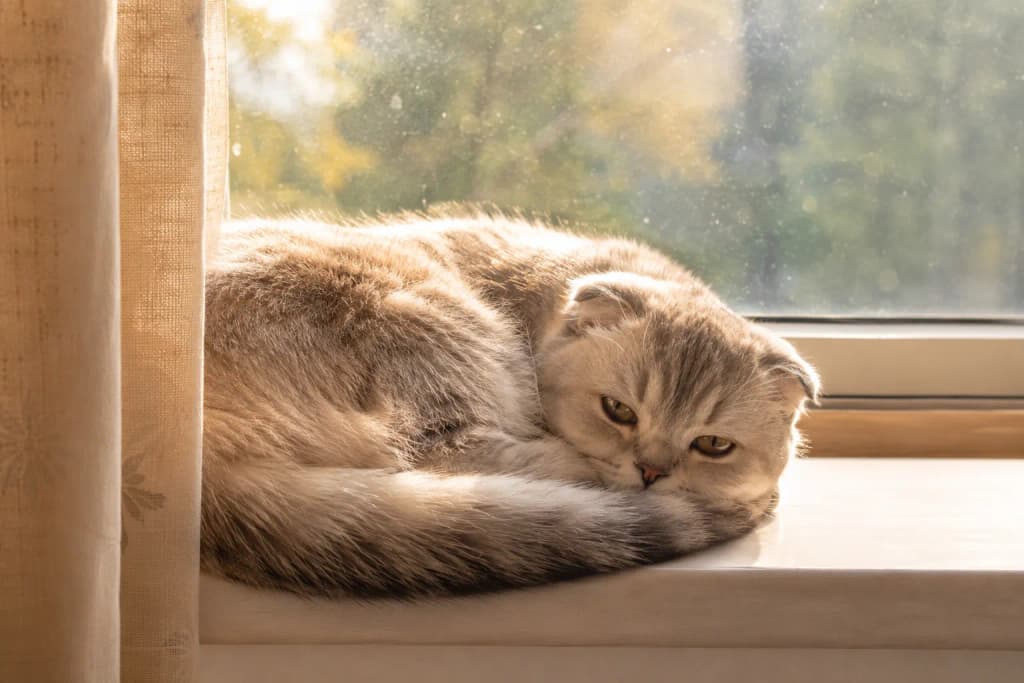
"Light is the first of painters." — Ralph Waldo Emerson
Down in our basement finishing room, every Scottish Fold figurine finish decision comes down to one stubborn question: how does light land on those folded ears? Get it wrong and the fold looks like a dent. Get it right and it reads soft, alive, exactly like the cat curled on your couch.
Quick Takeaways
- Matte vs satin isn't about the resin itself — it's the clear coat sheen we apply after full-color 3D printing.
- Folded ears are all about shadow — matte deepens the crease, satin can flatten it under harsh light.
- Dense plush coats read softer in matte — the low sheen mimics how fur actually scatters light.
- Skip the glossy trap — high gloss makes fur look wet, not fluffy, on almost every cat sculpt.
- Bring the right photos and the finish choice gets easy — see how the process works at custom pet figurines.
Here's What Nobody Tells You About Figurine Finish
Most guides treat the finish like an afterthought. A checkbox at the end. Pick a sheen, ship it, done.
That's backwards. Honestly, the finish is doing more emotional work than almost anything else on the piece, and it does that work before your conscious brain even gets involved.
Here's the thing about how you see your cat. Your visual cortex reads softness through a specific cue — the way light scatters instead of bouncing back in a hard highlight. A real Scottish Fold coat is dense, plush, a little cloud-like. Light hits those fibers and diffuses in a thousand directions. Your brain files that under "soft, touchable, safe." That reaction happens in milliseconds, way faster than you can name it.
Now put a mirror-glossy coat on a figurine. Light bounces back as a sharp specular highlight. Your brain files that under "hard, wet, plastic." Same sculpt. Same colors. Completely different emotional read.
So when we talk about matte versus satin resin finish for a folded-ear cat, we're not fussing over a cosmetic detail. We're tuning the exact signal your nervous system uses to decide whether the thing on your shelf feels like your cat or feels like a toy.
"The finish is the difference between a figurine you glance at and one you reach out to touch."
That reach-out-and-touch instinct? That's the whole game. And it's why we spend real time on this conversation with Scottish Fold families specifically.
The perception science, in plain English
There's a concept in visual neuroscience called gloss perception. Your brain doesn't measure shininess with a light meter. It infers it from the size, sharpness, and movement of highlights across a surface as you tilt your head.
Small, soft, spread-out highlights = matte = "this is a soft material."
Tight, bright, sharp highlights = glossy = "this is a hard, smooth material."
Satin sits in the middle — a gentle sheen, highlights that are present but diffused.
For a Scottish Fold, whose entire visual charm is softness (the rounded head, the plush double coat, the ears that fold down like they're relaxing), the finish either supports that softness cue or fights it. We've seen this play out across a lot of orders, and the pattern is remarkably consistent: the finishes that photograph "impressive" in bright showroom light are often the ones that feel least like the real cat at home.
That's the counterintuitive part. The showroom winner is frequently the living-room loser.
Matte vs Satin Resin Sculpt: What You're Actually Choosing
Let's clear up the biggest misconception first, because it trips up almost everyone.
The finish is not the resin. It's the clear coat.
Here's how a PawSculpt piece actually comes together, shop-floor real:
- Our artists digitally sculpt your cat in 3D software — building the geometry, the coat flow, the fold of the ears, the proportions.
- That model gets precision 3D printed in full color. This is the part people misunderstand. The color isn't sprayed or brushed on. It's printed into the resin, voxel by voxel — think of a voxel as a 3D pixel — using UV-cured photopolymer with the pigment embedded right in the material. The tabby stripes, the copper eyes, the pink nose: all baked into the resin as it prints.
- After printing comes post-processing — washing off uncured resin, curing under UV, removing the support structures, and light sanding where those supports touched down.
- The final step, the only manual touch, is clear coat application. And that clear coat is where matte, satin, or gloss lives.
So the color is fixed by the print. The feel — the sheen, the way light behaves — that's the clear coat decision. Two identical prints of the same Scottish Fold can feel like entirely different objects depending on which coat goes over the top.
Why do we clear coat at all? Two reasons. Protection — full-color resin prints benefit from a UV-resistant sealing layer that guards against fading and handling wear. And aesthetics — the coat is how we dial in that gloss-perception cue we just talked about.
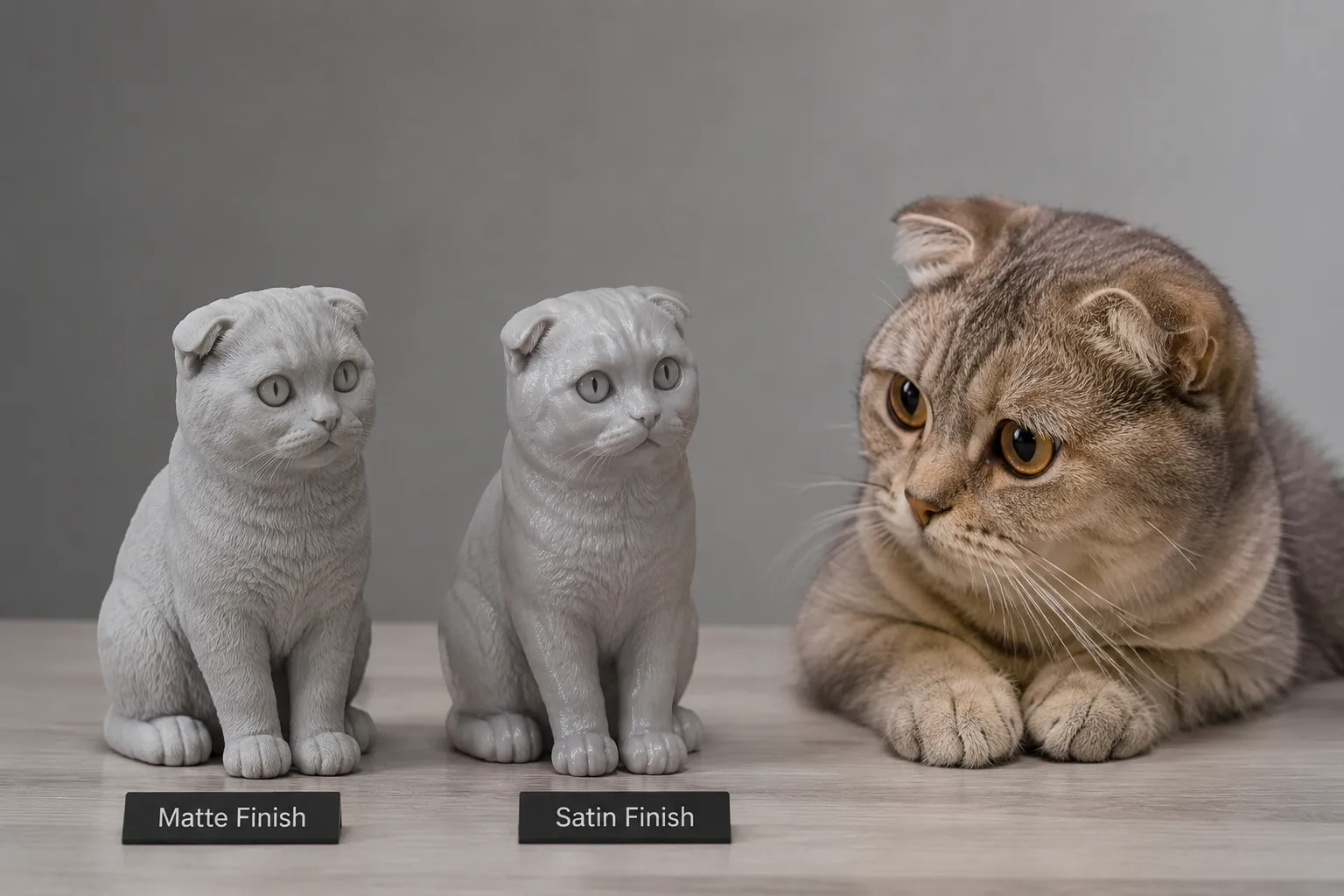
Matte finish: the softness specialist
Matte clear coat scatters incoming light in every direction. No sharp highlights. Almost no reflection you can point to.
On a Scottish Fold, matte does something specific and kind of magic. It lets the fold of the ear read as a soft crease rather than a hard edge. Because there's no bright line tracing the fold, your eye reads it as fabric-like, relaxed, natural.
Matte also flatters a dense coat. It mimics the actual light behavior of fur — that diffuse, no-glare quality. Set a matte figurine on a windowsill and it looks the same from every angle. Consistent. Calm.
The tradeoff, and we'll be real about it: matte can slightly mute the depth of very fine detail under flat, even lighting. Because there are no highlights to catch the ridges, extremely subtle coat texture can read a touch softer than it is. For most Scottish Folds this is a feature, not a bug — soft is the point. But if your cat has dramatic tabby banding or high-contrast markings you want to pop, that's worth a conversation.
Satin finish: the balanced middle
Satin is the diplomat. A low, gentle sheen. Enough reflection to give the surface a little life and depth, not so much that it turns glassy.
On a folded-ear cat, satin does a nice job of adding dimension to the coat — you get a faint, soft highlight that follows the contours, which can make the sculpt feel a bit more three-dimensional and rich. Markings look slightly more saturated because a thin sheen deepens perceived color.
The risk with satin shows up under harsh directional light. A single bright lamp or hard window sun can catch the fold of the ear and lay a soft highlight right along the crease. In the wrong spot, that highlight can flatten the fold — your brain reads the bright line as an edge, and the ear looks less "folded down softly" and more "creased." It's subtle. But on a Scottish Fold, where the fold is the signature, subtle matters.
And a word on gloss
We'll say it plainly: for cats, we're not huge fans of high gloss.
Gloss throws hard, bright specular highlights. On fur, that reads as wet. A glossy Scottish Fold can look like it just came in from the rain, or worse, like molded plastic. It fights the softness cue at every turn.
There are exceptions — a sleek-coated breed, or someone who specifically wants that polished collectible look. But for the plush double coat of a Fold? Gloss is usually the wrong tool.
Here's a quick side-by-side to keep the tradeoffs straight:
| Finish | Light behavior | Best for | Watch out for |
|---|---|---|---|
| Matte | Diffuse, no sharp highlights | Plush coats, soft folds, natural look | Slightly mutes ultra-fine texture under flat light |
| Satin | Gentle low sheen | Adding depth, richer color, subtle dimension | Harsh light can flatten the ear fold |
| Gloss | Sharp bright highlights | Sleek short coats, high-shine collectible look | Makes fur look wet; fights the "soft" read |
Why the Scottish Fold Is Its Own Special Problem
Not every breed forces this decision. A Scottish Fold does. And it's worth understanding why, because the reason shapes everything about how we approach the finish.
Two features collide.
First, the ears. The fold is created by a cartilage difference, and it gives the cat that rounded, owl-ish, permanently-relaxed silhouette. That fold is the single most recognizable thing about the breed. But geometrically, a folded ear is a shallow, curved crease — and creases are exactly where finish choice makes or breaks the read. Too much sheen and the crease catches a highlight and hardens. Too flat and it can lose some definition. It's a narrow target.
Second, the coat. Folds carry a dense, plush double coat — think British Shorthair-adjacent density. That coat is the softness signal. And dense coats are where matte earns its keep, because the diffuse light behavior of matte lines up with how real dense fur behaves.
So you've got one feature (the ears) that's sensitive to sheen, and another (the coat) that strongly prefers low sheen. That's why, for most Scottish Folds, our default lean is matte — with satin as a considered alternative when the specific cat and the specific display spot call for it.
A micro-story from the finishing table
One order stuck with us. A family sent photos of their Fold, a smoky blue-gray girl with these enormous copper eyes. First proof, we mocked up a satin coat because the owner mentioned she wanted the eyes to really glow.
Under our even studio light, gorgeous. But the customer had told us the figurine would live on a bookshelf beside a window that gets hard afternoon sun. We flagged it. Sure enough, in a test under raking light — that's light coming in at a low, sharp angle, the kind we use to inspect surfaces — the satin caught the ear fold and laid a bright little line right across it. The fold looked pinched.
We switched the coat to matte, kept a tiny satin detail only on the eyes to preserve that copper glow, and the whole thing relaxed. The ears went soft again. That hybrid approach — matte body, targeted sheen on the eyes — is something we reach for more and more on Folds.
"On a Scottish Fold, the fold is the whole story. The finish either lets it breathe or holds it stiff."
How Full-Color 3D Printing Captures a Cat (The Honest Version)
Let me pull back the curtain, because understanding the process helps you make a better finish call — and helps you send us photos that actually work.
From photos to a digital sculpt
Everything starts with your reference photos. Our artists study them to build the digital model, and the quality of that model is capped by the quality of what you send. A few practitioner heuristics:
- Eye-level, straight-on shots beat overhead shots. We need to read the true proportion of the head, the set of the ears, the length of the muzzle. Shooting down at a cat foreshortens everything.
- Multiple angles win. Front, both profiles, a three-quarter, and a clear shot of the ears from the front. The fold especially — we need to see exactly how those ears sit.
- Soft, even light is your friend. Bright overhead light or hard flash creates deep shadows that hide coat detail and eye color. A cloudy-day window is close to ideal.
- In focus, decent resolution. We can work with a good phone photo. We can't invent detail that the camera never captured.
From those references, an artist hand-models the cat digitally — sculpting the geometry, defining the coat flow, dialing the fold of the ears, checking proportions against your photos over and over. This is craftsmanship; it's just digital craftsmanship. The color markings get mapped onto the model so they'll print embedded in the resin.
The print itself
Then it goes to the printer. Full-color resin 3D printing (PolyJet/MJF-style technology) builds the piece up in ultra-thin layers, laying down UV-cured photopolymer with pigment already in the material. Layer heights in this world often land in the 25–50 micron range — a micron being a thousandth of a millimeter, so we're talking layers thinner than a sheet of paper. That resolution is what lets the print hold whisker-fine detail and smooth color transitions.
A few things a real practitioner thinks about here:
- Orientation. How the model sits on the build plate affects where supports touch and where tiny surface marks (support scars) can appear. We orient to keep supports off the most visible, most emotionally important surfaces — the face, the front of the ears.
- Supports. Overhangs need temporary scaffolding during printing. Where those touch, there's a little cleanup afterward. Good orientation minimizes it.
- Hollowing and drain holes. Larger pieces are often partially hollowed with small drain holes so uncured resin doesn't get trapped inside — trapped resin can cause problems later, like slow curing or weight imbalance.
Post-processing and the finish decision
Off the printer, the piece gets washed, cured under UV to fully harden the resin, and then supports come off with careful cleanup and light sanding at the contact points. We inspect under raking light for any surface irregularity — that low-angle light reveals texture the flat overhead view hides.
Common failure modes we watch for, so you know we're not hand-waving: under-cure (resin not fully hardened, leaving it soft or tacky), over-cure (which can make resin brittle), and support pitting if cleanup gets rushed. Quality control means dimensional checks against the sculpt, symmetry checks (are both ears folding at matching angles?), and a surface pass under that raking light.
Then comes the clear coat — matte, satin, or gloss — the one manual step, chosen for both protection and that all-important light behavior.
No brushes. No painting station. No waiting on layers of color to dry. The color came out of the printer already in the resin. The clear coat is what we're actually deciding when we talk finish.
Here's a rough map of the journey, though exact timing varies (check our process details for current turnaround):
| Stage | What happens | Why it matters for the finish |
|---|---|---|
| Photo review | Artists study your references | Determines how well the fold and coat translate |
| Digital sculpting | 3D model hand-built and refined | Sets the geometry that light will play across |
| Full-color printing | Pigmented resin printed layer by layer | Locks in markings and eye color permanently |
| Post-processing | Wash, cure, support removal, inspection | Clean surface = clean finish result |
| Clear coat | Matte/satin/gloss applied | The actual matte-vs-satin decision lives here |
"Every whisker tells a story. Our job is to make the light tell it right."
— The PawSculpt Team
The Psychology of Why This Object Matters So Much
Step back from the technical for a second, because there's a deeper reason people care this much about getting the finish right.
Psychologists talk about attachment theory — the bond systems that shape how we connect to the beings we love. With pets, that bond is real and measured; the human-animal bond has been studied enough that the NIH and researchers broadly recognize its effect on our stress physiology. Being near your cat can lower cortisol, the stress hormone. Your nervous system genuinely settles.
So when you look at a figurine of your Scottish Fold, you're not just admiring a sculpt. You're triggering — or failing to trigger — a piece of that same settling response. A finish that reads as soft and real can brush up against the actual comfort your cat provides. A finish that reads as hard and plastic keeps you at arm's length.
That's not sentimental fluff. That's why the matte-versus-satin call feels weirdly high-stakes when you're standing there deciding. Your brain knows the object is a stand-in for a living comfort source, and it's quietly grading how convincing the stand-in is.
A day-in-the-life moment
Picture a Tuesday morning. You come downstairs, the house still holds that warm, slightly-biscuity smell of sleeping cat and the coffee you're about to make. Your Fold used to wind around your ankles right here, by the counter. Now there's a figurine on the shelf by the window. You glance at it while the kettle heats — and because the matte coat reads soft in that gray morning light, for half a second your shoulders drop the way they used to when she'd appear. That half-second is the entire reason this matters.
This is also why smell memory hooks so hard into these keepsakes. Scent runs straight to the brain's memory and emotion centers, faster than any other sense. The figurine can't smell like your cat. But sitting where the sun warms the same blanket she used to knead — that faint wool-and-warm-fur smell — the object and the scent-memory start working together. The visual softness of a good matte finish lets the piece slot into that sensory memory instead of clashing with it.
Choosing Your Finish: A Straight-Talk Decision Guide
Okay. Enough theory. How do you actually decide? Here's how we'd walk a Scottish Fold family through it.
Start with where it'll live. This is the question people skip and it's the most important one.
- Bright spot with hard, direct light (sunny window, spotlight, glass display cabinet with LEDs)? Lean matte. It won't throw a distracting highlight across the fold, and it looks the same all day as the light moves.
- Soft, ambient light (a bookshelf in a normal room, indirect light)? Satin is safe here and gives you a little extra richness and depth.
- You want it to feel maximally like the real cat? Matte, almost every time. Softness is the signal.
Then think about the coat and markings.
- Dense, uniform, plush coat (classic Fold)? Matte flatters it.
- Bold, high-contrast tabby or dramatic markings you want to pop? Satin's gentle sheen deepens color and can make those markings sing — just mind the lighting on the ears.
Consider the eyes. Scottish Fold eyes are often huge and expressive. A tiny bit of sheen makes eyes look alive and glossy — which is realistic, because real eyes are glossy. This is why our favorite move on a Fold is a matte body with the eyes kept slightly brighter. Best of both: soft coat, living eyes.
Handling matters too. If this figurine is going to be picked up, held, passed around at family gatherings — matte hides fingerprints and micro-scuffs better than satin or gloss. Something to weigh if it's a memorial piece people will want to hold.
Here's the quick cheat sheet:
- Choose matte if: harsh lighting, plush coat, you want realism, the piece will be handled often.
- Choose satin if: soft lighting, you want richer color and a bit more dimension, bold markings to show off.
- Choose matte body + brighter eyes if: you want the best of both — our most-recommended combo for Folds.
- Skip gloss unless: you specifically want a polished, collectible look over realism.
The mistake most people make
The most common misstep? Choosing the finish based on the proof photo we send, viewed on a phone screen, in whatever light you happen to be in.
A screen can't show you how a physical finish behaves in your room. Satin looks fantastic on a bright screen because the screen adds its own glow. Then it arrives, sits in your actual afternoon sun, and the ear catches a highlight you never anticipated.
So don't decide from the screen alone. Tell us about the light where it'll live, and let us guide the call. That single piece of information — where does it go — prevents the vast majority of finish regrets we've seen. It costs you one sentence and saves you the one thing you can't easily redo.
Caring for Your Figurine So the Finish Lasts
A finish is only as good as how it holds up. Some plain-language care, because full-color resin prints have real needs.
- Keep it out of long, direct, blazing sun. UV-resistant clear coat helps, but no material loves being baked in a south-facing window for years. Bright indirect light is fine; harsh all-day sun is asking for slow fading.
- Dust with a soft, dry brush or microfiber cloth. A soft makeup brush is perfect for getting into the ear folds and around the whiskers. Skip paper towels — they can leave micro-scratches on satin and gloss especially.
- No harsh cleaners or solvents. Water and a barely-damp cloth for the occasional wipe, then dry it. Alcohol and household cleaners can attack the clear coat.
- Mind the temperature. Don't leave resin in a hot car or on a heat register. Resin can soften or, over long exposure, warp. Room temperature is its happy place.
- Handle by the base when you can. Oils from skin build up over time, especially on satin. The base is your friend.
Matte, worth repeating, is the most forgiving of everyday handling — it disguises fingerprints and light scuffs. Satin needs a touch more care. Gloss shows everything. Factor that into your choice if this is a piece meant to be held, not just displayed.
For breed-specific coat and grooming context that also informs how we read your cat's texture, the American Kennel Club and feline resources at PetMD are solid, non-commercial references (we're figurine folks, not vets — for anything health-related, your vet is the authority).
What to Expect When You Order
Without pinning down specifics that shift over time, here's the honest general shape of working with us on a Scottish Fold piece.
You send photos. Our artists build the digital sculpt and share a preview. This is your moment to check the important stuff — the fold angle, the eye color, the markings, the proportions. Look hard at the ears; that's the make-or-break feature. Revisions happen here, in the digital stage, which is exactly where you want them (changing a digital model is easy; changing a finished print is not).
Once the sculpt is approved, it goes to full-color printing, then post-processing, then the clear coat in your chosen finish. When you're unsure between matte and satin, tell us the lighting situation and we'll steer you.
For current turnaround, revision details, and the guarantee, the figurine service details are kept up to date on the site — we'd rather send you to the accurate source than quote you a number that might've changed.
"The best keepsakes don't sit on a shelf gathering dust. They catch your eye across the room and stop you for a second."
Frequently Asked Questions
Is matte or satin better for a Scottish Fold figurine?
For most Scottish Folds, matte wins. The plush double coat reads softer under a matte clear coat, and matte keeps harsh light from laying a highlight across the ear fold and flattening it. Satin is a great choice in soft, indirect lighting when you want a touch more color depth and dimension. Our most-recommended combo is actually a matte body with slightly brighter eyes.
Does the finish change the color of my cat figurine?
Not really. Because we use full-color 3D printing, the colors are embedded in the resin itself — they're locked in before any clear coat goes on. The finish changes how light behaves, not the pigment. Satin and gloss can make colors appear slightly deeper due to the sheen, while matte keeps them soft and even from every angle.
Do you hand-paint the figurines?
No. This is the biggest thing people get wrong about our process. We use full-color 3D printing, where the pigment is printed directly into the resin, layer by layer. There are no brushes and no painting step. The only manual touch is applying the protective clear coat in your chosen matte, satin, or gloss finish.
Why does a glossy pet figurine sometimes look wet or plastic?
It comes down to gloss perception. High gloss creates sharp, bright highlights, and your brain interprets those as a wet or hard surface. On a fluffy cat, that fights the softness cue completely. For plush-coated breeds like the Scottish Fold, matte or satin looks dramatically more natural and fur-like.
How should I care for the finish so it lasts?
Keep it out of long, direct, harsh sunlight, dust it gently with a soft brush or microfiber cloth, and avoid solvents or harsh household cleaners. Don't leave it somewhere hot, like a car or a heat register. Matte is the most forgiving day-to-day because it hides fingerprints and light scuffs better than satin or gloss.
What photos give the best result for a folded-ear cat?
Eye-level, in-focus shots in soft, even light — a cloudy-day window is ideal. Send several angles: front, both profiles, a three-quarter, and a clear straight-on view of the ears so we can capture exactly how the fold sits. The better your references, the more faithfully the sculpt reads.
Ready to Celebrate Your Pet?
Every pet has a story worth preserving. Whether you're honoring a beloved companion who's crossed the rainbow bridge or celebrating your folded-ear friend's unmistakable personality, a custom PawSculpt figurine captures the details that make your cat one-of-a-kind — right down to nailing the Scottish Fold figurine finish that makes those soft, folded ears look truly alive.
Visit pawsculpt.com to explore our full-color 3D printing process, preview turnaround, revision options, and quality guarantee.