
How to Photograph a Short-Coat Boxer for a Fully Customizable Resin Pose
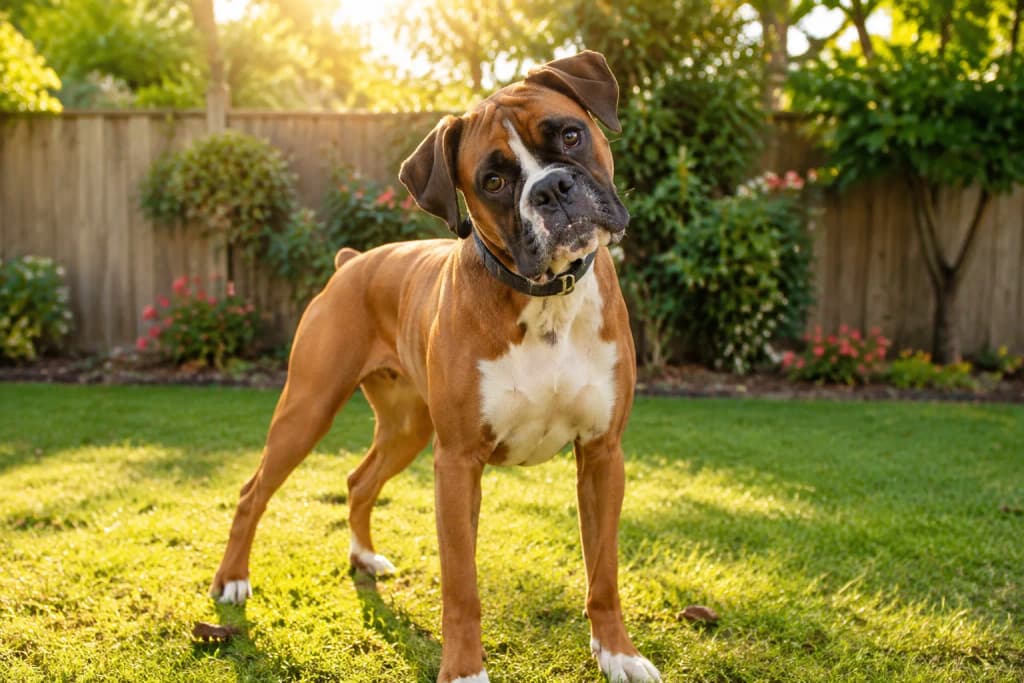
Your boxer plants all four paws in the wet sand, ears pitched toward a wheeling gull, and you raise your phone to photograph your dog for a figurine — then freeze. The light is low and gold. The pose is honest. And for once, he's holding completely still.
Quick Takeaways
- Shoot at his eye level, not yours — kneel down so the lens meets his chest, not the top of his skull.
- Side light beats front light — raking light at a low angle reveals the muscle ridges a short coat hides.
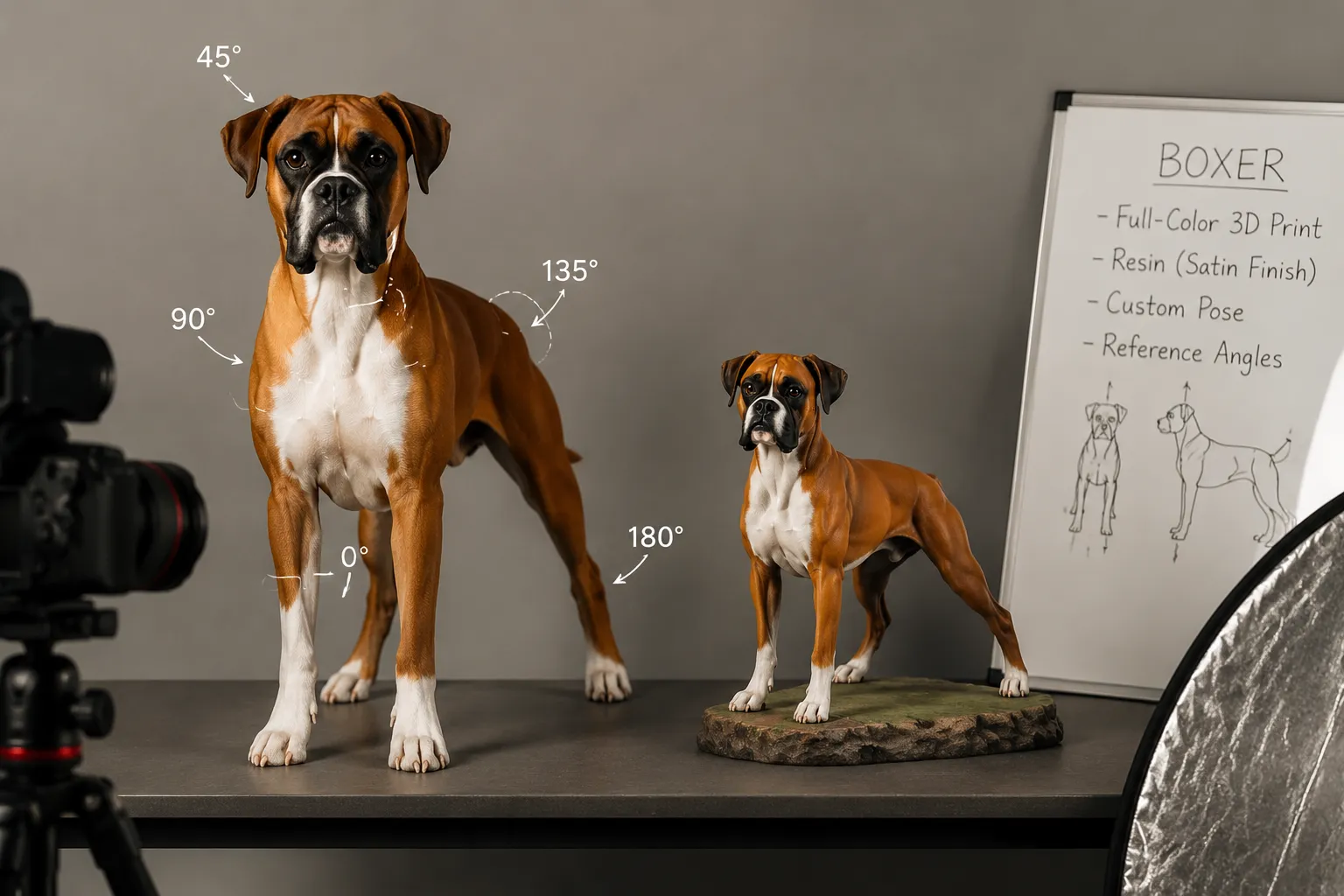
- Capture four angles minimum — front, both profiles, and a three-quarter turn give sculptors true 3D data.
- Avoid harsh noon sun — it flattens the chiseled lines that make a boxer a boxer.
- Good source photos drive everything, which is why we built our custom pet figurine process around reference quality first.
Why a Short-Coat Boxer Is the Hardest Easy Dog to Photograph
Here's the paradox nobody warns you about. A boxer looks like the simplest dog in the world to capture. No flowing fur to render, no feathering on the legs, no double coat catching light in twelve directions. Just a smooth, tight, athletic body.
That's exactly the trap.
When you photograph a dog for a figurine, fur is forgiving. It hides asymmetry. It blurs the line between "the sculpt is slightly off" and "that's just how the coat fell that day." A long-haired dog gives a 3D artist a margin of error measured in millimeters of fluff.
A short-coat boxer gives you nothing to hide behind. Every plane of muscle, every shadow under the brisket, the exact set of the jaw — it all shows. The skin reads like a topographic map, and the camera records the truth of it.
So the work of getting a good boxer figurine pose starts before the print, before the sculpt, before anything. It starts with how you hold the light and where you put your knees.
"A short coat doesn't hide anything. That's not a problem to solve — it's the whole gift."
We've reviewed thousands of customer uploads over the years, and boxers, French bulldogs, Dobermans, and other smooth breeds follow a clear pattern. The owners who understand this one truth — that the coat reveals rather than conceals — send us reference photos that practically sculpt themselves.
The Spatial Problem Most People Miss
Think about where your boxer actually lives in your home. The corner of the couch he's claimed. The patch of floor by the back door where he waits. The specific spot at the foot of the bed.
You know his shape in space better than any photograph you've ever taken of him. You know the weight of him leaning against your shin. You know how he fills a doorway.
The job of a good reference photo is to transfer that spatial knowledge — the thing you carry in your body — into data a sculptor can work with. Most phone photos fail not because they're blurry, but because they flatten three dimensions into one flattering angle. We'll fix that below.
How a Photo Actually Becomes a Figurine (The Honest Version)
Before you can shoot smart, it helps to know what happens to your photos after you send them. Most guides skip this entirely, which is why people send us beautiful, useless images — gorgeous shots that don't carry the information a 3D pipeline needs.
Let me walk you through it the way we'd explain it on the shop floor.
Step One: Photo to Digital Sculpt
Your reference photos go to a master 3D artist who hand-models your pet digitally — in software like ZBrush or Blender — building a three-dimensional model on screen, vertex by vertex. This is digital sculpting. Nothing physical exists yet. It's pure geometry and color living inside a computer.
This is why multiple angles matter so much. The artist is reconstructing a real, volumetric body from flat images. Give them only a front shot, and they're guessing at the depth of the chest, the length of the back, the taper of the haunches. A profile photo tells the artist things a front photo physically cannot.
They check proportions against your references constantly — comparing the head-to-body ratio, the leg length, the depth of the muzzle. For a boxer, the brachycephalic (short-nosed) skull is unforgiving. A few degrees of error in the muzzle angle and it stops looking like your boxer and starts looking like a generic one.
Step Two: Full-Color 3D Printing
Once the digital sculpt is approved, the model goes to a full-color 3D printer. This is the part people misunderstand most, so I want to be precise.
We do not print a white model and color it afterward. The color is printed directly into the resin, voxel by voxel — a voxel being a 3D pixel, the smallest unit of printed material. The machine lays down UV-cured photopolymer resin with the pigment already embedded in the material itself. Your boxer's fawn coat, the white blaze on his chest, the black mask around his muzzle — all of it is built into the physical material as it prints.
The technology sits in the PolyJet and multi-jet family. Think of it less like a desktop hobby printer and more like an industrial machine that jets thousands of tiny droplets of photopolymer, flash-curing each layer with UV light as it goes.
| Print Stage | What Happens | Why It Matters for a Boxer |
|---|---|---|
| Digital sculpt | Artist models pet in 3D software | Captures the brachycephalic skull and muscle planes |
| Full-color print | Color embedded in resin, layer by layer | Reproduces fawn, brindle, white markings exactly |
| Support removal | Scaffolding cleaned away | Protects thin areas like ears and tail |
| Curing | Resin hardened under UV | Locks in durability and color stability |
| Clear coat | Protective gloss applied | Adds sheen, guards color, the one manual step |
Step Three: Post-Processing
After printing, the figurine goes through cleaning, full curing under UV light, and support removal — supports being the temporary scaffolding the printer builds to hold up overhangs like ears, tails, and lifted paws during the print.
Removing supports is delicate work. Pull them wrong and you get "support scarring" — small pits or rough patches where the scaffold attached. On a short-coat dog, where the surface is meant to read as smooth skin, a scar shows immediately. This is why orientation on the print bed is planned carefully: the artist decides which surfaces face down so the inevitable support marks land on hidden areas, like the underside of the belly, not the cheek.
Then comes the only manual finishing step: the clear coat. A protective varnish that adds sheen, deepens the color, and shields the surface from UV fading and handling. No brushes touch the color itself. The pigment was always in the resin. The clear coat just protects what the printer already laid down.
"Every plane of a boxer's body is a story the camera either tells or hides. Our job is to make sure your photos tell it."
— The PawSculpt Team
Personal Aside: We'll be honest — boxers are quietly our favorite breed to bring through the full-color process. There's something about that compact, expressive face. The wrinkle of worry above the eyes, the underbite that somehow reads as a grin. When a sculpt nails a boxer's expression, the whole team gathers around the screen. It doesn't happen with every breed. With boxers, it happens a lot.
The Light: Where Most Short-Coat Photos Go Wrong
Here's the single biggest mistake we see, and it's counterintuitive.
People photograph their boxer in bright, direct sunlight because it looks "clear." High noon, full sun, the dog squinting happily. The photo is sharp and well-exposed. And it's nearly useless for sculpting a smooth-coated dog.
Direct overhead light flattens muscle. It erases the very shadows that define a boxer's shape. The shoulder, the ribcage, the cut of the thigh — all of it goes smooth and shapeless under hard top light. You end up with a dog-shaped balloon instead of an athlete.
What Actually Works: Raking Light
The fix is raking light — light that strikes the body at a low, shallow angle, almost grazing across the surface. This is exactly why the beach at the start of this article works so well. Early morning or late afternoon sun comes in low and sideways.
That low angle catches every ridge and hollow. The shadow on the far side of a muscle defines its volume. Suddenly the camera can see the difference between the deltoid and the bicep, the swell of the chest and the tuck of the waist.
This is the same principle we use in our own quality control. When we inspect a finished figurine, we hold it under raking light and rotate it slowly, watching how shadows travel across the surface. It reveals any flaw the print left behind. You can borrow the trick for your photos.
The practical timing:
- Golden hour (the hour after sunrise or before sunset) gives warm, low, directional light.
- Open shade on a bright day — under a tree, beside a building — gives soft, even light that still has gentle direction.
- Overcast afternoons are surprisingly good: soft but not flat, with subtle modeling.
What to avoid:
- Harsh noon sun that flattens everything and blows out white markings.
- On-camera flash, which does the same thing as noon sun, only worse, and adds a glassy reflection in the eyes.
- Mixed indoor light — a window on one side and a yellow lamp on the other confuses the color of the coat.
"Soft sideways light is the difference between sculpting an athlete and sculpting a balloon."
So what? Because for a short-coat breed, the light is the texture. There's no fur to provide visual interest, so the play of shadow across muscle becomes the entire visual story. Get the light right and you've done half the sculptor's work for them.
Getting the Boxer Figurine Pose Right
Now the pose. This is where your specific dog stops being "a boxer" and becomes your boxer.
Shoot at His Level, Always
Kneel. Lie down if you have to. Bring the camera to his chest height, not your standing eye level.
Shooting down at a dog foreshortens his body — it makes the head huge and the back end tiny, a distortion the wide-angle lens on a phone makes worse. We get a lot of uploads taken from a standing human's height, and they all share the same problem: a balloon head on a shrinking body.
When you drop to his level, the proportions read true. The chest comes forward with proper depth. The topline — the line of the spine from neck to tail — reads at its real length. For a sculptor, a level shot is worth three downward ones.
The Four-Angle Minimum
One photo, no matter how perfect, is a flat slice of a three-dimensional animal. To build a faithful boxer figurine pose, our artists need to see around the dog. The minimum reference set:
- Full front — square on, showing the chest, the set of the front legs, facial symmetry, and markings.
- Left profile — the complete side, from nose to tail tip, showing the topline and leg position.
- Right profile — because no dog is perfectly symmetrical, and the markings differ side to side.
- Three-quarter view — angled between front and profile, the angle that best conveys true 3D volume.
Add a few extras if you can: a clear close-up of the face for expression, a shot of any unique markings, and one of the tail and rear. The more angles, the less guessing. And less guessing means a sculpt that looks like him instead of like a boxer.
| Angle | What It Captures | Common Mistake |
|---|---|---|
| Full front | Facial symmetry, chest, markings | Tilting the camera up or down |
| Left profile | Topline, leg position, body length | Dog turning head toward camera |
| Right profile | Asymmetry, opposite-side markings | Skipping it ("one side's enough") |
| Three-quarter | True 3D volume and depth | Too steep an angle, distorts proportion |
| Face close-up | Expression, eye shape, wrinkles | Using flash, glassy eye reflection |
Choosing the Pose That Means Something
This is the part that turns a figurine from a generic dog statue into a keepsake with presence.
Most people default to the formal sit — the show-ring pose. It's fine. It's also the pose that looks least like the dog you actually live with. Your boxer at rest, your boxer at attention, your boxer mid-play-bow with his rear in the air — those poses carry his spirit.
Think about the posture that is him. The way he plants himself in a doorway. The lean he gives you when he wants something. The alert stance when a leaf moves in the yard. A pose is a gesture, and a gesture is personality made visible.
We worked with one family whose boxer always sat with one paw slightly lifted, like he was about to shake hands but never quite committed. That detail — that single hesitant paw — was the whole dog. When they saw it in the sculpt preview, they cried. Not because it was technically perfect, but because it was him.
So when you choose your pose, don't ask "what looks impressive." Ask "what would make someone who loved him say, that's exactly how he stood."
Capturing a Boxer's Markings and Color Accurately
Because we print color directly into the resin, the color in your photos becomes the color in the figurine. This is wonderful and it's also a responsibility. Garbage color in, garbage color out.
Why Color Fidelity Matters More for Boxers
Boxers come in fawn, brindle, and white, often with bold markings: a white chest blaze, white paws, a dark mask. These high-contrast patterns are a gift for a figurine — they read instantly and make the piece unmistakably your dog. But they demand accurate reference.
The enemies of accurate color:
- Colored light. A yellow indoor bulb pushes a fawn coat toward orange. A blue dusk shadow pushes white toward gray. Shoot in neutral daylight when you can.
- Backlighting. Light behind your dog throws his face and chest into shadow and confuses the true coat tone.
- Over-editing. Please don't run your phone's auto-enhance or a heavy filter. The saturated, contrast-boosted version isn't his real color, and we'll reproduce exactly what you send.
The Brindle Challenge
Brindle — those tiger-stripe streaks over a base coat — deserves special mention. It's one of the most beautiful patterns we reproduce and one of the easiest to photograph badly.
The stripes need even, diffuse light to read clearly. Harsh shadow breaks up the pattern and makes it impossible to tell where a real stripe ends and a shadow begins. For a brindle boxer, shoot in bright open shade — outdoor light, but out of direct sun — so the striping shows cleanly across the whole body.
According to the American Kennel Club's boxer breed standard, brindle ranges from sparse, clearly defined stripes to such heavy striping the dog looks "reverse brindle." Wherever your dog falls on that spectrum, capture it in even light, and the print will carry it faithfully into the resin.
What to Expect: From Beach Photo to Finished Figurine
People always want to know how the process unfolds once they've taken good photos. We'll describe the general arc — for current specifics on turnaround, revisions, and guarantees, the details live on our website and change from time to time, so we'd rather point you there than quote a number that's gone stale.
Here's the general shape of the journey:
- You submit your reference photos. The four-angle set plus any extras. More is better.
- A 3D artist builds the digital sculpt. They model your boxer in software, checking proportions and that signature expression against your references.
- You review a preview. This is your chance to refine — the tilt of the head, the set of the ears, the exact pose. Speak up here. It's far easier to adjust pixels than resin.
- Full-color 3D printing. Once approved, the digital model prints in full-color resin, with markings embedded in the material.
- Post-processing and clear coat. Cleaning, curing, careful support removal, and the protective clear coat that gives the piece its sheen.
- It arrives. A small, solid version of your dog you can hold in one hand.
The Honest Tradeoffs
We promised practitioner-level honesty, so here are the real tradeoffs nobody mentions in the glossy marketing.
Detail versus durability. A figurine printed with extremely fine detail can have delicate, thin features — a raised tail, a lifted paw — that are more fragile. We balance this by keeping such features robust enough to survive normal handling. A boxer's natural compact build actually helps here; he's not a fine-boned greyhound.
Surface texture. Full-color resin prints carry a very fine grain or subtle layer texture — the signature of additive manufacturing, where the object is built up layer by layer. Under the clear coat it reads as a natural, authentic surface. We mention this because some people expect glassy, injection-molded perfection. That's not what this is. It's a fine-grained, true-color reproduction with the honest character of a printed object.
Size and detail. Smaller figurines can't hold the same fine detail as larger ones — there's a physical floor to how small a feature can print and still be recognizable. For a heavily marked or expressive face, a slightly larger size lets the detail breathe.
Caring for Your Figurine
Once it's home, treat it like the keepsake it is:
- Keep it out of direct, prolonged sunlight. The materials are UV-resistant and the clear coat helps, but no pigment is truly immortal under years of harsh sun.
- Dust with a soft, dry cloth or a soft brush. Skip harsh chemical cleaners, which can dull the clear coat.
- Handle by the base or the body, not by delicate extremities like ears or tail.
- Give it a home with presence. A shelf, a mantel, a desk corner — a place where it occupies space the way he did.
That last point isn't really about maintenance. It's about ritual. Where you choose to place the figurine becomes a small sacred space in your home, a fixed point that holds his presence. We've heard from families who set it where the afternoon light hits, in the exact corner the dog used to claim.
The Overlooked Truth: You're Photographing a Bond, Not a Body
Here's the insight we wish more people sat with before they started shooting.
You're not really photographing a dog. You're photographing a relationship — the specific shape of a bond that exists between exactly two beings and no others. The boxer at the beach isn't a generic specimen of his breed. He's the one who waited by a particular door, who took up a particular corner, who leaned into your leg with a particular weight.
A technically perfect photo of the wrong moment misses everything. A slightly imperfect photo of his moment — the head tilt, the lifted paw, the alert ears toward a gull — carries his whole spirit into the resin.
This is why the spiritual weight of a figurine surprises people. They expect a decorative object. They receive an anchor — something solid that holds the shape of a love that was, until now, only carried in memory and muscle. The bond was always real. The figurine just gives it a body again, a fixed presence in the empty room.
So when you kneel in the sand with your phone, remember you're not documenting anatomy. You're translating a sacred contract into something your hands can hold. The light and the angles are just the grammar. The dog — your dog — is the language.
Frequently Asked Questions
What photos work best for a custom boxer figurine?
Shoot at your dog's eye level in soft, directional side light rather than harsh noon sun. Capture at least four angles — full front, both profiles, and a three-quarter view — plus a clear close-up of the face. The more angles you provide, the more accurately a 3D artist can reconstruct his true volume and expression.
Why does lighting matter so much for a short-coat dog?
Because a short coat hides nothing. There's no fur to provide visual texture, so the shadows across muscle become the entire visual story. Low, raking side light reveals the ridges and hollows that make a boxer look athletic, while flat overhead sun erases them and leaves a shapeless form.
Are PawSculpt figurines hand-painted?
No. We use full-color 3D printing, where the pigment is embedded directly into the resin and printed voxel by voxel. Your boxer's fawn coat, white blaze, and dark mask are built into the material itself. The only manual step is applying a protective clear coat for sheen and durability.
How do I choose the best pose for my boxer?
Skip the formal show-ring sit and choose the posture that is him — the doorway stance, the lean, the play-bow, the alert ears. A pose is personality made visible. Pick the gesture that would make someone who loved him say "that's exactly how he stood."
Can the process capture a brindle boxer's stripes accurately?
Yes. Since color is printed into the resin, brindle striping reproduces faithfully. The key is your reference photo: shoot in bright, even open shade so the stripes read cleanly across the whole body, without harsh shadows breaking up the pattern.
Ready to Celebrate Your Pet?
Every pet has a story worth preserving. Whether you're honoring a beloved companion who's crossed the rainbow bridge or celebrating your boxer's chiseled, goofy, one-of-a-kind self, a custom PawSculpt figurine captures the details that make him unmistakably yours — the lifted paw, the worried brow, the exact set of that underbite grin.
Take your four angles, find that low golden light, and when you're ready to photograph your dog for a figurine that holds his whole spirit, we're here to bring it into full color.
Visit pawsculpt.com to learn more about our full-color 3D printing process, preview turnaround, flexible revisions, and quality guarantee.