The Ultimate Guide to Scaling a Great Dane Into a Full-Color Resin Figurine
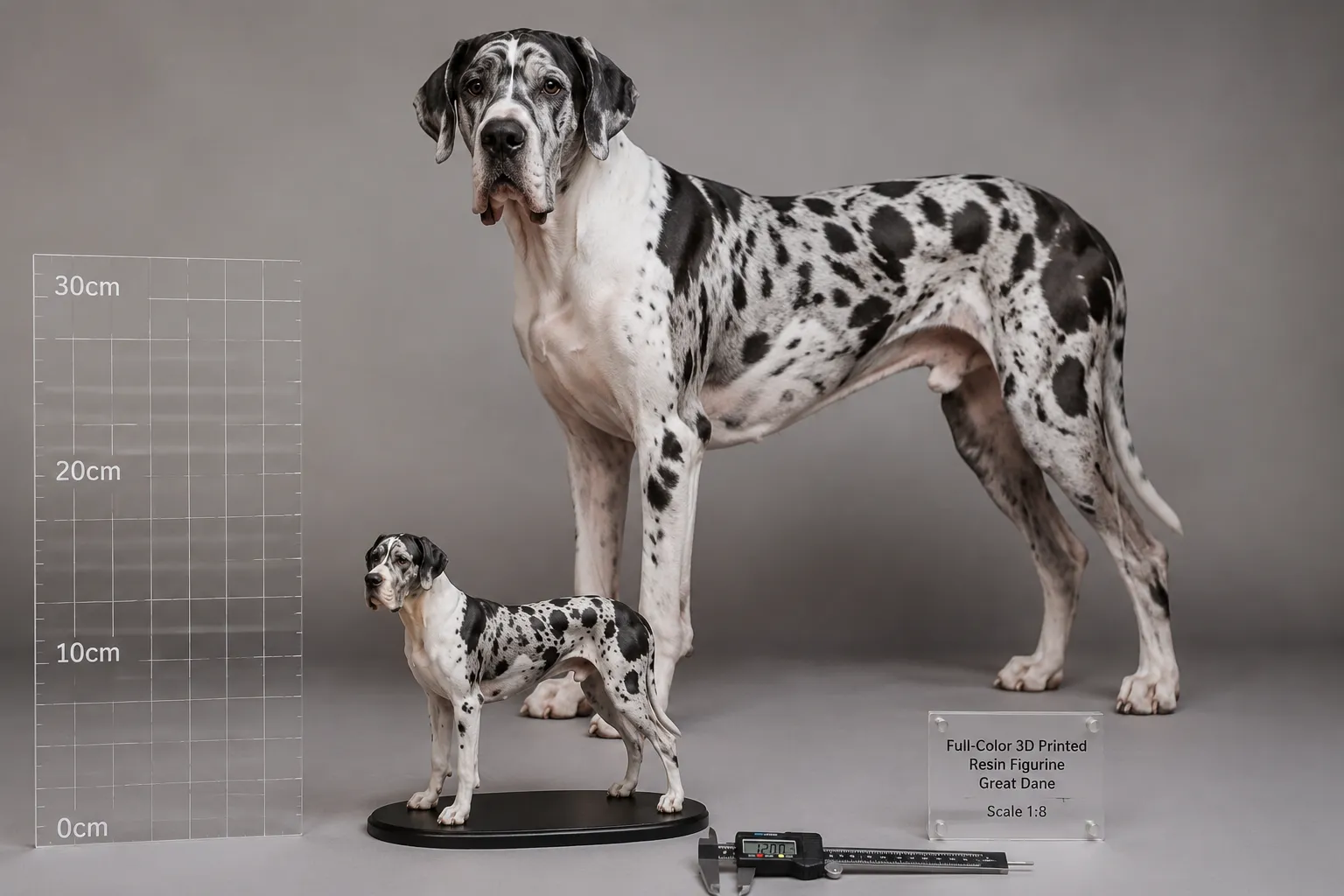
Last winter, the foot of your bed sagged under a hundred and forty pounds of warm, snoring dog. Tonight the mattress lies flat and cool — which is exactly why so many people end up searching for a large breed pet figurine at midnight, thumb hovering over a single blurry photo.
Quick Takeaways
- Scaling down a giant breed is harder than scaling a small one — thin legs and long limbs become fragile print points.
- Proportion beats raw size — a faithful Great Dane figurine keeps the "gentle giant" stance, not just the height.
- Your reference photos decide everything — eye-level shots and good light matter more than megapixels.
- Full-color 3D printing embeds color in the resin itself, so markings won't chip the way painted layers can.
- Do your homework before you pre-order — the custom pet figurine process at PawSculpt rewards owners who plan their photos first.
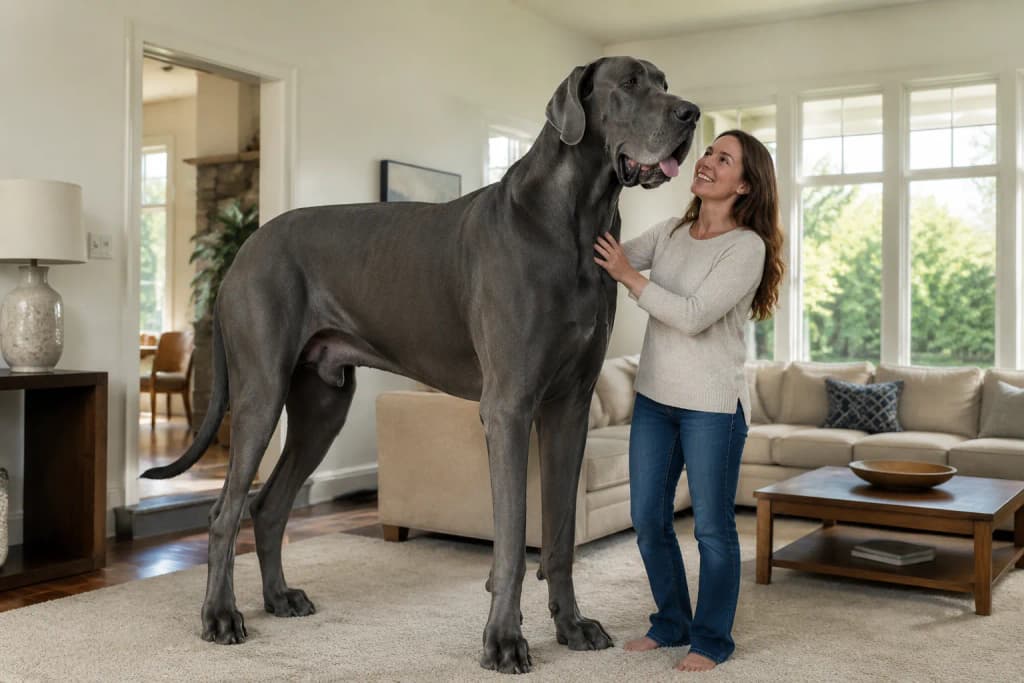
There's a specific ache that comes with loving a big dog. Their bodies take up so much room — the doorway they block, the couch cushion permanently dented, the way their head settles on your knee with a weight that pins you in place. So when you decide to shrink all of that down to something that fits in your palm, it feels almost like a betrayal of scale. How do you compress a creature whose entire charm was bigness?
That's the real question underneath "how do I get a Great Dane figurine made." And honestly, most guides skip right past it. They'll tell you to upload a photo and pick a size. We want to tell you what's actually happening between that photo and the little resin dog that eventually sits on your nightstand — and why giant breeds are their own particular puzzle.
We've worked with thousands of pet families, and the big ones come with stories that hit a certain way. So let's walk through this together, the engineering and the feeling both.
Why Big Dogs Are Secretly the Hardest to Scale
Here's the thing nobody tells you. A Chihuahua and a Great Dane do not shrink the same way.
You'd assume the giant breed is easier — more dog, more surface, more detail to capture. The opposite is true. When we digitally sculpt a pet (that means our 3D artists build a model of your dog inside software like ZBrush or Blender, sculpting it on screen the way you'd shape clay, except nothing physical exists yet), the trouble with a Great Dane shows up immediately in the legs.
A Dane stands on long, lean limbs. Beautiful in life. In a six-inch figurine, those same legs become slender little columns of resin, sometimes thinner than a pencil. That's a structural problem. We call these fragile print points — the spots where a figure is most likely to snap during support removal, shipping, or that one inevitable knock off the shelf.
"With giant breeds, we're not fighting to add detail. We're fighting to keep four delicate legs from becoming the weakest part of the whole piece."
So the first counterintuitive truth: scaling a Great Dane is mostly about managing fragility, not capturing size. A pug, by contrast, is a forgiving blob of sturdy geometry. The Dane is an engineering negotiation between elegance and durability.
The "gentle giant" problem
There's a second issue, and it's more emotional than technical.
The thing you love about a Dane isn't measurable. It's the presence. The way a dog that tall can be so impossibly soft. When you scale that body down without thinking, you lose the presence entirely — you end up with a generically large dog shape that could be a fawn-colored anything.
Our sculptors talk about preserving stance and proportion over literal dimensions. A Dane's signature is the long neck arc, the deep chest, the slightly mournful set of the jowls, the way the weight sits back into the hips. Get those relationships right and a three-inch figure still reads, instantly, as your gentle giant. Get them wrong and no amount of color accuracy will save it.
This is where attachment theory quietly enters the room. Psychologists who study the human-animal bond describe how we encode our companions not as a list of features but as a gestalt — a whole-pattern recognition. Your brain doesn't audit ear length. It knows the silhouette of your dog the way it knows a family member's footsteps on the stairs. A good figurine has to satisfy that pattern-recognition, which is why proportion matters more than any single measurement.
From Photo to Sculpt: What Your Pictures Are Really Doing
Let's get practical, because this is the part you can actually control.
The single biggest lever you have over the final figurine is the reference photos you provide. Not the resin, not the printer, not even the artist's skill. Your photos. We can only sculpt what the camera saw.
A quick scene: a woman sends us fourteen photos of her Dane, Juniper. Thirteen are shot from above — the natural angle when you're six feet tall and your dog is on the floor. In every one, Juniper's long snout foreshortens into a stub and her chest disappears. The fourteenth photo, taken by accident when she crouched to clip a leash, shows the dog at eye level. That one photo did more work than the other thirteen combined.
What actually makes a photo useful
Here's what we've learned from looking at tens of thousands of submissions. Resolution matters far less than people think. Angle and light matter far more.
| Photo Element | What Helps | What Hurts |
|---|---|---|
| Angle | Eye-level, camera lowered to the dog | Shooting down from standing height |
| Lighting | Soft, even daylight (overcast, near a window) | Harsh sun, deep shadow, flash |
| Pose | Standing or sitting, full body visible | Curled up, legs tucked, half-hidden |
| Coverage | 3-5 angles: front, both sides, face | One single hero shot only |
| Markings | A clear close-up of any unique patches | Blurry or distant on patterned coats |
The reason eye-level wins is simple. When you photograph a tall dog from above, the camera lies about proportion. The legs shorten, the back compresses, the head balloons. Our sculptor then has to guess the real geometry, and guessing is where likeness goes to die.
So if you do one thing before you pre-order anything: get down on the floor and shoot your dog at their eye level, in soft daylight, from a few angles. Fifteen minutes of this beats a thousand random phone snaps.
The coat flow nobody mentions
Danes have short coats, which sounds easy. It's not entirely.
Short-coated breeds show muscle and skeletal structure through the skin — the shoulder blades, the tuck of the abdomen, the tendons in the legs. Our artists model what's called coat flow and anatomy together: the direction fur lies, yes, but also the underlying form pushing up against it. A close-up photo in raking light (light coming from the side, skimming across the body) reveals these contours beautifully. It's the difference between a figurine that looks like your athletic dog and one that looks like a smooth balloon animal.
"Send us the photo that made you stop scrolling. The one where you saw them. That's the one our sculptors fall in love with too."
How Full-Color 3D Printing Actually Works (In Plain English)
Okay. Let's open the hood. You don't need an engineering degree, but understanding this will make you a much smarter buyer — and it'll explain why your figurine looks the way it does when it arrives.
PawSculpt uses full-color 3D printing. That phrase does a lot of heavy lifting, so let's break it down.
After our artists finish the digital sculpt, the file goes to a printer that builds your dog layer by microscopic layer out of UV-cured photopolymer resin. "Photopolymer" just means a liquid resin that hardens when hit with ultraviolet light. The printer cures one thin slice, drops down, cures the next, and so on — often in layers in the 25 to 50 micron range (a micron is a thousandth of a millimeter; for reference, a human hair is around 70 microns thick). Those ultra-thin layers are how you get smooth curves out of a stack of flat slices.
Now here's the part that sets full-color apart, and the part people most often misunderstand.
The color is printed directly into the resin. It's not added afterward. There are no brushes, no paint, no white model waiting to be colored in. The machine deposits pigment voxel by voxel — a voxel is just a 3D pixel, a tiny cube of material — so your dog's fawn coat, black mask, and white chest blaze are all embedded in the material itself as it forms.
Why "embedded color" is a big deal for you
This is genuinely one of the best-kept advantages of the technology, so let it sink in.
When color is part of the material rather than a coating on top, it can't chip off the way painted layers can. A scratch on a painted figure reveals bare material underneath. A scratch on a full-color resin print is still colored through — like how a stick of rock candy has the design running all the way through.
For a Great Dane with bold markings — that classic black-masked fawn, or the dramatic black-and-white of a harlequin — this matters enormously. Those patterns are reproduced directly in the resin, following the exact map our artists pulled from your photos.
| Aspect | Full-Color 3D Print (our process) | Paint-on-top methods |
|---|---|---|
| Where color lives | Embedded throughout the resin | Surface layer only |
| Chip behavior | Color continues beneath a scratch | Bare material shows through |
| Pattern accuracy | Mapped digitally to your photos | Depends on hand steadiness |
| Texture | Natural fine print grain under clear coat | Brush texture varies |
| Fine markings | Crisp voxel-level transitions | Limited by brush width |
The only hands-on, manual step in our whole process comes at the end: applying a clear coat — a protective varnish that seals the surface, deepens the colors, and adds a subtle sheen. Think of it like the topcoat on a fine guitar. It protects the print and makes the fawn glow a little richer, but it adds no color of its own.
The honest tradeoff: texture, not plastic-perfection
We'll be real with you about something. A full-color resin print is not a glassy, injection-molded toy surface.
Look closely and you'll see a fine grain — the gentle texture of those stacked micro-layers, softened under the clear coat. Some people expect mass-produced plastic smoothness and are briefly surprised. But here's our honest opinion: that subtle texture is part of what makes these feel real rather than manufactured. It catches light the way a living coat does. A perfectly slick surface would actually look more fake, not less.
That's the tradeoff of the technology, and we think it lands on the right side.
The Engineering Decisions You Never See
Between the finished sculpt and the dog on your shelf, a bunch of invisible choices get made. You'll never have to make them — that's our job — but knowing they exist tells you why quality varies so much between providers, and why pre-order research pays off.
Print orientation: the hidden art
When we load your Dane into the printer, we have to decide how to angle it. This is called print orientation, and it's far more consequential than it sounds.
Every 3D print needs supports — temporary scaffolding, like little resin stilts, that hold up the parts of the model that would otherwise droop into thin air mid-print. Where those supports touch the model, they leave faint marks after removal. We call them support scars or support pitting — tiny blemishes where the scaffold was snapped away.
The whole game is choosing an orientation that puts those unavoidable scars somewhere they won't show — the underside of the belly, the bottoms of the paws — and keeps them off the face, the chest, the show-side of the body. For a long-limbed Dane, orientation also decides whether those fragile legs print strong or print weak. Angle it wrong and you get warping or a snapped limb. There's real craft here, built from a lot of trial and error.
Hollowing and drain holes
A solid resin figure of a giant breed would be heavy, expensive in material, and — counterintuitively — more prone to cracking, because thick resin can cure unevenly and build internal stress.
So larger pieces are often hollowed — printed with an empty interior and a wall of consistent thickness. That requires drain holes, small openings (usually tucked underneath) that let uncured liquid resin escape from the inside during cleaning. Skip the drain holes and you trap liquid resin in the belly, where it can leak or cure into a rattling lump later. It's the kind of detail that separates people who do this every day from people who just bought a printer.
What "curing" really means
After printing, your figure isn't done. It gets washed (to remove sticky uncured resin from the surface) and then cured under UV light to reach full hardness.
This is a Goldilocks problem. Under-cure and the resin stays a little soft and can yellow or deform over time. Over-cure and it turns brittle — more likely to shatter if dropped. There's also a phenomenon called bloom, a hazy white film that can appear on improperly handled resin. Getting cure time right, especially on a hollowed large-breed piece with varying wall thickness, is experience-driven. There's no universal dial setting.
| Process Stage | What Happens | Why It Matters to You |
|---|---|---|
| Digital sculpt | Artist models your dog in 3D software | Likeness is locked in here — proportion is everything |
| Orientation & supports | Engineer angles the model, adds scaffolding | Determines where blemishes hide and if legs survive |
| Full-color printing | Resin built in layers, color embedded | Your dog's markings printed into the material |
| Wash & cure | Surface cleaned, UV-hardened | Decides durability — not too soft, not too brittle |
| Support removal & finishing | Scaffolding removed, scars sanded | Smooths the show surfaces |
| Clear coat | Protective varnish applied (only manual step) | Seals color, adds sheen, guards against scratches |
Quality control under raking light
Before anything ships, good shops do a final inspection — and our favorite trick is dead simple. Raking light.
We hold the figure under a light angled almost parallel to the surface, so it skims across like late-afternoon sun across a field. Under that grazing light, every flaw jumps out — a missed support scar, an uneven patch, a surface ripple you'd never catch under flat overhead lighting. We also run symmetry checks (are both ears, both eyes, both shoulders matched?) and dimensional checks against the original sculpt.
For a Great Dane, the symmetry check on those long legs is non-negotiable. The eye is unforgiving about a tall dog standing crooked.
"Every whisker tells a story. With the big breeds, our job is to keep the gentleness in a body we've shrunk to the size of your hand."
— The PawSculpt Team
A Morning With the Little Giant
Let us paint you a small picture of why people do this at all.
It's 6 a.m. The house is darker and quieter than it used to be. You pad into the kitchen out of habit, half-expecting the click of nails on tile behind you, the heavy lean against your leg while the coffee brews. The lean doesn't come. But there, on the windowsill where the first light hits, is a small resin Dane standing the way she always stood — chest out, head tilted, like she's about to ask for breakfast. You run a thumb over the cool, smooth weight of her. And the morning hurts a little less.
That's it. That's the whole reason. Not decoration. An anchor.
There's actual science under this. When we lose a companion, our brains keep running the old prediction routines — expecting the nails on the tile, the weight on the bed. Grief researchers describe this gap between expectation and reality as one of the most painful parts of loss. A tangible object you can hold gives that searching mind something to land on. It won't fix anything. Grief was never a problem to be solved. But it gives your hands somewhere to go.
The American Veterinary Medical Association has written about the depth of the human-animal bond and why pet loss deserves to be taken seriously rather than brushed off. If you've ever felt silly for grieving a dog this hard — don't. The attachment is real, measurable, and worth honoring.
Some families plant a tree. Some keep a collar in a drawer they can't quite open yet. And increasingly, people choose tangible keepsakes like a 3D pet sculpture that holds the exact stance, the exact markings, the exact tilt of the head. There's no right answer. There's only what helps you reach for something instead of empty air.
Living Pets, Not Just Memorials
We want to gently push back on an assumption, because it's one we see all the time.
Most people think of a custom figurine as a memorial thing — something you do after. And sure, plenty are. But honestly? Some of the most joyful orders we get are for dogs who are very much alive, snoring on the couch right now.
There's something quietly wonderful about capturing your Dane in their prime, while you still have them. A figurine of the goofy two-year-old version, before the gray crept into the muzzle. A birthday marker. A "we finally finished training and he didn't eat the furniture this year" trophy. We've made figures celebrating a dog's adoption-day anniversary, a clean bill of health after surgery, a new puppy joining the pack.
Here's the counterintuitive part: the photos are almost always better when the dog is alive. You can set up the lighting, get down at eye level, take ten shots until one is perfect. Memorial orders often rely on whatever photos exist, which is sometimes heartbreakingly few. So if your gentle giant is currently sprawled across two-thirds of the sofa — that's the ideal moment to capture them, not someday.
A scene we love: a guy ordered a figurine of his Dane the week the dog turned seven, "the gray years," he called them. He told us he wanted to remember exactly how the dog looked now, not just how he'd look at the end. That reframe stuck with us. You don't have to wait for grief to justify wanting something beautiful of your dog.
Doing Your Pre-Order Research the Smart Way
If you're going to commit to a custom piece, a little pre-order figurine research goes a long way. We'd rather you choose well — even if that means asking hard questions — than end up disappointed.
Here's what genuinely smart buyers check before placing any custom order, with any company:
- How is it actually made? Ask whether color is printed into the material or added on top. Embedded full-color resin behaves very differently from surface coatings over the long haul.
- Can they handle your breed's challenges? For a giant breed, ask specifically about those thin legs and structural durability. A shop that does a lot of large breeds will have a ready answer.
- What do they need from you? A serious maker will tell you the photos matter and guide you on angles and light. If they say "any photo's fine," be a little skeptical.
- Is there a preview step? Seeing a digital proof of the sculpt before it prints is your best protection against a likeness that's off. Use it.
- What's the finish like in real life? Look for honesty about texture and the natural print grain under clear coat. Anyone promising flawless plastic-toy smoothness either isn't using this process or isn't being straight with you.
We're not going to quote you prices or turnaround windows here, because those things shift and we'd rather you get current, accurate details straight from the source. Take a look at the PawSculpt FAQ for the up-to-date specifics, or reach out with questions about your particular dog — especially if you've got a tricky pose or a heavily patterned coat you're worried about.
"The best keepsake isn't the most expensive one. It's the one that makes you say that's him the second you see it."
Choosing your pose and size with the head, not just the heart
One more practical note, and it's a tradeoff worth thinking through.
Bigger figurines give the sculptor more room for detail and make those Dane legs structurally sturdier — more material, more strength. Smaller ones are more affordable and easier to display, but every detail and every leg gets more delicate. There's no universally "right" size. There's the size that fits where you'll actually keep it.
And on pose — a sitting or lying pose is inherently more durable for a long-limbed breed, because the weight isn't balanced on four pencil-thin legs. A standing pose is dramatic and captures that signature Dane stature, but it's the more fragile choice. Neither is wrong. Just know the tradeoff going in so you can decide what matters more to you: durability or that towering, unmistakable silhouette.
The American Kennel Club's Great Dane breed profile is a surprisingly handy reference here, by the way — looking at the breed-standard proportions can help you spot a photo angle that flatters your dog's natural lines versus one that distorts them.
What to Expect From the Creative Process
People want to know what it feels like to go through this, beyond the mechanics. So here's the general shape of it, without pinning down numbers that change.
You start by gathering your photos — and now you know to get down at eye level in soft light. You share what makes your dog them: the way one ear flops, the specific patch on the chest, the slightly crooked sit. The small stuff is the whole point. Then our 3D artists begin the digital sculpt, building your dog in software with those reference photos pinned up beside them like a portraitist works from a sitting.
There's typically a point where you'll see a preview of the digital model. This is the moment to speak up. Is the head tilt right? Does the chest read deep enough? Adjustments are far easier in software than after printing, so this is where your eye really earns its keep. You knew this dog better than anyone — trust that knowing.
Once the sculpt is approved, it moves to full-color printing, then washing, curing, support removal, and that final clear coat. Each stage we described earlier happens in sequence, with quality checks along the way.
For current details on preview turnaround, revisions, and the satisfaction guarantee, head to pawsculpt.com — we keep that information current there rather than in a blog post that might go stale.
Caring for Your Full-Color Resin Figurine
You went to the trouble of capturing your giant. Let's keep them looking right.
Full-color resin is durable but not indestructible — remember the over-cure brittleness tradeoff we mentioned. A few simple habits go a long way:
- Keep it out of direct, prolonged sunlight. Quality resin and clear coats are UV-resistant, but no pigment loves years of harsh, direct sun. A spot with daylight but not blazing afternoon glare is ideal.
- Dust with a soft, dry brush or microfiber cloth. Skip harsh chemical cleaners and solvents, which can dull or haze the clear coat. For a giant-breed figure with detailed legs, a soft makeup brush gets into the gaps gently.
- Mind the fragile points. If you chose a standing pose, lift the figure by the body, not the legs. Those slender limbs are the strongest they can be — but physics is physics on a small standing giant.
- Avoid extreme heat. Don't leave it on a sunny dashboard or near a heat vent. Resin can soften and warp under sustained high temperature.
Do that, and your little Dane will stand guard on the windowsill for a very long time.
The Quiet Power of Holding Something
Back to that windowsill, and the cool weight under your thumb in the early dark.
What you're really doing when you scale a giant down to palm-size isn't shrinking your dog. You're concentrating them. Distilling a hundred-plus pounds of devotion into something you can pick up on a hard morning and hold against your chest. The bigness was never really about the body anyway. It was about how much room they took up in your life. That doesn't scale down. That stays exactly as big as it always was.
So take the photos while you can. Get on the floor, let the soft light fall across that broad chest, and capture the stance that's been leaning on you all these years. Whether your gentle giant is snoring beside you right now or you're searching for a large breed pet figurine to bring one home in resin, the most important work is yours: choosing the angle, the moment, the them-ness that only you can see.
We'll handle the microns and the curing and the careful little legs. You just bring us the dog you love.
Frequently Asked Questions
Are Great Danes harder to make into figurines than small dogs?
Surprisingly, yes. The challenge with giant breeds isn't capturing detail — it's structure. Those long, lean legs become very thin when scaled down, which makes them the most fragile part of the piece. A maker experienced with large breeds will plan the print orientation and pose specifically to keep those legs strong.
What photos work best for a custom Great Dane figurine?
Get down to your dog's eye level and shoot in soft, even daylight — near a window or on an overcast day. Take three to five angles (front, both sides, and the face), plus a clear close-up of any unique markings. Angle and lighting matter far more than how many megapixels your phone has.
Is the figurine hand-painted?
No. We use full-color 3D printing, where the printer embeds color directly into the resin, voxel by voxel, as the model is built. There are no brushes and no paint. The only hands-on step is applying a protective clear coat at the end, which seals the surface and adds a subtle sheen.
Will the colors chip or fade over time?
This is one of the real advantages of the technology. Because the color runs through the resin rather than sitting on top as a painted layer, a scratch won't expose bare uncolored material. The clear coat and UV-resistant materials add further protection — just keep the figure out of prolonged direct sunlight to be safe.
Should I pick a standing or sitting pose for my big dog?
It depends on what you value. A standing pose captures that towering, unmistakable Dane silhouette but balances the whole figure on slender legs, making it more delicate. A sitting or lying pose is sturdier because the weight is distributed differently. Neither is wrong — it's a tradeoff between drama and durability.
How do I do good research before pre-ordering?
Ask how the figurine is actually made (embedded color versus surface coating), whether the maker has experience with your breed's structural quirks, what photos they need, and whether you'll see a digital preview before printing. You can find current process details and guarantees on the PawSculpt site.
Ready to Celebrate Your Pet?
Every pet has a story worth preserving. Whether you're honoring a gentle giant who's crossed the rainbow bridge or capturing your big goofball in their prime, a custom PawSculpt figurine holds the exact stance, markings, and head-tilt that make your dog one-of-a-kind — brought to life through full-color 3D printing, not generic molds.
If you've been searching for a large breed pet figurine that actually looks like your dog, start by gathering a few eye-level photos in good light. The rest is our job.
Visit pawsculpt.com to learn more about our preview process, revisions, and satisfaction guarantee.