How Our Sculptors Recreate a Poodle's Curls From Photos, Even After They're Gone
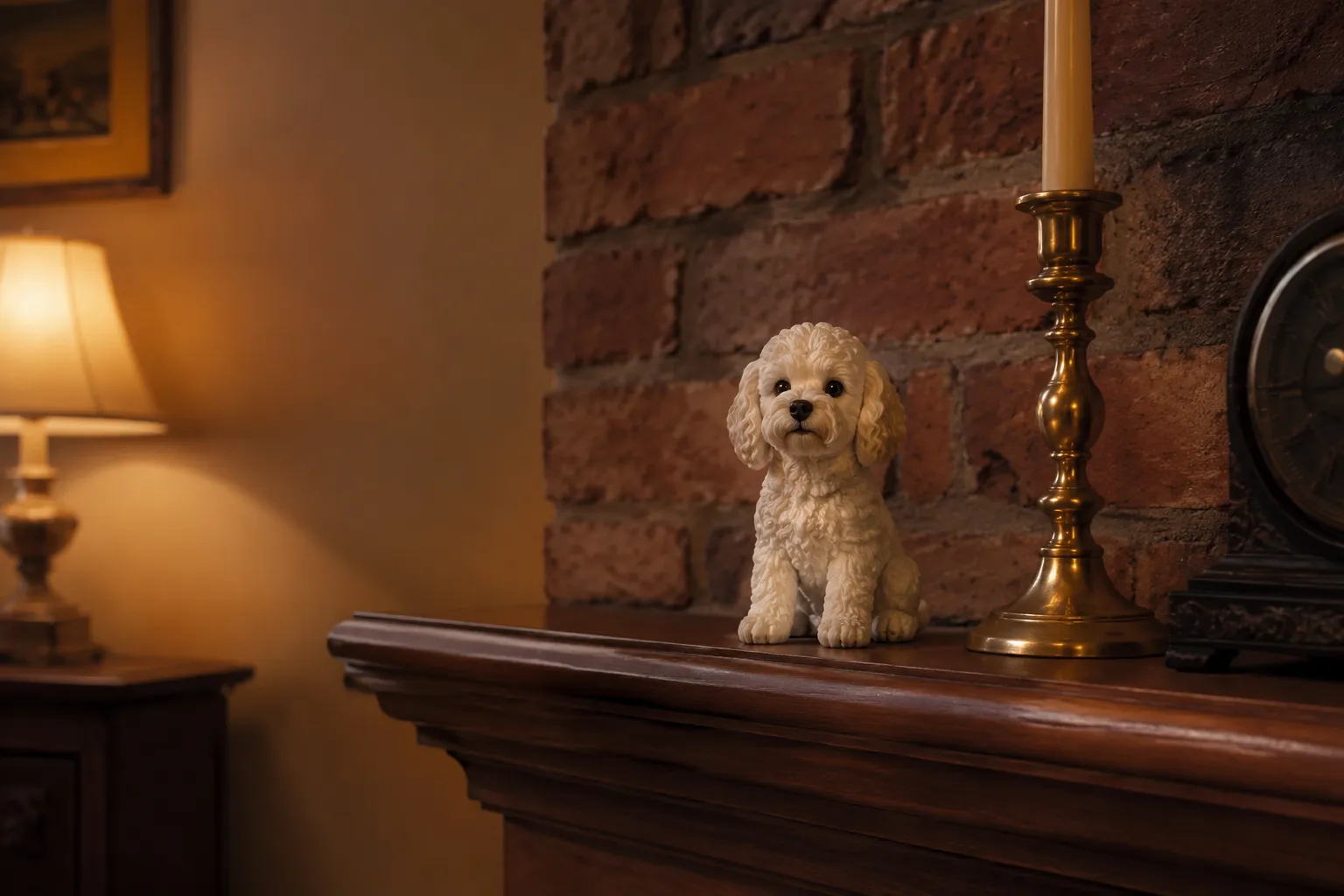
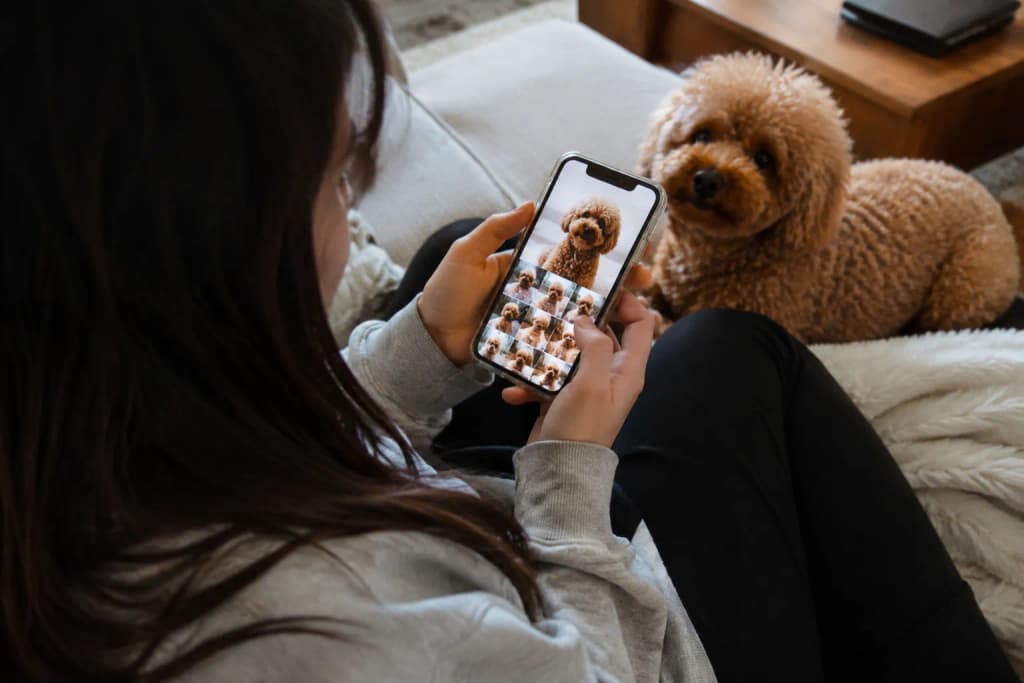
"Are you sure you can even work from these? Half of them are blurry." She slid her phone across the coffee table, thumb hovering over a silver Poodle caught mid-shake. That anxious question sits behind almost every poodle figurine from photo request we get.
Sculptors recreate a Poodle's curls by reading coat flow and body structure, not by copying individual curls. Working from several reference photos, a digital artist models the dog's silhouette, clip pattern, posture, and expression, then precision full-color 3D prints it in resin. The result captures the pet's character and texture faithfully, even when the photos are all that's left.
Quick Takeaways
- Coat flow beats curl-counting — sculptors read curl direction and mass, not every ringlet.
- Fewer sharp photos win — three clear angles outperform forty blurry burst shots.
- A Poodle's silhouette is a grooming choice — the clip you loved shapes the sculpt as much as the dog does.
- Full-color 3D printing embeds color in the resin — explore how custom pet sculptures turn flat photos into something you can hold.
- Touch matters for grief — a solid, weighty keepsake gives your hands somewhere to go.
Why Sculpting Curly Coats Isn't Really About the Curls
Here's the thing most people get backwards. When you ask someone to recreate a Poodle, you picture the curls first. The sculptor doesn't.
A Poodle's coat is a texture problem disguised as a detail problem. If an artist tried to model every single ringlet as a separate little spiral, the figurine would read as gravel from two feet away. Noise, not fur. The eye can't parse thousands of competing highlights, so the whole thing turns muddy.
What actually works is coat flow — the direction the fur travels and the way it clumps into soft masses of light and shadow. Think of it like drawing hair. You don't draw strands. You draw the shapes the strands make together. A skilled digital sculptor blocks in those larger curl masses first, then breaks the surface into medium clusters, and only suggests the finest detail where the light would actually catch it: the crown of the head, the edge of an ear, the pom on the tail.
There's a piece of biology underneath this that helps. A Poodle's curl pattern isn't random. It follows hair growth tracts — the same directional patterns every dog has, just exaggerated by the tight curl. Fur sweeps back from the muzzle, fans down the neck, breaks along the spine. Once you know the map, you can rebuild curl direction on a body panel even when one photo is soft or badly lit, because the coat has to obey that flow. Physiology fills in what the camera missed.
"You don't sculpt a thousand curls. You sculpt the ten shapes those curls make, and let the light do the rest."
The counterintuitive part: you're sculpting a haircut
This surprises almost everyone. The Poodle shape living in your memory is, to a large degree, a grooming decision. A puppy clip, a continental, a simple sporting trim. The rounded head, the clean face, the fluffy legs. Those are choices a groomer made every six to eight weeks, and they define your dog's silhouette far more than breed alone does.
So a good sculptor isn't only reading the dog. They're reading the clip. If your Poodle wore a teddy-bear trim with a rounded topknot, that geometry has to be right or the whole thing stops looking like your dog, even if the color is perfect. We've had families send a beautiful photo, then a second one where the coat was freshly groomed shorter, and the two dogs barely looked related. Same Poodle. Different haircut. It matters.
The Photos That Actually Work for a Poodle Figurine From Photo
Most guides tell you to send as many photos as possible. We'd push back on that. Quantity is not the goal — coverage and clarity are. Forty burst-mode shots of a dog shaking water off are forty blurry frames. Three sharp, well-lit photos from different angles give a sculptor more usable information than a hundred motion-smeared ones.
The single most common problem we see isn't bad cameras. It's motion blur on the coat. Curly fur is high-frequency detail, and it's the first thing to smear when a dog moves or the light is low. A crisp photo of a calm dog in daylight beats a dramatic action shot every time.
Here's what our sculptors actually look for when a photo set lands on the desk:
| What we need | Why it matters | Quick tip |
|---|---|---|
| One clear profile (side view) | Sets true body proportions and leg length | Shoot at the dog's eye level, not from above |
| One front-facing head shot | Locks in face shape, eye spacing, ear set | Natural light near a window; no flash |
| A recent grooming reference | Defines the clip and silhouette | Even a groomer's post-visit photo works |
| A photo showing true coat color | Full-color printing reproduces what it sees | Avoid orange indoor bulbs; they warp color |
| Any shot with personality | Captures posture and expression | A favorite sit, a head tilt, the way she stood |
Notice color got its own row. With full-color 3D printing, the material is the color — pigment is embedded in the resin as it prints, not added afterward. That's a huge advantage for a silver or apricot or parti Poodle, where the coat shifts subtly across the body. But it means the reference photo's color is doing real work. A photo shot under warm kitchen bulbs can turn a cool silver into a dingy tan, and the sculptor has to reverse-engineer the real shade. If you have one photo taken outdoors in shade (not direct sun, which blows out detail), send that one.
When you only have a phone full of imperfect shots
This is the reality for most families, especially with a deceased pet figurine. You don't get to reshoot. You have what you have, and half of it is blurry Christmas-morning chaos.
That's workable more often than people fear. A sculptor cross-references. A blurry photo might have perfect ear position. A dark one might show the exact tail carriage. The proportional anchors get pulled from the sharpest images, and the personality details get harvested from the rest. This is where the "portrait, not a photocopy" idea earns its keep. We're not scanning a photo. We're reconstructing a dog from evidence, the way a portrait artist has always worked.
"Grief needs an anchor. Something with weight, that stays put on a shelf when everything else about the day feels like it's moving."
— The PawSculpt Team
From Screen to Shelf: How the Sculpt Becomes Resin
People assume there's a physical carving happening somewhere. There isn't. The whole first act is digital.
A master 3D artist opens software like ZBrush or Blender and builds your Poodle as a digital sculpt — a virtual model they can rotate, zoom into, and refine from every angle. This is where the reference photos get translated. The artist blocks the body masses, checks proportions against your profile shot, establishes the coat flow, and shapes the clip. They're constantly doing proportional checks: is the muzzle-to-skull ratio right, are the eyes spaced correctly, does the topknot sit where it did in life.
At PawSculpt, you see this stage. There's a free instant AI preview on the website to start, and after a deposit, an artist shares a real 3D preview within about seven days so you can catch anything that feels off before a single gram of resin is committed. That feedback loop is the whole point — a sculpted portrait should feel like your dog to you, and only you can confirm that.
The printing itself
Once the sculpt is approved, it goes to a full-color resin 3D printer (PolyJet/MJF-style technology). Here's the part that trips people up: the color is printed into the object, voxel by voxel — a voxel being a 3D pixel, a tiny cube of material the printer places with a specific color already assigned to it. There is no painting step. No brushes, no acrylics, no white model waiting to be colored in. The apricot of the ears and the silver of the back are laid down as the piece is built, embedded in UV-cured photopolymer resin.
A few practitioner realities worth knowing:
- Layer height typically runs fine, often in the 25–50 micron range (a micron is a thousandth of a millimeter). Finer layers mean smoother curls but slower prints. There's always a tradeoff between crispness and time.
- Orientation on the print bed is a judgment call. Angle the model well and support scars land in hidden areas. Angle it poorly and you get pitting on a visible cheek. Experienced operators think about this before hitting print.
- Hollowing and drain holes come into play on larger pieces so uncured resin doesn't pool inside and so the part doesn't warp as it cures. Solid isn't always better.
- Supports are thin scaffolds that hold overhangs (like a lifted paw) during printing. They get removed afterward, and where they touched needs cleanup.
Post-processing, honestly explained
After printing, the piece is washed to clear residual resin, then fully cured under UV light so the material reaches its final hardness. Under-cure and it stays slightly tacky and soft. Over-cure and resin can grow brittle. There's a window, and hitting it is craft.
Then supports come off and those contact points get gently sanded. A technician inspects the surface under raking light — a light held at a low angle across the piece — because that's how you catch a stray support nub or a shallow print artifact that flat overhead light hides completely. Symmetry checks confirm the eyes match and the ears sit level.
The one and only manual finishing step is a clear coat: a protective varnish that seals the resin, adds a subtle sheen, and guards against UV fading over time. It doesn't add color. It protects the color that's already there and gives the curls a finish that reads like a healthy coat rather than bare plastic.
Here's a rough map of the journey so you know what's happening behind the scenes:
| Stage | What happens | Who's driving |
|---|---|---|
| Digital sculpt | Body, coat flow, and clip modeled in 3D | Master 3D artist |
| 3D preview | You review and request adjustments | You + artist |
| Full-color print | Color-embedded resin built in layers | Printer + operator |
| Wash & cure | Cleaned, then UV-hardened | Technician |
| Support removal | Scaffolds off, contact points sanded | Technician |
| Clear coat & QC | Sealed, inspected under raking light | Technician |
For timing: delivery typically runs about 27–40 days in the US and 33–47 days internationally after final payment. We won't promise faster, because rushing the cure or the QC is exactly where quality dies.
Myth vs. Reality: Curly-Coat Figurines
A few things pet owners believe that we'd gently correct.
Myth: "More photos always help."
Reality: Beyond a good coverage set, extra photos of the same angle add little. Three sharp, varied shots beat a blurry avalanche. Clarity is the currency, not volume.
Myth: "The figurine is hand-painted to match my dog's color."
Reality: There's no paint. The color is printed directly into the resin as the piece is built. A clear protective coat is the only thing applied by hand afterward.
Myth: "Every curl has to be reproduced exactly or it won't look like her."
Reality: The opposite. Copying every ringlet reads as visual noise. Recognition comes from silhouette, proportion, coat flow, and expression — the same things that make you spot your dog across a crowded park.
When the Photos Are All You Have Left
There's a specific kind of quiet that a curly coat leaves behind. Poodle fur doesn't shed like a Labrador's, so there's no tumbleweed under the couch to find months later. Owners tell us that absence hits strangely. Nothing to sweep up. Just the empty spot on the cushion.
This is where a deceased pet figurine does something a framed photo can't. Attachment theory — the framework psychologists use to describe the bonds we form — tells us those bonds don't vanish when a companion dies. They look for a new object to attach to. A transitional object, in the clinical language: something physical that carries the emotional weight of the relationship. Grief researchers have long noted that mourners often gravitate toward tangible items, and organizations like the Association for Pet Loss and Bereavement recognize how central those anchors can be to healing.
Touch is the reason a figurine works where a screen doesn't. A photo lives behind glass. A sculpted piece has weight in your palm, a cool smoothness where the resin is sealed, the faint texture of curls under your thumb. Your hands remember more than you'd expect. Petting was a hundred small motions a day, and giving those motions somewhere to land seems to quiet something. It's not magic. It's just that the nervous system trusts the hands.
We remember one order — a standard Poodle named after a jazz musician — where the family's best photo was a slightly out-of-focus shot on a porch. They apologized for it three times. But it had everything: the tilt of his head, the exact set of his ears, the topknot his groomer always rounded just so. The sculptor built the proportions from a sharper profile shot and pulled the soul from that porch photo. When the piece arrived, the daughter said it caught the way he "asked questions with his face." That's the target. Not a clone. A likeness that makes you say that's him.
Families memorialize in lots of ways, and no single one is right. Some plant a tree. Some keep the collar in a drawer. Some choose a tangible keepsake like a pet memorial figurine that sits where the dog used to sit. If you're weighing options, the American Kennel Club's guidance on coping with pet loss is a warm, practical starting point that doesn't try to sell you anything.
Caring for a Curly-Coat Figurine
A full-color resin print with a clear coat is durable, but it isn't indestructible. A little sense goes a long way.
- Keep it out of direct, all-day sun. The clear coat resists UV, but no material loves a south-facing windowsill for years. Bright room, not baking spotlight.
- Dust with a soft dry brush or microfiber cloth. Curly detail traps dust in the recesses. A cheap makeup brush works beautifully for getting into the coat texture.
- Skip harsh solvents. Water and a barely-damp cloth for anything stubborn. Alcohol and cleaners can dull the finish.
- Give it a stable shelf. Resin is tough but a hard fall onto tile can chip a thin extremity like a lifted paw or an ear tip.
Do this and the piece holds its color and detail for many years. We deliberately don't make forever-guarantees, because materials are materials — but treated reasonably, it ages gracefully.
Frequently Asked Questions
How many photos do I need for a poodle figurine from photo?
Three to five clear photos usually cover it: one side profile for proportions, one front-facing head shot for the face, and a couple that show true color and personality. A recent grooming reference helps too, since the clip defines the silhouette. Clarity always beats a big pile of blurry shots.
Can you make a figurine of a Poodle that has already passed away?
Yes, and it's one of the most common requests we handle. Sculptors reconstruct a deceased pet figurine from whatever photos exist, anchoring the proportions to your sharpest images and gathering expression and posture from the softer ones. Imperfect phone photos are workable more often than families expect.
Is the figurine hand-painted to match my dog's markings?
No paint is involved. PawSculpt uses full-color 3D printing, so the color is embedded in the resin as the piece is built, layer by layer. The only thing applied by hand afterward is a clear protective coat that seals the surface and adds a natural sheen.
Why don't sculptors reproduce every curl exactly?
Because it would look wrong. Modeling thousands of individual ringlets turns into visual noise that reads as gravel, not fur. What creates real recognition is coat flow, the clip's silhouette, and the dog's expression. Sculptors shape curl masses and let the finish and lighting suggest the fine detail.
What makes curly coats harder to sculpt than straight fur?
Curls are high-frequency, three-dimensional texture that shifts with grooming and moves constantly, so they blur in photos and resist simple copying. The skill is reading the underlying body shape and hair growth direction beneath the fluff, then rebuilding curl direction as organized masses rather than random spirals.
Ready to Celebrate Your Pet?
Every pet has a story worth preserving. Whether you're honoring a beloved companion who's crossed the rainbow bridge or celebrating your Poodle's unmistakable curls and character, a custom PawSculpt figurine — a sculpted portrait, not a photocopy — turns your photos into something you can actually hold. If you've been wondering whether a poodle figurine from photo can truly capture those curls, this is where you find out.
Start with a free instant AI preview, then review your artist's 3D preview before anything prints. Every order ships insured, tracked, and carefully packed.