
Where to Display Your Vizsla Figurine: A Beginner's Guide to Pose and Placement
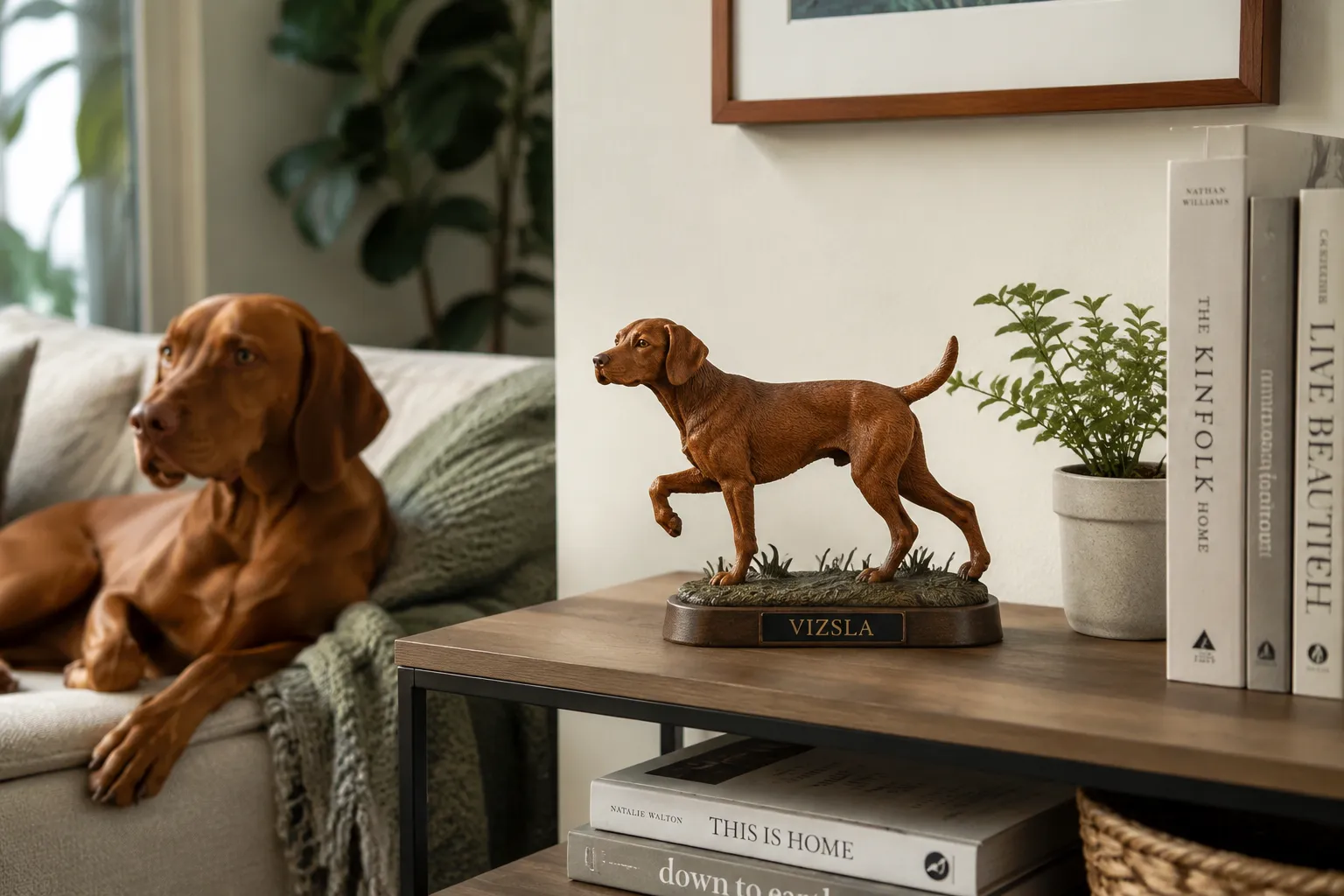
Your thumb finds the corner of the desk again—smooth, cool, empty—the spot where you keep meaning to display a pet figurine of the dog currently sprawled across your office doorway like she pays the mortgage. The Vizsla doesn't move. She just watches you work.
Quick Takeaways
- Match the pose to a behavior you'll miss most, not the most photogenic one your camera caught.
- Vizslas are "velcro dogs"—display their figurine along your daily sightlines, not tucked on a high shelf.
- Eye-level placement at 40–60 inches creates the strongest emotional anchor for most rooms.
- Full-color 3D printing captures the russet coat and lean build—see how custom Vizsla figurines are made before you order.
- Indirect light protects the finish and reads the sculpted muscle far better than harsh overhead glare.
Why a Vizsla Figurine Asks More of You Than Most
Here's the thing nobody tells you when you go looking for where to display a vizsla figurine: the breed itself changes the rules.
A Vizsla isn't a still dog. You know this. You've never once seen her hold a pose unless she was asleep or staring you down for a walk. The whole identity of the breed is motion, lean and rust-colored and impossibly close to you at all times—the original velcro dog, the one who follows you from the kitchen to the bathroom to the home office and back, who leans her whole forty-something pounds into your shin while you're on a call.
So when you set out to display a pet figurine of a dog like this, you're not decorating a shelf. You're trying to hold still something whose entire nature was never holding still.
That tension is the whole game. And it's why the generic advice—"put it on a mantel, add some greenery, done"—falls apart the second you try it with a Vizsla.
"A Vizsla figurine shouldn't look parked. It should look like she paused for one second on her way to you."
Let me introduce you to someone. One of our customers—we'll call her Marisol—came to us after losing her Vizsla, Juniper, at eleven. She told us something that stuck with our whole team: she didn't want a figurine that looked "nice on a shelf." She wanted the exact half-turn Juniper did at the top of the stairs, the one where she'd check that Marisol was still coming. That specific glance. We'll come back to Marisol, because her instinct about pose turned out to be exactly right—and it's the opposite of what most first-time buyers reach for.
The attachment science underneath the shelf
There's a real reason a figurine of your dog hits differently than a generic statue, and it's not sentiment alone.
Decades of research on the human-animal bond—much of it funded through institutions like the National Institutes of Health—points to dogs functioning as genuine attachment figures, the same psychological category we reserve for the people who make us feel safe. Your nervous system literally treated your Vizsla as a secure base. When she was nearby, your body ran calmer.
That's not a metaphor. Interaction with a bonded dog is associated with lower cortisol (the body's primary stress hormone) and a bump in oxytocin, the same bonding chemistry that runs between parents and infants.
So when you place a figurine where you'll see it, you're not just adding decor. You're giving your brain a familiar visual cue tied to that old sense of safety. The placement isn't aesthetic. It's regulatory.
That single idea—that a figurine's location does psychological work—is the lens for everything that follows.

Choosing the Pose: Figurine Pose Customization That Actually Means Something
Most people, when they think about figurine pose customization, default to the "trophy" instinct: sit pretty, chest out, head high, the show-ring stack. It photographs well. It looks proud.
And honestly? For a lot of dogs, it's the wrong choice. Especially for a Vizsla.
The trophy pose captures what your dog looked like at her most formal. But that's almost never the version you actually miss. You don't lie awake remembering the perfect sit. You remember the lean. The flop. The way she folded herself into an impossible knot on your office chair the second you stood up.
"We don't grieve the show pose. We grieve the ordinary one—the lean, the flop, the glance back."
Start with the behavior, not the photo
Here's the workflow we walk people through, and it's backward from what most do.
Don't start by scrolling for your best-lit photo. Start by finishing this sentence out loud: "The thing she always did was ___."
For Vizslas, the answers cluster in beautiful, specific ways:
- The velcro lean—full body weight against your leg
- The sit-and-stare, head tilted, demanding the walk
- The prey-pose point, one paw lifted, body frozen mid-spot (this breed's pointing heritage runs deep)
- The donut curl, nose tucked to tail, the famous Vizsla need to be warm and buried
- The half-turn glance back, the "are you coming?" check—Marisol's choice
Once you've named the behavior, then you go find reference photos that show it. Not the other way around.
This matters because of how digital sculpting actually works, which we'll get into. A 3D artist can build almost any pose, but they build it from the geometry your photos reveal. Name the pose first, and you'll photograph the right angles for it.
The pose-to-room logic most guides skip
Here's the counterintuitive part. The pose should be chosen partly based on where it will live.
A standing or pointing pose has a clear "front" and reads best when you approach it head-on—a console table you walk toward, an entryway. A curled or seated pose reads beautifully from above, which makes it perfect for a desk you look down at while you work. A lean pose, with its implied second body (you), wants a flat surface against a wall where the "leaned-into" space makes sense.
Match the pose to the sightline and the figurine stops looking placed. It starts looking caught.
This table maps the most common Vizsla poses to where they actually shine:
| Pose | Best Placement | Why It Works |
|---|---|---|
| Velcro lean | Desk edge, low shelf against a wall | The implied "leaned-on" space reads as you |
| Sit-and-stare | Entryway, eye-level console | Faces you as you arrive home |
| Point (paw up) | Open shelf, viewed head-on | Directional energy needs a clear front |
| Donut curl | Desk, nightstand, viewed from above | Top-down angle shows the tucked nose |
| Half-turn glance | Top of a bookshelf, stair landing | The "are you coming?" check needs height |
Where to Display Your Vizsla Figurine: Placement as Emotional Architecture
Okay. You've got the pose. Now the question that brought you here: where does it actually go?
The single most common mistake we see—and it's understandable—is treating the figurine like a fragile collectible to be protected and admired from a distance. People put it high, behind glass, in the "nice" room nobody sits in.
That's backward. A vizsla figurine that you rarely see does almost none of the psychological work it's capable of.
Display along your daily paths, not your display surfaces
Think about where your Vizsla actually was. Not where she looked nice. Where she physically existed in your day. The home office doorway. The kitchen threshold where she waited for the food bowl. The foot of the bed.
Those are your placement candidates. The best spot is the one your eyes already go to out of habit.
There's a reason for this rooted in neuroplasticity—your brain's ability to rewire based on repeated experience. For years, your visual system built a low-level expectation: when I glance at that doorway, she's there. That expectation didn't vanish when she did. It's still firing, and finding nothing, which is part of why empty spots ache.
Placing the figurine in that exact line of sight doesn't erase the loss. But it gives the expectation something to land on. Over weeks, the glance stops being a small wound and becomes a small hello.
"Put her where your eyes already look for her. The brain that misses her will find her there."
The 40-to-60-inch rule
For most rooms, the emotional sweet spot for displaying a pet figurine sits between 40 and 60 inches off the floor—roughly seated-eye-level to standing-eye-level for an average adult.
Below that, and the piece reads as underfoot, easy to overlook, easy to knock. Above 60 inches, and you've put your dog on a pedestal in the literal sense—you have to look up, which subtly changes the relationship from companion to monument.
Vizslas were never monuments. They were the warm weight in your lap. Keep them at the height where you'd have met their eyes.
The exception: the half-turn glance-back pose, which actually wants a little height (a stair landing, the top of a low bookcase) because the whole emotional logic is her looking back and slightly down at you, checking.
Let Marisol show you what placement does
Marisol put Juniper's figurine—that half-turn glance—on the landing of her stairs, at the height where the real Juniper used to pause.
She wrote to us a few months later. For the first week, she said, climbing the stairs gutted her every single time. By the second month, something had shifted. The figurine had stopped being a reminder that Juniper was gone and started being a reminder that Juniper had been there. Same object. Completely different emotional weight.
That shift—from absence to presence—is the entire point of placement. And it almost never happens when the figurine is hidden in a curio cabinet.
Light: the variable everyone underestimates
This one surprised even some of our team early on. Light does more for a figurine than the surface it sits on.
A Vizsla's defining visual feature is that lean, athletic build—the shoulder, the tuck of the waist, the long clean lines of a working dog. Those forms only read when light rakes across them at an angle, casting soft shadow into the muscle definition. Flat, head-on light (a ceiling fixture directly above) erases all of it and flattens your dog into a russet blob.
A few practical rules:
- Aim for indirect, angled light—a window to the side, a lamp at a 45-degree angle.
- Avoid direct, prolonged sunlight. Even UV-resistant materials hold up better out of a south-facing window's all-day glare. Display near the light, not baking in it.
- Warm-toned light (2700–3000K) flatters the russet coat; harsh blue-white LEDs can make it look gray.
That golden, russet coat is the whole reason this breed stops people on the sidewalk. Light it like it matters.
The "What to Expect" Part: How a Full-Color Vizsla Figurine Is Actually Made
If you're going to display something for the next twenty years, you should understand what you're displaying. And the honest version of this process is more interesting than the marketing version.
We're going to be real about the tradeoffs, because a figurine made by people who pretend there are no tradeoffs is a figurine to be suspicious of.
Step one: digital sculpting from your photos
It starts with a master 3D artist building your Vizsla inside sculpting software—tools like ZBrush or Blender. This is digital sculpting: shaping a virtual model on screen, pushing and pulling geometry the way you might shape clay, except nothing physical exists yet.
The artist works from your reference photos. This is why photo quality matters so much—the sculptor can only reconstruct anatomy they can actually see. They're checking proportions (a Vizsla's leg-to-body ratio is distinctly leggy and lean—get it wrong and it reads as a Lab), studying coat flow (how the short coat lies over the muscle), and matching the specific shape of your dog's head, which varies more than people think.
"Every Vizsla has a different glance. Our job is to find the one your hand remembers."
— The PawSculpt Team
Step two: full-color 3D printing
Here's where we diverge hard from how most people assume figurines get made. There is no painting step. None.
Your Vizsla is produced through full-color 3D printing—specifically the kind of multi-color additive manufacturing (building an object layer by layer) where color is jetted into the material as it prints, voxel by voxel. A voxel is just a 3D pixel: a tiny cube of material that carries its own color information.
So the russet of the coat, the lighter fawn of the muzzle, the dark of the nose, the catch-light in the eye—all of it is embedded directly into the resin as the machine builds the model. The color is part of the material itself, not a coating sprayed or layered on top afterward.
This is genuinely different from a hobby miniature that comes out as a blank model and gets color added by a person with a brush. With full-color resin 3D printing, your dog emerges from the machine already wearing her own coat.
The tradeoff, in the spirit of honesty: 3D-print resolution is excellent but it's its own look. Under close inspection you may notice an incredibly fine grain or subtle layer texture—the natural fingerprint of additive manufacturing. We think that authenticity is a feature. It's a real object made by a real process, not a flawless factory-injection toy.
Step three: post-processing (and the only manual touch)
Out of the printer, the model isn't finished. It goes through:
- Washing—clearing away uncured resin from the surface.
- Curing—a controlled UV light bath that hardens the photopolymer (light-sensitive resin) to full strength. Under-cure it and the piece stays slightly soft and brittle; over-cure it and it can grow overly rigid. There's a window, and hitting it is craft.
- Support removal—printed objects need temporary scaffolding (supports) to hold up overhangs like a lifted paw. Removing these cleanly, then gently smoothing any small contact marks (what we call support pitting), is careful handwork.
- Clear coat—the one and only manual finishing step. A protective clear varnish goes on to seal the surface, add durability, control the sheen, and guard against UV fade. This isn't adding color. It's protecting the color that's already there.
Quality control runs throughout: dimensional checks against the digital model, symmetry checks (does the left side match the right—easy to miss on a turned head), and a surface inspection under raking light (light angled low across the surface, which throws every tiny imperfection into shadow so it can't hide).
This table lays out the journey end to end:
| Stage | What Happens | Why It Matters |
|---|---|---|
| Digital sculpting | Artist models your dog in 3D software | Captures the specific pose and proportions |
| Full-color printing | Resin built layer by layer, color embedded | Coat and markings printed into the material |
| Washing & curing | Surface cleaned, UV-hardened | Sets final strength and durability |
| Support removal | Scaffolding removed, contact points smoothed | Eliminates print scars |
| Clear coat | Protective varnish applied | Seals color, controls sheen, guards UV |
| QC inspection | Dimensional, symmetry, raking-light checks | Catches what the eye misses |
If you want the specifics on materials, finishes, and how the preview process runs, it's all laid out on the custom pet figurine site—worth a look before you commit to a pose.
What photos actually work best
Since the sculpt lives or dies on your reference photos, here's what genuinely helps. This isn't generic "use good lighting" advice—it's what our sculptors actually wish they got more of.
| Photo Angle | What It Captures | Pro Tip |
|---|---|---|
| Straight-on side profile | True body proportions, the lean line | Get the dog standing level, not on a slope |
| Front of the face, eye level | Head shape, eye spacing, expression | Crouch to their height—shooting down distorts |
| Three-quarter turn | The transition the sculptor needs | This is the single most useful angle |
| Close-up of markings | White chest patch, any unique spots | Natural daylight, no flash washout |
| The actual pose you want | Body geometry for that specific posture | Even a blurry one helps—reference, not art |
The biggest mistake people make? Sending five photos all from the same angle, all looking down at the dog. Sculptors need to walk around your Vizsla. Give them the turn.
For breed-accurate proportions, the American Kennel Club's Vizsla standard is a genuinely useful reference—it describes the lean, "ready to work" build that separates a Vizsla from a Weimaraner or a Lab, and it can help you confirm a sculpt feels right.
Styling the Display: Texture, Weight, and the Senses
Let's talk about the part that turns a placed figurine into a small shrine to an ordinary, extraordinary dog.
Anchor it in texture
A Vizsla was, above all, a tactile creature. That short coat—warm, almost suede-like, the strange smooth-then-velvety feel under your palm. The surprising warmth of the body (the breed runs hot, which is exactly why they bury under blankets).
When you stage the display, lean into texture, because touch memory is some of the longest-lasting memory you have.
- Set the figurine on a small piece of natural material—a slice of warm-toned wood, a flat stone, a square of linen.
- Avoid cold, hard, glossy bases (glass, mirror, slick acrylic). They fight the warmth the breed embodied.
- A folded scrap of her actual blanket underneath is allowed to wreck you a little. That's the point.
The figurine itself has a real, satisfying heft—solid cured resin under your clear-coated fingertips, cool at first touch then warming in your hand. Pick it up sometimes. It's not a museum piece behind a rope. It's meant to be held.
One object, not twelve
The instinct to surround the figurine with everything—the collar, the tags, three framed photos, a candle, dried flowers—is understandable and usually a mistake.
Visual clutter scatters the eye. A single meaningful companion object (just the collar, or just one photo) lets the figurine stay the focal point. Restraint reads as reverence. A crowded shelf reads as a junk drawer of grief, and your dog deserves better than to compete for attention.
A note for living-dog displays
Not every figurine is a memorial, and we love that. Plenty of people commission a figurine of a Vizsla currently chewing a shoe in the next room—a birthday, a "gotcha day," a celebration of a dog who's gloriously alive.
If that's you, the placement logic flips slightly toward joy. Put it somewhere you'll catch it alongside the real dog. The desk, where she naps while you work. The shelf above her bed. There's a quiet delight in glancing up and seeing both the dog and her tiny twin, the living velcro lean and the captured one.
Common Mistakes That Quietly Ruin the Effect
A few patterns we see again and again. None are fatal. All are fixable.
Displaying it too high. Covered this, but it's the number one issue. You made her a monument. Bring her back down to companion height.
Harsh overhead light. Flattens the sculpt, washes the russet to gray. Switch to angled, warm, indirect light and watch the whole piece come alive.
The "good room" trap. Putting it in the formal space you never enter. The figurine works through repeated glances. Banishing it to the unused room starves it of the very thing that makes it heal.
Choosing the trophy pose by default. If you didn't actively choose the show-ring sit, you probably defaulted into it. Ask the real question: what did she actually do?
Direct sun all day. UV-resistant doesn't mean UV-proof. Near the window, not in the blast zone.
Over-cluttering. One companion object. Trust the figurine to carry the moment.
What to Expect Emotionally (The Part No One Warns You About)
We'd be doing you a disservice if we only talked about lighting angles.
Here's the honest emotional arc, drawn from years of customers telling us what actually happened after the box arrived.
For memorial pieces, the first sight is often hard. Sometimes harder than expected. Seeing your dog's specific glance rendered in three dimensions can crack something open—organizations like the Association for Pet Loss and Bereavement note that tangible reminders frequently trigger an acute wave of grief before they bring comfort. That wave is normal. It's not a sign you made a mistake. It's a sign the likeness landed.
Give it time in place. Most people describe the same shift Marisol did: a turn, somewhere in the first month or two, where the figurine stops being a fresh wound and becomes a settled comfort. The object doesn't change. Your relationship to it does. That's the neuroplasticity again—your brain slowly re-encoding that spot from "she's gone" to "she was here, and that was real, and it was good."
And the guilt, the relief, the strange flashes of something almost like anger—all the messy stuff you're not supposed to admit feeling—those are allowed too. A figurine doesn't ask you to have tidy feelings. It just sits there, at companion height, in the warm angled light, being the shape your hand remembers.
"The figurine doesn't fix the missing. It just gives the missing somewhere to rest."
Frequently Asked Questions
Where is the best place to display a Vizsla figurine?
Put it along the paths you walk every day—the office doorway, the kitchen threshold, the foot of the bed—at roughly 40 to 60 inches high. The best spot is the one your eyes already drift toward out of habit. Add warm, angled, indirect light and keep it out of all-day direct sun.
What pose should I choose for my figurine?
Skip the show-ring sit unless you actively love it. Instead, name the everyday thing your Vizsla always did—the lean, the glance back, the donut curl—and build the pose around that. Match the pose to the placement so a standing dog faces you head-on and a curled dog can be viewed from above.
Are PawSculpt figurines hand-painted?
No. They're made with full-color 3D printing, where the color is embedded into the resin as the model is built, voxel by voxel. There's no brush and no painting step. The only manual finishing is a protective clear coat that seals the surface and guards against UV fade.
What photos give the sculptors the most to work with?
A clean side profile, a face shot taken at your dog's eye level, and—most useful of all—a three-quarter turn. Crouch down to their height instead of shooting from above, use natural daylight, and include a close-up of any unique markings.
Will my figurine fade or get damaged over time?
The full-color resin is UV-resistant and sealed with a protective clear coat, so it holds up well for years. That said, UV-resistant isn't UV-proof. Display it near a window rather than baking in direct afternoon sun, and dust it gently with a soft, dry cloth.
Can I get a figurine of a dog who's still alive?
Absolutely, and many people do—for birthdays, adoption anniversaries, or just because. For living-dog displays, place the figurine somewhere you'll see it alongside the real thing, like your desk or the shelf above her bed.
Ready to Celebrate Your Pet?
Every pet has a story worth preserving. Whether you're honoring a Vizsla who's crossed the rainbow bridge or celebrating the velcro shadow currently leaning on your leg, the right pose and the right spot turn a keepsake into a daily moment of connection. When you're ready to display a pet figurine that captures your dog's exact glance, lean, or curl, our master 3D artists can bring it to life in full color.
Visit pawsculpt.com to learn more about our full-color 3D printing process, preview turnaround, and quality guarantee.