
How to Pose and Place a Custom French Bulldog Figurine So Its Squish Shines
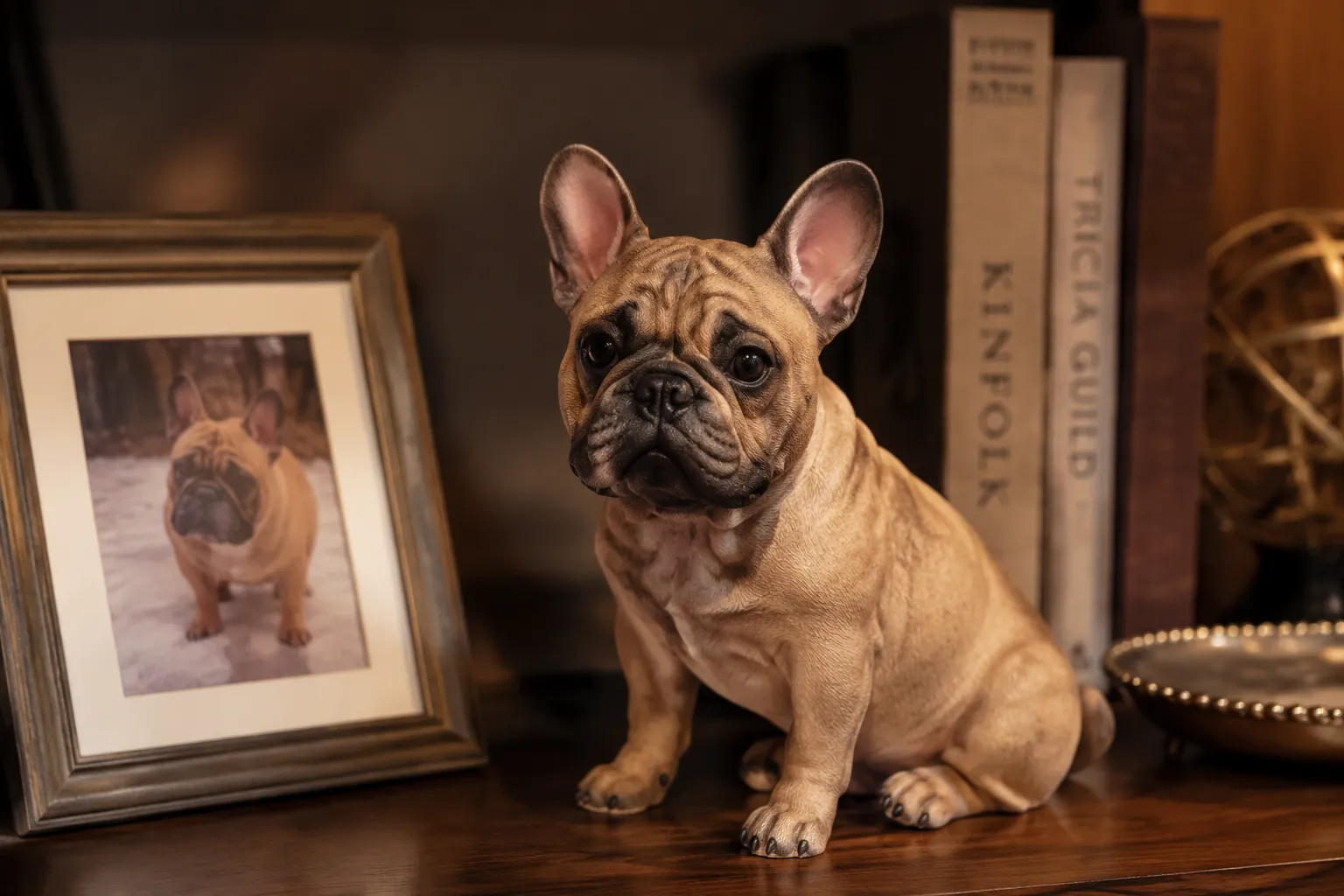
Ever watched a French Bulldog plop down in the middle of a pet store aisle, all wrinkled brow and barrel chest, refusing to budge? That squish is the whole personality. A custom french bulldog figurine only shines when it captures it—and most miss the mark by a mile.
Quick Takeaways
- Pose for the squish, not the standard — a slight head tilt reads more "Frenchie" than a show stance
- Low, frontal display beats high shelves — brachycephalic faces lose their charm viewed from above
- Raking light is your secret weapon — side lighting makes wrinkles and coat texture pop
- Send photos at the dog's eye level — angle matters more than megapixels for custom pet figurines that actually look like your dog
- Full-color 3D printing captures markings directly — no paint to chip, just embedded color under a clear coat
Why a Frenchie Is the Hardest Breed to Get Right (And Why That Matters for You)
Here's something nobody tells you before you order: French Bulldogs are one of the trickiest breeds to translate into three dimensions. Not because they're complicated. Because they're deceptively simple.
A Border Collie has flowing coat and dramatic markings that hide small errors. A Frenchie has almost none of that. Short coat. Compact body. Which means every proportion is exposed. Get the muzzle 10% too long and suddenly you're looking at a Boston Terrier. Round the skull too much and it's a Pug. The margin for error is brutal.
We've sculpted thousands of pets, and we'll be real—the brachycephalic sculpt detail on a Frenchie gets scrutinized harder than almost any other breed. Owners know that face. They've memorized the exact gap between the eyes, the precise fold above the nose, the way one ear sits a hair differently than the other.
"With a Frenchie, you're not sculpting a dog. You're sculpting the one specific dog your customer fell in love with."
So what does this mean for you, practically? It means the choices you make—pose, photo angle, where you put it on the shelf—matter more for this breed than almost any other. A great Frenchie figurine that's posed wrong or lit badly looks generic. A thoughtfully posed one stops people mid-conversation.
Let's get into how to make yours the second kind.
The brachycephalic problem, explained simply
"Brachycephalic" just means short-skulled—the flat-faced look you see in Frenchies, Pugs, and Bulldogs. The defining features all live in a tiny zone: the wrinkled muzzle, the wide-set bulging eyes, the undershot jaw, those signature bat ears.
That compression is the challenge. On a long-snouted breed, features spread out and breathe. On a Frenchie, they're packed into a few square centimeters, and the relationships between them are everything. Move the eyes 2mm apart and the whole expression changes.
This is also why viewing angle becomes critical, which we'll come back to when we talk placement. A flat face has a "sweet spot" where it reads correctly, and angles outside that spot flatten or distort it.
Choosing the Pose That Makes the Squish Sing
Most people default to the "good dog sitting at attention" pose. It's fine. It's also the most forgettable choice you can make, and after reviewing what actually delights owners versus what gets a polite "oh, nice," we've got opinions here.
The pose is your single biggest lever for personality. Let's rank what works.
Our top pick: the relaxed sit with a head tilt
This is the standout, and it's not close. A relaxed sit—weight settled, chest forward, maybe a slight slump—captures the Frenchie attitude. Add a 10–15 degree head tilt and you've got that curious, slightly-judging expression every Frenchie owner knows.
Why it works from a sculpting standpoint: the tilt creates asymmetry, and asymmetry reads as life. A perfectly symmetrical pose looks like a trophy. A tilt looks like your dog just heard the treat bag.
There's actually a cognitive reason this lands so hard. Our brains are wired with a fusiform face area that lights up for familiar faces and their micro-expressions. A head tilt triggers the same recognition response you get from a real glance. That's the little jolt of "that's him" people feel when they unwrap it.
"Symmetry looks like a trophy. A head tilt looks like your dog just heard the treat bag open."
Worth considering: the play bow
Front down, rear up, that universal "let's go" signal. It's dynamic and full of joy, and it shows off the Frenchie's compact athleticism. The standout benefit is energy—it captures a living dog mid-moment.
The tradeoff, and this is the practitioner part: dynamic poses need more support structures during printing (we'll explain those in a minute), and the contact points can leave faint marks that need extra cleanup. Worth it for the right dog. Just know it's a more involved sculpt.
The sploot (the one that surprised us)
You know the sploot—back legs kicked straight out behind, belly flat on the floor. Pure Frenchie. We didn't expect this to be as popular as it's become, but it's developed a real following, and honestly it's grown on us.
What makes it work: it's specific. It's not a generic dog pose, it's a Frenchie-and-a-few-other-breeds pose. Specificity is what separates a figurine of your dog from a figurine of a dog. The flat orientation also happens to print beautifully with minimal support scarring on the visible top surfaces.
Poses we're not huge fans of (for this breed)
- The rigid show stance — technically correct, emotionally flat. Frenchies aren't show-stance dogs.
- Standing on hind legs — cute idea, but it fights the breed's low center of gravity and looks unnatural
- Anything jumping/airborne — the stocky build doesn't sell "lightness," and it's a support nightmare
Here's the table we wish someone had handed us before our first Frenchie order:
| Pose | Personality It Captures | Print Difficulty | Best For |
|---|---|---|---|
| Relaxed sit + head tilt | Curious, cheeky | Low | Most Frenchies, first-timers |
| Play bow | Joyful, energetic | Medium-High | Young, playful dogs |
| Sploot | Goofy, signature | Low | Dogs known for splooting |
| Lying down, chin on paws | Calm, sweet | Low | Senior dogs, memorials |
| Standing alert | Confident | Low-Medium | Working personalities |
Notice the chin-on-paws option in there. For memorial pieces especially, that quiet resting pose carries a tenderness the upright poses can't. We'll touch on that later, because the emotional weight of pose selection deserves its own honest conversation.
How We Actually Make These: From Your Photo to Full-Color Resin
You can't pose or place a figurine well without understanding what it is. So let's pull back the curtain on the real process—the shop-floor version, not the marketing version. This is where understanding the craft helps you make better choices.
Step one: photo to digital sculpt
Everything starts with your photos. A master 3D artist studies them and digitally sculpts your dog from scratch in software like ZBrush or Blender—building the form vertex by vertex, checking proportions against your reference images the whole way.
This is digital work. No clay, no carving. The artist rotates the model in 3D space, checking the muzzle length against the skull, the ear set, the eye spacing—all those brachycephalic relationships we talked about. For a Frenchie, they're constantly cross-referencing multiple angles because that flat face hides nothing.
This is exactly why your photo angles matter so much. More on that in the photo section, but here's the preview: the artist can only sculpt what the camera saw.
"Every wrinkle on a Frenchie's face is a fingerprint. Our job is to read it right the first time, because owners always know."
— The PawSculpt Team
Step two: full-color 3D printing
Once the digital sculpt is approved, it goes to a full-color 3D printer. Here's the part most people get wrong when they imagine the process: the color isn't added afterward. It's printed directly into the material.
We use full-color resin printing—PolyJet/MJF-style technology where the machine deposits color voxel by voxel (a voxel is just a 3D pixel). Your dog's brindle pattern, the white chest patch, the pink of the nose—all of it is embedded in the resin as it prints. The color is part of the material, not a coat on top.
This is genuinely different from the old model of printing a white figure and painting it. There are no brushes involved anywhere in our process. The pigment lives inside the cured photopolymer—that's a resin that hardens under UV light—which is why the color won't chip or flake the way surface paint does.
Step three: the orientation and support decisions
Before printing, we decide how to orient the model on the build plate. This is more art than people realize. Orientation affects everything—surface quality, where support marks land, how much detail survives on the face.
Quick jargon check: supports are temporary scaffolding the printer builds to hold up overhanging parts (like ears or a tucked paw) so they don't sag or fall during printing. The catch is that wherever a support touches the model, it leaves a tiny mark when removed—we call it support scarring or pitting.
The shop-floor heuristic: never let supports land on the face. We orient Frenchies so the support contact points hit the belly, the underside, the back—places you won't see on display. This is also why we asked you to think about display placement early. We're optimizing the visible surfaces.
Layer height (how thick each printed slice is) typically runs in the 25–50 micron range for detailed figures—a micron is a thousandth of a millimeter. Finer layers mean smoother surfaces and crisper wrinkles, but slower prints. For a face this detailed, we lean fine.
Step four: post-processing and the clear coat
After printing, the figure gets washed (clearing away uncured resin), fully cured under UV light, and then supports are carefully removed and any contact points are gently sanded smooth.
The one and only manual finishing step is the clear coat—a protective varnish that seals the surface, deepens the colors, and adds a subtle sheen. Think of it like the topcoat on a car: it protects the color underneath and makes it glow. That's it. No painting, no hand-coloring. Just print, clean, cure, protect.
The result has an honest quality to it. You'll see a fine, natural texture from the layering up close—we think that's a feature, not a flaw. It reads as real and crafted, not injection-molded plastic-perfect.
A reality check on durability
Let's be honest about tradeoffs. Resin figures are detailed but they're not toys. UV-cured resin can be a little brittle—a drop onto tile can chip a thin ear or paw. The clear coat helps, and our materials are UV-resistant so colors hold up to ambient light, but this is a display piece, not a chew toy.
This durability reality directly shapes where you should put it. Which brings us to the part most guides completely skip.
Display Placement: The 90% of Owners Get Wrong
Here's the counterintuitive truth that took us years to fully appreciate: where and how you display a Frenchie figurine matters almost as much as the sculpt itself.
Most people unwrap their figurine and put it on the highest, most "honored" shelf in the house. Top of the bookcase. Above the TV. And then they wonder why it looks a little... off. A little generic.
The problem is geometry. Brachycephalic faces are designed to be seen at or near eye level, straight on. When you look up at a flat-faced dog, you lose the eyes into the brow and the whole expression collapses. When you look down on it from a high shelf, you flatten the muzzle into a pancake.
The eye-level rule
Place your figurine where your gaze naturally meets it head-on. A console table. A desk. A mantel that's roughly chest-height. The mid-shelf of a bookcase, not the top.
The "so what": this is the angle the artist sculpted for. The sweet spot where the eyes, muzzle, and ears all resolve into the expression you recognize. Display it there and it looks alive. Display it above your sightline and you're seeing an angle the squish was never meant to be viewed from.
One customer told us she'd had her figurine on a high shelf for a month, feeling vaguely disappointed, then moved it to her desk and "suddenly it was him again." Nothing changed but the viewing angle. That's the whole game.
Lighting: the raking light trick
This is the insider move almost nobody knows. Side lighting—what we call raking light—is what makes texture pop.
Raking light just means light coming from the side at a low angle, rather than straight on. We use it in quality control to inspect surfaces, because it throws tiny shadows that reveal every wrinkle, fold, and bit of coat texture. The exact same trick works on your shelf.
Here's how to apply it:
- Position a small lamp or LED to one side of the figurine, not directly overhead
- Aim for a 30–45 degree angle so light grazes across the surface
- Avoid flat, head-on lighting (like a ceiling light directly above)—it erases all the dimension
Flat top-down light is the enemy. It washes out the very wrinkles that make a Frenchie a Frenchie. Side light brings them back into relief. Try it tonight with a phone flashlight—move it around your figurine and watch the face come alive at the right angle.
"Move a lamp six inches to the side and your figurine stops being an object and starts being your dog."
The spatial story: where it belongs in your home
Think about proximity. A figurine across a large room reads as decoration. The same piece on the corner of your desk, within arm's reach, becomes a companion you glance at twenty times a day.
There's real psychology here. Objects we keep in our intimate spatial zone—the few feet around where we work and rest—get encoded differently in memory. They become what attachment researchers loosely call "transitional objects": physical anchors for an emotional bond. The closer it sits to where you live your hours, the more it does its quiet work.
For a lot of families, the right spot ends up being somewhere with a small absence to fill. The corner of the desk where he used to sleep. The end of the couch nobody sits on anymore. We've heard this from countless customers—the figurine doesn't just decorate a space, it answers one.
| Placement Spot | Viewing Angle | Lighting Potential | Verdict |
|---|---|---|---|
| Desk corner | Eye-level, frontal | Easy side lamp | Best overall |
| Chest-height mantel | Near eye-level | Good with sconce | Excellent |
| Mid bookshelf | Eye-level | Often flat | Good, add light |
| Top of tall shelf | Looking up | Usually overhead | Avoid |
| Windowsill | Variable | Backlit risk | Risky—glare |
A note on that windowsill: backlighting throws the face into shadow and direct sun, over years, is one thing even UV-resistant resin doesn't love. Pretty spot, wrong physics.
What Photos to Send (This Determines Everything)
Circling back to that promise from the process section. The single biggest factor in whether your figurine nails the squish isn't our sculptors' skill—it's your reference photos. We can only build what the camera captured.
After thousands of orders, the pattern is dead clear: good photos make great figurines, and there's no skill on our end that fully overcomes bad ones.
Get down to their level
The number one mistake: shooting from human standing height, looking down. This is the killer for brachycephalic breeds. A top-down photo distorts the muzzle and hides the eyes—exactly the features we need most.
Get on the floor. Phone at the dog's eye level, straight on. Yes, you'll look ridiculous. Do it anyway. This one change improves more sculpts than any camera upgrade ever could.
Cover the angles
We need to understand a 3D form, so give us 3D information:
- Straight-on front — the money shot for the face and eye spacing
- Full profile (side) — critical for muzzle length and that brachycephalic skull shape
- Three-quarter view — the angle between front and side, fills in the transitions
- Top-down of the body — helps us read the back and how the body sits
- Any markings close-up — brindle patterns, patches, that one weird spot
Light it like we'd light it
Soft, even, natural light is your friend. Window light on an overcast day is honestly ideal—bright but diffused, no harsh shadows hiding detail. Avoid direct flash (flattens everything and creates glowing eyes) and harsh noon sun (blows out the lighter fur).
For coat color accuracy, this matters a lot. Since our full-color printing reproduces exactly what we can see in your photos, color-accurate lighting means color-accurate figurine. A photo under warm yellow lamplight will read warmer than your dog actually is.
Here's a quick reference table:
| Shot | Why We Need It | Common Mistake |
|---|---|---|
| Front, eye-level | Face, eye spacing | Shot from above |
| Full profile | Muzzle, skull shape | Dog turned slightly |
| Three-quarter | Form transitions | Skipped entirely |
| Markings close-up | Color accuracy | Blurry, dark |
| Whole body | Proportions, pose | Cut-off legs |
The American Kennel Club's French Bulldog breed standard is also a useful reference for understanding the proportions that define the breed—handy if you want to point us toward features you especially want emphasized. (Though we always prioritize your dog's quirks over the textbook standard. A real Frenchie's slightly-off ear is the whole point.)
What We Wish We Knew Sooner
A candid sidebar from our team—the stuff we learned the hard way so you don't have to.
- The "perfect" pose isn't the goal. Early on we chased technically flawless, balanced poses. They looked like merchandise. The slightly-imperfect, caught-in-a-moment poses are the ones that make people cry happy tears. Lean into your dog's specific weirdness.
- Customers underestimate how much placement changes things. We used to think our job ended at shipping. Now we include placement guidance, because we watched too many beautiful pieces get buried on high shelves where the face couldn't be read.
- Photos beat everything. We wish we'd hammered this from day one. A phone photo taken at floor level beats a professional photo taken from standing height. Angle over equipment, always.
- The clear coat sheen is a personal preference. Some folks love a glossy finish, others want it subtle. It's worth knowing your options exist before you assume there's only one look. The folks at our contact page can walk you through it.
- Memorial pieces need different conversations. When a figurine is honoring a dog who's passed, the pose carries enormous weight. We've learned to slow down and ask gentle questions rather than rush. There's no "redo" on grief.
The Emotional Weight of Getting It Right
Let's talk about the part that's bigger than technique.
For a lot of people, this figurine isn't a decoration. It's a stand-in for a presence. And French Bulldogs, with their almost human expressiveness, forge particularly intense bonds—their flat, forward-facing faces actually trigger the same caregiving responses in our brains that human baby faces do. That's not sentimentality. It's neuroscience. The breed is practically engineered to live in our hearts.
So when the figurine captures the squish right, something happens that's hard to describe. We've had customers tell us they reached out to touch the head the way they used to. That they keep it where they can see it from their pillow.
"A figurine that nails the squish doesn't fill the empty corner. It lets you sit with what was there."
For memorial pieces, the science of grief is worth understanding. Holding a tangible object linked to a lost loved one can genuinely help with what psychologists call "continuing bonds"—the healthy maintenance of a relationship with someone who's gone. It's not about not moving on. It's about carrying them with you as you do. The Association for Pet Loss and Bereavement (aplb.org) has thoughtful resources if you're navigating that grief.
Some families plant a garden. Some keep a collar on a hook by the door. And some choose a custom French bulldog figurine posed exactly the way their dog used to wait for them—a physical anchor for a bond that didn't end. There's no wrong answer. There's only what helps you.
This is why we obsess over the squish. Because for the person who ordered it, that wrinkle above the nose isn't a detail. It's a memory made solid.
What to Expect From the Process
Without getting into specifics that change over time, here's the general arc of how a custom Frenchie figurine comes together:
- You share photos following the angle and lighting guidance above
- A master artist digitally sculpts your dog, paying close attention to that brachycephalic face
- You review a preview of the digital sculpt and request adjustments
- Once approved, it prints in full-color resin with careful orientation
- Post-processing and clear coat finish the piece
- It ships to you ready to display
For current turnaround times, revision details, finish options, and guarantees—those evolve, so check pawsculpt.com or the FAQ page for the latest. We'd rather send you to the source than quote you something that might've changed.
A word on caring for it once it arrives: keep it out of direct sun, dust it gently with a soft dry cloth (skip the chemical sprays—they can dull the clear coat over time), and give it a stable spot where it won't take a tumble. Treat it like the keepsake it is and it'll hold its color and detail for many years.
Bringing It Home
Go back to that pet store aisle—the Frenchie planted in the middle of it, wrinkled and stubborn and utterly itself. That specific squish, that exact attitude, is what you're trying to hold onto.
The figurine is only half the equation. Pose it for personality over perfection. Set it at eye level where the face resolves the way it's meant to. Throw a little side light across it and watch the wrinkles wake up. Put it close—on the desk, the nightstand, the corner that's felt a little empty. Then let it do its quiet work.
Because in the end, a custom french bulldog figurine done right isn't an object on a shelf. It's that face, looking back at you from across the room, exactly the way you remember it.
Frequently Asked Questions
What pose works best for a custom French Bulldog figurine?
A relaxed sit with a slight head tilt is our top pick. The tilt creates asymmetry, and asymmetry reads as life—it captures that curious, slightly-judging Frenchie expression. Rigid show stances are technically correct but emotionally flat. For senior or memorial pieces, a calm lying-down pose with chin on paws carries a special tenderness.
Where should I display my French Bulldog figurine?
At eye level, viewed straight on. A desk corner, chest-height mantel, or mid-bookshelf works beautifully. Avoid high shelves—brachycephalic (flat-faced) breeds lose their expression when you look up at them, and the muzzle flattens when viewed from above. The angle the artist sculpted for is the one you want to recreate.
What photos should I send for the best result?
Get on the floor and shoot at your dog's eye level—this is the single biggest factor. Include a straight-on front shot, a full profile, a three-quarter view, and close-ups of any markings. Use soft, even light (overcast window light is ideal) and skip the flash. Angle matters far more than camera quality.
Are PawSculpt figurines hand-painted?
No. We use full-color 3D printing, where the color is embedded in the resin as the piece is printed—voxel by voxel, not brushed on afterward. The only manual step is applying a protective clear coat that seals the surface and deepens the colors. Because the color is part of the material, it won't chip or flake like surface paint.
How do I make the wrinkles and texture stand out?
Use side lighting, what we call raking light. Position a small lamp or LED to one side at a 30–45 degree angle so the light grazes across the surface. This casts tiny shadows that bring out every wrinkle and bit of coat texture. Flat overhead light does the opposite—it washes the detail away.
Is resin durable enough for everyday display?
It's durable for display but it's not a toy. UV-cured resin can be somewhat brittle, so a drop onto a hard floor can chip a thin ear or paw. Our materials are UV-resistant so colors hold up to ambient light, but keep it out of direct sun and give it a stable spot. Dust gently with a soft dry cloth.
Ready to Celebrate Your Pet?
Every pet has a story worth preserving. Whether you're honoring a beloved companion who's crossed the rainbow bridge or celebrating your Frenchie's stubborn, squishy, utterly unrepeatable personality, a custom PawSculpt figurine captures the details that make your dog one-of-a-kind—right down to that wrinkle above the nose.
Visit pawsculpt.com to learn more about our full-color 3D printing process, preview turnaround, revision options, and quality guarantee—so your custom French Bulldog figurine comes out exactly the way you remember them.