
The Photo You Finally Framed: Finding Your Russian Blue in a Circle of Others
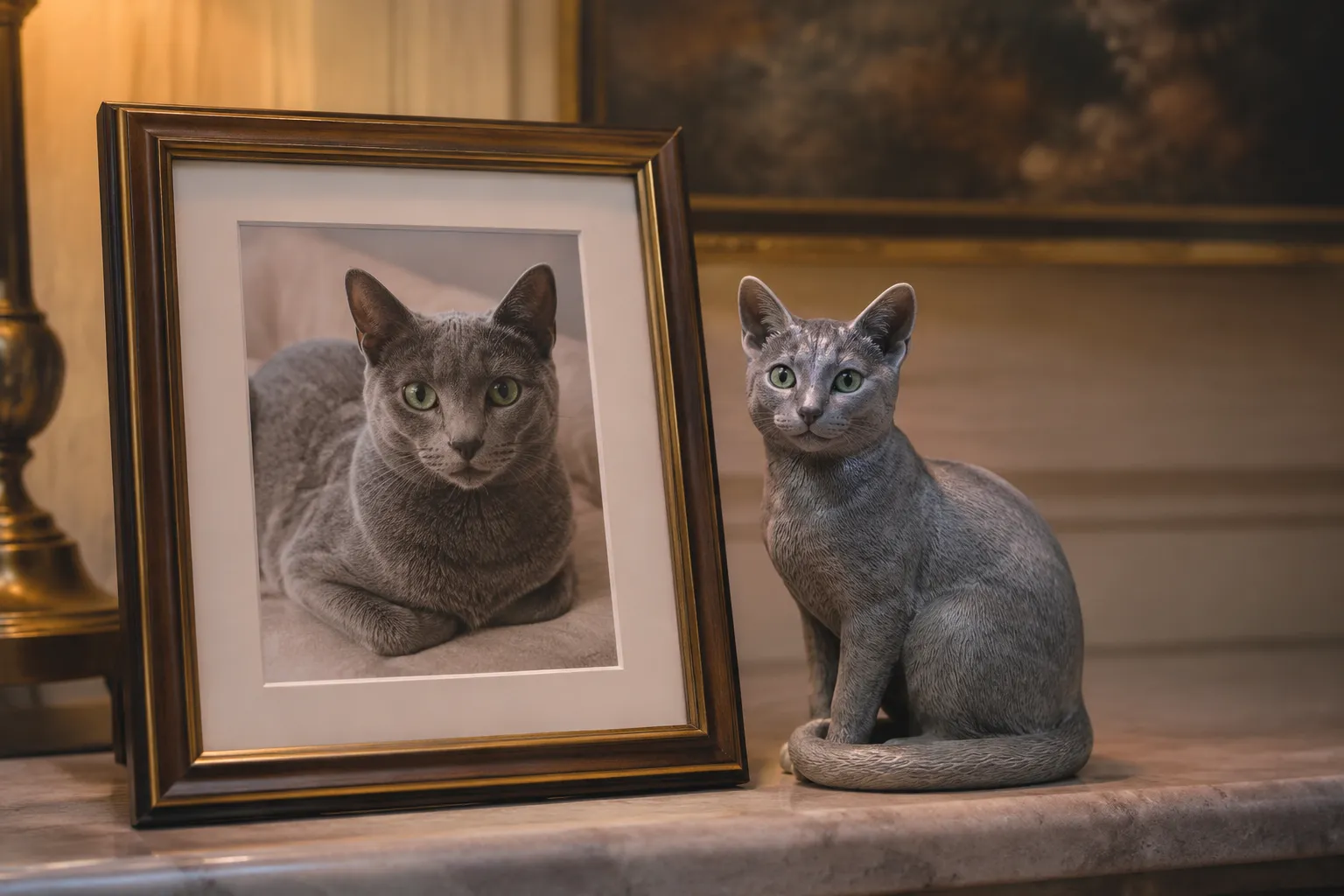
What does Russian Blue loss look like at 7 a.m.? It looks like an empty patch of windowsill where silver fur used to catch the morning light, turning gray into something closer to pewter and smoke.
Quick Takeaways
- Russian Blue grief feels uniquely quiet — their reserved, one-person bond leaves a specific kind of absence behind
- A pet grief support group breaks isolation — sitting in a circle of others who "get it" accelerates healing
- The acceptance stage isn't forgetting — it's carrying the bond differently, with less weight and more light
- Framing a photo is a small sacred ritual — choose the image that shows their soul, not just their face
- Tangible keepsakes anchor memory — many families find comfort in custom pet figurines that hold a pet's exact silver coat and copper eyes
The Particular Hush of Losing a Russian Blue
Here's something nobody warns you about. The grief of losing a Russian Blue arrives in a different register than the grief of losing a more boisterous animal.
These cats choose. They don't scatter their affection across the whole household. They pick one person, usually, and pour everything into that single channel. So when they go, the loss isn't loud. It's the disappearance of a presence that followed you from room to room without a sound.
You feel it in the negative space. The cool spot on the bed that no longer warms. The shoulder that no longer carries a quiet gray weight while you make coffee. The plush double coat that you could press your face into, dense as velvet, gone from the air.
"Russian Blues don't fill a room with noise. They fill it with presence. That's what you miss most."
We've worked with thousands of pet families at PawSculpt, and the Russian Blue parents tell us the same thing again and again. Their cat wasn't a pet. Their cat was a witness. A silent companion who saw them on their worst days and stayed anyway.
That's the spiritual contract these cats make. They give you their full attention in exchange for yours. And when the contract ends, the silence that follows isn't empty. It's full of everything they used to be.
Why the "Reserved" Breeds Leave Sharper Edges
Most grief guides treat all pet loss the same. That's a mistake.
A dog who greeted every guest, a cat who napped on every lap, leaves a loss that's spread thin across many memories. A Russian Blue leaves a concentrated one. The bond was narrow and deep, like a well. And wells take longer to fill.
The emerald-green eyes that opened slowly when you walked in. The way they tilted their head and considered you before deciding to approach. That deliberation was love. They weren't easy with everyone, which made their ease with you mean something.
So if your friends seem confused by how hard you're taking this, here's the truth. They're measuring your loss against a friendly golden retriever. You're mourning a soul that chose you specifically. Those aren't the same math.

The Feeling You're Afraid to Say Out Loud
Let's talk about the thing you've been carrying alone.
You're terrified of forgetting. Not forgetting that they existed, but forgetting the small things. The exact pitch of their rare meow. The specific weight of them settling against your ribs at night. The way their fur shifted from slate to silver depending on how the light hit.
The fear of forgetting is one of grief's most isolating tricks. And almost nobody admits to it.
Here's what we've learned from families we've worked with. The fear of forgetting often hits hardest around the three-to-six week mark, right when the acute shock fades and the world expects you to be "better." You're not better. You're just newly afraid that the memories are already softening at the edges.
This is normal. More than normal. It's a sign of how much you loved.
"The fear of forgetting isn't a betrayal of memory. It's proof of how desperately you want to keep it."
And here's the counterintuitive part. The harder you grip at the memories, the faster they seem to slip. Trying to force yourself to remember everything at once creates anxiety, and anxiety blurs recall. The memories return more clearly when you stop chasing and start anchoring.
Anchoring means giving the memory a physical home. A photo. An object. A small ritual that calls the memory back without you having to summon it from sheer willpower.
When Grief Comes Tangled with Guilt
For many of you, the fear of forgetting sits right next to guilt.
Maybe you were at work the day they declined. Maybe you waited a day longer than you should have, or a day less. Maybe in the exhausting final weeks you felt a flicker of something that looked like relief, and that flicker has haunted you since.
We'll be real with you. That relief doesn't make you cold. It makes you someone who watched a creature you loved struggle, and who wanted their struggle to end. The guilt that chases the relief is the cruelest part, because it punishes you for an act of love.
You made decisions with the information and the heart you had at the time. That's all any of us can do. The version of you that's judging those decisions now has hindsight the old you never had access to.
Set the guilt down. Not because it isn't real, but because your Russian Blue never asked you to carry it.
Why a Pet Grief Support Group Changes Everything
You googled "pet grief support group" at some odd hour, didn't you? And then maybe you closed the tab, because the idea of sitting in a circle of strangers talking about a dead cat felt like too much.
We get it. But hear us out.
The single biggest accelerator of healing we see isn't time. It's being witnessed by people who don't think you're being dramatic.
When you tell a coworker your cat died, you watch their face do a quick calculation. A cat. They're already moving on. When you tell a room full of people who've also lost the animal that was their whole quiet world, nobody calculates. They just nod. They've reached for the empty windowsill too.
"Grief shared in a circle of others weighs less than grief carried alone in a dark room."
A good pet grief support group does three things that no amount of solo journaling can replicate:
- It normalizes the intensity. When someone else describes crying in the cat food aisle, your own breakdown stops feeling like a malfunction.
- It creates a sacred space. For one hour, your grief is the legitimate center of attention, not an inconvenience to schedule around.
- It offers a future self. You meet someone six months ahead of you who's laughing again, and you realize the road has an exit.
Where to Find Your Circle
You don't have to do this in person if that feels like too much.
The Association for Pet Loss and Bereavement runs online chat-based support groups specifically for grieving pet owners, staffed by people trained in pet loss. Many veterinary teaching hospitals and local humane societies host free grief circles too. And there are quiet, well-moderated online communities where you can read others' stories at 2 a.m. without speaking a word until you're ready.
Here's the insider tip most articles skip. The first session is almost always the hardest, and almost never the most helpful. Give it three. The first time you're just surviving the room. By the third, you start to actually receive what's being offered.
The table below shows how different support options compare, so you can find the right fit for where you are right now.
| Support Option | Best For | Time Commitment | What It Offers |
|---|---|---|---|
| In-person group | Those who need physical presence | Weekly, 1-2 hours | Deep connection, eye contact, shared space |
| Online video group | Limited mobility or rural areas | Weekly or biweekly | Connection without travel |
| Text-based chat group | The privately grieving | Flexible, drop-in | Anonymity, read before you share |
| One-on-one grief counselor | Complicated or prolonged grief | Scheduled sessions | Personalized, professional support |
| Trusted friend who's "been there" | Early raw days | As needed | Immediate, low-pressure comfort |
The Acceptance Stage of Grief, Honestly Explained
Let's bust the biggest myth in pet loss right now.
MYTH vs. REALITY
Myth: Grief moves through five neat stages and ends at acceptance.
Reality: The stages aren't a staircase. You'll loop back through anger and bargaining for months. That's not failure.
Myth: Acceptance means you've "moved on" and stopped hurting.
Reality: Acceptance means the loss has found a place to live inside you that doesn't dominate every day.
Myth: Crying months later means you're stuck.
Reality: A wave of grief on a random Tuesday a year later is the bond announcing itself. It's love, not regression.
The acceptance stage of grief is the most misunderstood part of the whole process. People imagine it as a finish line. It's not. It's a shift in how the weight sits.
In the early days, grief is the whole sky. It's the first thing you feel when you wake and the last thing you feel before sleep. Acceptance is when the sky becomes a horizon. The grief is still there, on the edge of everything, but you can also see the rest of the landscape again.
You'll know you're entering it when a memory makes you smile before it makes you cry. When you can say their name out loud without your throat closing. When you reach for the windowsill and the empty space feels less like a wound and more like a quiet hello.
The Mistake Most People Make in This Stage
Most people think acceptance requires letting go.
It doesn't. The mistake we see again and again is people forcing themselves to pack everything away too soon, believing that erasing the evidence will speed up the healing. They donate the bed, hide the photos, scrub the apartment of any trace. Then they feel worse, and they don't understand why.
Here's the spiritual truth. You don't accept a loss by removing the reminders. You accept it by integrating them. By turning the painful artifacts into honored ones. The bed becomes a soft thing you keep on a shelf, not a wound on the floor. The photo comes out of your phone and onto the wall.
What actually helps more than forgetting is remembering deliberately. On your terms. In a form you can hold.
The grief timeline below isn't a rulebook, because grief refuses rulebooks. But it gives you a rough map of what many families experience, so you stop measuring yourself against an imaginary schedule.
| Phase | Rough Timeframe | What You Might Feel | What Helps |
|---|---|---|---|
| Acute shock | First 1-2 weeks | Numbness, disbelief, autopilot | Basic routines, letting others help |
| Raw grief | Weeks 2-8 | Waves of crying, fear of forgetting | Support group, anchoring rituals |
| Adaptation | Months 2-6 | Better days mixed with hard ones | Creating a memorial, photo framing |
| Integration | 6 months onward | Memory brings warmth more often | Honoring the bond on your terms |
A note from the heart. If months pass and you can't function, if the grief never loosens its grip at all, that may be complicated grief, and a professional counselor can help. We're not therapists. But we know the difference between grief that's healing and grief that's stuck, and there's no shame in the second.
The Photo You Finally Framed
So you've got a thousand photos on your phone. Why does framing one matter so much?
Because a phone photo is a thumbnail in an endless scroll. A framed photo is a declaration. It says: this presence was real, this bond was sacred, and I am giving it a permanent place in my home and my life.
Framing a pet photo is a small ritual with outsized power. It's the moment you move your grief from the private dark of your camera roll into the shared light of your living space.
But which photo? This is where people freeze.
How to Choose the Right Image
Don't choose the most technically perfect phot