How to Judge a Samoyed Sculpt When Fluff Hides the Shape You Love
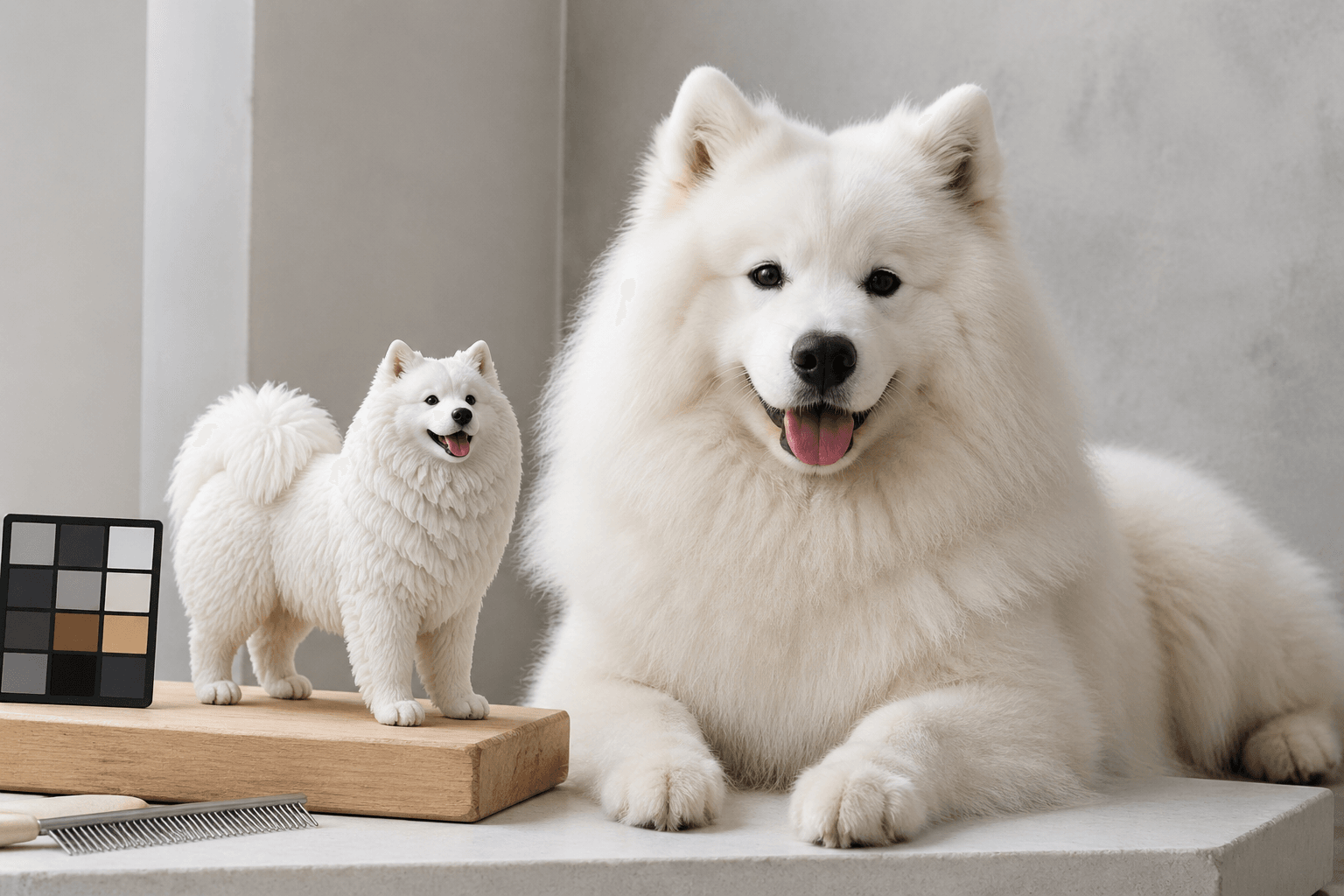
In 2014, a Samoyed portrait on a kitchen calendar looked like a drifting snowbank; today, under the cool slick edge of a countertop, Samoyed figurine accuracy depends on noticing the body hidden beneath that white cloud.
Quick Takeaways
- Judge the skeleton, not just the fluff — ask whether chest, muzzle, and hocks read clearly
- Use standing side, front, and three-quarter photos — coat volume alone often distorts proportion
- A great long coat dog sculpture guide starts with restraint — too much fur can erase breed structure
- Review digital previews for silhouette first — custom pet figurines at PawSculpt succeed when outline feels unmistakably right
Why Samoyed Accuracy Is Harder Than Most Pet Owners Expect
A short-haired dog tells on itself. You can see the shoulder layback, the tuck-up, the true width of the skull. A Samoyed does not. A Samoyed arrives wrapped in optical illusion.
That is the first truth most guides skip.
We’ve worked with many long-coated breeds, and Samoyeds are among the most deceptively difficult to judge well in sculptural form. Not because they lack shape, but because they possess too much visual information. The coat creates a halo around the dog’s actual anatomy. Owners often love that halo—and they should—but if an artist copies only the fluff, the figurine stops looking like a Samoyed and starts looking like “generic white fluffy dog.”
There’s a psychological reason this happens. Human memory stores pets in salient features—the most emotionally sticky details. With Samoyeds, that often means smile, ruff, plume tail, and brightness. But memory is not neutral. It exaggerates what comforted you. In attachment theory terms, the brain privileges the cues associated with bonding: eye shape, expression, softness, approachability. That’s beautiful. It’s also why owners sometimes approve a reference photo set that is emotionally right but structurally weak.
Here’s the counterintuitive insight: The more you love the fluff, the more important bone structure becomes.
Because structure is what makes the fluff believable.
A customer once sent us fourteen photos of her Samoyed on a cream rug. Every image was charming. None of them were ideal. The fur merged into the floor; the legs disappeared into brightness; the chest read as one soft oval. The dog looked adorable—but anatomically unreadable. Once we asked for one outdoor side profile in open shade, suddenly everything clarified: the depth of rib cage, the slight taper into the loin, the spacing of the front legs, the tail set. Same dog. Different truth.
That’s where a real long coat dog sculpture guide needs to begin: not with “capture every hair,” but with “identify what the coat is hiding.”
The three shapes inside the Samoyed silhouette
A useful way to look at your dog—more useful than staring at fur mass—is to break the Samoyed into three internal forms:
- The wedge of the head
- The barrel and taper of the body
- The column-and-angle rhythm of the legs
If those three forms are right, the coat can be stylized slightly and still feel true. If those forms are wrong, no amount of fur detail will rescue the likeness.
Think of sculpture the way a tailor thinks about a winter coat. The garment matters. But the body underneath determines whether the whole thing hangs correctly.
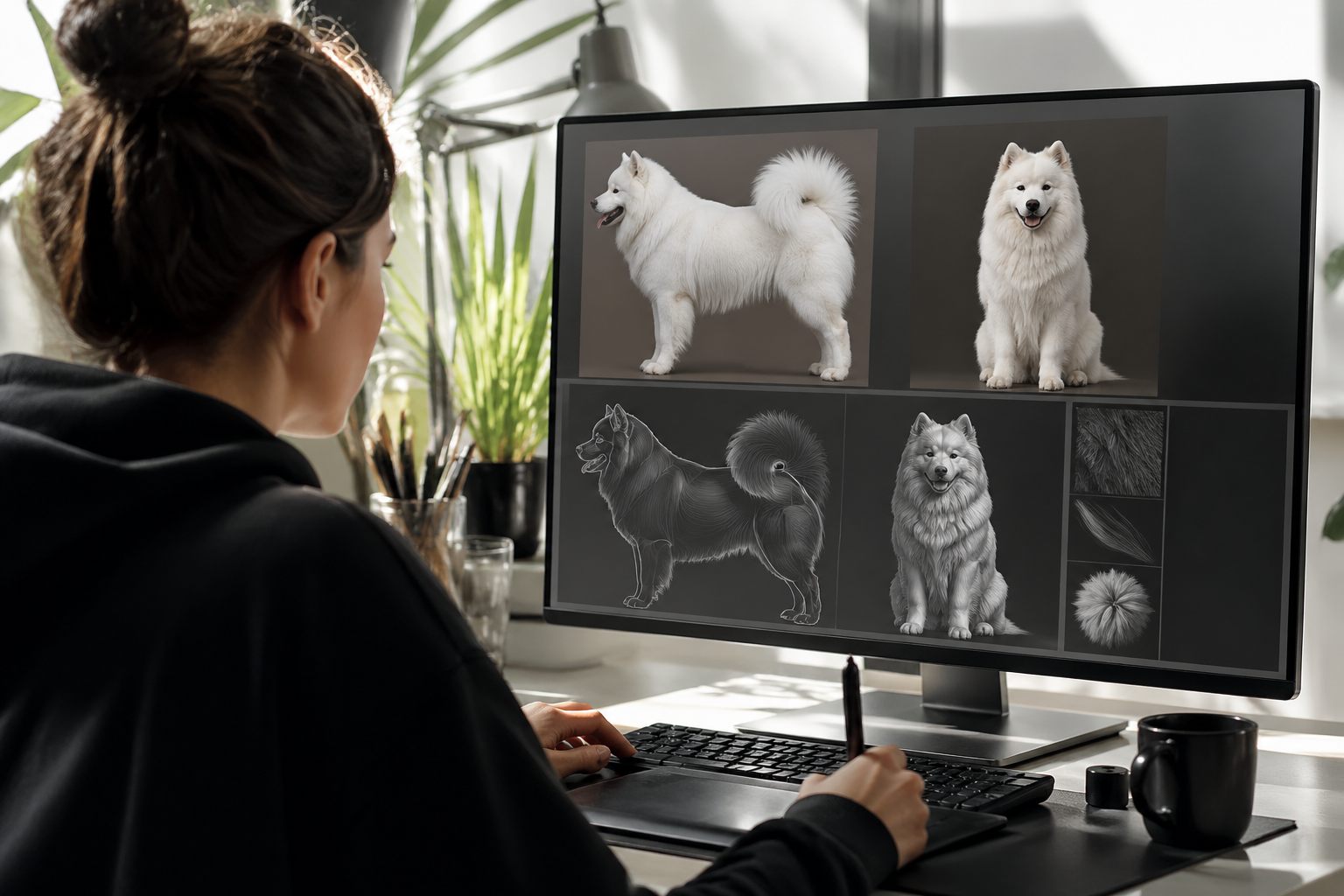
How to Judge a Samoyed Sculpt: Structure Beneath the Coat
Most pet owners begin with face. We understand why. The face is where recognition lives. But in figurine review, silhouette beats facial detail first.
At shelf distance—say three to six feet away—you don’t register tiny fur striations. You register outline, posture, mass distribution, and expression. Your brain decides in a second: yes, that’s my dog, or no, something’s off. Usually, what’s “off” is structural, not cosmetic.
Start with the outline, not the texture
Set a phone photo of the sculpt preview next to a favorite reference shot. Then squint. Literally.
When you squint, you reduce detail and evaluate major forms. Does the head feel too round? Does the body look like a tube instead of a compact working spitz? Are the legs swallowed by coat volume? This simple trick works because the visual system shifts away from surface noise and toward proportion.
"If the silhouette is wrong, more fur detail only hides the mistake."
For a Samoyed figurine accuracy check, ask these questions:
- Is the head wedge-shaped, rather than circular like a teddy bear?
- Is the muzzle substantial but not blocky?
- Does the chest project naturally, not as a puffball shelf?
- Is the body compact and strong, rather than long and sagging?
- Do the legs read as real legs, not four soft cones lost in fur?
- Does the tail emerge from the correct height, with a clean arc over the back when posed that way?
That last point matters more than people realize. Tail set is one of the breed cues that owners feel before they can articulate it. A tail attached too low changes the dog’s whole dignity. The figurine may still be cute. It just won’t feel like a Samoyed.
The face trap: “smile” is not enough
Samoyeds are famous for expression. The so-called smile is part mouth shape, part eye shape, part cheek volume, part muzzle relationship. But overemphasizing smile creates a cartoon effect.
What actually helps more than a dramatic grin is correct spacing:
- eye-to-muzzle balance
- ear placement
- forehead transition
- cheek fullness relative to the muzzle
We see this all the time in digital review. If ears are set too wide, the dog looks toy-like. If the muzzle is too short, the figurine drifts toward plush mascot instead of breed-faithful sculpture. If the eyes are oversized, emotional appeal rises for a second and then drops—the “uncanny cute” problem. Your brain notices it before you can name it.
This is partly cognitive dissonance. You want the object to be both a faithful portrait and an idealized keepsake. But a figurine can’t serve both goals equally at every scale. In production, there is always a tension between likeness and readability. Very tiny nostril modeling may be accurate, but if it prints too shallowly, it disappears after clear coat. Slightly simplifying a feature can sometimes preserve the dog better than over-chasing realism.
That’s not compromise in the lazy sense. It’s judgment.
A quick visual checklist for owners
Before approving any sculpt preview, compare it against this simplified framework:
| Feature | What “right” looks like | Common mistake | Why it matters |
|---|---|---|---|
| Head shape | Broad wedge with soft taper | Perfect sphere of fur | Loses breed identity fast |
| Muzzle | Medium length, strong but refined | Too short or too narrow | Changes expression and type |
| Chest/front | Full but structural | Overstuffed puff | Makes dog look shapeless |
| Leg definition | Visible separation and stance | Fur blob over feet | Weakens realism and balance |
| Tail set | High, integrated, confident arc | Tail attached too low | Distorts silhouette immediately |
Keep this simple rule in mind: if the figurine looks best only from one angle, something probably needs review.
A strong sculpt survives front, side, and three-quarter view.
The Most Overlooked Part of a Long Coat Dog Sculpture Guide: Fur Flow Has Direction
Pet owners often ask for “more fur detail,” which is understandable. Fur feels like personality made visible. But fur detail without fur direction is just noise.
Real coat has flow. It breaks at joints. It compresses where the dog sits. It lifts over the ruff. It falls differently on forelimbs than on pants (the longer fur on the rear thighs). A Samoyed coat is not one fluffy blanket. It is a system of lengths, densities, and directional changes.
And this is where digital sculpting either becomes art—or stays approximation.
Photo-to-sculpt workflow: what artists actually need
For a Samoyed, good references are less about quantity than coverage. We’d rather have six clear images than twenty soft, backlit, overexposed ones.
The ideal set usually includes:
- One full-body side profile with the dog standing naturally
- One front view at eye or chest height
- One three-quarter view showing head and body together
- One close facial reference with visible eye shape and muzzle
- Optional movement photo if your dog has a characteristic lean, bounce, or tail carriage
A family we worked with once sent beautiful snow photos. The problem? The dog was a white Samoyed against white snow under bright winter glare. The coat looked luminous, but all edge definition vanished. We asked for indoor window-light shots against a darker hallway runner. Suddenly the underjaw line appeared, the feet separated, and the neck-to-shoulder transition made sense.
That’s not nitpicking. That’s anatomy recovery.
What good Samoyed photos should show
This table makes the reference-photo problem easier to diagnose before you submit anything.
| Photo Type | What it should reveal | Best conditions | What to avoid |
|---|---|---|---|
| Side profile | Backline, chest depth, leg length | Open shade, dog standing square | Sitting, bending, blowing coat |
| Front view | Width, symmetry, chest and forelegs | Camera level with dog | Wide-angle closeups |
| Three-quarter view | Head-body relationship | Soft daylight | Heavy backlight |
| Face closeup | Eyes, smile, muzzle proportions | Sharp focus, neutral expression | Filters, motion blur |
| Tail/coat detail | Tail carriage, ruff, texture breaks | Contrast background | White background or snow glare |
Here’s a practical heuristic from the shop floor: if you can’t clearly count where the legs begin and end in a photo, the artist will be making educated guesses. And every guess compounds.
Fur should explain anatomy, not bury it
The best Samoyed sculpts use fur to reveal the dog’s underlying framework. Think of the coat as topography.
You should see:
- lift and breadth at the ruff
- controlled volume over shoulders and barrel
- clear narrowing through lower legs
- heavier furnishing in rear pants and tail
- subtle separation around paws
The mistake most people make is assuming more fur texture means more realism. Honestly, that’s rarely true in a collectible-scale figurine.
At small scale, overtexturing creates visual static. Fine grooves can merge during printing or post-processing, especially in lighter colors where shadow contrast is lower. A cleaner, better-placed fur pattern reads more naturally than a thousand chaotic strand marks.
This is one of those production truths that surprises customers: less surface chaos often looks more like real fur.
The psychology of why “too fluffy” feels wrong
There’s a reason exaggerated fur can disappoint even when it seems impressive at first glance. The brain recognizes living animals through pattern coherence—consistent relationships between mass, movement, and form. If coat detail is hyper-busy but the body underneath lacks conviction, your perception flags a mismatch. You read it as decorative instead of embodied.
That’s why the figurines people treasure longest often have disciplined sculpting. Not dull. Disciplined.
"A believable pet portrait doesn’t copy every strand; it protects the shape your memory returns to."
— The PawSculpt Team
What Full-Color 3D Printing Can—and Can’t—Do for a Samoyed Figurine
This is where education matters, because many pet owners are judging the wrong thing.
PawSculpt’s process is digitally sculpted, then precision 3D printed in full color. That means artists first build your pet in 3D software—typically programs like ZBrush or Blender—using your photos as reference. Then the approved model is produced through full-color resin 3D printing, where color is embedded directly into the material during printing. After that comes cleaning, curing, support removal, and a protective clear coat.
No manual color application. No brushes. No “white print, then color later” workflow.
That distinction matters because it changes what kinds of detail are strongest, what kinds are fragile, and how you should evaluate the final look.
A plain-English version of the print process
Let’s define the technical terms without making this a factory manual.
Additive manufacturing means building an object layer by layer, rather than carving it from a block. In the broader industry, pet figurines may be produced with technologies like SLA/MSLA/DLP (different resin-based systems that cure liquid photopolymer with light) or powder-based full-color systems. PawSculpt’s style of output is in the full-color resin category—think UV-cured photopolymer with embedded pigments.
Typical high-detail layer ranges in resin work are often around 25–50 microns (a micron is one-thousandth of a millimeter), though color workflows involve different compromises than monochrome display resins. In simple terms: the prints can hold excellent detail, but not the same kind of razor-edge microtexture you’d expect from a larger, single-color display piece intended for manual finishing.
That’s not a flaw. It’s a different objective.
The real tradeoffs: detail, durability, and scale
Owners sometimes imagine a perfect world where a Samoyed figurine is:
- feather-light but unbreakable
- ultra-detailed but smooth everywhere
- fluffy and airy but with no fragile bits
- bright white with deep shadow definition
- identical to photos from every angle at a tiny size
Physics says no.
In actual production, we weigh detail vs. durability constantly. More separated fur spikes may look dramatic on screen, but thin projections are vulnerable. A tail loop with too much unsupported openness can become a handling risk. Tiny ear edges can chip more easily than slightly thickened ones. Slender ankle transitions may print beautifully and still fail if the pose puts stress into narrow sections.
For long-coated breeds, the smartest sculpting often means integrating fur mass to reinforce weak points. That’s invisible engineering. Customers may not notice it consciously, but they benefit from it every time they pick up the piece.
A good figurine should feel reassuring in the hand. Not brittle in spirit.
Orientation logic: why the model’s angle during printing matters
This is one of the most overlooked aspects of figurine quality.
In resin-style printing, orientation means how the model is angled on the build platform. That angle affects surface finish, support placement, suction forces, print success, and post-processing marks.
For a Samoyed:
- Printing perfectly upright may preserve some symmetry but can create other issues depending on geometry.
- Tilting the model can reduce large flat exposure zones and improve certain surface outcomes.
- But tilt also determines where supports (temporary contact structures) touch the model.
Supports are necessary. They hold the print during creation. But every support contact leaves a small witness point that must be removed and refined afterward. On fur texture, this can be forgiving. On a smooth muzzle or around the eyes, it’s much less forgiving.
That’s why experienced teams think strategically:
- put supports where cleanup is least visually disruptive
- avoid contact clusters on face planes
- manage tail and ear vulnerability
- preserve visible front-facing surfaces whenever possible
And yes, there are failure modes non-experts never hear about.
Failure modes a real production team watches for
If you want to judge a maker intelligently, it helps to know what can go wrong.
Common issues in resin and full-color additive work include:
- Warping: slight bending during printing or curing, especially on thin or asymmetrical parts
- Suction cup effects: trapped resin or pressure issues in concave geometry, which can distort or fail prints
- Support pitting: tiny marks where supports were removed
- Bloom or haze: a cloudy residue or surface dullness if washing/curing is off
- Over-cure: too much UV exposure can increase brittleness or shift appearance
- Under-cure: insufficient curing leaves surfaces weak or tacky
- Layer stepping: fine visible build lines on shallow curves
- Color flattening: subtle tonal transitions can compress on bright white subjects
Samoyeds are tricky because white fur already compresses contrast. A black dog naturally reveals form with shadows and highlights. A white dog asks the sculpt and print process to create shape without much help from color separation.
That is why a Samoyed figurine should not be judged by “how white” it is alone. It should be judged by whether the whiteness still contains structure.
Hollowing, drain paths, and practical engineering
Depending on scale and process, figurines may be solid or hollowed. Hollowing reduces material use and can lower stress, but it introduces engineering requirements like internal drainage paths for certain resin workflows. If a model is hollowed carelessly, trapped resin can create curing problems, imbalance, or long-term issues.
With furry breeds, hollowing decisions get complicated because paws, tail bases, and body transitions can conceal or expose engineering constraints. Good teams think about where geometry naturally allows strength and where it invites trouble.
Most customers never need to obsess over drain holes or shell thickness. But they should appreciate the larger point: a pet figurine isn’t only an artistic likeness. It’s also a small engineered object.
That combination matters.
"The best figurines feel inevitable—as if your pet simply resolved into form."
How We Evaluate Samoyed Figurine Accuracy in the Digital Stage
The digital stage is where most quality is won—or lost. Once a full-color 3D print begins, major structural issues are expensive and inefficient to correct. This is why preview review matters so much.
At PawSculpt, as with any serious digital workflow, the sculpting phase is not just “make it fluffy.” It is a sequence of proportion checks, anatomy interpretation, and surface decisions.
First, lock the proportions
A professional artist generally starts by establishing:
- overall height-to-length ratio
- rib cage volume
- neck insertion
- head size relative to body
- leg spacing and stance
- tail base and carriage
This is the skeleton logic of the figurine, even if no bones are visible.
For Samoyeds, the coat can tempt artists to enlarge everything equally. But real Samoyeds don’t expand like marshmallows in all directions. They have specific density zones. The neck may look massive because of the ruff; the lower legs usually do not. The chest feels broad, but the loin should not disappear. Rear furnishings can look generous, but the hock area still needs definition.
One order that stuck with us involved a Samoyed whose owner kept saying, “He was fluffier than this.” She wasn’t wrong. But every increase in outer coat volume started to erase his elegant leg set and compact body. We ended up showing a side-by-side digital adjustment. The version with slightly less coat looked more like her dog because the body language came back. She saw it immediately.
That’s a powerful lesson: likeness often lives in proportion before texture.
Then, calibrate symmetry—without making the dog lifeless
Owners often ask for perfect symmetry because they equate it with polish. Real dogs are not perfectly symmetrical. One ear may sit a touch differently. The tail may favor a side. The smile may pull slightly unevenly. Those tiny asymmetries can be part of identity.
But there’s nuance here.
In collectible production, teams usually check:
- eye alignment
- ear height relationships
- shoulder width balance
- paw placement stability
- tail arc consistency
- facial plane harmony
The goal is not sterile perfection. It is controlled naturalism.
There’s a neurological reason asymmetry can feel “alive.” The brain is highly sensitive to minor deviations in biological forms. Too much symmetry can trigger an artificial reading, a bit like a face filter that smooths away character. Too much asymmetry, of course, just looks inaccurate. The sweet spot is where the figurine preserves individuality without reading as accidental.
Surface review under “raking light”
A real maker doesn’t only inspect a model straight on. We look at surfaces under raking light—light cast from a low angle across the form—because it reveals every bump, ripple, flat spot, and transition break.
Why should you care?
Because white dogs are unforgiving. Even in digital preview, surface rhythm matters. A smooth cheek that suddenly turns into random fur cuts will look wrong in the final print. A neck transition that’s too abrupt will catch highlights oddly. A chest panel that isn’t subtly shaped can make the entire front view look stiff.
This kind of inspection is where teams catch:
- accidental lopsidedness
- overbusy fur grooves
- muddy facial planes
- tail-to-back transitions that look pasted on
- feet that merge into base mass
You may never use the phrase “raking light” yourself. But you’ll feel its absence if nobody checked the sculpt carefully.
The best owner feedback is surprisingly simple
If you’re reviewing a preview, don’t flood the artist with twenty vague comments. Start with three categories:
- Silhouette — “The tail sits too low,” “The head feels too round.”
- Expression — “Her eyes were softer,” “His smile was subtler.”
- Signature detail — “The left ear always tipped outward,” “Her mane was fuller at the chest.”
That’s enough to be useful.
What doesn’t help:
- “Can you make it more realistic?”
- “Add more fur everywhere.”
- “Something feels off” with no follow-up
Specificity saves time and improves outcome. And yes, if you want to preserve a living pet’s exact quirks, it’s often worth gathering references over a few days rather than grabbing random phone photos from six months of motion blur.
Counter-Point: You Can Over-Chase Accuracy
This article argues for structure, discernment, and technical honesty. But we should challenge our own premise a bit.
Absolute accuracy is not always the highest good.
A figurine is not a CT scan. It is not veterinary imaging. It is a designed object that has to survive scale reduction, material constraints, color interpretation, and the emotional burden you place on it. Sometimes a tiny adjustment away from literal truth creates a stronger tribute.
That may sound contradictory. It isn’t.
If your Samoyed had a coat that constantly blew sideways in photos, should the figurine freeze that accidental weather effect forever? Usually not. If your favorite picture was taken with a phone lens six inches from the nose, should the sculpt honor that distortion? Again, probably not. If one eye looks larger in a single image because the head was turned, should the portrait lock that in? No.
The deeper standard is not “Does it duplicate every photo artifact?” It is “Does it preserve the dog you knew?”
There’s an old aesthetic problem here, one artists have always faced. Literal copying can betray essence. In portraiture, the truest likeness is sometimes one layer removed from exact measurement. A Samoyed’s identity may live less in the count of fur ridges than in the alert softness of posture, the buoyancy of the chest, the composure of the head over that famous white coat.
So yes—fight for Samoyed figurine accuracy. But define accuracy wisely.
When stylization is actually helpful
Stylization is not the enemy if it does these things:
- clarifies anatomy hidden by coat
- improves durability at small scale
- preserves expression when tiny features would print weakly
- prevents visual clutter in white-on-white subjects
We’re not huge fans of exaggerated “cute-ification” that shortens muzzles and enlarges eyes for effect. But modest simplification? That can be excellent. Especially in a memorial or display object viewed at conversational distance, not under a jeweler’s loupe.
Some families want strict show-stack posture. Others want their dog’s head tilt, side lean, or slightly goofy sitting habit. Neither is inherently more correct. The question is whether the pose supports the identity you’re trying to keep.
What to Expect from a High-Quality Full-Color Samoyed Figurine Process
A trustworthy figurine process is usually calm, methodical, and transparent. Not magical. Not vague. Not “send any photo and we’ll somehow do the impossible.”
Stage 1: Reference gathering and interpretation
This is where the project either becomes precise or stays approximate.
A serious team will use your photos to assess:
- coat condition in the images
- standing posture consistency
- facial visibility
- whether the dog is groomed naturally or blown out dramatically
- whether key breed markers are obscured by lighting or angle
And here’s something many owners overlook: if your Samoyed was photographed after a bath and blow-dry in one image and muddy after play in another, those are almost different sculptural subjects. Coat volume changes perception. So does moisture. So does grooming.
That doesn’t mean one version is wrong. It means you should decide which state of your dog you want preserved.
Stage 2: Digital sculpting from photos
At this stage, artists hand-model digitally in 3D software. They interpret anatomy, compare references, and build the form from the inside out—first proportion and mass, then expression, then coat flow.
A good digital sculptor working on a Samoyed pays attention to:
- forehead-to-muzzle transition
- ear thickness and placement
- chest prominence without overinflation
- tail merge into the body
- paw readability through fur
- coat rhythm, not random texture
This is not a drag-and-drop filter. It’s skilled visual translation.
If you’re looking into 3D pet sculptures, it helps to know what can reasonably be changed at this stage versus what belongs in the source photos. Expression and pose can often be interpreted. Missing anatomy cannot always be guessed cleanly if references are poor.
Stage 3: Full-color printing
Once the model is approved, the piece moves into full-color 3D printing. In this method, color information is part of the print itself. For a Samoyed, that often means subtle whites, creams, pinkish ear interiors, dark eye rims, nose tone, and gentle gray-beige shadowing where needed to preserve readable form.
This is where expectations need nuance. White dogs are among the hardest subjects in full color because “white” in life is never one flat white. Under different lighting, it can shift warm, cool, silver, cream, even faint peach around the ears or muzzle.
A good print respects those transitions without turning the dog dingy.
Stage 4: Post-processing and clear coat
After printing, the figurine is cleaned, cured, and freed from supports. Support removal may be followed by careful surface refinement where necessary. Then a clear coat is applied for protection and finish.
That clear coat matters. It influences sheen, color depth, and tactile feel. Too glossy, and white fur can look synthetic. Too matte, and color richness can die. Most premium figurine finishes aim for a balanced protective sheen that lets the printed color read naturally while still feeling durable in the hand.
This is also where teams watch for:
- support witness marks
- uneven sheen
- residue haze
- tiny chips at delicate edges
- surface bloom from curing imbalance
Stage 5: Quality control
This is the least romantic stage and one of the most important.
A serious QC review typically includes:
- dimensional checks for overall stability and obvious distortion
- symmetry checks from front and top views
- surface inspection under angled light
- color review for major mismatch or blotching
- stance inspection to ensure the figurine reads confidently upright
For Samoyeds, we’re especially attentive to face contrast and leg clarity. A white dog with weak eye definition can lose expression fast. A fluffy dog with muddy foot transitions can look half-finished even when the print itself is structurally fine.
If you’re comparing options, this is one reason families choose premium makers such as PawSculpt’s custom pet figurines: not because full-color printing is simple, but because hard breeds need practiced judgment at every stage.
Care, Display, and the Tactile Reality of Living With the Figurine
A Samoyed figurine isn’t just looked at. It’s handled. Moved from shelf to desk. Lifted during cleaning. Pressed into a palm during anniversaries and ordinary afternoons.
That tactile life matters.
We’ve heard customers describe touching a figurine’s smooth clear-coated surface and being startled by the emotional reversal of it: the dog they remember was warm, soft, slightly damp at the nose, thick at the ruff, full of static in winter. The keepsake is cool at first touch. Firm. Finite. And yet consoling.
Psychology has something to say here. Tangible objects can support grief and attachment because the brain responds strongly to sensorimotor cues—the loop between hand, object, and memory. Not because the object replaces the pet. It doesn’t. But because touch helps organize emotion. For some people, that lowers agitation and gives memory somewhere to land. If you’re navigating loss, the Association for Pet Loss and Bereavement offers thoughtful support resources as well.
How to display a white long-coat figurine well
White figurines are surprisingly sensitive to environment.
Best practices:
- Place against a medium-contrast background so the silhouette reads
- Avoid direct harsh sunlight for long periods
- Use stable shelving away from vibration or frequent bumps
- Dust gently with a soft dry method rather than abrasive rubbing
- Keep away from high humidity and heat extremes when possible
A Samoyed figurine against a white wall can visually flatten. Against warm wood, charcoal, sage, navy, or muted stone, it often comes alive. This sounds minor. It isn’t. Display context changes how well the shape can be read—especially for long-coated white subjects.
What good care is really about
Care isn’t only preservation of material. It’s preservation of legibility.
Dust collecting in fur texture can mute facial contrast. Poor lighting can erase the muzzle. Crowding the figurine between visual clutter can reduce the emotional impact of the piece.
And honestly, if this is a memorial object, you may not want it hidden among unrelated décor. Many families create a small intentional zone: a shelf with one framed photo, a collar, maybe a favorite tag or a paw print impression. Others prefer the figurine in the everyday life of the home—near cookbooks, on a desk, by the entryway where the leash once hung. Both choices are valid.
The deeper question is: where do you want memory to meet your body? In passing? In ritual? In private?
If your dog is still living, don’t wait for “perfect” photos forever
This may be the most practical advice in the article.
Take reference photos now.
Not someday after the next groom. Not when the lighting is ideal. Not only when your house is spotless or your dog looks show-ready. Take a usable set this week:
- standing side view
- front view
- three-quarter view
- face closeup
- tail/coat detail
- one image that captures personality
The American Kennel Club’s Samoyed breed guide can help you understand breed structure if you’re not sure what to notice in those images.
Why now? Because memory is generous but imprecise. And because the ordinary version of your dog—the one who drifts through the kitchen, leans against your leg, leaves a pale storm of fur on dark socks—is often the version you miss most.
Choosing the Right Photos and Feedback Before You Order
If you do decide to commission a figurine, your role is not passive. The process gets better when owners know how to contribute clearly.
A practical photo-prep checklist
Before submitting anything, do this:
- Choose one “anchor photo” that best captures your dog’s overall identity.
- Add support photos for anatomy, face, and tail.
- Avoid heavy filters and aggressive portrait mode blur.
- Use contrasting backgrounds if your dog is very white.
- Include one note about personality, not just appearance.
That last step is more important than it sounds. “He always stood like he was listening for snow.” “Her left ear tipped when she was curious.” “His tail curled tighter when excited.” These cues help artists understand what the photos alone may not spell out.
Good reference sets vs. weak ones
Here’s a fast comparison that saves frustration.
| Reference Quality | Strong Set | Weak Set | Likely Result |
|---|---|---|---|
| Body visibility | Legs and chest clearly separated | Dog buried in fluff or furniture | Better structural accuracy |
| Lighting | Soft, even daylight | Yellow indoor dimness or glare | Better color interpretation |
| Angles | Side, front, three-quarter | Only closeups from above | Fewer anatomical guesses |
| Focus | Crisp eyes and muzzle | Motion blur | Better facial likeness |
| Consistency | Similar coat condition across photos | Mixed wet, groomed, running, puppy shots | Cleaner artistic decisions |
A customer once sent one perfect face photo and nothing else. The face was enough to recognize the dog emotionally—but not enough to build the body faithfully. After we requested additional angles, the owner said, “I didn’t realize how much of him I was assuming instead of seeing.” That sentence has stayed with us.
It captures the heart of the issue.
Questions worth asking a figurine company
You don’t need to interrogate anyone like a machine auditor. But you should ask enough to understand the process.
Useful questions include:
- How do you handle long-coated breeds where anatomy is hidden?
- What kinds of photos produce the best result?
- Do you provide a digital preview for review?
- Is the color printed into the material or applied later?
- How do you protect the surface after printing?
- Where can I review process details or ask questions?
If you’re exploring options, PawSculpt keeps process information and common questions available through its FAQ page and contact page, which is helpful if you want clarity before committing.
And one honest note: if a company talks beautifully about sentiment but vaguely about production, be careful. Emotion matters. So does process literacy.
The Meaning Under the Fluff
There’s something almost philosophical about a Samoyed. The breed presents itself first as abundance—coat, brightness, volume, softness. But what people love most is rarely abundance alone. It is the order inside that abundance. The steadiness. The alert grace. The benevolent face above a body built to work.
That’s why judging a Samoyed figurine well requires a deeper look. You are not merely asking, “Does this resemble fur?” You are asking whether the object preserves relationship. Whether the head tilt is your dog’s head tilt. Whether the chest feels proud in the right way. Whether the tail carries that familiar self-possession. Whether the piece has enough discipline to survive time.
Take one evening and study your dog—or your photos of the dog you miss. Start with silhouette. Then structure. Then expression. Then coat flow. Write down three things you never want lost.
That is your real brief.
And if you move forward with a figurine, choose the maker the way you’d choose a portraitist: not by promises of perfection, but by evidence of judgment. In the end, the fluff is only the doorway. The love is in the shape beneath it.
Frequently Asked Questions
How do I judge Samoyed figurine accuracy?
Start with the overall silhouette. If the head wedge, chest depth, leg separation, and tail set feel right, the figurine usually reads correctly even before you inspect facial detail. Then check expression and coat flow from several angles, not just the most flattering one.
What photos work best for a long coat dog sculpture guide?
The strongest set includes a side profile, a front view, a three-quarter view, and a sharp face closeup in soft daylight. For white dogs, contrast is essential—dark flooring, a shaded yard, or a medium-tone wall helps the artist recover the body beneath the coat.
Are full-color pet figurines painted by hand?
No. In full-color resin 3D printing, the color is embedded directly into the material during production. After printing, the piece is cleaned, cured, refined where needed, and protected with a clear coat—there is no manual color application step.
Why do Samoyed figurines look wrong even when they seem fluffy enough?
Because fluff alone is not breed identity. If the muzzle is too short, the head too round, the legs too buried, or the tail set too low, the figurine can look charming and still fail as a Samoyed likeness. Structure is doing more work than most people realize.
What should I look for in a custom pet figurine company?
Look for process clarity. You want a team that explains photo requirements, offers preview review, describes how color is actually produced, and speaks honestly about scale, surface texture, and durability. If the technical explanation is vague, the result often is too.
Ready to Celebrate Your Pet?
Every pet has a story worth preserving. Whether you're honoring a beloved companion who's crossed the rainbow bridge or celebrating your furry friend's unique personality, a custom PawSculpt figurine captures those details that make your pet one-of-a-kind.
For owners focused on Samoyed figurine accuracy, that means more than fluff—it means the calm intelligence in the face, the buoyant outline, and the body hidden beneath the coat, translated through digital sculpting and full-color 3D printing.
Create Your Custom Pet Figurine →
Visit pawsculpt.com to learn more about our process and guarantees