
10-Step Checklist: Environmental Enrichment for Your Mid-Life Maine Coon
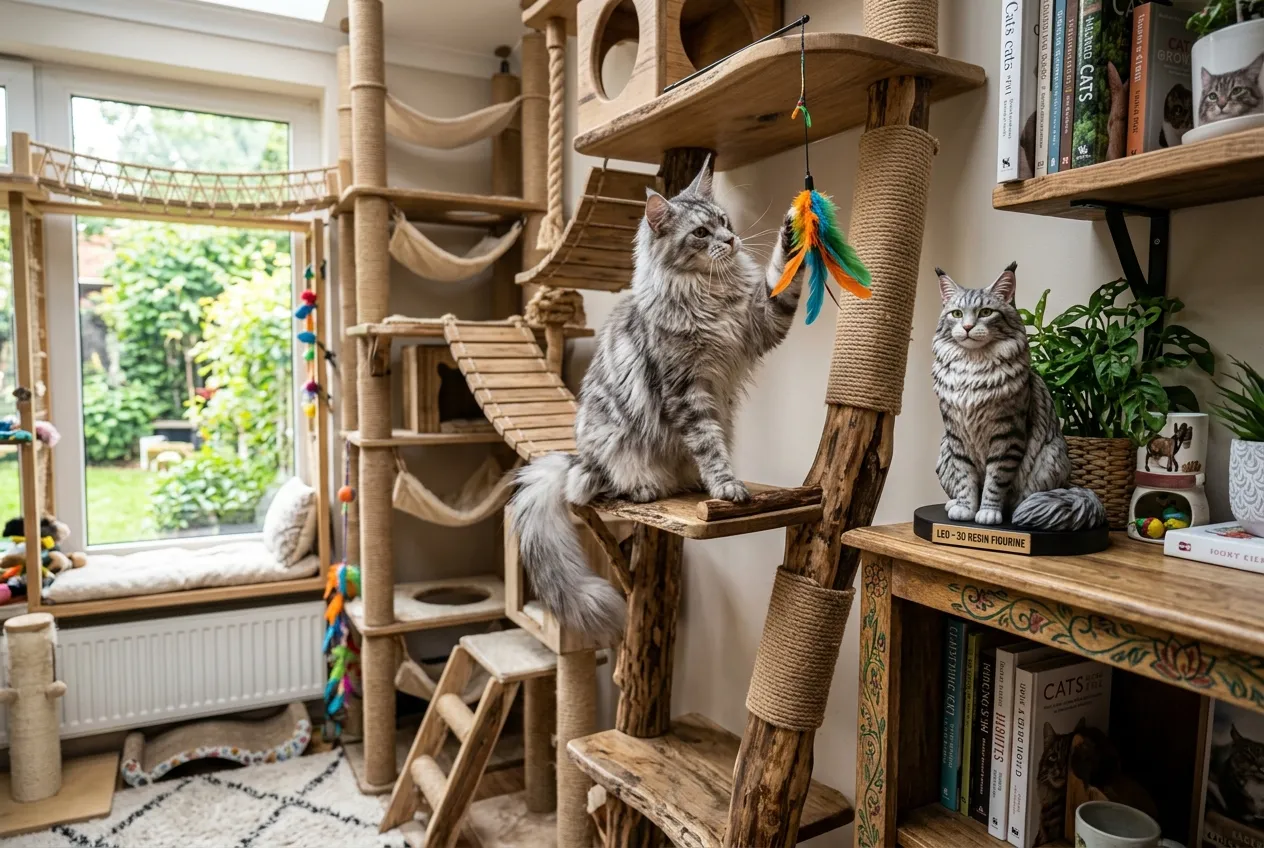
The crinkle of treat bags in the pet store aisle can make a mid-life Maine Coon snap his ears forward like a kitten again—and that sound is your first clue that maine coon care isn’t only about food, grooming, or vet visits. It’s about keeping his world interesting.
Quick Takeaways
- Mid-life is not “low-energy” by default — adjust challenges, don’t remove them.
- Sound matters more than most cat enrichment guides admit — use safe audio cues.
- Large cats need large-scale enrichment — size your perches, tunnels, and puzzles correctly.
- Preserve personality as part of care — explore custom pet figurines as a meaningful keepsake.
- Behavior changes are data — track patterns before assuming your cat is “just aging.”
Why Mid-Life Maine Coon Care Needs a Different Kind of Cat Enrichment
A seven-year-old Maine Coon padding into the kitchen doesn’t sound like a small cat. There’s that soft thump-thump of big paws, the tiny trill that seems too delicate for such a lion-sized creature, the slow scrape of claws catching the rug as he stretches like he owns the lease.
And honestly? He does.
Mid-life cats are often treated like they’ve entered some sleepy, beige chapter of life. Fewer toys. Fewer climbing experiments. Less novelty because “he’s not a kitten anymore.”
That’s the mistake.
For Maine Coons, mid-life is often the season when their personality gets more specific. They’ve got opinions now. They know which chair is theirs. They know the sound of the treat drawer versus the sound of the vitamin bottle. They know your laptop closing means maybe, maybe, you’re available.
Environmental enrichment at this stage is not about turning your cat back into a kitten. It’s about giving his adult brain enough texture, sound, choice, and movement to stay engaged.
The overlooked angle: enrichment is a “soundtrack,” not just a toy box
Most cat enrichment advice focuses on objects: cat trees, toys, puzzles, scratching posts. All useful. But many owners miss the sound environment their cat lives inside every day.
A Maine Coon’s world has a soundtrack:
- The clink of kibble in a bowl
- The chirp of birds through a window
- The snap of a wand toy
- The washing machine’s low rumble
- Your voice saying his name in that ridiculous tone you claim you don’t use
When that soundtrack gets too predictable, a smart cat can start checking out. When it gets too chaotic, he may become jumpy, avoidant, or clingy.
Cat enrichment is partly about designing better noises.
Not loud noises. Not random YouTube bird videos blasting for hours. We mean thoughtful sound cues that tell your cat, “Something safe and interesting is happening.”
A crinkly tunnel placed near a window. A puzzle feeder that rattles just enough. A five-minute “call and response” session where you mimic his trill and wait for him to answer. It sounds silly until your cat starts showing up for it.
And many do.
Mid-life is when boredom gets misread as aging
One of our customers once told us her Maine Coon had “retired” from play around age six. He stopped chasing toys and mostly sat near the hallway vent. She assumed he was slowing down.
Then she swapped the tiny feather wand for a longer lure that moved under butcher paper with a crisp, skittering sound. He pounced so hard the paper slid across the floor.
He hadn’t retired. The game had gotten boring.
That’s the counterintuitive thing: older cats often need more customized enrichment, not less enrichment. The generic mouse toy doesn’t fail because your cat is old. It fails because your cat has solved it.
"Boredom in cats often looks like calmness until the behavior starts asking louder."
Know what’s normal, but don’t self-diagnose
We’re not veterinarians, so if your Maine Coon suddenly hides, stops eating, loses weight, limps, vocalizes unusually, or avoids jumping, loop in your vet. Enrichment should support health, not cover up pain.
Maine Coons are large, long-haired cats with breed-specific care needs, and reputable breed resources like the American Kennel Club’s Maine Coon breed guide can help you understand general temperament and lifestyle expectations. For medical concerns, your veterinarian is always the first call.
Environmental enrichment works best when your cat is physically comfortable enough to participate.
The mid-life enrichment mindset
Before we get into the 10-step checklist, here’s the lens we want you to use:
Don’t ask, “How do I entertain my cat?”
Ask, “Where does my cat still want agency?”
That one shift changes everything. A mid-life Maine Coon doesn’t need you to become a cruise director. He needs opportunities to choose:
- Where to perch
- When to hunt
- What texture to scratch
- Which route to take through a room
- Whether to observe or participate
- How much social contact feels good today
Choice is enrichment. Predictable choice is even better.
The 10-Step Environmental Enrichment Checklist for a Mid-Life Cat
Picture this: your Maine Coon hears the dry clicking of a cabinet latch and appears from nowhere, tail up, eyes bright, as if he has been summoned by ancient magic. But when you toss the same toy mouse, he watches it bounce twice and walks away.
That’s not attitude. That’s feedback.
Use this environmental enrichment checklist as a practical reset for your home. You don’t have to do all 10 steps in one day. In fact, please don’t. Mid-life cats usually respond better to small, intentional changes over 3 to 6 weeks than one giant makeover.
1. Audit your cat’s daily soundtrack
For one day, listen like your cat.
Not poetically. Literally.
Walk through your home and notice the sounds your Maine Coon hears on repeat: refrigerator hum, doorbell, kids’ footsteps, dog tags jingling, traffic, TV chatter, automatic feeder whir, your phone alarm. Then notice which sounds cause his ears to swivel, body to freeze, or tail to twitch.
Action item: Make a two-column note on your phone:
| Sound | Your Cat’s Reaction |
|---|---|
| Treat bag crinkle | Runs over, tail up |
| Vacuum | Hides under bed |
| Birds outside window | Chirps, crouches |
| Dishwasher | Ignores |
| Doorbell | Freezes, retreats |
So what? Because enrichment is not only adding stimulation. Sometimes it’s removing the wrong stimulation.
If the doorbell sends him under the bed for 45 minutes, your enrichment plan should include a safe retreat and desensitization—not just another toy. If bird sounds make him chirp and paw gently at the window, that’s a cue to create a window perch ritual.
2. Build vertical space for a big body, not a generic cat
Many Maine Coons look at standard cat trees like adults looking at toddler chairs.
They might squeeze onto the platform, but their back half hangs off. They might jump up once, feel the wobble, and decide, “Absolutely not.” We respect that.
For Maine Coon care, stability matters more than height. A seven-foot tower that shakes is less useful than a lower, rock-solid perch with a broad platform.
Look for:
- Platforms at least wide enough for full-body lounging
- Heavy bases or wall-mounted supports
- Steps or staggered levels for joint-friendly access
- Sisal posts tall enough for a full stretch
- Washable surfaces, because long fur collects everything
The overlooked part? Your cat may avoid climbing not because he’s lazy, but because the structure feels unsafe under his weight.
So what? Big cats need confidence in their environment. A sturdy perch gives your Maine Coon observation power without making his joints or balance do unnecessary work.
3. Create “slow hunting” sessions instead of frantic play
A lot of us play with cats like we’re trying to win a carnival game. We wave the toy wildly. We make it jump in the air. We expect the cat to launch.
But mid-life Maine Coons often prefer strategic hunting.
They want the rustle under the rug. The pause behind the chair leg. The tiny scratch-scratch of a lure moving along cardboard. The suspense.
Try this 12-minute sequence:
- 2 minutes: Let the toy “hide” with subtle movement.
- 4 minutes: Drag it slowly along edges and corners.
- 3 minutes: Offer two short chase bursts.
- 2 minutes: Let your cat catch and hold it.
- 1 minute: End with a small treat or meal portion.
That final catch matters. If your cat never “wins,” play can become frustration, not enrichment.
So what? Hunting behavior has a natural arc: stalk, chase, pounce, catch, eat, groom, rest. When play follows that rhythm, your cat’s nervous system gets closure.
4. Rotate toys by sound profile, not just type
Here’s one you probably won’t see in the first few search results: rotate toys by what they sound like.
A felt mouse, a crinkle ball, a bell toy, a rattle feeder, a paper bag, and a silicone chew toy all create different sensory experiences. To your cat, that difference matters.
Weekly sound rotation idea:
| Day | Sound Theme | Example Enrichment |
|---|---|---|
| Monday | Crinkle | Paper tunnel, crinkle mat |
| Tuesday | Soft scrape | Wand toy under towel |
| Wednesday | Rattle | Puzzle feeder with kibble |
| Thursday | Silence | Scent toy or slow visual lure |
| Friday | Chirp/trill | Interactive vocal play |
| Weekend | Natural sounds | Window perch, bird-safe viewing |
The “silent toy” day may sound odd, but it’s important. Some cats get overstimulated by constant noise. A scent-based toy with silvervine or catnip can be deeply engaging without adding more sound.
So what? Sound rotation prevents novelty fatigue. Your Maine Coon doesn’t just see a different toy—he experiences a different tiny world.
5. Make feeding less bowl-shaped
A bowl is efficient. It is also kind of boring.
For a mid-life Maine Coon, food can become enrichment without turning every meal into a puzzle exam. The goal isn’t to make eating hard. The goal is to make it mildly earned.
Start with one meal per day in a simple puzzle feeder, lick mat, snuffle mat, or treat-dispensing ball. If your cat gets frustrated, make it easier. We’re not huge fans of “let them figure it out” when a cat is clearly annoyed. Frustration is not enrichment.
Good first options:
- Scatter a few dry pieces on a towel fold
- Place wet food on a lick mat
- Hide treats in three open cardboard cups
- Use a slow feeder with wide grooves
- Put a tiny treat trail leading to a perch
So what? Food-based enrichment taps into seeking behavior. It gives your cat a reason to move, sniff, paw, and solve.
6. Add joint-friendly pathways before your cat needs them
This is a big one.
Most people add ramps after their cat starts struggling. But mid-life is the perfect time to add preventive pathways so your Maine Coon doesn’t have to choose between comfort and favorite spots.
If your cat loves the bed, couch, window, or desk, create intermediate steps now. Ottoman to bench to windowsill. Low stool to sofa. Wide ramp to the sunny perch.
The sound you’re trying to avoid is that heavy landing thud from a big cat jumping down from too high. You know the one. It makes your own knees hurt.
So what? Reducing repeated impact may support comfort over time, especially for large cats. And emotionally, it keeps your cat’s world open instead of slowly shrinking.
7. Give him social choice, not forced affection
Maine Coons are famous for being social, chatty, and people-oriented. But social does not mean constantly touchable.
A mid-life Maine Coon might want to be near you without being on you. He might follow you room to room, chirp at you, supervise your laundry, and still duck away when you reach down.
That’s not rejection. That’s a boundary.
Create three social zones:
- Near zone: A bed or mat within six feet of where you work
- Touch zone: A spot where petting is usually welcomed
- Retreat zone: A no-touch area where he can rest undisturbed
So what? Cats relax when they can control distance. Forced affection can make a social cat less social over time.
"The best enrichment doesn’t demand attention. It offers an invitation."
8. Use scent like a map
Sound gets attention, but scent holds memory.
A Maine Coon’s home is full of scent landmarks: scratching posts, blankets, doorframes, your hoodie, the corner of the couch he rubs every morning like he’s signing a guestbook.
When you clean or rearrange too aggressively, you can accidentally erase his map.
Action item: If you replace bedding, cat trees, or scratching surfaces, keep one familiar scent item nearby for 2 to 4 weeks. A small blanket, old scratching pad, or favorite washable mat can make a new setup feel like his—not like a stranger’s furniture.
So what? Scent continuity lowers stress during environmental change. This matters especially in mid-life, when cats may become less tolerant of sudden household shifts.
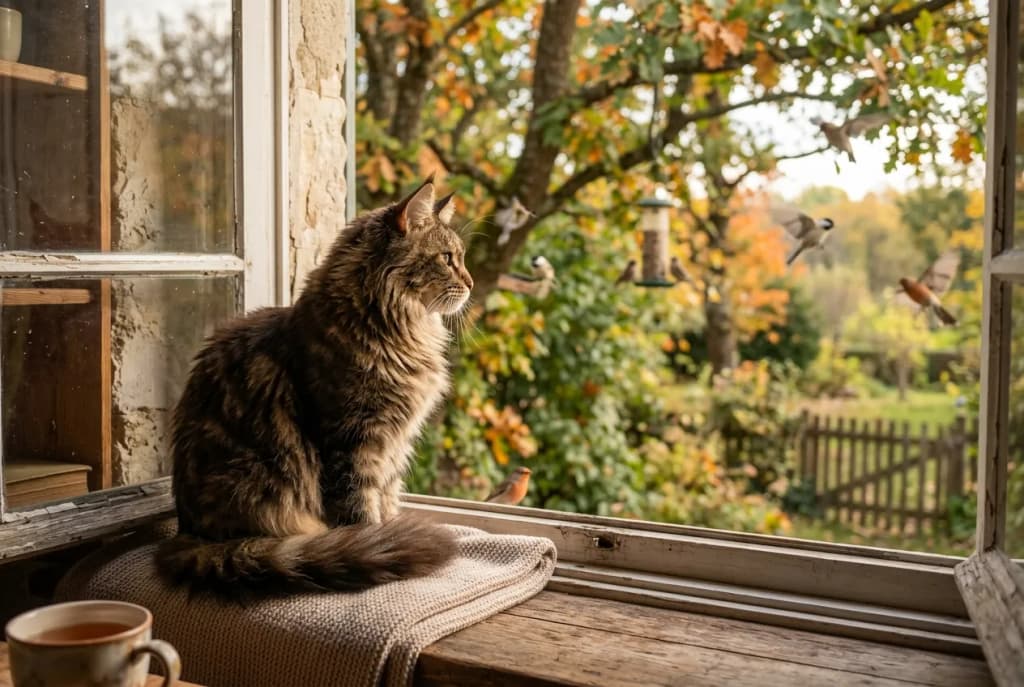
9. Create a “weather report” window station
Not every cat can safely access outdoor spaces, and not every home allows a catio. But a window station can become a daily enrichment anchor.
We call it a weather report because that’s basically what many cats are doing: monitoring birds, leaves, squirrels, delivery trucks, neighbors, sun patches, rain sounds, and wind movement.
Set up:
- A stable, wide perch
- A washable cushion
- A bird feeder outside only if it’s safe and appropriate for your area
- A sound element, like a slightly open screened window when weather permits
- A nearby scratcher for redirected excitement
Please make sure screens are secure. A Maine Coon leaning into a flimsy screen is not a small event.
So what? Window stations combine visual, auditory, and scent enrichment. They create predictable novelty—the scene changes, but the place stays safe.
10. Track behavior like a loving detective
You don’t need a spreadsheet. Though if you love spreadsheets, we support your journey.
For cat behavior, the useful question is: what changed, and when?
Track these for two weeks after adding enrichment:
| Behavior to Watch | Good Sign | Check-In Sign |
|---|---|---|
| Play interest | Shorter but focused sessions | Sudden refusal of all play |
| Vocalizing | Contextual trills, greetings | New crying at night |
| Jumping | Uses ramps/perches confidently | Hesitates or misses jumps |
| Grooming | Normal coat maintenance | Mats, overgrooming, neglect |
| Feeding | Engages with easy puzzles | Frustration or appetite drop |
So what? Patterns protect your cat. A behavior log helps you tell the difference between “he hates the new feeder” and “something medical might be going on.”
For general cat health and behavior guidance, resources like VCA Hospitals’ cat care library can be helpful, but your vet should evaluate sudden or concerning changes.
The Sound-Based Cat Enrichment Plan Most People Miss
There’s a particular sound many Maine Coon owners know: the tiny questioning chirp from the next room. Not a meow. Not a demand. More like, “Hello? Are we still doing life together?”
That sound is part of your relationship.
And it’s a huge clue for enrichment.
Why sound is powerful for mid-life cats
Cats don’t only respond to sound volume. They respond to sound meaning.
The can opener has meaning. Your car in the driveway has meaning. The laptop closing has meaning. Even the drawer where you keep nail clippers has meaning, and frankly, some cats file that under “betrayal.”
For mid-life cats, meaningful sound cues can create structure. The goal is not to train your Maine Coon like a dog. The goal is to build little rituals that make the day easier to predict and more interesting to enter.
Try using consistent sound cues for:
- Playtime
- Feeding puzzles
- Grooming
- Rest
- Window time
- Medication, if needed
For example, shake a specific soft rattle before puzzle feeding. Use a particular phrase before brushing. Tap the window perch twice before opening the blinds.
So what? Predictable cues reduce uncertainty. Your cat learns what’s coming, and choice becomes easier.
The “too much enrichment” problem
This is where we’ll be real: more is not always better.
Some cat parents, with the absolute best intentions, turn the house into a sensory carnival. Toys everywhere. Bird videos running all day. Treat puzzles in every room. New scents. New sounds. New tunnels. New everything.
Then the cat starts avoiding the living room.
The issue isn’t enrichment. It’s enrichment noise.
Mid-life cats often prefer layered routines over constant novelty. Think “daily jazz set,” not “marching band in the kitchen.”
A better rhythm:
- Morning: Window perch and food puzzle
- Afternoon: Quiet scent object or nap zone
- Evening: Interactive hunting play
- Night: Calm grooming or social near-zone
So what? Enrichment should create confidence, not clutter. If your cat can’t predict where to rest, the home stops feeling restful.
Safe sound ideas for Maine Coons
Use sound intentionally and keep volume low. Cats hear more than we do, and what seems mild to us may feel intense to them.
Here are sound-based enrichment options that tend to work well:
| Sound Type | How to Use It | Watch For |
|---|---|---|
| Crinkle | Short play sessions with paper or tunnels | Excitement without frantic biting |
| Rattle | Puzzle feeders or treat balls | Problem-solving, not frustration |
| Soft scrape | Wand toy under fabric | Stalking and pouncing |
| Human voice | Call-and-response trills | Relaxed ears, tail up |
| Outdoor ambience | Screened window time | Calm watching, chirping |
Avoid leaving loud bird videos or prey sounds on for hours. Some cats become agitated when they can hear prey they can’t access. That frustrated little chatter may be cute, but if it escalates into pacing or swatting, it’s time to stop.
Personal Aside
One thing our PawSculpt team talks about a lot: the sounds people mention when they send us pet stories. Not just “he was fluffy” or “she had green eyes,” but “he chirped at the fridge,” “her paws sounded like popcorn on the stairs,” “he made this tiny brrrp when he jumped.” Those details matter. They’re personality clues, and they’re often the things families miss most later.
Build a “signature sound” ritual
This one is our favorite.
Choose one small sound that belongs only to a positive ritual. Maybe it’s the lid of a treat tin, a soft bell, two taps on the cat tree, or your specific “come see” phrase.
Use it once daily for something your cat genuinely likes. Keep it consistent for 3 weeks.
Examples:
- Two taps on the window perch before blinds open
- Soft rattle before puzzle feeding
- A specific whistle before wand play
- A gentle phrase before brushing
So what? A signature sound becomes emotional orientation. It tells your cat, “You know this. You like this. Come be part of it.”
"Enrichment works best when it sounds like safety before it looks like excitement."
— The PawSculpt Team
Step-by-Step Maine Coon Care: Matching Enrichment to Body, Brain, and Age
The brush makes a soft shushing sound through a Maine Coon’s ruff when everything is going well. When it snags on a mat, the whole mood changes—you feel it in your shoulders, and your cat feels it in his skin.
That’s enrichment, too.
Grooming. Comfort. Access. Texture. The boring stuff is not separate from fun. For a mid-life Maine Coon, the “care” part of maine coon care is often the foundation that makes play possible.
Body: support movement without babying him
Mid-life does not mean fragile. But Maine Coons are large cats, and repeated jumping from high surfaces can be a lot.
The goal is not to bubble-wrap your cat. The goal is to give him options.
Add movement supports:
- Wide ramps to favorite high spots
- Low platforms between furniture pieces
- Non-slip rugs on slick floors
- Large litter boxes with easy entry
- Stable scratching posts that don’t wobble
The mistake most people make is waiting until their cat visibly struggles. But cats are masters at hiding discomfort. By the time you notice hesitation, he may have been compensating for a while.
So what? Preventive access keeps your cat participating in family life. If the couch, bed, or window becomes too hard to reach, his world gets smaller.
Brain: give problems with adjustable difficulty
A smart Maine Coon can solve a simple feeder once and then treat it like old news. But if the puzzle is too hard, he may quit.
The sweet spot is adjustable challenge.
Start easy enough that success happens within 60 to 90 seconds. Then increase difficulty only when your cat approaches confidently.
Puzzle ladder:
- Treats visible in open cups
- Treats partly covered with paper
- Treats hidden under loose fabric folds
- Puzzle feeder with sliding pieces
- Multi-step feeder or treat ball
So what? Confidence builds curiosity. If your cat repeatedly fails, the enrichment becomes a tiny daily insult. Nobody needs that.
Coat: turn grooming into sensory enrichment
Maine Coon grooming is not optional, but it doesn’t have to feel like a court summons.
The key is to separate grooming into tiny, predictable sessions. Instead of one long weekly battle, try 3 to 5 minutes several times a week.
Use sound and sequence:
- Say the same phrase.
- Let him sniff the comb.
- Brush one easy area first.
- Reward before he gets annoyed.
- Stop while it’s still going well.
That last step is the whole game. Stop before the tail starts thumping.
So what? Short grooming protects the coat and teaches your cat that grooming ends before panic begins. That’s how trust is built.
Mouth, nails, and vet handling: enrichment can be rehearsal
This may sound unglamorous, but cooperative care is one of the most underrated forms of enrichment.
Touch a paw, treat. Lift a lip briefly, treat. Open the carrier door and toss in a snack, no trip required. Let the brush appear without always using it.
You’re creating low-stakes rehearsals.
For many cats, the scariest sounds in life are carrier latches, nail clippers, and car doors. If those sounds only happen before stressful events, your cat learns the whole awful playlist.
So what? Familiarity lowers the emotional spike. A mid-life cat who can tolerate handling is easier to care for as he ages.
Social brain: respect the “supervisor cat”
Maine Coons often like jobs. Not jobs like paying taxes. Jobs like inspecting grocery bags, watching you fold towels, standing on the exact paper you need, and offering commentary while you assemble furniture badly.
Give your cat safe “supervisor stations” near household activities.
Examples:
- A stool near the laundry area
- A mat near your desk
- A perch in the kitchen but away from counters
- A box near gift wrapping or paperwork
- A bed near your workout space
So what? Your cat gets social engagement without being underfoot. You get fewer “helpful” paws in the middle of everything.
Memory and identity: enrichment includes being seen
This is the softer part, but it matters.
In our years working with pet families, we’ve noticed something: people often talk about their pets in behaviors, not labels. “He sleeps with one paw over his face.” “She yells at closed doors.” “He sits like a loaf but one leg sticks out.”
That’s identity.
Some families preserve those details through photo books, framed portraits, paw prints, or journals. Others choose 3D pet sculptures or custom pet figurines that capture a beloved cat’s markings, posture, and presence.
At PawSculpt, the process is digitally sculpted by master 3D artists, then precision 3D printed in full color. The full-color resin carries the color as part of the material itself, with a protective clear coat added afterward for sheen and durability. It’s not about making a plastic-perfect object. It’s about preserving something recognizable.
So what does this have to do with enrichment? More than you’d think.
When you study your cat closely enough to notice the tilt of his ears, the shape of his mane, the way he sits near the window—you become a better caregiver. Attention is practical. Attention is emotional. Attention is love with receipts.
A Room-by-Room Cat Behavior Reset for Environmental Enrichment
The hallway has its own little rhythm: claws ticking on hardwood, a pause, a chirp, then the heavier landing sound as your Maine Coon hops onto the bench by the door. If that route matters to him, the environment is already speaking.
Your job is to listen.
A room-by-room reset helps because cats don’t experience “the house” as one big concept. They experience zones: safe zone, food zone, ambush zone, nap zone, forbidden-but-interesting zone.
Kitchen: make food work smarter
The kitchen is often the loudest emotional room in the house. Bowls clink. Cabinets open. Water runs. People gather. Food appears.
For many cats, the kitchen becomes a stage.
Enrichment upgrades:
- Place one puzzle feeder away from heavy foot traffic.
- Use a lick mat during busy dinner prep.
- Add a water fountain if your cat likes moving water.
- Keep feeding sounds consistent.
- Avoid placing food beside loud appliances.
The overlooked issue is appliance noise. Some cats avoid water bowls near dishwashers, washing machines, or ice makers because sudden mechanical sounds startle them.
So what? If your cat isn’t drinking well from a certain spot, the bowl may not be the problem. The soundtrack may be.
Living room: build choice into shared space
Your living room should have at least three cat options: high, hidden, and social.
A Maine Coon may want to watch from above during movie night, disappear into a tunnel during a loud game, or sprawl beside you while the TV murmurs. All three are valid.
Try this setup:
| Zone | Purpose | Maine Coon-Friendly Detail |
|---|---|---|
| High perch | Observation | Wide, stable platform |
| Covered bed | Decompression | Large opening, soft washable fabric |
| Scratch station | Emotional reset | Tall, sturdy vertical scratcher |
| Social mat | Nearness | Placed beside couch, not in walkway |
| Toy basket | Choice | 3 toys visible, rest rotated |
So what? A cat with choices is less likely to create his own chaos. And yes, knocking things off the coffee table can be a form of self-made enrichment.
Bedroom: protect sleep and security
A bedroom can become a sanctuary or a battleground, depending on your cat’s rhythm.
If your Maine Coon wakes you at 4:30 a.m. with a dramatic opera performance, he may need a better evening routine. Many night disruptions are really unmet hunting needs, hunger timing issues, or habit loops.
Try:
- A 10 to 12-minute hunting play session before bed
- A small food puzzle afterward
- A consistent lights-out phrase
- A warm bed near yours
- No rewarding loud demands with immediate breakfast
We know. That last one hurts.
So what? If meowing reliably produces breakfast, the meowing will continue. Shift breakfast cues away from your body waking up. An automatic feeder can help some households, as long as your cat doesn’t become obsessed with it.
Bathroom: don’t underestimate weird enrichment
Some Maine Coons love bathrooms. Running water, echoing acoustics, smooth tile, towels, forbidden cabinets—what’s not to supervise?
If your cat insists on joining, make it safer and less annoying:
- Keep lids closed.
- Store dental floss and hair ties securely.
- Offer a washable mat as a “bathroom throne.”
- Let him investigate water safely if appropriate.
- Keep cleaning products locked away.
So what? If your cat keeps seeking a room, there’s something enriching there. Identify the appeal and make it safe instead of turning every visit into a standoff.
Home office: solve the keyboard problem
The keyboard has everything: warmth, attention, clicking sounds, your hands, and the sacred power to interrupt work.
Instead of constantly moving your Maine Coon off the desk, give him a better job.
Set up a “coworker station”:
- A bed at desk height
- A decoy keyboard or cardboard scratch pad
- A treat puzzle before your first meeting
- A 5-minute play break between calls
- A consistent phrase when work starts
So what? Your cat may not want the keyboard. He may want access to your attention and the sound of your hands moving. Give him a parallel version.
Entryway: manage arrival energy
Many Maine Coons greet people like tiny, furry receptionists. The entryway can become a high-energy sound zone: keys, doors, bags, shoes, voices.
Create a landing routine:
- Put bags down in the same place.
- Greet your cat with voice first, hands second.
- Offer a scratch station nearby.
- Give attention after he has four paws settled.
- Avoid letting him dart toward open doors.
So what? Predictable arrivals reduce door-dashing risk and help social cats regulate excitement.
Common Mid-Life Cat Enrichment Mistakes We See Again and Again
A toy bell jingles once under the couch and then nothing. You know it’s there. Your cat knows it’s there. Nobody retrieves it for three weeks.
That, weirdly, is the perfect metaphor for a lot of enrichment plans: good intentions, lost under furniture.
Let’s talk about the mistakes that sneak up on loving owners.
Mistake 1: Confusing rest with contentment
Mid-life cats sleep a lot. That’s normal. But if your Maine Coon is awake and disengaged—watching the room without participating, ignoring old rituals, or only moving for meals—that’s worth noticing.
Rest has softness. Boredom has a flatness.
You can often hear the difference. A content resting cat sighs, shifts, grooms, responds to your voice. A bored cat may seem oddly tuned out, then suddenly overreactive when stimulation finally appears.
Try this: Offer a low-effort invitation, like dragging a shoelace slowly behind a chair for 30 seconds. If his ears lock on, he may want subtle play rather than big play.
So what? The right enrichment intensity can wake up interest without overwhelming him.
Mistake 2: Buying smaller versions of dog enrichment
Cats are not small dogs, and Maine Coons are definitely not small anything.
Dog-style enrichment often emphasizes endurance, obedience, or big food rewards. Cats typically prefer brief, choice-based, sensory-rich interactions.
A Maine Coon may enjoy a puzzle, but he probably doesn’t want to grind through a complicated device for 20 minutes while everyone cheers.
Keep sessions short:
- Play: 8 to 15 minutes
- Puzzle feeding: 3 to 10 minutes
- Grooming: 3 to 5 minutes
- Training touch: 30 to 90 seconds
So what? Short sessions respect feline motivation. Stop before the moment turns sour.
Mistake 3: Leaving all toys out all the time
If every toy is always available, most toys become furniture.
Rotate toys in small sets. Keep the rest hidden so they can “return” with novelty.
A good rotation:
- 2 solo toys
- 1 sound toy
- 1 scent toy
- 1 interactive toy stored away for use with you
The interactive toy should not live on the floor. Wand toys can be dangerous if strings are chewed or swallowed, and they lose magic when they’re always around.
So what? Scarcity creates interest. Safety matters, too.
Mistake 4: Ignoring frustration signals
A cat who walks away from a puzzle is not “stubborn.” He may be saying it’s too hard, too noisy, too unstable, or not worth the food reward.
Frustration signals include:
- Tail lashing
- Ears sideways or back
- Hard staring without engagement
- Biting the puzzle instead of solving
- Leaving and not returning
- Swatting aggressively
Make it easier immediately. Let success happen.
So what? Enrichment should build confidence. Repeated frustration can reduce willingness to try new things.
Mistake 5: Forgetting the emotional value of observation
Some owners feel guilty if their cat “just watches” birds or household activity. But observation can be meaningful enrichment.
A Maine Coon on a perch, eyes tracking leaf shadows, ears turning toward far-off traffic, whiskers forward at a squirrel’s scratching sound—that cat is busy.
Not all enrichment looks like movement.
So what? Watching is cognitive work. For a mature cat, a good observation station can be as satisfying as a toy chase.
"A cat’s world doesn’t need to get bigger. It needs to stay interesting."
Mistake 6: Making every change permanent too fast
Cats need trial periods. Your first setup may flop. That’s not failure; that’s feedback.
Give new enrichment 7 to 14 days unless your cat seems distressed. Place new items near familiar scent markers. Let him investigate without pressure.
If he ignores a new bed, try moving it. If he avoids a puzzle, lower the difficulty. If he hates a sound toy, switch to scent or texture.
So what? Location often matters as much as the item itself. A bed in the wrong acoustic zone—near a humming appliance, for example—may never get used.
Mistake 7: Treating memorial thinking as only for end-of-life
This one is tender, but stay with us.
Many families only think about preserving a pet’s details when the pet is elderly or gone. We understand why. Nobody wants to feel like they’re preparing for loss while their cat is still loudly yelling at the pantry.
But celebrating a living pet can be joyful, not morbid.
Take the photos now. Record the trills. Write down the ridiculous habits. Notice the markings that make him him. If you ever choose a keepsake, like a photo album, framed print, or full-color resin 3D print from PawSculpt, you’ll have better references and better memories.
PawSculpt figurines are hand-modeled digitally with care by experienced 3D artists, then brought to life through advanced full-color 3D printing technology. The color is printed directly into the resin voxel by voxel, with natural 3D print texture and a protective clear coat.
So what? The act of noticing deepens the bond right now. Preservation isn’t only about grief. It’s about paying attention while the room is still full of paws and sound.
Your 30-Day Environmental Enrichment Checklist for a Happier Maine Coon
The best checklist is the one you’ll actually use. Not a perfect Pinterest board. Not a $600 shopping spree. A plan that fits real life, real rooms, and a real cat who may decide the cardboard box is better than the thing that came inside it.
Here’s a practical 30-day reset.
Week 1: Listen and observe
For the first week, don’t change much. Watch.
Daily 5-minute notes:
- What sound gets his attention?
- Where does he rest most?
- What time is he most playful?
- Does he jump confidently?
- What does he avoid?
- When does he vocalize?
You’re building a baseline.
So what? Without a baseline, you can’t tell whether enrichment helped. You’re just guessing with toys.
Week 2: Improve access and comfort
This is the week of boring magic.
Add ramps, rugs, wider perches, better litter access, and stable scratchers. Move food or water away from noisy appliances. Create one no-touch retreat.
Priority upgrades:
| Need | Best First Fix | Why It Matters |
|---|---|---|
| High resting | Wide stable perch | Supports confidence and observation |
| Joint comfort | Step or ramp | Reduces heavy landing impact |
| Scratching | Tall sturdy post | Allows full-body stretch |
| Quiet retreat | Covered bed | Gives control during noise |
| Food engagement | Easy puzzle | Adds low-stress problem solving |
So what? Comfort is enrichment because discomfort blocks curiosity.
Week 3: Add sound and hunting rituals
Now introduce one daily interactive ritual.
Keep it small. Same time if possible. Same cue sound. Same satisfying ending.
Example evening routine:
- Soft whistle or phrase
- Wand toy slowly scraping under paper
- Two short chase bursts
- Let him catch it
- Small treat or dinner
- Calm voice and lights lower
This routine usually works better than random play because the sequence becomes meaningful.
So what? Predictability makes play easier to enter, especially for cats who have grown selective.
Week 4: Rotate and refine
By week four, you’ll know what your Maine Coon actually uses.
Keep what works. Remove what clutters. Adjust what almost works.
Ask:
- Did he use the perch?
- Did he avoid a sound?
- Did play improve?
- Did night vocalizing change?
- Did grooming get easier?
- Did he seem more confident moving around?
The goal is not a busier home. The goal is a more legible home.
The 30-day checklist at a glance
Use this as your fridge note, phone screenshot, or “I’m trying, okay?” reminder.
| Timeline | Focus | Action | Success Looks Like |
|---|---|---|---|
| Days 1-7 | Observation | Track sounds, routines, favorite zones | Clear behavior patterns |
| Days 8-14 | Comfort | Add ramps, stable perches, quiet retreat | More confident movement |
| Days 15-21 | Ritual | Begin daily sound-cued play | Faster engagement |
| Days 22-30 | Rotation | Swap toys by sound, scent, texture | Renewed interest |
| Ongoing | Health check | Note sudden changes for vet | Earlier problem detection |
What if your Maine Coon ignores everything?
First, don’t take it personally. Cats are experts at making us feel like unpaid interns.
If your cat ignores new enrichment:
- Move it to a different location.
- Add familiar scent nearby.
- Lower the difficulty.
- Try a different time of day.
- Use food motivation sparingly.
- Make the sound softer.
- Pair it with your presence.
If he ignores everything and shows other changes—less appetite, hiding, stiffness, irritability, litter box changes—call your vet.
So what? Disinterest can be preference, stress, pain, or confusion. Context tells the story.
What if you have multiple cats?
Multi-cat enrichment is less about more stuff and more about resource spacing.
A mid-life Maine Coon may be physically larger but socially conflict-avoidant. He might give up a perch or feeder if another cat blocks access.
Offer multiples:
- Feeding stations
- Water stations
- Litter boxes
- Scratchers
- Resting zones
- Vertical routes
Avoid placing all “good stuff” in one room. That creates traffic jams and social pressure.
So what? Enrichment only works if your cat can access it without negotiating with a roommate.
What if your cat is overweight?
This is common, and it’s not a moral failure. Please don’t crash diet your cat or drastically cut food without veterinary guidance.
Use enrichment to support movement gently:
- Treat trails across a room
- Puzzle feeders with measured meals
- Low jumps or step routes
- Short play bursts
- Slow feeders for wet food
- Daily weigh-ins only if your vet recommends them
So what? Movement attached to curiosity is more sustainable than forced exercise.
What if your cat seems anxious?
Start smaller than you think.
An anxious cat may need enrichment that looks almost invisible: a cardboard box turned sideways, a familiar blanket on a low shelf, a quiet scent toy, a predictable feeding cue.
Avoid sudden noisy toys or major rearranging. For anxious cats, environmental enrichment begins with safety.
So what? Safety is the doorway to curiosity. You can’t enrich a nervous system that feels under threat.
Closing: Keep the Crinkle in His World
That pet store treat-bag crinkle from the opening? It’s not just a cute sound. It’s a reminder that your mid-life Maine Coon is still listening for life to invite him in.
He may not leap like he did at ten months old. He may prefer a slow stalk over a wild sprint, a sturdy perch over a wobbly tower, a soft trill over chaos. But he is still here, still curious, still building his day from sounds, scents, textures, and the tiny rituals you share.
Start tonight with one thing: listen for what wakes him up. Not from sleep, necessarily, but from routine. The ear turn. The chirp. The paw step closer.
That’s your first enrichment clue.
And if this season of maine coon care teaches us anything, it’s this: aging well is not about making life quieter and smaller. It’s about keeping the right sounds alive.
Frequently Asked Questions
What is the best enrichment for a mid-life Maine Coon?
The best enrichment is a mix of stable vertical space, slow hunting play, food puzzles, scent familiarity, and sound-based rituals. Maine Coons are large, intelligent cats, so generic small cat furniture and random toys often don’t cut it.
Start with one sturdy perch, one daily play ritual, and one easy feeding puzzle. Then adjust based on what your cat actually uses.
How much playtime does a mid-life Maine Coon need?
Many mid-life Maine Coons do well with 8 to 15 minutes of interactive play once or twice a day. The quality matters more than the length.
Slow stalking games often work better than frantic toy waving. If your cat loses interest quickly, make the toy move like prey: hide, pause, scrape, dart, and let him catch it.
Is it normal for my Maine Coon to play less as he gets older?
Some decrease in wild kitten-style play is normal, but a sudden drop deserves attention. Your cat may be bored with the toy, uncomfortable jumping, stressed by household changes, or dealing with a medical issue.
Try lower-impact play first, like a wand moving under paper or fabric. If appetite, mobility, litter habits, or mood also change, call your veterinarian.
How do I enrich an indoor Maine Coon’s environment?
Think in zones: window watching, scratching, climbing, hiding, feeding, playing, and resting. Indoor Maine Coons need sturdy furniture, big enough resting spots, safe observation areas, rotating toys, and predictable human interaction.
Sound matters, too. A crinkly tunnel, rattling puzzle feeder, or consistent play cue can make the home feel more engaging.
What are signs my cat needs more environmental enrichment?
Signs can include excessive meowing, destructive scratching, night restlessness, overeating, attention-seeking, or sudden chaotic bursts. Some cats also become flat and disengaged rather than obviously disruptive.
Before assuming boredom, rule out medical issues if the behavior is sudden or intense. Then add enrichment gradually and track changes for two weeks.
Ready to Celebrate Your Pet?
Every pet has a story worth preserving, and your Maine Coon’s mid-life chapter may be one of the richest—full of trills, routines, window watching, and unmistakable personality. Whether you’re deepening your maine coon care routine or simply celebrating the cat who supervises your whole household, a custom PawSculpt figurine can preserve the details that make your pet one-of-a-kind.
Visit pawsculpt.com to learn more about our process and guarantees