
How to Photograph Your Senior Scottish Fold: 7 Setup Steps and 2 Mistakes to Avoid
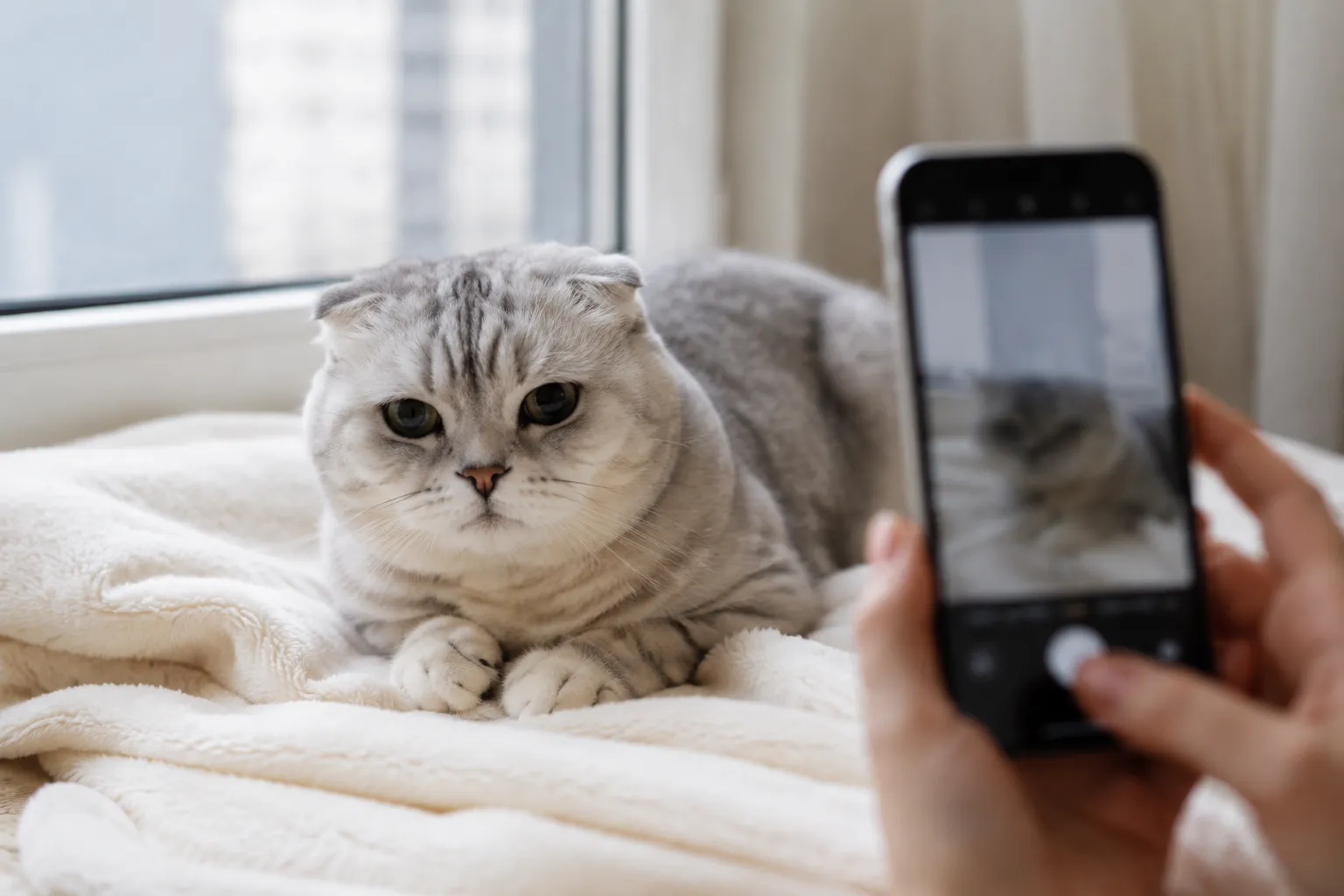
Ever catch your senior Scottish Fold parked in the same warm sunbeam, ears tucked low, eyes half-lidded against the afternoon? That's the shot. Photographing a senior cat isn't about chasing them around the living room—it's about reading them, then setting the stage before they ever notice the lens.
We've handled thousands of pet photos over the years, and the senior Fold is its own category. Here's how to do it right.
Quick Takeaways
- Shoot at their eye level on the floor — towering over a folded-ear cat flattens their best feature.
- Use the window, kill the flash — soft side light reveals fur texture that overhead bulbs erase completely.
- Photograph the routine, not the pose — their favorite blanket spot beats any forced studio setup.
- Capture markings clearly now — sharp reference photos let you turn them into a full-color custom figurine that holds the details forever.
- Two big mistakes — over-editing the fur and ignoring the ears will ruin an otherwise great frame.
Why Senior Scottish Folds Break the Usual Cat Photo Rules
Here's something most pet photography guides won't tell you: the advice that works for a kitten actively works against you with a senior Fold.
Kittens give you motion, contrast, those wide curious eyes. You shoot fast and hope. A senior Scottish Fold gives you something quieter—and frankly, more interesting. Stillness. Texture. A face that has settled into itself.
The folded ears are the whole game. They sit low and tight against the skull, which means the standard "shoot slightly from above" portrait angle you see everywhere will hide them. You end up with a round gray blob and no signature.
And senior Folds carry weight in their expression. The fur around an older cat's muzzle often lightens. The eyes go softer, sometimes a little cloudy. These aren't flaws to hide—they're the texture of a life lived in your house, and they're exactly what you'll want to remember.
"An old cat's face is a map. Your job isn't to smooth it out—it's to light it so the map shows."
One thing worth naming early: many Scottish Folds develop a condition called osteochondrodysplasia, a skeletal issue tied to the cartilage that gives them those ears. Older Folds may sit or move stiffly because of it. We're not vets—if your cat seems uncomfortable, that's a conversation for your veterinarian, and the American Kennel Club's breed overview is a decent starting point for understanding the breed's quirks. For photography, it means one thing: don't force positions. Work with how they already like to sit.
That's the lens for everything below. You're not staging a cat. You're documenting one.
The 7 Setup Steps for Photographing a Senior Cat
These go in order for a reason. Skip around and you'll fight the process. Follow them and your shoot might take fifteen quiet minutes instead of an hour of frustration.
Step 1: Pick the Spot They Already Love
Don't build a set. Find theirs.
Every senior cat has a throne—the corner of the couch, the foot of the bed, the spot on the home-office windowsill where they supervise your workday. That place smells like them. It carries that warm, slightly nutty scent of cat fur soaked in afternoon sun, the one you'd recognize blindfolded.
Shoot there. The micro-story we hear constantly from customers: they spent twenty minutes coaxing the cat onto a fancy blanket backdrop, got nothing, then snapped the perfect frame the second the cat hopped back to its usual cushion.
Why it matters: A relaxed cat in a familiar scent-soaked spot holds still longer and looks like itself. Forced settings read as forced in the final image.
Step 2: Get Down to Their Eye Level
This is the single biggest upgrade you can make, and it costs nothing.
Lie on the floor. Get your phone or camera lens level with their eyes, or even slightly below. For a folded-ear cat, shooting from their level (or a touch under) lifts the ears back into view and gives the face dignity instead of making it look squashed.
You'll feel ridiculous flat on the rug. Do it anyway.
Why it matters: Eye-level shots create connection—the viewer meets the cat as an equal, not a pet being looked down at. With Folds specifically, it rescues the ears.
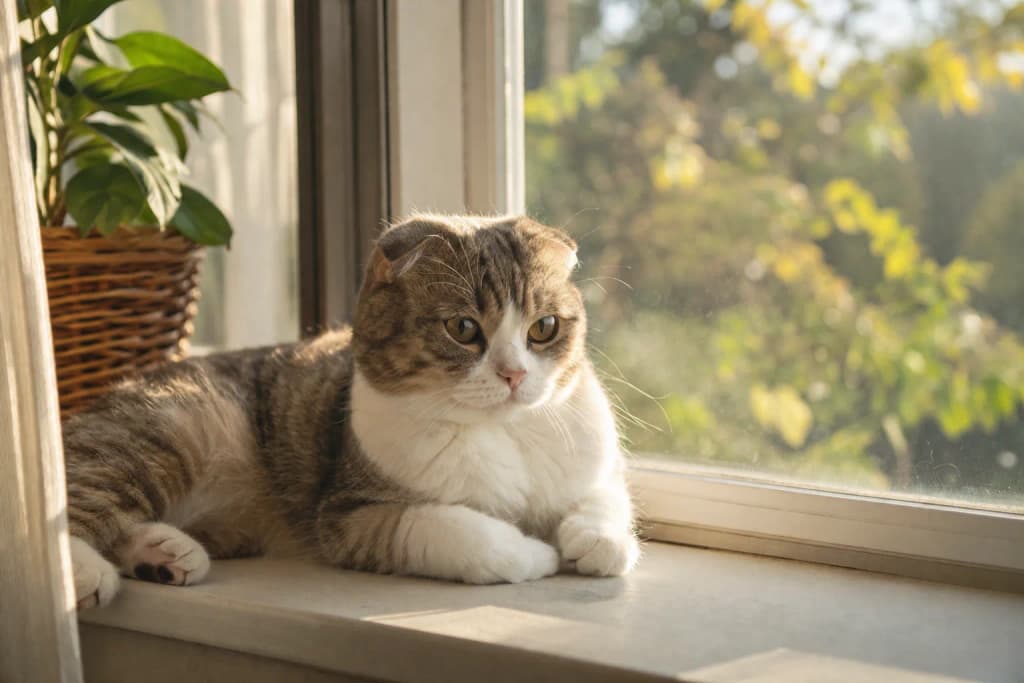
Step 3: Find the Window, Turn Off Every Other Light
Natural side light is free, and it's better than anything you can buy under $200.
Position your cat so a window is off to one side—not behind them, not directly in front. Side light rakes across the fur and reveals every layer of that dense double coat. You'll see the silver tips, the softer undercoat, the slight wave some Folds carry. Overhead room lights flatten all of that into mush.
Then switch the flash off. Always. We'll come back to why this is non-negotiable.
| Lighting Setup | What You Get | Best Time |
|---|---|---|
| Window side light | Rich fur texture, soft shadows | Mid-morning or late afternoon |
| Overhead room light | Flat, gray, lifeless coat | Avoid |
| Direct flash | Flat face, demon eyes, panic | Never |
| Overcast window light | Even, gentle, very forgiving | All day on cloudy days |
Why it matters: Texture is the entire appeal of a senior Fold's coat. Light it wrong and you lose the one thing that makes the photo feel like fur instead of a stuffed toy.
Step 4: Clean the Frame Behind Them
Look past your cat. What's back there?
A tangle of phone chargers. A laundry pile. The corner of a cardboard box. Your brain edits that clutter out in real life, but the camera keeps every bit of it, and it pulls the eye away from your cat's face.
Take ten seconds. Move the obvious junk. You don't need a clean room—you need a clean three feet behind the cat.
Why it matters: A calm background makes the cat the unmistakable subject. It also matters enormously if you ever want the image turned into art later; busy backgrounds compete with the very details you're trying to preserve.
Step 5: Wake the Eyes Without Waking the Cat
A sleeping senior cat is peaceful but a little flat in a photo. You want one beat of alertness—ears perking, eyes opening fully—without sending them bolting.
The trick veterans use: a soft, novel sound, not a loud one. A gentle finger-tap on the floor. A quiet kiss-noise. The crinkle of a treat bag from across the room. You're aiming for that half-second where the eyes go wide and the face lights up.
Shoot in burst mode the instant you make the sound. You'll get one keeper out of eight, and one is all you need.
"The best pet photos live in the half-second between curiosity and boredom. Be ready for it."
Why it matters: Open, engaged eyes are what make a portrait feel alive. With a sleepy senior, you get maybe two or three of these windows before they're done with you.
Step 6: Shoot Wide, Crop Later
Resist the urge to zoom in tight while shooting.
Digital zoom destroys detail—it just enlarges and softens pixels. Instead, frame a little wider than you think you need, keep the full body and face in the shot, and crop afterward on a screen where you can see what you're doing.
This also gives you options. A wide frame can become a tight face portrait, a body shot, or a whole-scene image later. A tight frame can only ever be the one thing you shot.
Why it matters: Wider source images hold more usable detail, and detail is everything if these photos become reference for a keepsake. More on that in a minute.
Step 7: Take Far More Than You Think You Need
Here's the insider math: professionals don't shoot better than you, they shoot more and delete ruthlessly.
For a senior Fold session, aim for 40 to 60 frames across a few short sittings. Not one marathon. Three or four two-minute bursts spread across an afternoon, working around naps. Older cats fatigue, and a tired cat looks tired.
Capture variety on purpose: the full face straight on, a three-quarter angle, a profile that shows the ear set, the paws, a close-up of the markings on the back and flank.
| Shot to Get | Angle | Why You Want It |
|---|---|---|
| Full face | Eye level, straight on | The signature portrait |
| Three-quarter | Slightly to the side | Most flattering, shows ear fold |
| Profile | Direct side | Captures ear set and muzzle line |
| Markings | From above the back | Records coat pattern accurately |
| Paws & posture | Eye level, wide | The little details you forget |
Why it matters: You're not just making one photo. You're building a complete visual record of who this cat is right now—something you'll be deeply grateful for down the road.
The 2 Mistakes That Ruin Senior Fold Photos
We see these constantly. Both are fixable in seconds, and both are the difference between a photo you keep and one you scroll past.
Mistake 1: Smoothing the Fur in Editing
The instinct is understandable. Phone editors push you toward "clarity" and "smoothing" filters, and on a human face they can flatter. On a senior cat, they're a disaster.
A heavy smoothing pass erases the exact thing that makes the coat real—the layered grain, the silver tipping, the slight roughness around an older cat's face. You end up with a waxy, plastic-looking creature that doesn't read as your cat at all.
What to do instead: Adjust brightness and contrast. Maybe nudge the warmth a touch. Stop there. Let the fur be fur. The texture of a senior coat isn't noise to clean up—it's the most honest part of the picture.
Mistake 2: Using Flash (and Losing the Ears)
We told you we'd come back to this.
Direct flash does three terrible things to a Scottish Fold. It flattens the face into a pancake. It triggers the green-eye glow that makes a beloved pet look possessed. And it startles a senior cat into flattening their ears even tighter and bolting—so you lose the calm posture and the ear shape in one shot.
What to do instead: Kill the flash and lean entirely on window light from Step 3. If a room is genuinely too dark, move the cat's cushion closer to the window rather than reaching for the flash. Brighter room, never brighter flash.
"Flash doesn't capture your cat. It interrupts them."
A Counter-Point: When the 'Perfect' Photo Isn't the Point
Now let's be honest with ourselves, because we'd be doing you a disservice otherwise.
Everything above assumes you want a polished, frame-worthy portrait. But here's the thing we've learned from thousands of pet families: the photo people treasure most is almost never the technically perfect one.
It's the slightly blurry shot of the cat mid-yawn. The one where they're squashed into a too-small box. The accidental frame where they're looking at your kid instead of the camera. These imperfect photos hold a feeling that no amount of correct lighting can manufacture.
So take the good shots. Follow the seven steps. But don't let the pursuit of the perfect frame stop you from just grabbing your phone in the moment. A real photo of a real moment beats a flawless photo of a posed one, every single time.
The texture of memory isn't sharp. It's a little soft around the edges, and that's exactly why it lasts.
If your hands aren't steady, if the cat won't cooperate, if the light is bad—shoot anyway. You can always take more. The one regret we hear over and over from families isn't "I wish that photo were sharper." It's "I wish I'd taken more of them."
What to Do With These Photos (Beyond the Camera Roll)
So you've got 50 good frames. Now what? Most of them will sit in your phone, swallowed by ten thousand other pictures, surfacing only by accident two years from now to absolutely wreck your afternoon.
There are better ways to live with them.
Some families print a small photo book—physical, on the coffee table, where you actually see it. Some frame a single favorite. Some keep a dedicated album that's easy to find.
And increasingly, pet parents are turning their best reference shots into something they can hold. Companies like PawSculpt take your clearest photos and turn them into a museum-quality custom pet figurine—digitally sculpted by 3D artists, then precision 3D printed in full color so your senior Fold's exact markings, ear set, and coat tones live in resin you can pick up off the shelf.
This is where Steps 4, 6, and 7 quietly pay off. Clean backgrounds, wide frames, and multiple angles are precisely what makes a great figurine possible. The color is part of the resin itself, printed voxel by voxel, then sealed with a clear protective coat—so it keeps that vibrant detail without fading on a sunny windowsill (the very spot your cat would've chosen).
"Every whisker, every fold, every patch of silver around the muzzle—those are the details that say 'this is mine, not just any cat.' That's what we're built to capture."
— The PawSculpt Team
The photo quality requirements here aren't complicated, but they matter. Here's what helps a 3D artist most.
| Photo Element | Ideal | Why It Helps |
|---|---|---|
| Lighting | Soft, even, natural | Shows true coat color and tone |
| Angles | 3–5 different views | Lets artists build a full 3D form |
| Focus | Sharp on face and markings | Preserves the defining details |
| Background | Clean and uncluttered | Keeps the cat readable |
| Resolution | Full size, no digital zoom | More detail to work from |
You don't need a professional setup. You need the seven steps above and a handful of clear, well-lit angles. For specifics on the process, turnaround, and what's possible, it's worth browsing the custom figurine options directly—details shift, and the site keeps the current picture.
The point isn't to spend money. It's that the photos you're taking today are worth more than a spot in a camera roll. Whatever form you choose, get them out of the phone and into your life.
A Few Things Photography Guides Skip
Quick hits from the trenches that don't fit neatly anywhere else.
Wipe the lens. Phone lenses live in pockets and against your cheek. A smudge softens every photo and you'll blame your skills instead of the grease. Ten seconds with a shirt corner.
Shoot during their good hours. Senior cats have peak windows—often mid-morning after breakfast, or that golden late-afternoon stretch. Match your session to when they're already alert and content. Photographing a senior cat the moment they wake from a deep nap rarely works; they're groggy and grumpy.
Bring the smells they trust. A familiar blanket in the frame does double duty—it looks like home and it smells like safety. That faint scent of a sun-warmed bed, a little musky, a little sweet, keeps an anxious senior settled. Comfort photographs as calm.
Don't bribe with food too early. A treat held up gets you a cat staring at your hand, not the camera. Use sounds for attention (Step 5) and save treats as the after-session reward so they associate the whole thing with something good.
Mind the eyes for health, gently. While you're shooting close-ups, you might notice cloudiness or discharge you hadn't clocked before. That's not a photography note, it's a vet note—worth mentioning at the next checkup. Resources like PetMD can help you understand what you're seeing, though nothing replaces an actual exam.
Frequently Asked Questions
How do I photograph a senior cat that won't sit still?
Stop trying to make them sit. Shoot in the spot they already love, use burst mode to catch the good half-second, and break it into short two-minute sessions around their naps. A relaxed cat in a familiar place holds still far longer than one being staged.
What's the best angle for Scottish Fold photography?
Eye level, or even slightly below. Folded ears sit low and tight, so any angle from above hides them and turns the face into a featureless blob. Lie on the floor, get the lens level with their eyes, and the ears and expression come right back.
Should I ever use flash on my cat?
No. Direct flash flattens the face, creates that eerie green-eye glow, and startles senior cats into bolting—taking your calm pose with them. Lean entirely on natural side light from a window. If a room's too dark, move the cat closer to the window instead.
What photos work best for turning my cat into a figurine?
Clear, evenly lit shots from three to five different angles, with a clean background and sharp focus on the face and coat markings. Skip the digital zoom and shoot full-size frames so there's maximum detail for the artists to work from.
Is it normal for my senior cat's coat to look different in photos?
Yes. Older cats often show lighter fur around the muzzle, a coarser texture, and softer eyes. That's the texture of age, not a flaw. Don't smooth it out in editing—it's the most honest, recognizable part of who your cat is now.
Ready to Celebrate Your Pet?
Every pet has a story worth preserving. Whether you're honoring a beloved companion who's crossed the rainbow bridge or celebrating your senior Scottish Fold's quiet, sun-loving personality, a custom PawSculpt figurine captures the details that make your cat one-of-a-kind—the ear set, the coat tones, the markings you've memorized by heart.
You've already done the hard part by photographing your senior cat with care. Those clear, well-lit frames are exactly what our 3D artists use to bring your companion to life in full-color resin you can hold.
Visit pawsculpt.com to learn more about our process, revision options, and quality guarantee.