Moving Day: 4 Tips for Transporting Your Husky Memorial When You Change Homes (And How to Pack It)
"Memory is the only paradise from which we cannot be driven." — Jean Paul
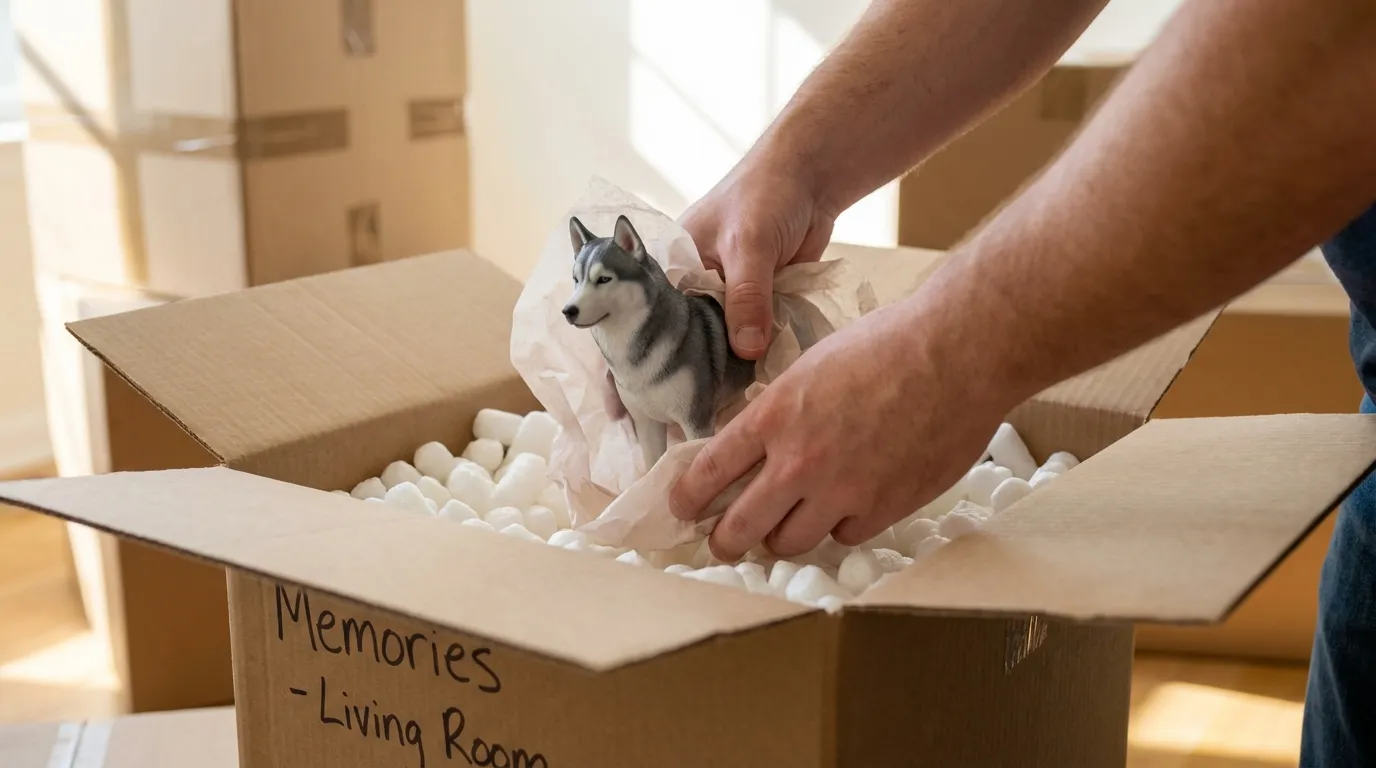
You are standing in the center of the bedroom, surrounded by the chaotic architecture of cardboard towers and half-filled rolls of tape. In your hand, you hold the small, familiar weight of your husky keepsake, the one object you haven't been able to pack yet. The sunlight catches the clear coat on the figurine, highlighting the heterochromia in the eyes—one blue, one brown—just like they were in life. It feels wrong to wrap this in newsprint and bury it in a box labeled "Living Room Decor." This isn't decor. This is the passenger you need to get safely to the next chapter of your life.
Quick Takeaways
- Treat it like biology, not geology — While resin is hard, it reacts to thermal shock and vibration; keep the figurine in a climate-controlled environment (your car, not the moving van).
- The "Floating" Method is non-negotiable — Never let the figurine touch the walls of the box; it must be suspended in a "cloud" of shock-absorbing material.
- Ears are the danger zone — For huskies specifically, the upright triangular ears are the most fragile points; avoid putting direct pressure on these tips during wrapping.
- Documentation is your safety net — Take photos of the condition before packing; if you are using professional movers for your art, this proof is vital for insurance.
- Upgrade your memorial — If you are worried about an existing fragile piece, many owners choose to create a durable, custom 3D printed replica to travel with while keeping the original safe.
The Weight of What We Carry
We have all been there. The lease is up, or the house is sold, and suddenly your entire life is being categorized into "Keep," "Donate," and "Trash." But then there is that fourth category: "Irreplaceable."
When we move, we aren't just transporting furniture; we are transporting our history. For those of us in the pet community, a memorial figurine isn't just an object occupying x-amount of cubic inches in a truck. It is a physical anchor to a bond that no longer has a physical presence.
The anxiety you feel about moving this object is valid. We hear it from our community constantly. There is a specific fear that if the object breaks, the memory somehow breaks with it. While we know logically that isn't true, the heart doesn't always listen to logic.
The mistake most people make is treating a custom pet figurine like a coffee mug or a heavy book. They wrap it tight, tape it up, and hope for the best. But as specialists in additive manufacturing who work with these materials every day, we can tell you that hope is not a packing strategy. To protect your husky, you need to understand exactly what you are holding.
Understanding the Material: It’s Not Just "Plastic"
To pack your figurine correctly, you have to understand how it was made. At PawSculpt, we utilize full-color 3D printing technology (specifically PolyJet or similar multi-jet fusion processes). This is critical to understand because the material properties dictate the risk.
Your figurine was not hand-carved from wood (which has grain) or molded from PVC (which is flexible). It was digitally sculpted by an artist, then printed layer by microscopic layer using a UV-cured photopolymer resin.
The Engineering Reality
Here is the "shop floor" reality of full-color resin prints: 1. The Color is Embedded: We don't paint these. The machine prints the color into the resin voxel by voxel. This means you don't have to worry about paint chipping off, but you do have to worry about deep scratches marring the surface texture. 2. Hardness vs. Toughness: In engineering terms, resin is "hard" (it holds detail incredibly well) but it is not "tough" (it doesn't like to bend). If you drop a rubber ball, it deforms and bounces back. If you drop a cured resin print, the energy has nowhere to go but through the material, leading to fractures. 3. Anisotropic Weakness: While modern printers are amazing, prints can sometimes have microscopic variances in strength depending on the orientation they were printed in."A moving truck is essentially a low-frequency vibration chamber. Your packing job isn't just protecting against a fall; it's dampening eight hours of constant shaking."
The "Husky" Geometry Profile
Every dog breed presents a different engineering challenge during transport.- Golden Retrievers: Generally sturdy, though the tail feathers can be thin.
- Bulldogs: Compact, low center of gravity, easier to pack.
- Huskies (The High Risk): Huskies are an "additive manufacturing challenge" because of their distinct silhouette.
- The Ears: Those alert, triangular ears act as lever arms. A small force applied to the tip creates significant torque at the base (where it connects to the head).
- The Tail: A husky's curled tail often creates a "negative space" loop. If packing material gets forced through that loop and then pulled, it can snap the tail.
The "Matryoshka" Packing Method
We strongly recommend the "box-in-a-box" method, often called the Matryoshka technique (after Russian nesting dolls). This is the industry standard for shipping high-value, fragile prototypes.
Step 1: The Surface Shield (Acid-Free Tissue)
Never put bubble wrap directly against the clear coat of your figurine. In high heat (like a moving truck in July), plastic wrap can sometimes react with the varnish or leave "impression marks" on the glossy finish.- Action: Wrap the figurine loosely but completely in acid-free tissue paper. This creates a breathable barrier and protects the clear coat from abrasion.
Step 2: The Soft Shell (Bubble Wrap)
Here is where most people go wrong. They wrap it tight, like a mummy. Do not do this.- The Mistake: Wrapping tight puts constant compressive pressure on the ears. If the box gets squeezed, that pressure transfers directly to the ear tips.
The Fix: Tape the bubble wrap to itself*, creating a loose cylinder or cocoon around the dog. You want the figurine to sit inside the bubble wrap tube without being crushed by it.
Step 3: The Inner Sarcophagus (Small Box)
Place the wrapped figurine into a small, rigid cardboard box. This box should be just large enough to fit the bubble-wrapped bundle.- Fill the voids: Use biodegradable packing peanuts or crumpled kraft paper to fill the empty space so the bundle doesn't shift.
- The Shake Test: Close the box and give it a gentle shake. You should feel zero movement inside. If it thunks, add more paper.
Step 4: The Suspension System (The Outer Box)
This is the secret weapon. Take a second box that is at least 3-4 inches larger than your inner box on all sides.- Create a bed of packing peanuts or crumpled paper at the bottom (3 inches deep).
- Place the Inner Box in the center.
- Fill the sides and top with more packing material.
- The Physics: The inner box is now "floating." If the outer box gets dropped, the packing material absorbs the kinetic energy before it reaches the inner box. The vibration from the road is dissipated by the outer layer of air and foam.
Moving Day Logistics: Control the Environment
We have seen heartbreaking photos from customers who did everything right with the packing, but ignored the environment.
Temperature Fluctuations
Resin expands and contracts with temperature. It's a small amount, typically in the micron range, but rapid cycles can cause stress fractures, especially in older prints.- The Danger: The back of a moving truck can reach 120°F in summer or drop below freezing in winter.
- The Solution: Your husky memorial belongs in the cab of the truck or the backseat of your car. It should stay in the same climate control that you do.
The "Last In, First Out" Rule
Treat your memorial box like your overnight bag. It should be the last thing you pack into your car and the first thing you bring into the new house.- Why? Fatigue. By the end of a moving day, you are exhausted. You are more likely to drop a box or stack something heavy on it by accident at 8 PM than at 8 AM.
| Packing Material | Protection Level | Risk Factor | Best Use |
|---|---|---|---|
| Newspaper | Low | Ink transfer to Clear Coat | Void fill only (outer box) |
| Bubble Wrap | High | Crushing fragile ears if too tight | The "Soft Shell" layer |
| Packing Peanuts | Medium | Static cling; shifting during transit | Suspension layer |
| Acid-Free Tissue | Medium | None | First contact layer |
| Towels/Linens | Low | Snagging on 3D texture | Avoid completely |
When You Arrive: The Ritual of Unpacking
There is a psychological phenomenon we often discuss in the studio: the "Unpacking Grief."
When you move to a new home, you are essentially building a new life. Placing your pet's memorial is a declaration that they are part of this new life, too. It is a heavy moment.
We recommend waiting until you have the furniture arranged before unpacking the figurine. Don't let it sit on the floor. Wait until its permanent spot—the mantle, the bookshelf, the nightstand—is ready.
When you cut the tape on that inner box, do it slowly. Check the ears first. Check the tail. Wipe away any dust with a microfiber cloth (the kind used for glasses).
"We've seen families heal by holding something tangible. Grief needs an anchor, especially when the waters around you are changing."
— The PawSculpt Team
Why We Do What We Do
At PawSculpt, we obsess over these details—the resin chemistry, the layer adhesion, the clear coat durability—because we know we aren't manufacturing toys. We are manufacturing memories.
Our process involves digital sculpting by artists who study anatomy, followed by precision 3D printing where colors are fused directly into the material. We finish every piece with a protective clear coat to seal the color and add a lifelike sheen. We do this so that when moments like "Moving Day" come, your keepsake has the best possible chance of surviving the journey.
But even the best engineering has limits. Resin is not steel. It requires care.
If you are reading this because you are about to move, take a breath. You are doing a good job. The fact that you are researching how to pack this item proves how much that dog meant to you. That love is the most durable thing of all—stronger than resin, stronger than cardboard, and certainly strong enough to survive a move.
Frequently Asked Questions
Can I use bubble wrap directly on my resin figurine?
We advise against direct contact for long periods. Wrap the figurine in acid-free tissue paper first. In high-heat situations (like a hot car), plastic bubble wrap can sometimes stick to or react with the protective clear coat varnish, potentially leaving impression marks on the surface.Will the colors fade if I leave the figurine in the car during a move?
Short-term exposure is usually fine, but you should absolutely avoid leaving it in direct sunlight (like on a dashboard). While our full-color 3D prints are made with UV-cured resin, prolonged exposure to harsh UV rays can cause colors to shift or fade over many years. Treat it like a watercolor painting—keep it out of direct sun.My figurine has a thin tail; how do I support it?
This is common with huskies and cats. Do not pack material tightly through the loop of a curled tail or between the legs. If the box shifts, that packing material becomes a wedge that can snap the appendage. Instead, create a soft "cloud" of tissue around the entire area so any external pressure is distributed across the sturdy hips, not the fragile tail.Is it safe to ship my figurine with a moving company?
We strongly recommend transporting it personally in your own vehicle. Moving trucks are subject to high vibration, shock, and uncontrolled temperatures that can make resin brittle. If you absolutely must use movers, use the double-box method described above, label it "High Value/Fragile/Art," and ensure it is listed on the inventory sheet.Ready to Celebrate Your Pet?
Every pet has a story worth preserving. Whether you're honoring a beloved companion who's crossed the rainbow bridge or celebrating your furry friend's unique personality, a custom PawSculpt figurine captures those details that make your pet one-of-a-kind.
Free instant AI preview • 3D artist preview within 7 days • 5 free revisions