12 Years in 12 Centimeters: Summarizing a Border Collie's Life in One Sculpt (The 'Prop' Method)
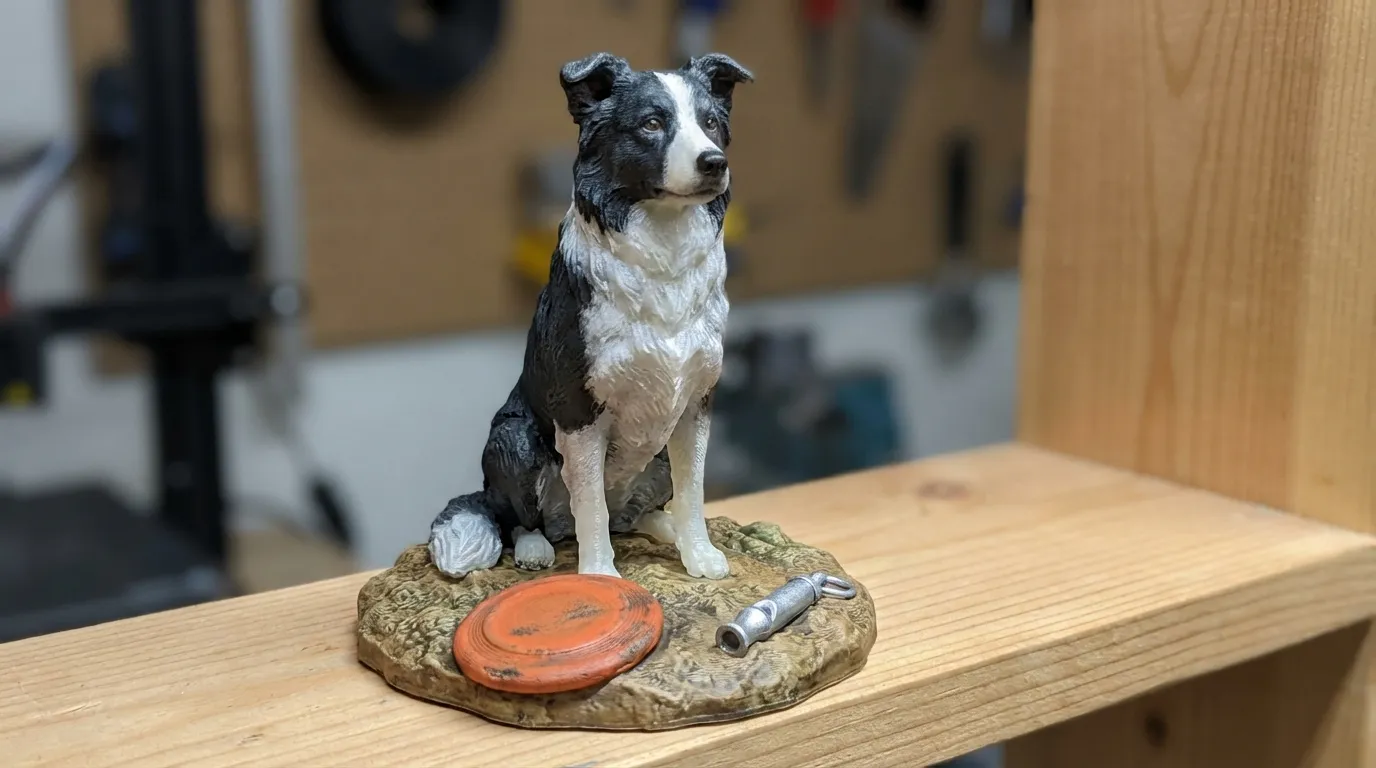
The average Border Collie runs approximately 25,000 miles in a lifetime—roughly the circumference of the Earth—chasing frisbees, sheep, or just the wind. But when a client asked us to memorialize their collie, "Buster," they didn't send a photo of him running; they sent a photo of him sleeping with a battered, duct-taped tennis ball. That ball wasn't just a toy; it was the anchor of his entire existence, and including it in his Border Collie tribute transformed a standard figurine into a biographical sculpture.
Quick Takeaways
- The 'Prop' Method — Elevate a figurine from a portrait to a story by including one defining object (toy, collar, bed).
- Scale Matters — In 3D printing, small accessories (under 2mm) need specific thickening to survive post-processing.
- Color Context — Full-color 3D printing captures the specific wear-and-tear on a favorite toy, not just the generic colors.
- Narrative Anchors — Choose props that represent a behavior, not just an aesthetic (e.g., a chewed stick vs. a pristine bow tie).
- Digital Integration — Learn how PawSculpt artists merge separate reference photos of pets and props into one cohesive mesh.
The Engineering of Emotion: Why Props Matter
In my 15 years in additive manufacturing, I've overseen the production of thousands of models. I've seen perfectly executed, anatomically flawless prints that felt... empty. I've also seen prints with slightly messy fur textures that brought grown men to tears. The difference is almost always context.
A dog standing in a generic show pose is a biological record. A dog guarding a specific, shredded frisbee is a memory.
We call this the "Prop Method." It’s a concept borrowed from theater design but applied to the rigid constraints of full-color resin 3D printing. When you condense 12 years of life into a 12-centimeter statute, you have limited real estate. You cannot capture every moment. You have to capture the essence.
The Rule of One
The mistake most people make is clutter. They want the collar, the bed, the bone, and the favorite blanket all in one sculpt. In 3D modeling and printing, this creates visual noise and structural weak points.- One Pet (The Subject)
- One Prop (The Context)
- One Surface (The Grounding)
If you have a Border Collie, that prop is rarely a soft pillow. It’s usually an object of obsession.
Technical Constraints: What Can Actually Be Printed?
Let's get into the shop-floor reality. We use full-color PolyJet-style technology. This means we are jetting millions of droplets of photopolymer resin and curing them instantly with UV light. It allows for incredible color blending—we can reproduce the exact shade of slobber-stained yellow on a tennis ball—but it has physical laws we must obey.
The "Floating Geometry" Problem
In a digital file (ZBrush or Blender), you can have a ball floating an inch from the dog's nose. In the physical world, gravity wins.If you want a figurine of your collie catching a frisbee mid-air, we have to engineer a solution.
- The Support Rod: We can print a clear resin rod to hold the item, but it’s visible.
The Contact Point: This is the professional choice. We sculpt the frisbee so it is just* touching the lip or the paw. This creates a single, solid mesh.
Wall Thickness and Durability
Here is a hard truth about resin printing: it is not injection-molded plastic. It is more like ceramic or alabaster in feel. Thin parts are fragile.If your Border Collie’s favorite toy was a piece of string or a frayed rope, we have to cheat the physics.
- Real Scale: A string might be 0.5mm thick.
- Printable Scale: We need at least 1.5mm to 2mm thickness to ensure the part doesn't snap during the cleaning process (where we blast away support material with high-pressure water).
"A prop isn't just an accessory; it's the adjective that modifies the noun of your pet."
Selecting the Right Prop for a Border Collie
Border Collies are intense. Their props should reflect that intensity. A generic bone usually feels wrong for this breed. Through our years of printing, we've categorized props into three structural tiers based on printability and emotional resonance.
Tier 1: The High-Contact Objects (Easiest to Print)
These items sit on the ground or are held firmly in the mouth. They are structurally sound and offer great surface area for color adhesion.- The Herding Ball: Large, usually scuffed. Great for stability.
- The Agility Tunnel: We can print a segment of a tunnel to act as the base.
- The "Woobie" (Stuffed Animal): If it’s being held in the mouth, the contact area is large, making the print robust.
Tier 2: The High-Detail textures (Moderate Difficulty)
These require high-resolution texture mapping. Since we don't hand-paint, the wear and tear must be digitally sculpted and colored into the file before printing.The Frisbee: specifically, the bite marks*. Our artists sculpt the punctures digitally. The printer then lays down darker pixels in those divots to create depth.
- The Stick: Organic shapes are great, but thin twigs will break. We usually thicken the branch slightly to ensure it survives shipping.
Tier 3: The "Impossible" Geometry (Requires Engineering)
- The Leash: A slack leash is a nightmare for 3D printing. It’s too thin and fragile. We recommend coiling the leash on the ground next to the dog (creating a base) rather than having it hang in the air.
- Loose Hair/Fur Clumps: Trying to print a "cloud" of shedding fur doesn't work. It looks like a solid blob.
| Prop Category | Best For | Printability Score (1-10) | Engineering Note |
|---|---|---|---|
| The Obsession | Tennis balls, Frisbees | 9/10 | Excellent integration with mouth/paws. |
| The Comfort | Beds, specific blankets | 10/10 | Acts as a stable base for the figurine. |
| The Job | Sheep, ducks, agility weave poles | 6/10 | Tall, thin poles (weave poles) are prone to warping; require thickening. |
| The Wearable | Bandanas, tactical harnesses | 8/10 | Must be "merged" to the chest mesh to avoid gaps. |
The Workflow: From Photo to Physical Object
How do we actually do this? Clients often assume they need a photo of the dog with the object. While that helps, it’s rarely enough.
Step 1: The Component Gathering
To get the geometry right, we treat the dog and the prop as separate assets initially.- For the Dog: We need the standard angles (front, side, profile).
- For the Prop: If your dog had a specific, destroyed toy, put it on a table and take photos of it alone. We need to see the texture of the rip, the label that’s half-torn off, the specific grime.
Step 2: Digital Kit-Bashing
Our digital sculptors use software like ZBrush. They sculpt the dog first. Then, they model the prop separately. Finally, they perform a Boolean operation—essentially digitally welding the two objects together.This is critical for full-color printing. If the meshes just overlap without being merged, the printer might interpret the intersection as a void, leading to structural failure or "resin traps" (where liquid resin gets stuck inside the model and cracks it later).
Step 3: Color Mapping (The "No Paint" Rule)
I cannot stress this enough: We do not paint. The color is voxel-based.If you send us a photo of a blue frisbee, we sample that blue. If the frisbee has white stress marks from bending, we map those white pixels directly onto the geometry. The printer jets cyan, magenta, yellow, black, and white resin simultaneously. The result is a prop that looks used, not just colored.
Case Study: The "Herding" Stare
We recently worked on a piece for a Collie named "Scout." Scout didn't play with toys. Scout worked. His owner wanted to capture his "eye"—that intense, lowering stare used to control sheep.
The problem? Without something to stare at, the figurine just looked angry.
The Solution:
We didn't print a sheep (which would mess up the scale). We printed a fence post.
We sculpted Scout in a "down" position, chin low, eyes locked forward. We placed a weathered, wooden fence post about 2 inches away on the base. The post had a tuft of wool caught in a splinter (digitally sculpted).
Suddenly, the empty space between the dog and the post became charged with energy. The prop wasn't the focus; it was the target that gave the dog's pose meaning.
"We don't just print geometry; we print the relationship between your pet and the physical world they loved."
— The PawSculpt Team
Practical Advice for Your Order
If you are planning a custom figurine with a prop, here is your checklist to ensure the final print survives the curing oven and shipping box:
- Check the Aspect Ratio: If the dog is 12cm long, a standard frisbee should be about 1.5cm wide. If you want the detail of the frisbee to be visible, we may need to cheat the scale slightly (make it 10% larger).
- Anchor It: If the dog is holding something, ensure it touches the ground or the body in at least two places if possible. This creates a "closed loop" of stability.
- Contrast is Key: A black dog holding a dark blue toy can lose definition. In the digital phase, we might lighten the toy slightly to ensure it pops visually against the fur.
Frequently Asked Questions
Can you print my dog's specific chewed-up toy?
Yes. We don't use stock 3D models of "generic balls." If you send photos of the specific damage—the ripped felt, the puncture marks—our artists sculpt those details. The full-color printer then reproduces the exact discoloration of the worn areas.Does adding a prop cost extra?
Simple props (balls, frisbees, sticks) are generally included in the standard sculpting fee. Complex environmental elements (agility ramps, intricate beds, or fencing) may incur a surcharge because they require significant additional design time and resin volume.Can I add a prop later?
No. Unlike action figures where accessories snap into hand, our high-end collectibles are printed as a single, solid piece of resin. The prop is fused to the pet at the molecular level during the printing process. It must be decided upon during the initial design phase.How do you handle thin items like whiskers or leashes?
Whiskers are the one detail we usually omit or suggest painting on lightly yourself (though we don't paint). At 12cm scale, a whisker is thinner than a human hair and cannot be 3D printed reliably without snapping. For leashes, we sculpt them lying on the base or draped over the body, rather than hanging freely in the air, to prevent breakage.Ready to Celebrate Your Pet?
Every pet has a story worth preserving. Whether you're honoring a beloved companion who's crossed the rainbow bridge or celebrating your furry friend's unique personality, a custom PawSculpt figurine captures those details that make your pet one-of-a-kind.
Free instant AI preview • 3D artist preview within 7 days • 5 free revisions