
The National Cat Day Challenge: 6 Environmental Enrichment Wins for Your Geriatric Tonkinese
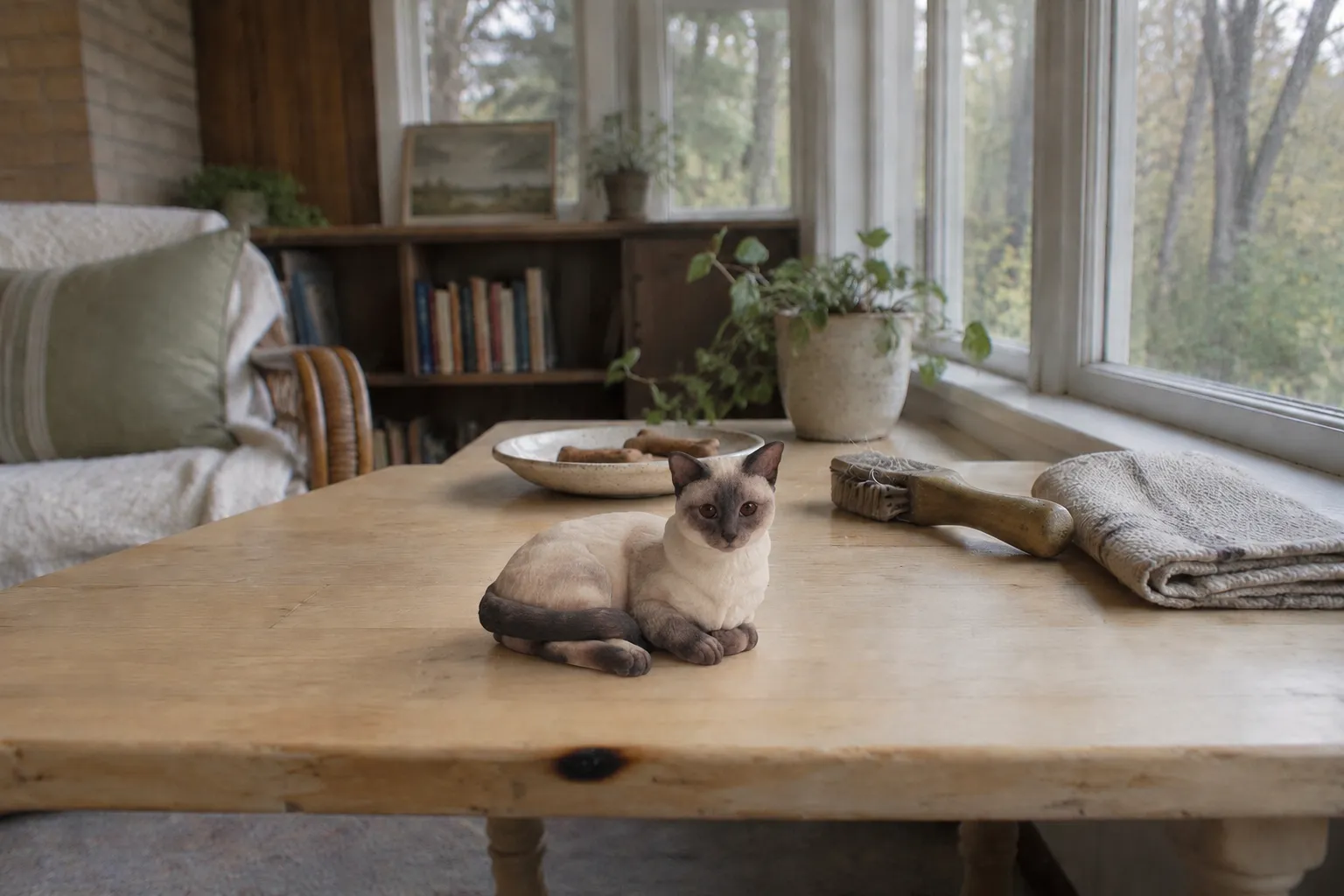
What does your senior Tonkinese actually see when she surveys her territory from that windowsill perch—and how much of her world has quietly shrunk to the few feet she can comfortably reach?
Geriatric cat enrichment for a senior Tonkinese means redesigning her environment around what she can still do easily: lower perches, warmer resting spots, gentler play, and consistent routines. National Cat Day is a good prompt to audit her space, but the American Animal Hospital Association recommends discussing life-stage and behavior changes with your veterinarian first.
Quick Takeaways
- Enrichment for an older cat is about access, not stimulation overload—make the good spots easier to reach.
- The AAHA recommends discussing age-related and behavior changes with your veterinarian; enrichment complements care, it doesn't replace it.
- Fresh, clean water at all times matters; the ASPCA advises washing and refilling bowls daily.
- Feeding should match her life stage, and the WSAVA treats nutrition as a vital sign to review at every visit.
- If you want to hold onto this chapter of her life, a photograph, a written note, or a sculpted keepsake each preserves a different kind of detail.
Why "Enrichment" Changes Meaning for a Geriatric Cat
Let's clear something up over coffee first. When people say "enrichment," they usually picture a young cat launching itself at a feather wand, or a puzzle feeder rattling around the kitchen floor. High energy, high novelty, lots of movement.
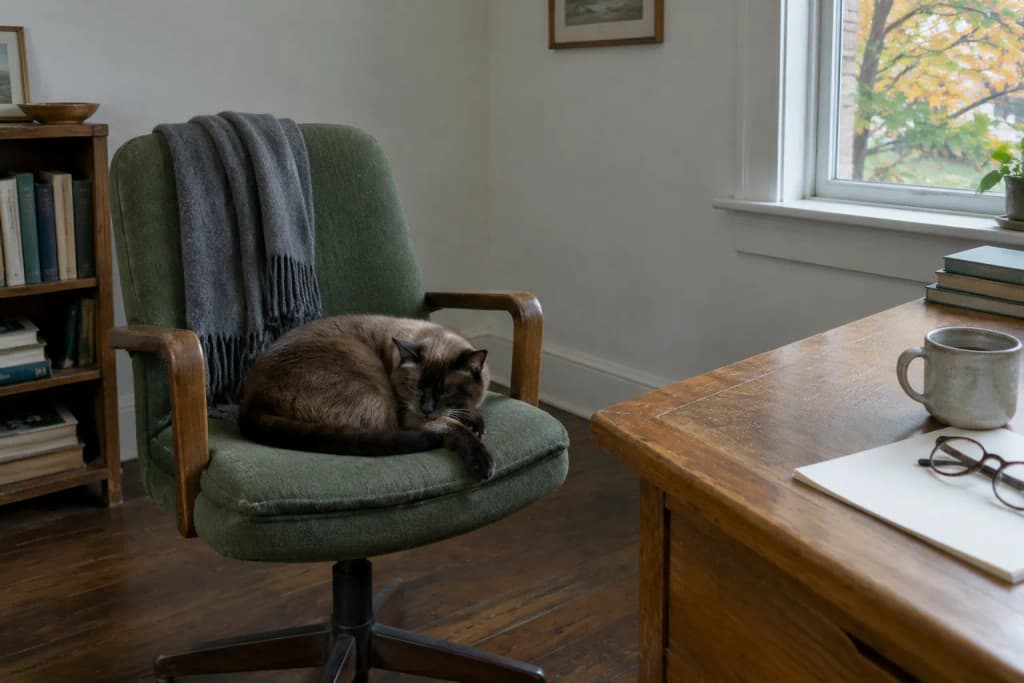
For a senior Tonkinese, the goal quietly inverts. The point isn't to add excitement. It's to remove friction from the things she already loves.
Think of it as a cause-and-effect chain. As a cat ages, her comfortable range narrows. Jumps get calculated more carefully. Warm spots become more valuable. Familiar routines carry more weight. So the enrichment win isn't "give her more to do"—it's "make the world she already navigates easier and richer within her actual reach."
The ASPCA lists grooming, feeding, litter care, and routine veterinary care as the core pillars of cat care. Notice what that framing implies: enrichment sits on top of those pillars, not instead of them. If the foundation is shaky—if she's eating a diet that doesn't match her life stage, or you haven't discussed recent changes with your vet—no amount of clever perch placement fixes that.
And here's the honest caveat, straight from the source: the AAHA specifically recommends discussing life-stage and behavior changes with a veterinarian, because care recommendations vary by age and individual risk. If your Tonkinese has started sleeping differently, hesitating before a jump, or changing her eating patterns, that's a conversation for a professional—not a puzzle for a blog to solve. I'll keep drawing that line throughout, because it matters.
Myth vs. Reality: What Senior Cat Enrichment Actually Requires
Before the six wins, let's bust a few assumptions that trip up first-time cat owners especially.
Myth: More toys and more stimulation means a happier senior cat.
Reality: The ASPCA frames good care around consistency and meeting core needs—feeding, water, grooming, litter, vet care. A cluttered environment can overwhelm an older cat more than it delights her. Fewer, better-placed options usually win.
Myth: If she's slowing down, enrichment doesn't really matter anymore.
Reality: A slower cat still benefits from a well-designed environment. The needs don't disappear with age—they shift. Grooming, gentle engagement, and access to comfortable resting spots remain part of everyday care.
Myth: Diet is a "young cat" concern; a senior cat can coast on the same food.
Reality: Both the ASPCA and WSAVA are explicit that diet should match a cat's life stage, and WSAVA recommends a nutrition assessment at every veterinary visit. Feeding isn't a set-it-and-forget-it decision—it's a vital sign worth reviewing as she ages.
Keep those three in mind. They quietly shape every decision below.
The 6 Environmental Enrichment Wins
Here's the framework. Each "win" follows the same logic: identify what she still enjoys, then reduce the friction between her and that thing. I'll describe how each might look, but treat the visuals as illustration, not prescription.
Win 1: Lower the Landing, Keep the View
The windowsill perch is prime real estate for a reason. Cats read their territory through the window—the shifting light across the day, movement in the yard, the slow drift of shadows as afternoon tips into evening. That visual feed is genuine enrichment.
The problem for a geriatric cat is the ascent, not the view. A perch she once reached in one fluid jump might now require a calculation she'd rather skip.
The fix is simple and visual: build a staircase of intermediate surfaces. A stable ottoman, then a chair seat, then the sill—each one a modest step rather than one ambitious leap. You keep the reward (the window, the warmth of sun-warmed cushion, the panorama) and remove the barrier.
Picture it: a cushioned windowsill spot, a soft blanket bunched into a nest, warm light pooling across the fabric in the late afternoon. That's the reward. Your job is just making it reachable.
Win 2: Warm Spots, Mapped to the Sun
Older cats gravitate toward warmth, and here's where a craftsman's eye actually helps. Spend one full day watching how sunlight moves through your home. Morning light hits one wall; by midday it's crossed the floor; late afternoon it climbs onto a different surface entirely.
Now map her resting spots onto that migration. A soft blanket in the morning-sun corner. A perch or bed where the afternoon light lands. You're essentially choreographing her day around the natural warmth she'll seek out anyway.
This is enrichment disguised as interior design. The texture matters too—a knitted blanket holds warmth and gives her claws something satisfying to knead. The visual payoff, if you're the type who notices these things, is lovely: a curled cat, half-lit, eyes drifting closed in a patch of gold.
Win 3: Water She Can Actually Get To
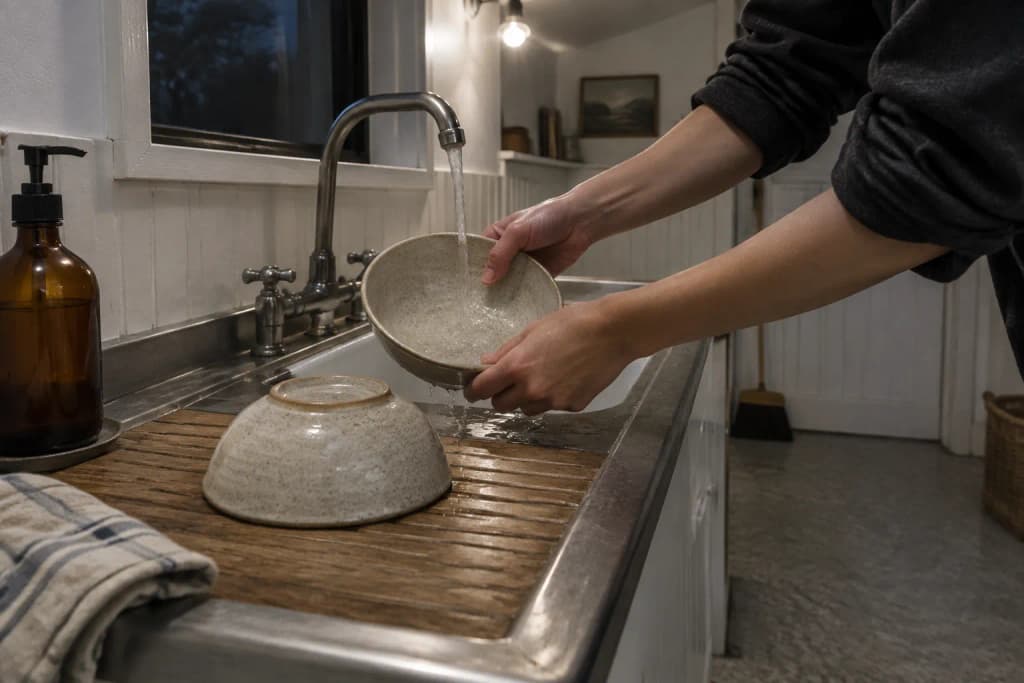
The ASPCA is blunt about this: fresh, clean water at all times, bowls washed and refilled daily. For a senior cat, add one word to that rule—accessible.
If her water sits in one distant corner, and her favorite resting spots have migrated (see Win 2), you've accidentally engineered a small obstacle course between her and hydration. That friction adds up.
The fix is multiplication, not relocation. Place a shallow, clean bowl near each of her main hangouts. A shallow ceramic dish reads clearly to a cat—she can see the water line, and the low rim means no awkward reaching. Wash them daily, as the ASPCA advises. It's unglamorous, but it's one of the highest-impact changes on this entire list.
Win 4: Gentle Play That Respects Her Pace
Play is still enrichment for a senior cat—it just changes gears. Instead of the frantic chase, think slow and deliberate. A soft plush mouse she can bat at from a lying position. A wand toy moved gently, at floor level, in short sessions rather than marathons.
The visual cue to watch for is her engagement, not her athleticism. A slow tail flick, a tracking gaze, a half-hearted paw swat—those are wins. You're not trying to exhaust her. You're keeping the predatory circuit lit, on a dimmer switch.
And genuinely, if she disengages quickly or seems reluctant to move in ways she used to, that's worth noting for your vet. The AAHA flags behavior changes as something to raise early with a professional. Play sessions are a low-key way to observe, not just entertain.
Win 5: Feeding as a Ritual, Not Just a Refill
Here's where the framework and the sources tighten together. The ASPCA notes that feeding schedules and diet change as a cat ages. The WSAVA goes further, recommending an individually tailored nutrition plan set with your veterinary team, and reassessed at every visit.
So the enrichment angle on feeding is twofold.
First, the content: match her food to her life stage, in consultation with your vet. That's not a decision to eyeball or crowdsource. It's the fifth vital sign, per WSAVA.
Second, the ritual: predictable feeding times and a calm, consistent spot give an older cat a rhythm to anchor her day. Cats read routine as safety. A quiet feeding station, away from foot traffic, at reliable times, turns a basic need into a small daily comfort.
Don't overthink puzzle feeders for a geriatric cat unless she genuinely enjoys them—for some seniors, easy access beats mental challenge at mealtime.
Win 6: Consistency as the Invisible Enrichment
This one's the least visible and possibly the most important. For a senior cat, predictability itself is enrichment.
Furniture that stays put. Litter in the same accessible spot. Feeding at steady times. Resting places that don't vanish overnight. The older she gets, the more her sense of security leans on a stable, legible environment.
If you rearrange the living room, you've quietly increased her cognitive load. She has to re-map. For a young cat, that's stimulating novelty. For a geriatric Tonkinese, it can be disorienting.
So the sixth win is a discipline more than an action: when in doubt, keep it consistent. Change the things that reduce friction (lower perches, closer water), and leave the rest reassuringly familiar.
A Comparison Worth Sitting With
Here's the whole framework in one view, since the through-line is the same every time.
| Enrichment Win | Young-Cat Instinct | Senior-Cat Adjustment |
|---|---|---|
| Perches & views | One big jump to a high spot | Stepped access to a reachable perch |
| Warmth | Finds sun on its own | Resting spots mapped to sun's path |
| Water | One bowl is fine | Multiple accessible bowls, washed daily |
| Play | Fast, athletic, long | Slow, gentle, short, observational |
| Feeding | Standard schedule | Life-stage diet, set with your vet |
| Environment | Novelty is fun | Consistency is comforting |
The pattern reads clearly down the right column: reduce friction, honor routine, keep the reward within reach. That's the entire philosophy of geriatric cat enrichment in one table.
The Texture of Memory: Why This Chapter Is Worth Preserving
Let me shift lenses for a moment, because National Cat Day tends to make people reflective, and there's a reason this stage of a cat's life hits differently.
A geriatric cat is at her most herself. The character is fully formed. The way she tilts her head, the exact curl she settles into, the half-closed-eye contentment of a warm afternoon—these are the specific, hard-to-photograph details that define who she is right now.
You can preserve this chapter in a few different ways, and they're not interchangeable:
- Photographs capture a literal instant—the light, the moment, the exact scene. Fast, honest, flat.
- Writing—a few notes about her quirks, her routine, the sound she makes at the window—preserves personality that a photo can't hold.
- A sculpted keepsake captures form and posture in three dimensions: the shape of that signature curl, the tilt of the head, rendered as an object you can hold.
None of these is "better." They preserve different layers. A thoughtful owner might reach for more than one.
If a three-dimensional keepsake speaks to you, it's worth understanding what it actually is before you decide. PawSculpt makes custom full-color 3D printed resin pet figurines, roughly 2.5 to 6 inches tall. The positioning matters here: it's a sculpted portrait, not a photocopy. An artist digitally sculpts the piece from your reference photos, which means it's an artistic interpretation of your cat's form—not a photo-exact replica, and it's not trying to be.
The process runs in a clear sequence: your reference photos are reviewed, an artist digitally sculpts the portrait, and—this is the part I'd underline—you confirm the artist preview before anything is printed. The first preview typically arrives within seven days after complete references are in and the order enters the design stage, with five revisions included so the pose and character actually look like her. Only after you approve does it print in full color on a Mimaki 3DUJ-553, which supports more than 10 million colors as an equipment capability. Supports are removed, the surface is inspected, and a transparent protective coat is applied for indoor shelf display.
I mention the details because a keepsake decision deserves the same clarity as an enrichment decision: know exactly what you're getting, and why.
Bringing It All Together on National Cat Day
National Cat Day works best not as a shopping prompt but as an audit prompt. Walk your home the way your senior Tonkinese does. Where's the friction? Which warm spot has drifted out of easy reach? When did you last wash the water bowls, and are there enough of them? When did you last talk to your vet about her diet and any changes you've noticed?
Fix the friction. Honor the routine. Keep the reward within reach. That's the whole framework, and it scales to almost any older cat.
And if, somewhere in that slow walk through her territory, you find yourself wanting to hold onto exactly how she looks right now—curled in the light, head tilted, entirely herself—that instinct is worth honoring too. Just choose the medium that captures the layer you care about most.
Frequently Asked Questions
What is the most important enrichment change for a geriatric cat?
Reducing friction to the things she already loves—like adding stepped access to a favorite perch and placing accessible water bowls nearby. The ASPCA advises fresh water at all times and daily bowl washing.
Should I change my senior cat's diet as she ages?
Diet should match her life stage, and the WSAVA recommends a nutrition assessment at every vet visit. Discuss any diet changes with your veterinary team rather than deciding alone.
How do I know if my cat's slowing down is normal aging or a health concern?
The AAHA recommends discussing age-related and behavior changes with your veterinarian, since care recommendations vary by age and individual risk. Raise changes early rather than guessing.
Is a sculpted figurine an exact replica of my cat?
No. PawSculpt makes a sculpted portrait, not a photocopy—an artist's interpretation of your cat's form. You confirm the artist preview before it's printed, with five revisions included.
How long does a custom figurine take?
The first artist preview typically arrives within seven days after complete references and design start. Delivery is 27–40 days (US) or 33–47 days (international) after final payment.
What does a figurine cost?
Single figurines range by size: 2.5-inch $429, 3-inch $489, 4-inch $589, 5-inch $789, and 6-inch $999 USD. A 40% deposit applies, refundable before modeling begins.
If You Want to Hold Onto This Chapter
Enrichment is about making her present life easier and richer—and that's the priority, always, in consultation with your vet. But this stage of a cat's life is also worth preserving, because she's never been more fully herself than she is now.
If a three-dimensional keepsake fits how you want to remember her, explore how a custom PawSculpt portrait is made—from reviewing your reference photos to the preview you approve before printing, with a nameplate option like "Old Pip" and the choice to include a companion pet. Or browse more pet-care and keepsake guides on the PawSculpt blog if you're still weighing your options. There's no rush. Take the walk through her territory first; the rest can follow.