
Stuffed Animal Replica vs. 3D Printed Chinchilla Figurine: The Eco-Footprint Data You Haven't Seen
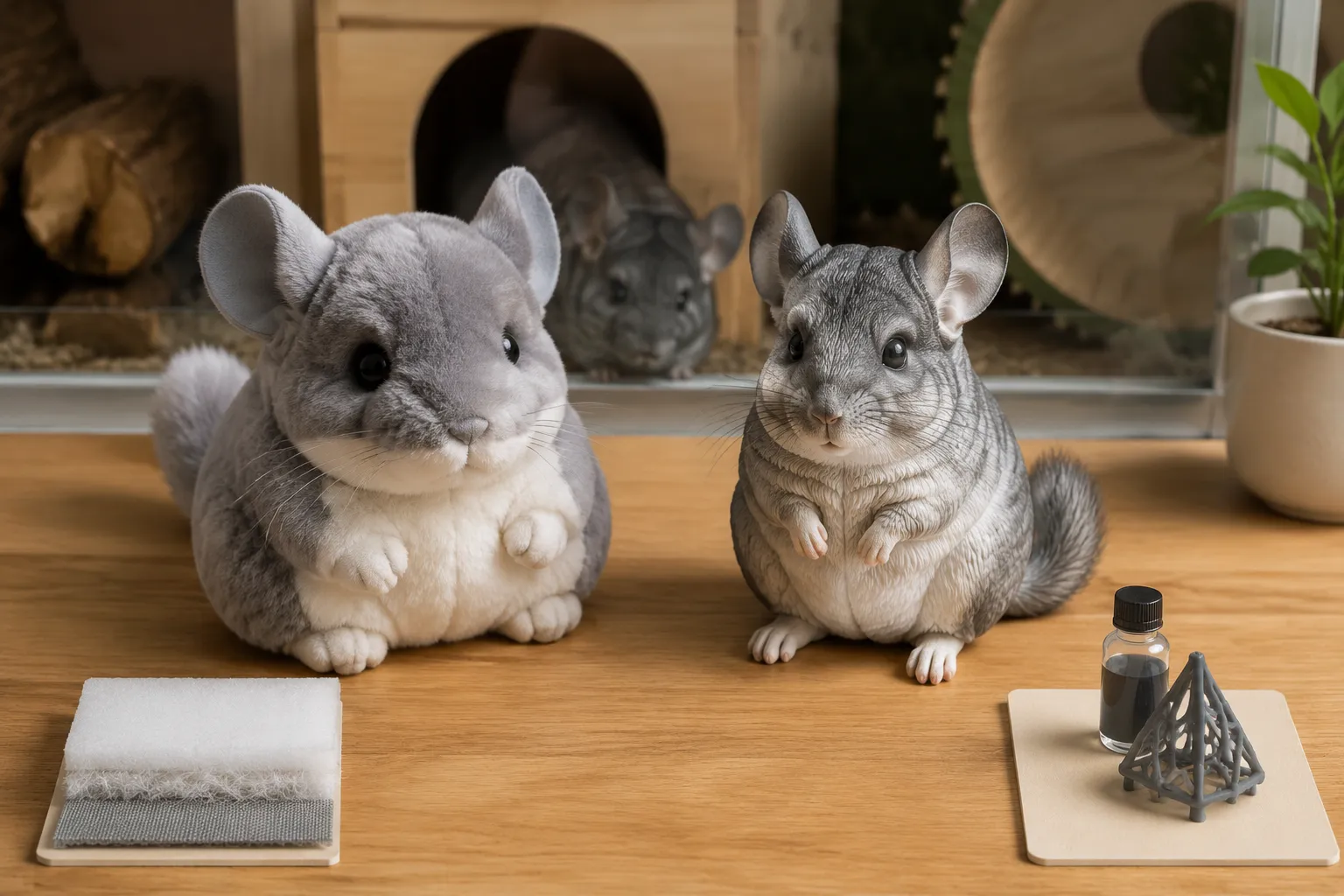
Two years ago, the backyard was a blur of silver fur and dust clouds—your chinchilla launching off the patio stones in that ridiculous popcorning leap, catching late afternoon light like a tiny, living thundercloud. Now you're standing in that same square of sun, holding your phone, scrolling through stuffed animal replica vs figurine options, trying to figure out which memorial won't end up in a landfill in twenty years.
You're not alone in that search. And the eco-footprint data behind these two choices? Almost nobody is talking about it honestly.
Quick Takeaways
- Stuffed replicas carry a hidden environmental cost — synthetic plush production generates3-5x more microplastic waste than most owners realize
- 3D printed figurines aren't automatically "green" — material choice and print method determine whether they're sustainable or not
- Full-color resin printing has the smallest waste footprint — voxel-level color eliminates paint, solvents, and finishing chemical runoff
- A lasting memorial reduces total lifecycle waste — durable kepsakes like custom pet figurines from PawSculpt avoid the replace-and-discard cycle of fabric memorials
- Your chinchilla memorial choice reflects your values — and there's a way to honor both your pet and the planet simultaneously
The Angle Nobody's Covering: Lifecycle Waste, Not Just "Materials"
Here's what frustrates us. Every comparison article you'll find pits stuffed animals against figurines on sentimentality, appearance, maybe price. But nobody—and we mean nobody in the first five pages of search results—is breaking down the total environmental lifecycle of these products.
Not just "what's it made of." But: what chemicals were used in production? How much waste was generated during manufacturing? What happens to it in5, 10, 50 years? Does it shed? Does it degrade? Does it off-gas?
We're going deep on this. Because if you're choosing an eco-friendly pet memorial, you deserve actual data, not marketing fluff dressed up as sustainability.
"The most sustainable memorial is the one you never have to replace."
— The PawSculpt Team
What's Actually Inside a Stuffed Animal Replica (And Why It Matters)
Let's crack open the plush memorial industry. Not literally—though if you did, here's what you'd find.
The Material Stack
A custom stuffed animal replica of your chinchilla typically contains:
- Outer fabric: Polyester plush (petroleum-derived synthetic fiber)
- Inner stuffing: Polyester fiberfill or, in premium versions, memory foam scraps
- Structural elements: Plastic pelets for weight, wire armatures for posing
- Adhesives: Hot glue, fabric cement, or thermoplastic adhesives
- Eyes/details: Acrylic plastic, sometimes glass
That's a minimum of four different material categories, most of which cannot be separated for recycling. The plush fabric alone is essentially spun plastic—it's polyethylene terephthalate (PET) fiber, the same polymer family as water bottles, but in a form that's nearly impossible to recycle once it's been cut, sewn, and glued into shape.
The Production Footprint You Don't See
Here's where it gets uncomfortable. Custom stuffed replicas—the good ones, the ones that actually look like your chinchilla—require:
- Pattern creation: Paper or digital pattern drafting (low impact)
- Fabric cutting: Generates 15-25% material waste per unit (those odd-shaped scraps can't be reused)
- Dyeing: Custom color-matching requires small-batch fabric dyeing, which uses significantly more water and dye per unit than bulk production
- Assembly: Typically 8-20 hours of hand labor (low environmental impact, high human cost)
- Shipping: Lightweight but bulky—oversized packaging, more truck space per unit
The cutting waste alone is staggering. A single custom plush chinchilla replica generates roughly 40-60 grams of polyester scrap that goes directly to landfill. Multiply that across the thousands of custom plush memorials produced annually, and you're looking at literal tons of non-biodegradable fabric waste.
The Microplastic Problem Nobody Mentions
This is the counterintuitive insight that changed how we think about plush memorials.
Every time you touch, move, dust, or display a polyester stuffed animal, it sheds microfibers. These are microscopic plastic particles—invisible to the naked eye—that enter your home's air and dust. Research from environmental science institutions has documented that synthetic textiles are one of the primary sources of indoor microplastic contamination.
Your chinchilla memorial, sitting on your shelf, is quietly shedding plastic into your living space for its entire lifespan.
We're not saying this to scare you. We're saying it because nobody else in the memorial product space is being honest about it.
| Factor | Stuffed Animal Replica | 3D Printed Resin Figurine |
|---|---|---|
| Primary Material | Polyester (petroleum-based) | Photopolymer resin |
| Production Waste | 15-25% fabric scrap + thread/stuffing waste | 2-5% support material (recyclable in some systems) |
| Microplastic Shedding | Continuous over lifespan | None (solid, sealed surface) |
| Biodegradability | 200-500+ years | Not biodegradable, but inert |
| Recyclability | Effectively zero (mixed materials) | Limited but improving |
| Lifespan Before Degradation | 5-15 years (fading, mating, dust accumulation) | 50-100+ years (UV-resistant resin) |
| Chemical Off-gassing | Flame retardants, dye fixatives | Minimal after full cure |
3D Printed Chinchilla Figurines: The Sustainability Breakdown
Now let's flip the lens. 3D printing has a reputation problem—people assume it's wasteful because they picture failed prints and plastic spaghetti. But the reality of modern full-color resin printing is radically different from hobyist FDM printing.
How Full-Color Resin Printing Actually Works
The technology behind high-quality figurines (the kind that capture your chinchilla's exact ear shape and fur gradients) uses a process where color is embedded directly into the material at the voxel level. Think of it like a full-color inkjet printer, but in three dimensions. Each microscopic point in the object contains its own color information.
This means:
- No paint — zero paint cans, zero solvent waste, zero brush-cleaning chemicals entering waterways
- No dye baths — no water contamination from color-matching processes
- No finishing chemicals — the only post-processing is a clear protective coat for UV resistance and sheen
- Minimal support material — modern print algorithms minimize waste structures, and what's generated is often a single material that can be processed
The Waste Comparison That Surprised Us
When we first looked at the numbers, we expected 3D printing to be "slightly better" than plush production. The gap is actually enormous.
A typical custom chinchilla figurine (let's say 4-5 inches tall) uses approximately 80-150 grams of resin. The waste generated during printing—support structures, calibration material—adds roughly 10-20% overhead. So you're looking at maybe 15-30 grams of waste material per figurine.
Compare that to the40-60 grams of fabric scrap from a plush replica, PLUS the water and chemical waste from dyeing, PLUS the adhesive waste, PLUS the packaging waste from the bulkier product.
The figurine generates roughly one-third the total waste of a comparable stuffed replica.
But What About the Resin Itself?
Fair question. Photopolymer resins aren't biodegradable. They're essentially cured plastic. So how is this better?
Three reasons:
- Density and durability: A resin figurine doesn't degrade, shed, or break down over decades. It's a one-time material investment that lasts essentially forever. No replacement cycle.
- Inert once cured: Fully cured photopolymer resin doesn't off-gas, doesn't leach chemicals, and doesn't shed particles. It sits on your shelf being chemically boring—which is exactly what you want.
- Volume: The total material volume of a figurine is a fraction of a stuffed animal. Less material in, less material eventually going to landfill (if it ever does—most become family heirlooms).
"A memorial that lasts three generations isn't waste. It's legacy."
Myth vs. Reality: Eco-Friendly Pet Memorials
Myth 1: "Natural fiber stuffed animals are the green choice"
Reality: Even cotton-stuffed, organic-fabric plush replicas require synthetic thread, plastic safety eyes, and non-biodegradable structural elements. The "natural" label applies to maybe 60% of the product by weight. And organic cotton production, while better than conventional, still uses 10,000+ liters of water per kilogram of fiber. A cotton chinchilla replica uses roughly100-200g of fabric—that's 1-2 liters of water just for the outer shell material, before dyeing.
Myth 2: "3D printing is wasteful because of failed prints"
Reality: This is true for hobyist FDM printers running at home. Professional full-color resin systems operate at 95-98% success rates with trained operators. Failed prints at the professional level are rare, and when they occur, the material is cataloged and in some facilities can be processed for non-cosmetic applications. The "3D printing = waste" narrative comes from YouTube videos of home printers, not commercial production.
Myth 3: "Stuffed animals are more 'natural' because they're soft"
Reality: Softness has nothing to do with environmental impact. Polyester feels soft. It's still plastic. The tactile experience of a product tells you nothing about its ecological footprint. A smooth, solid resin figurine with zero shedding and zero degradation is objectively less environmentally impactful over its lifetime than a soft polyester plush that's slowly disintegrating into microfibers.
The Longevity Factor: Why Duration Changes Everything
This is the part of the eco-friendly pet memorial conversation that gets overlooked most.
Environmental impact isn't just about production. It's about how many times you have to produce it.
The Replacement Cycle Problem
Here's what happens to stuffed animal replicas over time:
- Year 1-3: Looks great. Sits on shelf or bed. Accumulates dust.
- Year 3-7: Colors begin fading (UV exposure through windows). Fabric starts pilling. Dust embeds in fibers permanently.
- Year 7-12: Noticeable degradation. Mating of fur texture. Possible moth or pest damage. Stuffing compresses.
- Year 12-20: Significant deterioration. Many owners replace or retire the piece. Some attempt cleaning, which accelerates fiber breakdown.
We've heard from so many pet owners who ordered a plush replica, loved it for five or six years, then watched it slowly become a faded, dusty version of itself. The emotional pain of watching your memorial degrade—watching your chinchilla's likeness literally fall apart—is something nobody warns you about.
And then what? You order another one. Double the environmental impact. Or you throw it away, and now your memorial is in a landfill, taking centuries to decompose.
The Figurine Timeline
A full-color resin figurine with UV-resistant clear coat:
- Year 1-10: Identical to day one. Dust wipes clean with a soft cloth.
- Year 10-30: No visible change. Colors remain locked in the material.
- Year 30-50: Possible very slight yellowing of clear coat in extreme UV conditions (preventable with basic placement away from direct sun).
- Year 50-100+: Still structurally and visually intact. Becomes a genuine heirloom.
One production cycle. One shipping event. One set of materials. For a lifetime—or several lifetimes.
| Timeframe | Stuffed Replica Condition | Resin Figurine Condition |
|---|---|---|
| 1 year | Pristine | Pristine |
| 5 years | Minor fading, dust embedded | Pristine (dust wipes off) |
| 10 years | Noticeable wear, pilling | No visible change |
| 20 years | Significant degradation, likely replaced | No visible change |
| 50 years | Disposed or severely deteriorated | Minimal aging, fully intact |
| Lifetime replacements needed | 2-4 | 0 |
| Total material consumed | 2-4x initial production | 1x initial production |
The Carbon Footprint Comparison Nobody's Done
Let's talk shipping and logistics, because this is another area where the data tells a surprising story.
Stuffed Animal Shipping
A custom chinchilla plush replica typically ships in a box roughly 12" x 10" x 8"—it needs space so the fur doesn't get crushed. That's approximately 960 cubic inches of shipping volume. The product itself weighs maybe 200-400 grams, but the dimensional weight (what carriers actually charge and allocate truck space for) is much higher.
More truck space per unit = more fuel per unit = higher carbon footprint per delivery.
Figurine Shipping
A chinchilla figurine ships in a box roughly 6" x 4" x 4" with foam protection. That's 96 cubic inches—one-tenth the volume. Same delivery truck, ten times the density of products per trip.
This isn't trivial. Shipping logistics account for a meaningful percentage of any product's total carbon footprint, and the volumetric efficiency of figurines versus plush products is dramatic.
The Energy-of-Production Question
We'll be real—this is where the comparison gets more nuanced. 3D printing does consume electricity. A professional full-color print run uses industrial equipment that draws significant power over multi-hour print cycles.
But here's the context: a single custom plush replica requires8-20 hours of human labor in a heated/cooled/lit workshop, plus the energy costs of fabric production (spinning, weaving, dyeing—all industrial processes), plus adhesive manufacturing, plus stuffing production.
When you account for the full supply chain energy—not just the final assembly—the figurine's energy footprint is comparable to or lower than the plush replica's. And that's before factoring in the replacement cycle.
What About Biodegradable Options?
You might be thinking: what about memorial options that actually return to the earth? It's a fair question, and one worth addressing honestly.
Biodegradable Memorial Alternatives
Some options exist:
- Memorial seed plantings (biodegradable urn with seeds): Beautiful concept, zero lasting waste. But no visual likeness of your pet.
- Unfired clay paw prints: Will eventually crumble. Fragile. No full-body representation.
- Wooden carvings: Biodegradable over very long timeframes. Can capture likeness. But wood warps, cracks, and requires maintenance.
- Compostable paper art: Creative, eco-friendly. Extremely fragile. Not a lasting memorial.
Here's the tension: the most biodegradable options are also the least durable. And a memorial that disintegrates isn't really serving its purpose.
The most honest framing isn't "biodegradable vs. permanent." It's: what's the lowest-impact option that actually lasts long enough to fulfill its emotional purpose?
For most people, that answer points toward a single, durable, low-waste object that never needs replacing. Which brings us back to the figurine.
The Emotional Sustainability Angle
We want to talk about something that doesn't show up in carbon calculators but matters enormously.
Emotional sustainability—the ability of a memorial to continue serving its purpose without causing additional distress—is part of the equation.
A stuffed replica that fades and deteriorates doesn't just create physical waste when it's replaced. It creates emotional waste. The grief of watching your chinchilla's memorial degrade. The guilt of throwing it away. The decision fatigue of choosing a replacement. The disappointment if the new one doesn't match the original.
Each of those moments is a small re-opening of the wound.
A memorial that simply... stays. That looks the same on year ten as year one. That you can pick up and hold and see your chinchilla's exact markings, unchanged. That's not just environmentally sustainable. It's emotionally sustainable.
"The greenest choice and the most healing choice turned out to be the same thing. We didn't expect that."
We've worked with thousands of pet families at PawSculpt, and this pattern repeats: the owners who choose a permanent, full-color figurine report less memorial-related anxiety over time than those who chose degradable options. They're not worying about preservation. They're just... remembering.
Making the Decision: A Framework That Actually Helps
Look, we're not going to pretend this is purely a data-driven decision. You're memorializing your chinchilla. Feelings matter here. But if the environmental angle is part of your values—and if you're reading this article, it probably is—here's how to weigh it.
Choose a Stuffed Replica If:
- Tactile comfort is your primary need (you want to hold something soft)
- You're memorializing for a child who needs a huggable object
- You're comfortable replacing it every 5-10 years
- You prioritize the sensory experience over longevity
- Environmental impact is a secondary concern
Choose a 3D Printed Figurine If:
- Visual accuracy matters most (exact markings, colors, proportions)
- You want a single purchase that lasts decades or longer
- Minimizing total lifecycle waste is important to you
- You prefer low-maintenance memorials (no dust embedding, no fabric care)
- You want something that can become a family heirloom
Choose Both If:
- You want the immediate tactile comfort of a plush AND the permanence of a figurine
- Budget allows (and honestly, the combined cost is often less than people expect)
- You're in acute grief and need something to hold NOW, plus something that will last
The PawSculpt Approach to Sustainable Memorials
We built our process around the principle that the most sustainable product is the one that never needs to be made twice.
Our full-color resin printing technology embeds your chinchilla's exact coloring—those gorgeous grey gradients, the white belly, the dark ear edges—directly into the material at the molecular level. No paint to chip. No dye to fade. No surface treatment to wear away.
The only post-processing step is a clear protective coat that adds UV resistance and a subtle sheen. That's it. One material. One process. One object that outlasts everything else on your shelf.
For the specifics of how it works—turnaround times, what photos work best, how revisions are handled—visit pawsculpt.com and explore the process page. We'd rather you see the real details there than have us quote numbers that might change.
What we can tell you is this: our digital sculptors spend serious time on each piece. They're not running a template. They're studying your photos, modeling your chinchilla's specific anatomy, and printing a one-of-one object that exists nowhere else in the world.
The Bigger Picture: What "Eco-Friendly" Actually Means for Memorials
Let's zoom out for a second.
The pet memorial industry is worth billions globally. Most of it is fast-turnover product: mass-produced picture frames, generic paw-print ornaments, low-quality plush toys branded as "custom." The environmental cost of this churn is enormous—and invisible, because each individual product seems small.
But the ASPCA estimates that millions of pets pass away each year in the US alone. If even a fraction of those families purchase a memorial product that degrades and gets replaced within a decade, the cumulative waste is staggering.
The shift toward durable, high-quality, single-purchase memorials isn't just better for individual families. It's better for the planet. Fewer production cycles. Fewer shipping events. Fewer items in landfills.
This isn't about guilt. It's about awareness. And now you have the data to make a choice that aligns with both your heart and your values.
Practical Steps: Reducing Your Memorial's Eco-Footprint
Whatever you choose, here are concrete actions to minimize environmental impact:
If you go with a stuffed replica:
- Choose a maker who uses recycled polyester fill
- Ask about fabric sourcing (deadstock fabric = lower impact)
- Store it in a UV-protected display case to extend lifespan
- When it eventually degrades, look into textile recycling programs rather than landfill disposal
If you go with a figurine:
- Choose full-color printing over painted options (eliminates paint waste entirely)
- Ask about the resin type—UV-resistant formulations last longer, reducing any chance of replacement
- Display away from direct sunlight to maximize the clear coat's lifespan
- Consider the company's shipping practices (recycled packaging, carbon-offset shipping)
Regardless of choice:
- Buy once, buy quality. The cheapest option almost always has the highest lifetime environmental cost.
- Support small-batch or made-to-order production over mass manufacturing
- Consider digital memorials (photo books, video compilations) as zero-waste complements to physical objects
The Data Summary: Putting Numbers Side by Side
Here's the full comparison, consolidated. These are estimates based on industry averages and material science data—not exact figures for any single product, but representative of the category.
| Environmental Metric | Custom Stuffed Replica | Full-Color Resin Figurine | Figurine Advantage |
|---|---|---|---|
| Production waste (per unit) | 40-60g non-recyclable | 15-30g (partially processable) | 50-60% less waste |
| Water usage (production) | High (dyeing, washing) | Minimal (no wet processes) | ~90% less water |
| Chemical inputs | Dyes, adhesives, flame retardants | Resin + clear coat only | Fewer chemical types |
| Shipping volume | ~960 cubic inches | ~96 cubic inches | 90% less space |
| Microplastic shedding | Continuous, lifelong | Zero | Eliminated entirely |
| Expected lifespan | 5-15 years | 50-100+ years | 5-10x longer |
| Lifetime replacements | 2-4 over 50 years | 0 | 100% reduction |
| Total 50-year material use | 400-1600g+ | 80-150g | 75-90% less total material |
The numbers speak clearly. But numbers aren't the whole story—your chinchilla was never just a number either.
Coming Back to the Backyard
You're still standing there. Phone in hand. Sun on your face.
Your chinchilla isn't launching off those patio stones anymore. But the light is the same. The warmth is the same. And the love—that ridiculous, disproportionate love you had for a one-pound rodent with the softest fur on earth—that hasn't faded at all.
The memorial you choose won't bring them back. Nothing will. But it can hold the shape of them in the world. It can be the thing your hand reaches for on the hard days. It can sit in that same afternoon light, unchanged, for as long as you need it to.
And if it can do all that without costing the earth? That feels like something your chinchilla—who was, let's be honest, a pretty low-impact creature themselves—would approve of.
Choose the memorial that matches your values. Choose the one that lasts. Choose the one that lets you stop worying about preservation and start simply remembering.
That's what a stuffed animal replica vs figurine decision really comes down to. Not just sentiment. Not just aesthetics. But what kind of footprint—emotional and ecological—you want to leave behind.
Frequently Asked Questions
Is a 3D printed figurine more eco-friendly than a stuffed animal replica?
Yes, by a significant margin. Full-color resin figurines generate 50-60% less production waste, use minimal water in manufacturing, produce zero microplastic shedding, and last 5-10x longer than plush replicas. When you factor in the replacement cycle—most stuffed replicas need replacing every 5-15 years—the figurine's lifetime environmental advantage grows to 75-90% less total material consumed over a50-year period.
How long does a resin pet figurine last compared to a stuffed replica?
A UV-resistant full-color resin figurine maintains its appearance for 50-100+ years with basic care (keep out of direct sunlight, dust occasionally). Stuffed replicas typically show noticeable fading and fabric degradation within 5-7 years, with significant deterioration by year 12-15. The figurine is genuinely a multi-generational heirloom; the plush is a single-generation comfort object.
Do stuffed animal replicas shed microplastics?
They do, continuously. Polyester plush fabric—which is what virtually all custom stuffed replicas use—sheds microscopic plastic fibers every time it's touched, moved, or even just sits in air currents. These microfibers accumulate in household dust and are nearly impossible to eliminate. A solid resin figurine has a sealed, non-porous surface that sheds nothing.
What makes full-color 3D printing more sustainable than painted figurines?
The key difference is that full-color 3D printing embeds pigment directly into the resin at the voxel level during production. There's no separate painting step, which means no paint cans, no solvent waste, no brush-cleaning chemicals, and no risk of paint chipping that would require touch-ups or replacement. The only post-processing is a single clear protective coat.
Can I get an eco-friendly chinchilla memorial that actually looks like my pet?
Absolutely. Full-color resin 3D printing technology can reproduce your chinchilla's exact markings, fur gradients, and proportions from reference photos. Because the color is part of the material itself—not a surface coating—it captures subtle details like the transition from grey back to white belly with photographic accuracy that won't fade over time.
What is the most sustainable type of pet memorial overall?
The most sustainable memorial is the one you never have to make twice. By that metric, a durable full-color resin figurine wins: zero degradation, zero shedding, zero replacement purchases, minimal production waste, and a lifespan measured in generations rather than years. It's the rare case where the longest-lasting option is also the lowest-impact option.
Ready to Honor Your Chinchilla's Memory?
Your pet's story deserves a memorial that lasts as long as your love does—and one that doesn't cost the earth in the process. Whether you're preserving the memory of a chinchilla who's crossed the rainbow bridge or celebrating your current companion's quirky personality, a custom PawSculpt figurine captures every detail inurable, eco-conscious full-color resin. When comparing a stuffed animal replica vs figurine for your chinchilla memorial, the data is clear: permanence is the greenest choice you can make.
Visit pawsculpt.com to explore the full process, photo guidelines, and service details