
Pet First Aid Every Hamster Owner Should Know: The 5-Minute Basics That Could Save a Life
"The question is not whether we are too good to our small creatures, but whether we are good enough." — Anna Sewell's sentiment in Black Beauty echoes across species and centuries, landing squarely in the laps of those of us who love animals that fit in the palm of a hand.
Picture this: you're out in the garage reorganizing storage bins on a Saturday afternoon, and your kid comes running in, breathless, holding your hamster. Something's wrong. The little guy is limp, breathing fast, one eye half-shut. Your stomach drops. You pull out your phone and start Googling hamster first aid basics — and you get a wall of conflicting advice, half of it from forums circa 2009. Those next five minutes feel like five hours.
Here's the thing most hamster care guides won't tell you: the reason small pet emergencies feel so paralyzing isn't just panic. It's that our brains literally aren't wired to assess danger in animals this tiny. We evolved reading distress signals in dogs, horses, cats — animals whose body language is large enough to decode. A hamster's crisis unfolds in millimeters. And that cognitive gap can cost precious time.
This guide exists to close that gap.
Quick Takeaways
- Hamster emergencies escalate fast — their small body mass means you often have under 30 minutes to intervene effectively
- Temperature is your first diagnostic tool — a cold hamster and a hot hamster need opposite responses, and mixing them up can be fatal
- Most hamster injuries are handling injuries — falls from hands, escapes from exercise balls, and cage-mate aggression account for the majority of emergencies
- A basic first aid kit costs under $20 — and assembling one tonight could be the difference between life and loss
- Celebrate your healthy hamster now — capture their personality with a custom pet figurine from PawSculpt while they're at their most vibrant and full of life
Why Hamster Emergency Care Demands a Different Mindset
Let's start with the counterintuitive truth that changes everything about how you approach hamster emergency care at home: your hamster has been hiding its illness from you. Not sometimes. Always.
This isn't a metaphor. It's evolutionary biology. Hamsters are prey animals. In the wild, a Syrian hamster that looks sick gets eaten. So natural selection has spent millions of years perfecting the art of masking pain, weakness, and distress. By the time you notice something is wrong, the problem has likely been developing for hours or even days.
This is fundamentally different from dog or cat ownership. Your Labrador limps. Your cat yowls. But your hamster? Your hamster will run on its wheel with a broken toe. It'll eat with an abscess forming in its cheek pouch. It'll groom itself while running a fever.
So the first shift in mindset is this: if your hamster looks sick, it's sicker than it looks. Always.
The second shift is about scale. A hamster weighing 30-40 grams has a metabolic rate roughly 10 times faster than yours, pound for pound. That means dehydration hits faster. Hypothermia sets in faster. Shock progresses faster. You don't have the luxury of "let's wait and see how she is in the morning." In hamster time, morning is an eternity.
"A five-minute response window for a hamster is the equivalent of a golden hour in human emergency medicine."
Here's what that means practically: you need to know what to do before something goes wrong. You can't learn CPR while someone's coding on the floor. Same principle. Smaller patient.

The 5-Minute Hamster First Aid Assessment: A Step-by-Step Protocol
Forget the generic "observe your pet" advice. Here's an actual triage protocol you can run through in under five minutes. We've broken it down into what ER vets call the ABC method — adapted for hamsters.
A: Airway and Alertness
Pick up your hamster gently (we'll cover safe handling in emergencies below). Hold it at eye level. Ask yourself three questions:
- Is it breathing? Watch the sides of the ribcage. Hamster respiration is fast — 40 to 110 breaths per minute is normal. You're looking for extremes: gasping, open-mouth breathing, or no visible movement at all.
- Is it alert? A healthy hamster that's awake will react to being picked up. It'll squirm, sniff, or try to escape. A hamster that sits limp in your hand without reacting is in serious trouble.
- Are the eyes clear? Both eyes should be open (assuming the hamster is awake during its active period), bright, and free of discharge. One eye crusted shut often signals infection. Both eyes shut during waking hours can indicate systemic illness.
B: Body Temperature
This is the one most guides skip, and it's arguably the most important single data point you can gather. Gently touch your hamster's ears and feet. Healthy hamster extremities feel warm — not hot, not cold. Room temperature to slightly above.
| What You Feel | Likely Meaning | Immediate Action |
|---|---|---|
| Ice-cold ears and feet, stiff body | Possible torpor/hibernation attempt | Warm gradually (body heat, NOT heat lamp) |
| Ice-cold, limp body, no response | Hypothermia or near-death state | Warm slowly + emergency vet NOW |
| Very hot ears, lethargic behavior | Possible heatstroke | Cool down with damp cloth on ears, move to cooler room |
| Normal warmth, but lethargic | Internal illness, pain, or injury | Proceed to full body check |
A critical note on torpor — sometimes called "hamster hibernation," though it's not true hibernation. If your room temperature drops below about 65°F (18°C), Syrian hamsters especially can enter a torpor state where they appear dead. Cold, stiff, barely breathing. This is not death. But it will become death if you don't warm them up. Cup the hamster in your hands against your body. Breathe warm air over it. The warming process should take 20-30 minutes. If the hamster doesn't revive within an hour, get to a vet.
C: Circulation and Condition
Now do a gentle full-body scan. Run your finger lightly along the hamster's body. You're checking for:
- Lumps or swelling (abscesses, tumors, impacted cheek pouches)
- Wet tail area (wet tail disease — bacterial, often fatal within 48-72 hours if untreated)
- Blood (check ears, nose, mouth, vent area, and feet)
- Broken limbs (a leg that hangs at an odd angle or that the hamster won't put weight on)
- Fur condition (patchy fur loss can indicate mites, ringworm, or Cushing's disease)
The wet tail check is non-negotiable. Proliferative ileitis — "wet tail" — kills more pet hamsters than almost any other condition. If the area around your hamster's tail is wet, matted, or smells foul, this is a veterinary emergency. Not tomorrow. Today. The ASPCA's guide to small animal care emphasizes that wet tail requires immediate professional treatment, and we can't stress this enough.
Building a Hamster First Aid Kit (The Stuff You Actually Need)
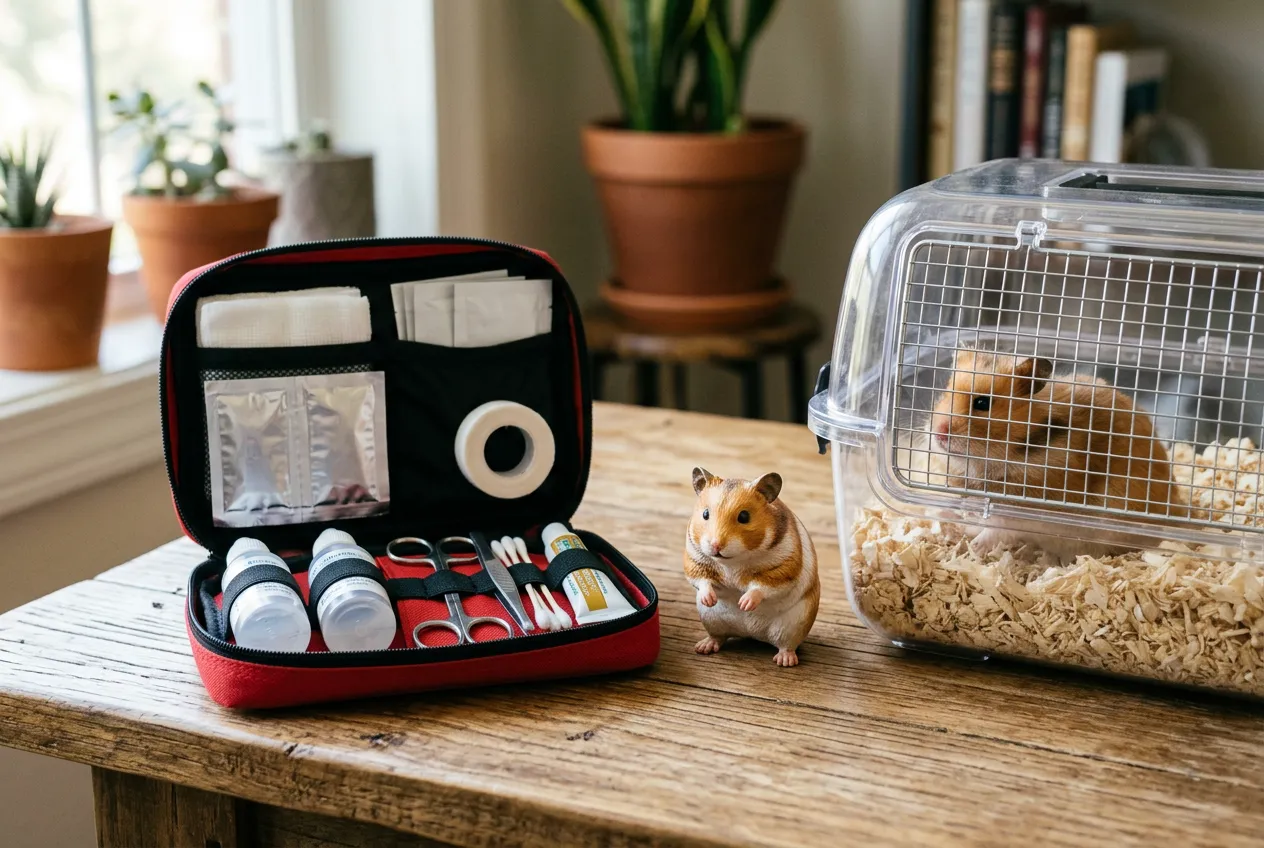
Most "hamster first aid kit" lists online read like someone raided a human medicine cabinet and scaled it down. Half the items are useless. Some are dangerous. Here's what actually belongs in your kit, and more importantly — what doesn't.
The Essentials
- Unflavored Pedialyte or electrolyte solution — For rehydration. Hamsters dehydrate terrifyingly fast during illness. Administer with a 1ml syringe (no needle), one drop at a time on the lips. Never force liquid into a hamster's mouth; aspiration pneumonia can kill them faster than the dehydration.
- 1ml oral syringes (at least 3) — Available at any pharmacy for free, usually. These are your primary tool for administering fluids and liquid medications.
- Styptic powder or cornstarch — For bleeding nails or minor cuts. A broken toenail on a hamster can bleed an alarming amount relative to their body size.
- Plain saline solution (wound wash) — For flushing wounds or cleaning eyes. Not contact lens solution — actual sterile saline wound wash.
- Small digital scale (measures in grams) — This is the sleeper MVP of your kit. Weigh your hamster weekly when healthy. A 10% weight loss in a hamster is a red flag. You can't eyeball a 4-gram weight change on a 40-gram animal.
- A small, clean towel or fleece square — For wrapping, warming, and gentle restraint.
- Emergency vet contact info — Written down, not just saved in your phone. Include an exotic animal vet, not just a regular dog-and-cat practice. Most general practice vets have minimal hamster training. That's not a knock on them — it's just reality.
What Does NOT Belong in Your Kit
| Item People Recommend | Why It's a Bad Idea |
|---|---|
| Hydrogen peroxide | Too harsh for hamster skin; causes tissue damage |
| Neosporin (with pain relief) | The "-caine" analgesics are toxic to hamsters |
| Bandages/Band-Aids | Hamsters chew them off and can ingest them |
| Essential oils | Toxic. Full stop. Even diffused in the same room |
| OTC pain medications (ibuprofen, etc.) | Lethal at hamster-scale doses; never administer human meds |
Here's the mistake most people make: they assume a hamster first aid kit is a miniature version of a human one. It's not. It's a stabilization kit. Your job isn't to treat the hamster. Your job is to keep the hamster alive and stable until a vet can treat it. That distinction matters more than any item in the kit.
"We've worked with thousands of pet families, and one thing we've noticed is that the smallest pets often inspire the deepest devotion. Size has nothing to do with love."
"The tiniest patients teach us the biggest lesson: preparedness isn't about fear — it's about love taking a practical form."
— The PawSculpt Team
Handling the Five Most Common Hamster Emergencies
Alright, let's get specific. These are the scenarios that actually happen — not the exotic edge cases, but the Tuesday-night, oh-no-what-do-I-do situations.
1. Falls and Impact Injuries
This is the number one hamster emergency, and it's almost always preventable. A hamster falls from a hand, from a table, from the top level of a cage with a platform. Hamsters have poor depth perception and zero fear of heights. They'll walk right off an edge.
What to do immediately:
- Don't squeeze or grab the hamster in a panic. Scoop gently from below.
- Place the hamster on a flat, soft surface (folded towel on a table).
- Watch for 10 minutes. Look for limping, dragging a limb, tilting to one side, or inability to right itself.
- If the hamster is walking normally after 10 minutes, monitor closely for 24 hours. Internal injuries can manifest late.
- If the hamster is limping, not moving, or bleeding, keep it warm, restrict movement (small container with soft bedding, no wheel), and call your exotic vet.
The counterintuitive part: a hamster that seems fine immediately after a fall is not necessarily fine. Adrenaline masks pain in prey animals even more effectively than in humans. The real assessment window is 6-24 hours post-fall.
2. Wet Tail (Proliferative Ileitis)
We mentioned this above, but it deserves its own section because it kills so quickly and so often.
Signs: Watery diarrhea, wet/matted fur around the tail, lethargy, loss of appetite, hunched posture, foul smell. Often appears in hamsters under 12 weeks old or in hamsters that have recently experienced stress (new home, cage change, loss of a companion).
What to do:
- Isolate the hamster from any cage mates immediately. Wet tail is contagious.
- Offer Pedialyte via syringe — one drop at a time, every 15-20 minutes. Dehydration is what kills most wet tail hamsters before the infection does.
- Keep the hamster warm. Sick hamsters lose body heat fast.
- Get to a vet within hours, not days. The vet will likely prescribe antibiotics (often a course of Baytril or similar). There is no effective home treatment for wet tail. This is not something you can ride out.
The survival rate for wet tail, even with treatment, hovers around 50%. Without treatment, it's close to zero. That's a hard truth, but it's one that should motivate you to act fast, not freeze.
3. Respiratory Distress
Hamsters can develop respiratory infections from drafts, dusty bedding (especially cedar or pine shavings — both toxic to hamsters, by the way), or bacterial/viral exposure. You'll hear it before you see it: clicking, wheezing, or labored breathing.
Immediate steps:
- Move the hamster to a warm, draft-free space
- Remove any cedar or pine bedding and replace with paper-based bedding (Carefresh or similar)
- Increase humidity slightly — a warm, damp washcloth draped near (not in) the cage can help
- Do not use Vicks, eucalyptus, or any mentholated product near your hamster. Their respiratory systems cannot handle it.
- Schedule a vet visit within 24 hours. Respiratory infections in hamsters can progress to pneumonia rapidly.
4. Cheek Pouch Impaction
Here's one that most small pet first aid guides completely ignore. Hamsters store food in their cheek pouches — that's normal. But sometimes food gets stuck, or the pouch lining gets irritated or infected, and the pouch becomes impacted.
Signs: One cheek looks perpetually full, the hamster is pawing at its face, drooling, or refusing to eat. Sometimes you'll see a foul discharge from the mouth.
What you can do (carefully):
You can try gently massaging the outside of the cheek pouch toward the mouth to help dislodge the material. Use a damp cotton swab if you can see the obstruction near the mouth opening. But honestly? This is one where the vet needs to intervene in most cases. Pouch tissue is delicate, and a puncture can lead to abscess.
Prevention: Avoid feeding sticky foods (dried fruits are a common culprit). Break treats into small pieces.
5. Heatstroke
Hamsters are desert-adjacent animals, but they're burrowers — they escape heat by going underground. In your home, there is no underground. If your room hits 80°F (27°C) or above, your hamster is at risk.
Signs: Lying flat and stretched out (trying to maximize surface area for cooling), panting, drooling, lethargy, convulsions in severe cases.
Emergency cooling protocol:
- Move the hamster to the coolest room in your home immediately.
- Dampen your hands with cool (not cold) water and gently stroke the hamster's ears and feet. The ears are where hamsters dissipate heat most efficiently.
- Place a ceramic tile (cool to the touch) in the cage for the hamster to lie on.
- Offer water via syringe — small drops on the lips.
- Do NOT submerge the hamster in water or use ice. Rapid cooling can cause shock. You want gradual temperature reduction.
| Emergency | Time Sensitivity | Home Treatable? | Vet Needed? |
|---|---|---|---|
| Fall injury | Monitor 6-24 hrs | If walking normally, yes | If limping or lethargic, yes |
| Wet tail | Hours | Stabilize only | Absolutely — ASAP |
| Respiratory distress | 24 hours | Partially (environment) | Yes, within a day |
| Cheek impaction | 24-48 hours | Minor cases only | Usually yes |
| Heatstroke | Minutes | Yes, begin cooling NOW | If no improvement in 30 min |
The Counter-Point: When "First Aid" Becomes Harmful
Okay, let's pump the brakes for a second and be honest about something.
There's a real risk in articles like this one — including this one. The risk is that well-meaning hamster owners read about first aid and start playing veterinarian. And look, I get it. It's midnight, the exotic vet is closed, your hamster is sick, and you feel helpless. The temptation to do something — anything — is overwhelming.
But here's the psychological trap: action bias. It's a well-documented cognitive bias where we feel compelled to act even when inaction (or minimal intervention) is the better choice. In penalty kicks, goalkeepers dive left or right 94% of the time — but staying in the center would actually save more goals. We're wired to move, to fix, to intervene.
With hamsters, this bias can be dangerous. Overhandling a stressed hamster increases cortisol levels and can worsen shock. Force-feeding fluids can cause aspiration. Attempting to splint a broken leg at home can cause more damage than the break itself.
So here's the nuance this article needs to carry: know enough to stabilize, and be wise enough to stop there. The five-minute basics are about buying time, not replacing professional care. Your first aid kit is a bridge, not a destination.
The hardest part of hamster first aid is sometimes doing less. Placing your hamster in a warm, quiet, dark space with access to water — and then waiting — can feel like negligence. It's not. It's often the most medically sound thing you can do.
Finding an Exotic Vet Before You Need One
This deserves its own section because it's the piece of preparedness that people skip until it's too late.
Here's the reality: most veterinary practices in the US are dog-and-cat clinics. Many vets received minimal exotic animal training in school. A vet who's brilliant with your Golden Retriever may have never treated a hamster in their career. That's not a criticism — it's a specialization issue.
What to do right now, today, while your hamster is healthy:
- Search for "exotic animal veterinarian" or "small mammal vet" in your area
- Call and ask specifically: "Do you treat hamsters? How often?" You want a vet who sees small rodents regularly, not one who'll "give it a try"
- Ask about after-hours emergency protocols. Many exotic vets partner with emergency animal hospitals for overnight coverage
- Save the number in your phone AND write it on a card you keep with your first aid kit
- The AVMA's veterinarian finder can help you locate exotic animal specialists in your area
One order that stuck with us at PawSculpt involved a family whose dwarf hamster, Pebbles, had survived a scary bout of wet tail. They'd caught it early — within hours — because they'd been weighing Pebbles weekly and noticed a sudden drop. After recovery, they wanted to celebrate. They sent us photos of Pebbles mid-cheek-stuff (classic hamster pose), and our digital sculptors captured every detail — those bulging cheeks, the tiny paws, the specific cream-and-gray fur pattern — all precision 3D printed in full-color resin. That figurine sits on their kitchen shelf now. A reminder that preparedness and love kept Pebbles alive.
The Psychology of Caring for Fragile Pets
Let's go deeper for a moment, because I think there's something here that most hamster care articles never touch.
Why do we love animals that are so... breakable?
Attachment theory — originally developed by John Bowlby to explain infant-caregiver bonds — applies to pet relationships too. Research on human-animal bonds shows that the vulnerability of a pet actually intensifies our attachment. We don't love hamsters despite their fragility. On some level, we love them because of it. Their smallness activates our caregiving system in a way that a more robust animal might not.
This is why hamster loss hits harder than people expect. Friends and coworkers might shrug — "It was just a hamster" — but the grief is real and neurologically legitimate. The same oxytocin pathways that fire when you hold your hamster fire when you hold a newborn. Your brain doesn't scale love by body weight.
"Grief doesn't measure the size of what you lost. It measures the size of what you loved."
And this is precisely why being prepared matters so much. The helplessness of watching a tiny animal suffer — an animal that trusts you completely, that curls into your palm every evening — triggers a specific kind of distress that psychologists call empathic overwhelm. Your mirror neurons are firing. You feel their pain. And that flood of empathy can actually impair your ability to think clearly and act decisively.
First aid knowledge is the antidote to empathic overwhelm. When you know what to do, your prefrontal cortex stays engaged. You can feel the fear and function through it. That's not cold detachment — that's love in its most useful form.
Ongoing Monitoring: The Weekly Hamster Health Check
Prevention beats treatment every single time. Here's a weekly check-in protocol that takes less than five minutes and can catch problems before they become emergencies.
Every week, during your hamster's active period (evening for most species):
- Weigh your hamster. Record it. A gram-accurate kitchen scale works perfectly. Look for trends, not single readings. A consistent downward trend over 2-3 weeks is a red flag.
- Check the teeth. Hamster incisors grow continuously. They should be roughly even, yellowish-orange (not white — white teeth in hamsters can indicate a nutritional issue), and not overgrown. Overgrown teeth prevent eating and can curve into the skull.
- Inspect the eyes, nose, and ears. Clear, bright eyes. Dry nose. Clean ears. Discharge from any of these warrants attention.
- Watch them move. Let your hamster walk on a flat surface. Are they favoring a leg? Tilting their head? Circling? Head tilt especially can indicate an inner ear infection.
- Check the bedding. Look at the droppings — they should be small, dark, and firm. Diarrhea or absence of droppings are both concerning. Note urine color if visible; dark or reddish urine needs veterinary evaluation.
| Health Indicator | Normal | Concerning | Emergency |
|---|---|---|---|
| Weight | Stable (±2g weekly) | 5%+ loss over 2 weeks | 10%+ sudden loss |
| Teeth | Even, orange-yellow | Slightly overgrown | Curving, broken, or white |
| Eyes | Clear, bright, open | Minor discharge, one eye | Both eyes shut, swollen |
| Droppings | Small, firm, dark | Soft or irregular | Watery/absent for 24+ hrs |
| Activity level | Curious, active at night | Slightly less active | Lethargic, unresponsive |
This weekly check is your early warning system. It's how you catch wet tail on day one instead of day three. It's how you notice the lump when it's pea-sized instead of golf-ball-sized. And it's how you build the kind of baseline knowledge about your specific hamster that no generic guide can provide.
Because here's the thing — and this is the insight I really want you to walk away with — hamster first aid basics aren't really about the emergency. They're about the relationship. The owner who weighs their hamster weekly, who knows their hamster's normal breathing rate, who can tell the difference between "sleeping deeply" and "something's wrong" — that owner has a fundamentally different relationship with their pet than someone who just fills the food bowl and watches from across the room.
Proximity. Attention. Knowledge. These are forms of love that happen to also be forms of medicine.
When the Worst Happens: Navigating Hamster Loss
We'd be doing you a disservice if we didn't address this. Hamsters live 2-3 years on average. Some make it to 4 with exceptional care and genetics. But the math is unavoidable: if you love a hamster, you will outlive that hamster.
And sometimes, despite perfect first aid, despite rushing to the vet, despite doing everything right — you lose them. The cage sits in the corner of the room, still set up, the wheel still, the water bottle still full. That spatial emptiness — the specific dimensions of absence — can be staggering.
We won't pretend to have answers for grief. But we will say this: the impulse to memorialize a hamster is not silly. It's not an overreaction. It's a psychologically healthy response to a real loss. Whether that looks like planting a small garden, framing a photo, writing about your hamster, or commissioning a 3D-printed figurine that captures their likeness down to the specific markings on their fur — these acts of remembrance serve a function. They give grief a place to live outside your body.
Rituals of remembrance work because they externalize internal pain. They transform an abstract feeling into a concrete object or action. And for a pet as small as a hamster — a pet that left no large-scale mark on your physical space — having something tangible to hold can matter even more.
Frequently Asked Questions
What are the most important hamster first aid basics every owner should know?
The core skills come down to three things: knowing the ABC triage method (Airway, Body temperature, Circulation), having a basic first aid kit assembled and accessible, and — critically — having an exotic vet's number saved before you need it. Your role in an emergency is to stabilize, not to diagnose or treat. Keep the hamster warm, hydrated, and calm while you arrange professional care.
How do I know if my hamster is in a medical emergency?
Watch for these red flags: wet or matted fur around the tail (wet tail disease), open-mouth breathing or audible wheezing, complete unresponsiveness when gently handled, ice-cold body temperature, visible bleeding from any area, or inability to walk normally. Any of these warrants immediate action — begin your triage protocol and contact your vet.
Can I treat my hamster's illness at home without a vet?
For minor issues like a small nail bleed or brief stress episode, home care is appropriate. But for wet tail, respiratory infections, suspected fractures, eye infections, or heatstroke that doesn't improve within 30 minutes of cooling, you need a veterinarian — specifically one experienced with exotic small animals. Home first aid buys time; it doesn't replace professional diagnosis and treatment.
What should be in a hamster first aid kit?
The essentials are: unflavored Pedialyte, at least three 1ml oral syringes, styptic powder or cornstarch, sterile saline wound wash, a gram-accurate digital scale, a clean small towel, and written emergency vet contact information. Equally important is knowing what to exclude — no hydrogen peroxide, no pain-relief Neosporin, no essential oils, and absolutely no human OTC medications.
How can I tell if my hamster is hibernating or dead?
Hamster torpor (often called hibernation) happens when room temperatures drop below about 65°F. A torpid hamster will feel cold and stiff but may show very faint breathing — watch the chest closely for 2-3 minutes — or slight whisker movement. Warm the hamster gradually using your body heat, cupping it in your hands for 30-60 minutes. If there's no response after an hour of gentle warming, the hamster has likely passed.
Is wet tail in hamsters always fatal?
Not always, but the odds are grim without fast action. With prompt veterinary treatment — usually antibiotics like Baytril plus supportive fluid therapy — survival rates are roughly 50%. Without treatment, wet tail is nearly always fatal within 48-72 hours. The single biggest factor in survival is speed: catching it early and getting to a vet the same day symptoms appear.
Ready to Celebrate Your Pet?
Your hamster's personality — the way they stuff their cheeks, the specific tilt of their head when they hear your voice, the exact pattern of their fur — deserves to be remembered in more than just photos. Whether your little one is thriving right now or you're holding onto the memory of a companion who's crossed the rainbow bridge, a custom PawSculpt figurine captures the details that make your hamster irreplaceably yours. Every marking, every pose, digitally sculpted and 3D printed in full-color resin that preserves their likeness for years to come. Because knowing hamster first aid basics is how you protect them — and preserving their memory is how you honor them.
Visit pawsculpt.com to explore the full process, see examples, and learn about our quality guarantee