
Why Photographing Your Border Collie at Eye Level Changes Everything
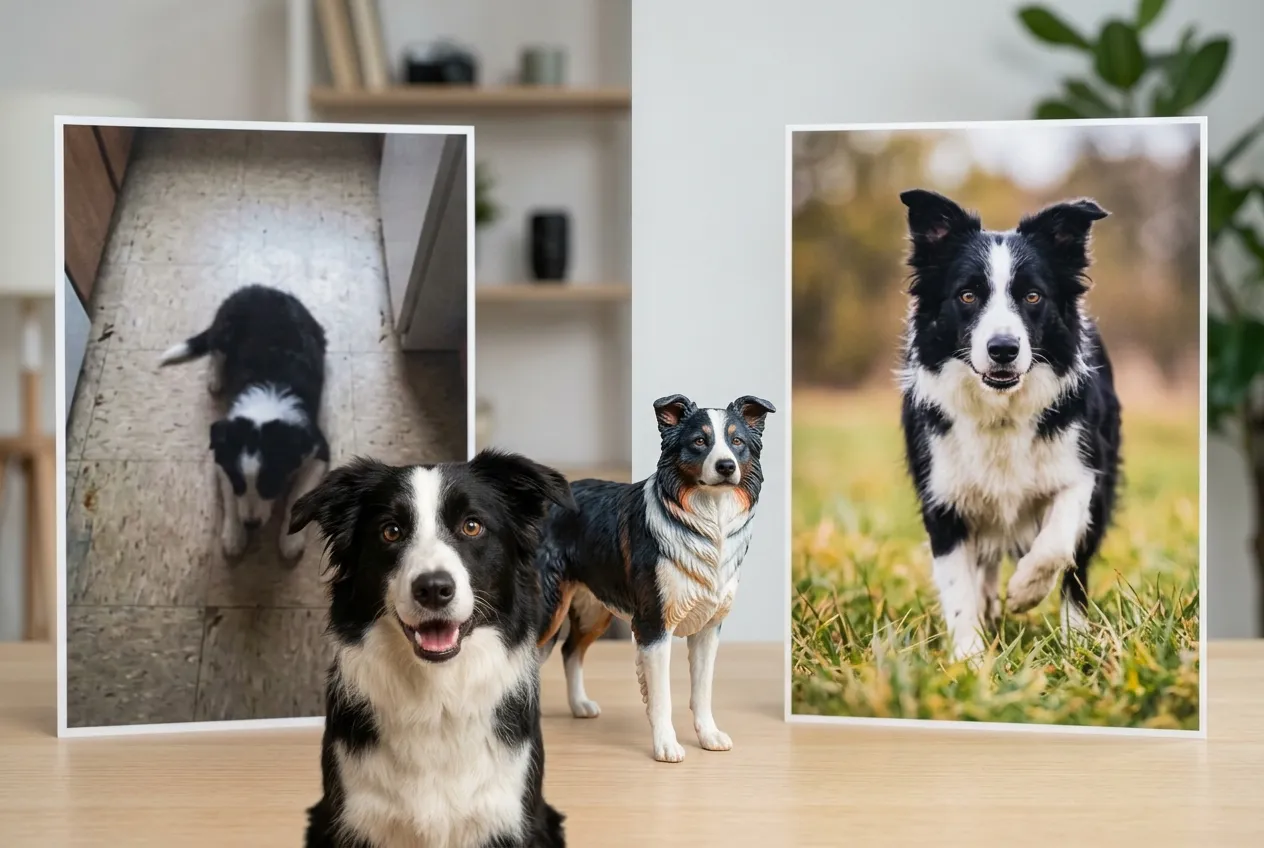
Have you ever crouched down on a walking trail, knees pressing into damp gravel, and looked your Border Collie straight in the eyes—only to realize you've never actually seen them from this angle before? That single shift in how to photograph your Border Collie changes the entire story your camera tells.
Quick Takeaways
- Drop to your dog's eye level — this one adjustment adds more depth and emotion than any filter or lens upgrade
- Shoot during "golden hour" or on overcast days — Border Collies' complex coat patterns photograph best in soft, diffused light
- Use burst mode and a quiet shutter — Border Collies move fast and startle easily, so speed and subtlety win
- Your best photos become lasting keepsakes — a great eye-level shot can even serve as the reference for a custom 3D-printed pet figurine that captures your dog's real personality
- Forget "sit and stay" portraits — candid, mid-motion shots at eye level reveal the Border Collie intensity that makes the breed unforgettable
A customer we worked with recently—let's call her Dana—sent us a folder of photos of her Border Collie, Kip. Dozens of shots. Kip on the couch. Kip in the yard. Kip next to the Christmas tree. Every single one taken from standing height, looking down. They were fine photos. Nice, even. But when we asked if she had anything taken from Kip's level, she dug up exactly one image: a blurry phone shot from a hiking trail where she'd knelt to re-tie her boot and Kip had walked right up to the lens. His amber eyes were sharp. His merle coat caught the late-afternoon light. His expression was pure, focused attention.
"That's the one," our team said immediately. And Dana paused. "That's funny," she told us. "That's the one that always makes me cry."
There's a reason for that. And it has almost nothing to do with camera equipment.
Why Eye Level Is the Border Collie's Best Angle (And Most Photographers Miss It)
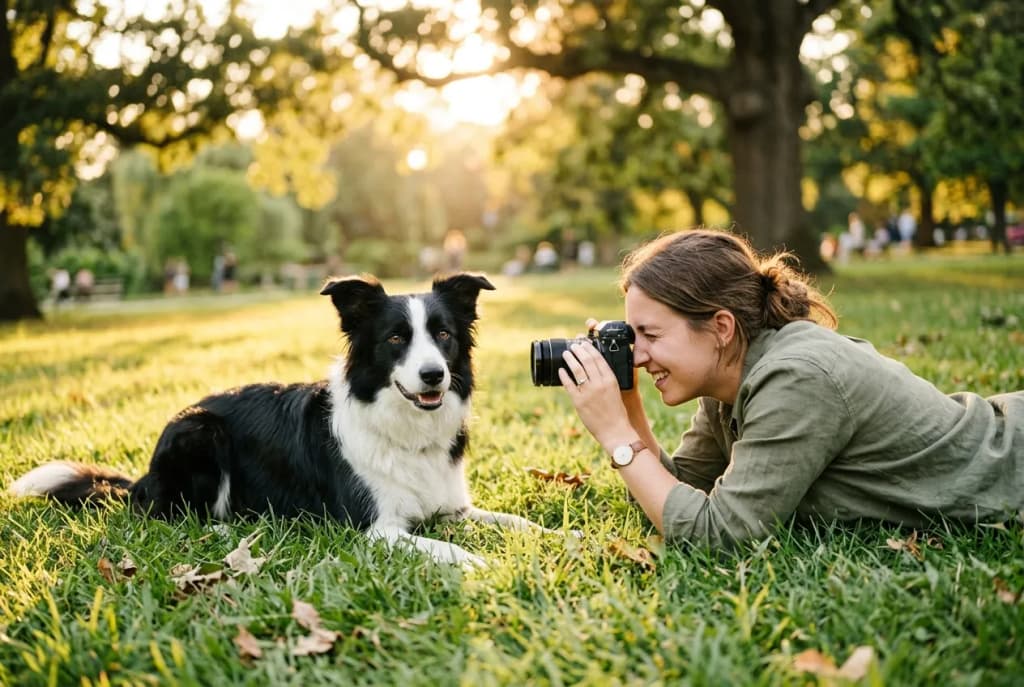
Here's the counterintuitive thing about dog photography that most guides skip right past: the biggest improvement you can make has nothing to do with your camera. It's about your body. Specifically, where you put it.
Most people photograph their dogs from standing height. It's natural. You're already up there. Your phone is in your hand. The dog does something cute, you point and shoot. But what you end up with is a top-down perspective that flattens your dog into the ground, shrinks their presence, and—worst of all—misses their face entirely.
With Border Collies, this is especially costly. The breed's entire identity lives in their expression. That locked-in stare. The slight tilt of the head when they're processing something. The way their ears shift forward a half-second before they bolt. You can't capture any of that from five feet above.
"The best dog photos aren't taken. They're met—eye to eye, on the dog's terms."
When you drop to eye level, three things happen at once:
- The background opens up. Instead of shooting down into grass or pavement, you get sky, trees, horizon lines—context that makes the image feel cinematic.
- Your dog becomes the subject, not an object. Eye-level framing gives them visual weight and presence. They stop looking like a pet in a snapshot and start looking like a portrait subject.
- You capture connection. A Border Collie looking into a lens at their own height reads as eye contact. And eye contact is what makes a photo feel alive.
This isn't just an aesthetic preference. It's rooted in how we process faces. Research from the American Kennel Club confirms that the most emotionally engaging pet photos share one trait: they're taken at the animal's level. Not above. Not below. Right there.
The "Belly on the Ground" Rule
We tell people this all the time: if your jeans aren't dirty, you haven't tried hard enough. The best angles for pet photos—especially with a low-to-the-ground breed like a Border Collie in motion—sometimes mean lying flat on your stomach. Elbows in the mud. Chin near the earth.
It feels ridiculous. It looks ridiculous. But the results are immediate and dramatic.
Try this on your next walk: find a stretch of trail with decent light, get all the way down, and just hold your phone at ground level while your Border Collie moves toward you. Don't worry about framing. Don't worry about focus. Just fire off a burst of shots. We promise—at least two or three will stop you mid-scroll later.
| Shooting Angle | What You Get | What You Lose | Best For |
|---|---|---|---|
| Standing (5-6 ft) | Full body overview, easy to shoot | Expression, depth, emotional connection | Quick ID shots, vet records |
| Kneeling (2-3 ft) | Decent face detail, some background | Still slightly "looking down" feel | Casual portraits, social media |
| Eye level (12-18 in) | Full expression, cinematic depth, connection | Convenience (you're on the ground) | Portraits, keepsakes, reference photos |
| Below eye level (ground) | Dramatic, heroic perspective | Can distort proportions if too close | Action shots, artistic images |
The Border Collie Problem: Why This Breed Is Uniquely Hard to Photograph
Let's be honest about something most dog photography guides gloss over: Border Collies are one of the most difficult breeds to photograph well. Not because they're uncooperative—actually, the opposite. They're too aware.
A Golden Retriever will sit in a sunbeam and gaze lovingly into the middle distance while you fiddle with settings for ten minutes. A Border Collie will notice the camera, assess it, decide it's not a sheep, and move on to something more interesting in about four seconds.
Their intelligence works against you. They read your body language faster than you can compose a shot. If you're tense, they're tense. If you're focused on them, they're focused on why you're focused on them. It creates this feedback loop where the harder you try, the more unnatural the photos look.
The "Ignore to Engage" Technique
Here's what actually works—and it's the opposite of what most people do. Stop trying to get your Border Collie to look at the camera. Instead, set up at eye level, point your lens in their general direction, and then completely ignore them.
Talk to someone else. Look at the scenery. Pretend to be interested in a rock.
Within 30 seconds to a minute, most Border Collies will do one of two things: they'll either relax into a natural posture (because the pressure is off), or they'll come investigate you (because you're suddenly more interesting when you're not asking anything of them). Either way, you win.
Dana told us she discovered this by accident. She was sitting on a trail bench, frustrated after twenty minutes of trying to get Kip to hold still, and she just gave up. Put her phone on her knee, pointed vaguely at him, and started watching the clouds. Kip walked over, sat down facing her, and tilted his head. She tapped the shutter without even looking at the screen.
Best photo she ever took of him.
Working With the Border Collie Coat
The other challenge specific to this breed is their coat. Border Collies come in an extraordinary range of colors and patterns—black and white, red and white, blue merle, sable, tricolor—and each one presents different exposure challenges.
Black and white Border Collies are the trickiest. The contrast range between their dark fur and white markings can confuse your camera's metering system, leaving you with either blown-out whites or muddy blacks. The fix: tap to expose on the mid-tone area (usually the border where black meets white on their face) and let the camera split the difference.
Merle-coated dogs are actually easier in some ways because the mottled pattern gives the camera more tonal range to work with. But they need soft light to really shine—direct sun washes out the subtle blue and gray variations that make merle so striking.
Here's a detail most guides miss entirely: the texture of a Border Collie's coat changes how light interacts with it depending on the angle. Their outer coat is coarser and slightly glossy, while the undercoat is dense and matte. When you shoot from above, you mostly see the glossy outer layer, which can create harsh reflections. When you shoot from eye level, you see more of the softer undercoat framing their face, which absorbs light and creates a warmer, more dimensional look.
That's not something you'll find in the first five Google results for "border collie photography guide." But it makes a real difference.
Lighting That Actually Works for Dog Photography at Eye Level
You've probably heard the golden hour advice a thousand times. And yes, the hour after sunrise and before sunset produces gorgeous, warm light that flatters everything—including your dog. But here's the thing: your Border Collie doesn't care about golden hour. They want to walk when they want to walk. They're going to do something adorable at 1 PM on a Tuesday in harsh overhead sun, and you need to be ready.
So let's talk about practical lighting for real life.
The Overcast Advantage
Cloudy days are a dog photographer's secret weapon. The cloud cover acts as a massive diffuser, spreading light evenly and eliminating harsh shadows. For Border Collies specifically, overcast light does something magical: it lets every color in their coat register accurately without blowing out the highlights or crushing the shadows.
If you have a blue merle Border Collie, an overcast day at eye level is basically a cheat code. The soft, even light reveals every speckle and swirl in their pattern. It's the difference between a photo that says "nice dog" and one that says "that dog."
Open Shade: Your Best Friend on Sunny Days
When the sun is blazing, look for open shade—the edge of a shadow cast by a building, a tree line, or a large structure. Position yourself and your dog just inside the shadow line, facing out toward the light. This gives you soft, directional illumination without the squinting and harsh contrast of direct sun.
The key word is "open." Deep shade under a dense canopy creates a color cast (usually green from the leaves) and drops your light levels too low for sharp handheld shots. You want shade that's bright, not cave-like.
The Backlight Secret
This one's a game-changer for Border Collies, and almost nobody talks about it in the context of dog photography at eye level.
Position your dog between you and the light source (the sun, a bright sky, even a window if you're indoors). Get down to their level. What happens is the light catches the edges of their fur—especially that fluffy ruff around their neck and the feathering on their legs—and creates a glowing outline called rim light.
On a Border Collie, rim light is extraordinary. It traces the silhouette of their ears, illuminates individual strands of fur, and separates them from the background in a way that looks almost painted. You'll need to tap-to-expose on their face (which will be in relative shadow) to keep the details, but the effect is worth the extra step.
"A photograph taken at your dog's eye level doesn't just show what they look like. It shows what it feels like to be known by them."
| Lighting Condition | Best For | Watch Out For | Quick Fix |
|---|---|---|---|
| Golden hour | Warm portraits, emotional shots | Dog may be tired/overstimulated by evening | Shoot in first 15 min for best energy |
| Overcast | Coat detail, merle patterns, even exposure | Flat-looking backgrounds | Add a pop of color (bandana, toy) |
| Open shade | Midday shooting, avoiding squint | Green color cast under trees | Move to building shade instead |
| Backlight | Rim light on fur, dramatic silhouettes | Lens flare, underexposed faces | Tap-expose on face, use lens hood |
| Indoor window light | Rainy day portraits, calm settings | Mixed lighting from lamps | Turn off overhead lights, use window only |
Camera Settings and Gear (That Actually Matter)
We'll be real with you: gear matters way less than most photography content implies. The best camera for photographing your Border Collie is the one you have with you when they do something incredible. For most people, that's a phone.
But there are a few settings and tools that genuinely make a difference when you're shooting at eye level.
Phone Photography Settings
If you're using an iPhone or Android flagship from the last three years, you have more than enough camera to get stunning eye-level Border Collie portraits. Here's what to adjust:
- Turn on burst mode. On iPhone, slide the shutter button left. On most Androids, hold the shutter button down. Border Collies move in bursts—quick head tilts, sudden ear shifts—and burst mode catches the micro-expressions between the obvious ones.
- Lock your focus and exposure. Tap and hold on your dog's face until you see the AE/AF lock indicator. This prevents the camera from re-focusing on the background every time your dog shifts slightly.
- Use portrait mode selectively. Portrait mode's artificial background blur can look great, but it often struggles with fur edges—especially the wispy bits around Border Collie ears. If you're getting weird artifacts where fur meets background, switch back to the standard camera.
- Shoot in the highest resolution available. You can always crop later, and with eye-level shots, you'll often want to crop tighter on the face.
The One Accessory Worth Buying
If you're going to spend money on one thing, make it a small, flexible tripod or phone mount that gets your camera to ground level. Something like a GorillaPod or even a beanbag that you can set on the trail. This lets you shoot at true eye level without lying flat on your stomach every time—which, trust us, gets old fast on a rocky trail.
The other option is even simpler: flip your phone upside down. Most phone cameras are positioned at the top of the device. If you hold your phone normally at ground level, the lens is still several inches up. Flip it, and the lens drops to the very bottom edge—closer to true Border Collie eye height.
Small detail. Big difference.
For DSLR/Mirrorless Shooters
If you're using a dedicated camera, a few specific recommendations:
- Lens: A 50mm or 85mm prime lens with a wide aperture (f/1.8 or f/2.8) gives you beautiful background separation at eye level. Zoom lenses work too, but primes force you to move your body, which often leads to better compositions.
- Autofocus: Switch to animal eye AF if your camera has it. Most mirrorless cameras from the last few years include this feature, and it's remarkably good at tracking a Border Collie's eyes even during movement.
- Shutter speed: Keep it at 1/500th of a second or faster for a Border Collie in motion. These dogs go from zero to full sprint in a heartbeat. If you're shooting a calm portrait, 1/250th is usually safe.
- Articulating screen: This is the real game-changer for eye-level work. A screen that flips down lets you compose at ground level without actually putting your face on the ground. If you're shopping for a camera body and this is a priority, look for models with fully articulating or tilt screens.
Composition Secrets for Border Collie Portraits
Getting to eye level is the foundation. But once you're down there, how you frame the shot determines whether it's good or genuinely great.
The "Negative Space" Trick
Most people center their dog in the frame. It's instinctive. But here's a technique that immediately elevates your eye-level Border Collie photos: place your dog in one third of the frame and leave the rest empty.
This empty space—called negative space—does something powerful. It gives the viewer's eye room to breathe. It creates a sense of environment and mood. And with a Border Collie, it emphasizes their intensity by contrast. A focused, alert dog occupying just a third of the frame, with a soft trail or open field stretching out beside them, tells a story that a centered close-up can't.
Leading Lines at Ground Level
When you're at eye level on a walking trail, you suddenly notice lines everywhere that are invisible from standing height. The edges of the path. A row of fence posts. The shadow line from a tree. Use these lines to draw the viewer's eye toward your dog.
The most effective composition places your Border Collie where two or more lines converge. The trail narrows toward them. The fence leads to them. It creates a natural visual funnel that makes your dog the undeniable focal point.
Catch the "Border Collie Stare"
Every Border Collie owner knows the stare. That locked-in, laser-focused gaze that the breed is famous for. It's the look they give sheep. It's the look they give the tennis ball. Sometimes, it's the look they give you when you're holding cheese.
This expression is the single most compelling thing you can capture in a Border Collie photograph, and it almost exclusively reads well at eye level. From above, the stare looks like the dog is just looking up. From eye level, it looks like the dog is looking into you.
To trigger it, try these:
- Hold a treat at lens level (not above)
- Make a soft, unusual sound (a quiet whistle or clicking your tongue)
- Have someone stand behind you holding a ball
- Simply wait—Border Collies will lock onto the camera lens itself if you give them a moment
"We've printed thousands of figurines, and the photos that translate best into three dimensions are almost always taken at the dog's eye level. That angle captures the personality, not just the appearance."
— The PawSculpt Team
The Motion Blur Intentional Shot
Here's one for the adventurous: instead of freezing your Border Collie in perfect sharpness, try intentionally slowing your shutter speed to 1/30th or 1/60th of a second while they're moving. Keep your camera at eye level and pan with them as they run past.
The result—when it works—is a sharp face with a streaked, blurred background that conveys speed and energy in a way that a frozen action shot never can. It takes practice. You'll get a lot of unusable frames. But the keepers are electric.
This technique works especially well on trails with autumn leaves, wildflowers, or dappled light, where the blurred background becomes an impressionistic wash of color behind your dog's focused expression.
From Photo to Something You Can Hold
Here's where we get to something most photography guides never touch, because they stop at the image. But a photograph—even a perfect one—lives on a screen. You scroll past it. It gets buried in your camera roll under screenshots and grocery lists.
The photos that actually stay with people are the ones that become something physical. Something with weight and texture. Something you can pick up off a shelf and turn in your hands.
We've seen this play out hundreds of times at PawSculpt. A family sends us their best photo of their Border Collie—often one taken at eye level, because those are the ones that capture the full personality—and our digital sculptors use it as the foundation for a custom 3D-printed figurine. The process starts with a master 3D artist digitally modeling every detail: the set of the ears, the specific pattern of the coat, the way one paw always turns slightly outward. Then it's precision-printed in full-color resin, where the color is built directly into the material, voxel by voxel. No painting. No surface coating except a protective clear finish. The markings, the eye color, the subtle brindle or merle variations—they're all part of the structure itself.
The result has a texture you don't expect. There's a fine grain to it, almost like sandstone, that makes it feel organic rather than plastic. When Dana got her figurine of Kip, she told us she kept running her thumb over the ridge of his ears. "It's not soft like his real fur," she said. "But it feels real in a different way. Like it has weight."
That's the thing about translating a great photograph into three dimensions. The photo captures a moment. The figurine captures a presence.
If you're curious about how it works or what photos make the best reference images, you can explore the full process at pawsculpt.com. But the short version is: eye-level photos with clear facial detail and good lighting are exactly what our sculptors look for. Everything we've covered in this article about how to photograph your Border Collie? It directly translates into better reference material for a figurine, a canvas print, or any physical keepsake you might want down the road.
Common Mistakes That Ruin Eye-Level Dog Photos
Let's run through the errors we see most often—because knowing what not to do is sometimes more useful than another tip about what to try.
Mistake #1: Getting Too Close
When you drop to eye level, there's a natural temptation to get right in your dog's face. Resist it. Too-close eye-level shots distort your Border Collie's features—their nose looks enormous, their eyes look small, and the proportions go cartoonish. Keep at least 3-4 feet of distance and crop in post if you want a tighter frame.
Mistake #2: Forgetting the Background
At eye level, the background takes up more of the frame than you're used to. A cluttered, distracting background—trash cans, parked cars, other people's legs—will undermine even the most beautiful portrait of your dog. Before you shoot, glance at what's behind your dog. Shift a few feet left or right to find a cleaner backdrop. It takes five seconds and saves the shot.
Mistake #3: Over-Directing
"Sit. Stay. Look here. No, HERE. Stay. Sit. STAY."
We've all done it. And the photos from those sessions always look the same: a dog who's tolerating you. Border Collies especially will give you this flat, patient expression that says "I'm doing what you asked but I'm not enjoying it." That's not the photo you want.
The best eye-level Border Collie photos come from patience, not commands. Set up your position, get your settings right, and then let your dog be a dog. The magic moments happen in between the commands—the ear flick, the tongue curl, the sudden alert posture when they hear a squirrel.
Mistake #4: Only Shooting Faces
Eye level doesn't just mean eye-to-eye portraits. Some of the most compelling shots at this height are detail shots: the texture of a muddy paw on a trail, the curve of a tail mid-wag, the way light catches the feathering on a Border Collie's chest. These close-up texture shots add variety to your collection and often become favorites because they capture something you see every day but never really notice.
Mistake #5: Shooting in JPEG When You Could Shoot RAW
If your phone or camera offers a RAW or ProRAW option, use it for your best eye-level shots. RAW files retain far more color and detail information, which means you can recover shadow detail in your dog's dark fur or pull back highlights on their white markings without the image falling apart. The files are bigger, yes. But for the shots that matter—the ones you might print, frame, or send to a 3D pet sculpture artist—the extra quality is worth it.
A Quick Field Guide: Your Next Walk With Your Border Collie
Let's make this practical. Here's a simple plan for your next outing:
- Choose your time. Early morning or late afternoon for golden light. Overcast day for coat detail. Avoid harsh midday sun unless you have open shade available.
- Pick your trail. Look for paths with natural leading lines, varied backgrounds, and room to get low without blocking other walkers.
- Warm up your dog. Let them burn off initial energy for 10-15 minutes before you start shooting. A slightly tired Border Collie is a slightly more cooperative Border Collie.
- Get down. Knees, belly, whatever it takes. Commit to eye level for at least 20 shots before you stand up.
- Use the ignore technique. Set up, look away, and let your dog come to you. Shoot in burst mode when they do.
- Vary your compositions. Some centered, some with negative space. Some tight on the face, some wide with environment. Some sharp, some with intentional motion blur.
- Review on a big screen later. Phone screens are too small to judge sharpness and expression. Wait until you can see the photos on a tablet or computer before you pick favorites.
| Session Phase | Duration | What to Do | Pro Tip |
|---|---|---|---|
| Warm-up | 10-15 min | Let dog explore, burn energy | Don't even take out the camera yet |
| Scouting | 5 min | Find good light, clean backgrounds | Look for leading lines at ground level |
| Active shooting | 15-20 min | Eye-level burst shooting, varied angles | Take 5x more photos than you think you need |
| Detail shots | 5-10 min | Paws, fur texture, ears, tail | Get within 12 inches for these |
| Candid wrap-up | 5 min | Put camera away, then sneak a few last shots | The "I'm done" moment often produces the best expression |
The Photo That Becomes More Than a Photo
Dana still has hundreds of photos of Kip. She takes new ones every week—and now, most of them are from eye level. She told us it changed not just her photography but how she sees him. "I used to look down at him all the time," she said. "Now I get down there with him. I see what he sees. The trail looks different from eighteen inches up."
The figurine of Kip sits on her desk. She touches it absently while she works—runs her finger along the ridge of his back, the slight tilt of his head that the sculptor captured from that one perfect trail photo. It's small enough to hold in one hand but detailed enough that visitors pick it up and say, "Wait, that looks exactly like him."
That's what a good eye-level photo can become. Not just an image on a screen, but the starting point for something with dimension and weight. Something that holds space in a room the way your dog holds space in your life.
And it all starts with getting low. Knees on the gravel. Elbows in the dirt. Eye to eye with the dog who already sees you more clearly than anyone.
The trail is right there. Your Border Collie is already waiting. Get down to where they are—and see what you've been missing.
Frequently Asked Questions
What is the best angle for photographing a Border Collie?
Eye level—roughly 12 to 18 inches off the ground—is consistently the most impactful angle. It captures your Border Collie's expression head-on, opens up the background for depth, and creates the sense of direct eye contact that makes photos feel emotionally alive. Most top-performing dog photos on social media and in professional portfolios share this one trait.
How do I get my Border Collie to look at the camera?
Counterintuitively, the best approach is to stop trying. Set up at eye level with your camera ready, then ignore your dog completely. Border Collies are curious and perceptive—when you remove the pressure of direct attention, they'll typically approach and engage naturally within a minute. A quiet, unusual sound (a soft whistle or tongue click) can trigger the classic Border Collie head tilt right when you need it.
What camera settings work best for Border Collie photography?
Use burst mode to catch fast micro-expressions, lock your autofocus on the eyes, and keep your shutter speed at 1/500th of a second or faster for any movement. For the high-contrast black and white coat, tap to expose on the mid-tone area where dark and light fur meet. If your camera has animal eye autofocus, turn it on—it's a game-changer for this breed.
Why are Border Collies harder to photograph than other breeds?
Their intelligence and awareness work against you. They notice the camera immediately, read your body language, and mirror your tension. Unlike more laid-back breeds that will hold a pose, Border Collies cycle through expressions and positions quickly, requiring faster reflexes and a more patient, hands-off approach to get natural-looking results.
What lighting conditions work best for dog photography outdoors?
Overcast days are ideal for coat detail and even exposure, especially for merle patterns. Golden hour (the first and last hour of sunlight) adds warmth and beautiful rim light on fur. On sunny days, seek open shade at the edge of a building or tree shadow. Backlighting—where the sun is behind your dog—creates a stunning glowing outline on Border Collie fur when shot at eye level.
Can I take professional-quality dog photos with just my phone?
Absolutely. A recent smartphone with burst mode, tap-to-focus, and exposure lock is more than capable of producing stunning Border Collie portraits. The single biggest factor in photo quality isn't your gear—it's your shooting angle and lighting. A phone shot taken at eye level in good light will outperform an expensive camera shot taken from standing height in harsh sun every time.
Ready to Celebrate Your Border Collie?
You've got the eye-level shots now—the ones that actually look like your dog. The stare, the tilt, the light catching every strand of that incredible coat. Those photos deserve more than a camera roll. A custom PawSculpt figurine starts with exactly the kind of image you just learned how to photograph: a clear, eye-level portrait that captures your Border Collie's real personality, digitally sculpted and precision-printed in full-color resin.
Visit pawsculpt.com to explore the process, see examples, and learn how to photograph your Border Collie for the perfect reference image