How to Pick Poodle Photos That Make a Custom Figurine Worth the Price
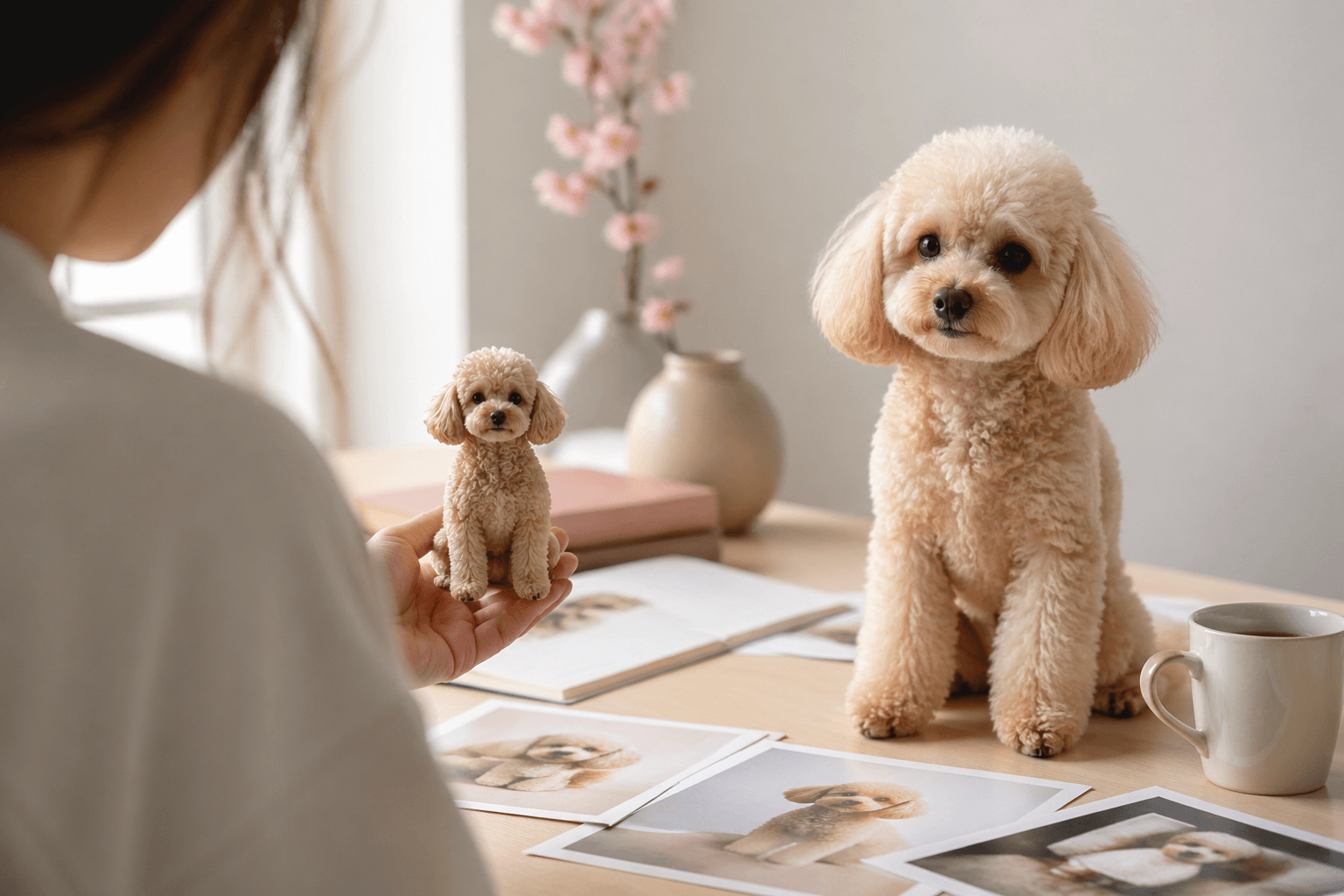
“Sometimes the smallest things take up the most room in your heart.” — A.A. Milne. Under the cold blue light of a vet office monitor, Poodle figurine photo tips suddenly matter more than most people expect.
Quick Takeaways
- Front-facing eye shots beat perfect poses — expression sells recognition faster than posture.
- Take coat photos in window light — curls read better when shadows stay soft.
- Include one ugly-but-honest photo — messy ears and squints often reveal true personality.
- Ask for a full-color 3D preview through custom pet figurines at PawSculpt — it helps you catch shape issues early.
- Side profiles matter more than people think — muzzle length and topknot shape define a poodle fast.
Why the “right” poodle photos matter more than the figurine size
Most people assume the value of a custom figurine comes from the material, the finish, or how big it is on a shelf. That's not the first thing we look at. In our years working with pet families, we've learned that photo quality is the real price multiplier.
A poodle can be beautifully groomed, professionally photographed, and still make a weak figurine reference if the photos hide the skull shape, flatten the curls, or blow out the coat color under harsh light. On the other hand, an ordinary phone photo taken near a kitchen window can be gold if it clearly shows the eyes, chest, ear set, and how the coat falls around the muzzle.
That surprises people. But it shouldn't.
A custom figurine isn't just about likeness in the abstract. It's about recognition at a glance. Your brain makes that recognition in a split second using pattern memory—something psychologists link to attachment theory, the way we form strong emotional bonds through repeated visual cues, routines, and familiar expressions. The reason a figurine feels “worth it” or “not worth it” often comes down to one question: Did they get my dog?
And “getting your dog” starts long before printing.
The overlooked truth: poodles are harder than many breeds
Here's the part most general guides miss. Poodles are technically tricky subjects.
Not because they're impossible. Because their look changes dramatically with grooming, moisture, age, and coat length. A Labrador still looks like that Labrador in most photos. A poodle can look like three different dogs across one camera roll.
We see this all the time. One customer sends six photos: in one, the dog has a rounded teddy-bear face; in another, a shorter muzzle trim; in another, the ears look much longer because the coat is brushed out. The family thinks these are all equally accurate. For sculpting, they are not.
A poodle figurine becomes convincing when the artist can separate bone structure from haircut. That's the whole game.
Micro-story: the ears were “wrong”... until they weren't
We remember one order where a family felt the preview looked off. They kept saying, “Her ears were softer than that.” But when we lined up all the reference images, the issue wasn't the ears. It was that most of their favorite photos were taken from above, which visually shortened the muzzle and widened the forehead.
Once better side and eye-level photos came in, the digital sculpt snapped into place.
That happens more than you'd think.
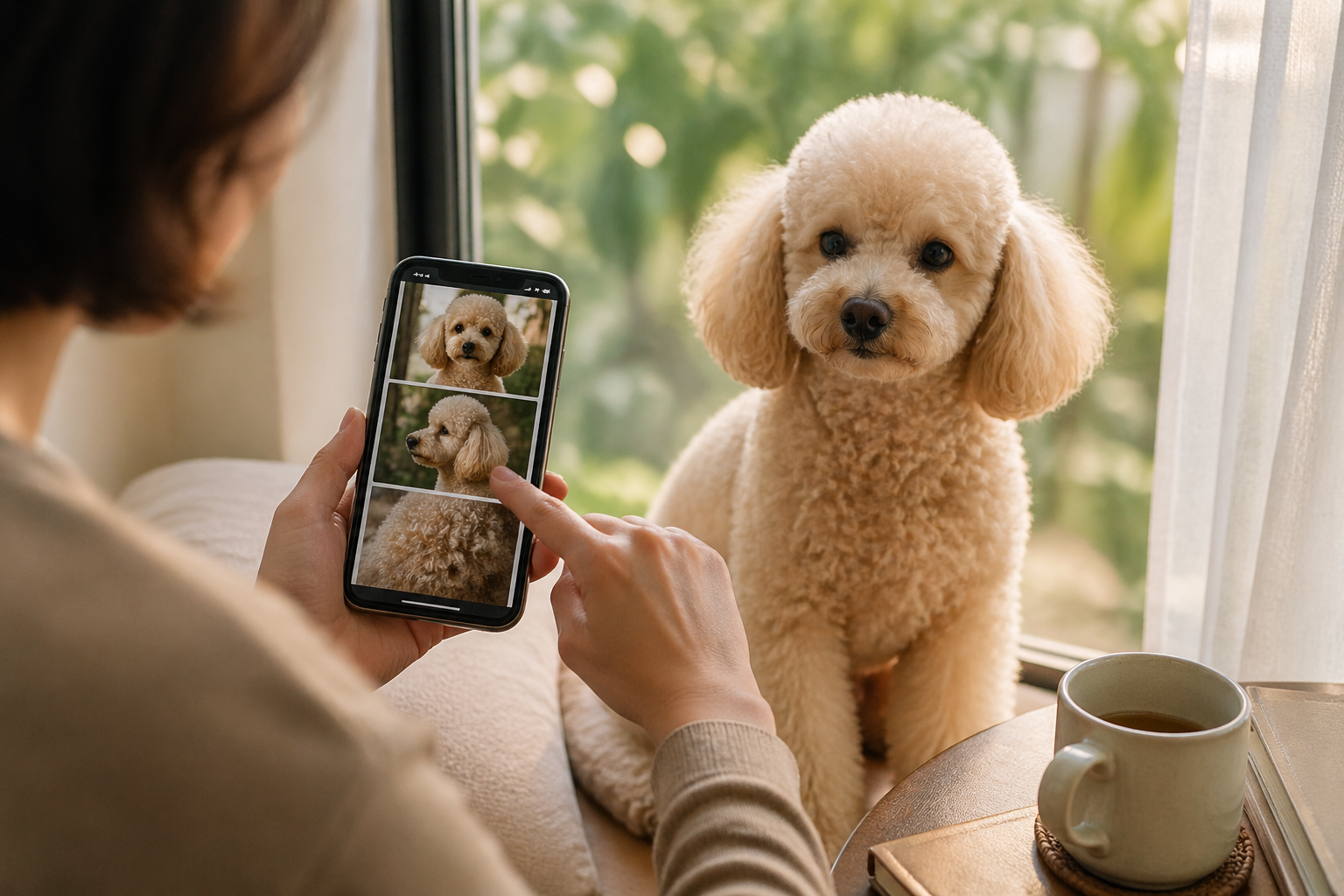
Poodle figurine photo tips that actually help a 3D artist
A lot of online advice says “use clear, high-resolution photos.” True, but that's entry-level advice. What actually helps is sending photos that reveal the structure, color transitions, and personality markers a sculptor can build from.
Start with the five-photo minimum that matters
If you only send five photos, make them these:
- Straight-on face shot at eye level
- Left side profile
- Right side profile
- Three-quarter angle (between front and side)
- Full-body standing shot
Why these? Because a 3D artist is reconstructing form from flat images. We need enough visual information to check proportions—the relationship between muzzle length, skull width, leg length, chest depth, and ear placement.
A straight-on image tells us about symmetry. The side views reveal the silhouette. The three-quarter shot often shows what the other images hide: how the curls break along the cheeks, whether the eyes sit deep under facial coat, and how the neck flows into the chest.
And yes, the standing shot matters more than a cute sleeping photo.
Add one “personality photo” on purpose
This is the counterintuitive one.
Most people think every reference should be crisp and formal. Honestly, one of the best things you can send is a slightly imperfect personality photo—your poodle tilting its head, giving side-eye, carrying a toy, or wearing that mildly offended expression poodles seem to master.
Why? Because memory is emotional before it's technical. In cognitive science terms, the brain stores emotionally loaded visual cues more strongly than neutral ones. That's why the tiny eye squint you loved can matter more than a mathematically perfect chest angle.
Not every figurine should include an action pose. But every great figurine needs personality evidence.
"Likeness lives in the eyes first, and the haircut second."
The best lighting is boring lighting
We're not huge fans of dramatic sunlight for reference photos. It looks beautiful on Instagram. It causes problems in production.
For full-color resin 3D printing, the digital artist has to interpret color zones accurately—cream vs apricot, silver vs charcoal, white highlights vs overexposure. Hard sunlight creates blown highlights and deep shadow pockets that hide the true coat value.
Better options:
- Bright window light
- Open shade outdoors
- Cloudy-day daylight
- Even indoor light without yellow bulbs dominating the coat
Avoid:
- Flash straight at the face
- Blue-tinted TV light
- Warm lamps that turn white fur yellow
- Backlighting that makes the dog a silhouette
Think soft, even, honest light. Not dramatic light.
What a 3D artist is checking in your photos
Readers usually don't get to see this part, so here's the real behind-the-scenes checklist. When our team reviews poodle references, we're not just admiring the dog. We're checking for:
- Head proportion: Is the skull narrow, rounded, or refined?
- Muzzle geometry: Long and elegant, or shorter with more teddy-bear shaping?
- Eye spacing and angle: Alert, gentle, mischievous, slightly hooded?
- Ear attachment point: Higher or lower than the haircut makes it seem?
- Topline: The back's visual line from shoulders to tail
- Leg-to-body ratio: Important in toy, miniature, and standard poodles
- Coat flow: Not individual strands, but the larger curl masses and shapes
- Color blocking: Where darker apricot shifts to cream, where black coat catches brown warmth, where white paws merge into the floor
That last one matters a lot for printing. With multi-color additive manufacturing, color is reproduced directly into the resin material during printing. It isn't added later by brush. So the better the source color information, the better the final result tends to feel.
Photo quality table: what works and what causes trouble
This quick reference shows what usually helps most.
| Photo Type | Why It Helps | What Can Go Wrong | Best Tip |
|---|---|---|---|
| Eye-level face shot | Captures expression and symmetry | Camera above head shortens muzzle | Kneel to your dog's eye line |
| Side profile | Defines muzzle, ear set, neck line | Fur fluff can fake head shape | Smooth coat lightly before shooting |
| Three-quarter view | Shows depth and curl flow | Motion blur softens detail | Use burst mode and pick the sharpest |
| Full-body standing | Helps with proportions and stance | Sitting hides leg length | Have someone hold a treat at eye level |
| Color reference close-up | Helps read markings accurately | Warm bulbs distort whites and creams | Shoot near a window in daytime |
Resolution matters, but not the way people think
Of course, higher resolution helps. But clarity beats megapixels.
A 12MP phone shot that's sharp, well lit, and close enough to show the eye rims will beat a 45MP professional image taken from too far away. The mistake most people make is sending beautiful photos where the dog occupies only 15% of the frame.
Crop tighter. We need the dog, not the whole backyard.
And if you're sending older photos of a pet who has passed, don't panic if they aren't perfect. We can often work with less-than-ideal references if you send a wider set and explain which features matter emotionally. Maybe the left ear always sat lower. Maybe the chest puff was bigger after grooming. Those notes help.
What makes a custom figurine worth it? Usually not what people assume
The keyword question—is custom pet figurine worth it—deserves a straight answer.
Sometimes yes. Sometimes no.
If you're expecting a flawless luxury object that behaves like injection-molded plastic or a hand-finished porcelain heirloom, you may be disappointed. That's not what full-color 3D printing is. And frankly, companies should be more honest about that.
If you're looking for a tangible, accurate, emotionally recognizable portrait of your dog, especially one that preserves markings, posture, and presence in a form photos alone can't quite do, then yes, it can absolutely be worth it.
The difference is expectation.
A figurine isn't valuable because it's perfect
We've seen people react strongly—in a good way—to tiny details outsiders would never notice. The slight turn of a paw. The way one curl mass hangs heavier over one eye. The little chest patch. Those details trigger recognition.
That recognition matters because the human brain uses familiar visual anchors to regulate emotion. During grief, stress hormones like cortisol can spike when routines break and reminders disappear. Tangible objects don't “fix” grief, but they can create a stable cue the nervous system returns to. That's one reason memorial objects matter more than people sometimes admit.
But even when your pet is still very much alive and stealing socks, the value works the same way. A custom figurine becomes worth it when it captures a dog as your dog, not just a poodle.
The tradeoff nobody talks about: realism versus durability
Here's some shop-floor honesty.
A figurine with very thin ankle areas, isolated tail tips, or floating curls may look exciting in a render, but fine projections are more vulnerable in resin-based production. In collectible making, we constantly weigh detail against durability.
With UV-cured photopolymer resin, you can achieve excellent surface detail—often in typical layer ranges around 25–50 microns depending on the system and workflow—but the material still has tradeoffs. Some formulations are stiffer and more brittle. Others are tougher but slightly softer in edge crispness.
For pet figurines, that means a smart artist doesn't chase every microscopic hair tuft. We look for readable forms that survive real life.
A shelf collectible is still a collectible. It isn't a chew toy, and it shouldn't pretend to be one.
Micro-story: the paw gap that looked amazing on screen
One of our preview models once had a dramatic little negative space under a lifted paw. On screen, it looked elegant. In production terms, it created a vulnerable thin section and support-removal risk near a high-visibility area.
The revision was simple: change the contact and mass slightly.
The final figurine looked better and was stronger.
That's the kind of decision that separates “looks good online” from “actually works as an object.”
"The best figurines don't chase every hair. They preserve the features your heart recognizes."
How full-color 3D printing changes the value equation
PawSculpt's process matters here, because not all custom figurines are made the same way.
Our team works through digital sculpting first. Artists build the pet in 3D software—typically tools in the ZBrush or Blender world—using your photos as reference. That's where the anatomy, coat masses, proportions, and expression get established.
Then the model is precision 3D printed in full color. That means the printer deposits or cures material with color information built in voxel by voxel (a voxel is like a 3D pixel). In plain English: the color is part of the material itself, not something added afterward.
After printing comes post-processing: cleaning, support removal, curing, surface inspection, and a protective clear coat for durability and sheen. No manual color application step. No brushes. No “we print it white and decorate it later.”
Why does that matter to you? Because it changes both the look and the limitations.
You get:
- Natural color transitions embedded in the resin
- Strong visual fidelity for markings and coat patterns
- A finish that feels more like a modern collectible than a glossy toy
But you should also expect:
- Some fine print texture or grain under close inspection
- Slight evidence of support strategy or orientation in less visible areas if you know what to look for
- A result that prioritizes overall likeness over fantasy-level miniature-painting effects
That's not a downside. That's honest manufacturing.
What we mean by “museum-quality” without pretending it's magic
“Museum-quality” gets tossed around a lot online. We think it should mean careful design, accurate color reproduction, solid materials, and strict quality control—not fake perfection.
A good collectible studio checks:
- Dimensional consistency against the approved sculpt
- Symmetry in the face and stance
- Surface quality under raking light (light angled across the surface to reveal texture)
- Color fidelity against the digital file
- Support scar placement in low-visibility zones where possible
The point is not to promise a supernatural object. The point is to deliver one that feels intentional, stable, and deeply personal.
The photo-to-sculpt workflow most companies never explain
This is where readers usually get generic fluff. Let's skip that.
A custom poodle figurine doesn't begin in a printer. It begins in interpretation. And interpretation is where most likeness succeeds or fails.
Step 1: Reference sorting is part detective work
When photos come in, the first challenge is consistency. Dogs look different across years, trims, camera lenses, and lighting conditions. A 26mm phone lens up close can distort a muzzle. A telephoto shot from farther away can compress features and make the face look flatter.
So the first real job is sorting images into three buckets:
- Structural references: best for anatomy and proportion
- Color references: best for coat tone and marking transitions
- Personality references: best for expression and emotional likeness
Sometimes the family's favorite image is not the main sculpt image. That's normal.
One order that stuck with us involved a black poodle whose owner adored a holiday photo under warm tree lights. Gorgeous photo. Terrible color reference. The coat looked brown-red under the bulbs. We used it for expression, not tone.
That's how this work actually goes.
Step 2: Digital sculpting means building the dog twice
The public sees one dog. A good 3D artist sees underlying anatomy plus visible coat.
First, we mentally reconstruct the dog's body beneath the fur—skull shape, muzzle volume, chest depth, leg structure. Then we build the exterior forms the eye will read: topknot, ears, muzzle trim, leg puffs, tail pom, chest coat, and all the visual masses that make a poodle look like that poodle.
This is where proportional checks matter. We compare front and side views, estimate lens distortion, and cross-check features that repeat across multiple images. If the left ear looks longer in one photo and normal in six others, we don't blindly trust the outlier.
And yes, coat flow matters. Not individual curls one by one—that gets noisy fast—but the directional flow of the coat. Which way the cheek volume leans. How the ear fur hangs in gravity. Whether the chest coat widens the silhouette.
Step 3: Pose selection should serve recognition, not drama
Most customers don't need an action pose. That's another common myth.
A calm standing pose, slight seated posture, or alert head tilt often works better because it shows identity markers cleanly. The more twisted or airborne the pose, the more support-heavy and structurally tricky the print becomes.
In resin workflows, pose affects everything:
- Support placement
- Surface exposure
- Balance and center of gravity
- Break risk in thin features
- How well facial details stay visible
A fancy pose can be worth it. But it's not automatically better.
Process table: what to expect in a custom figurine workflow
This isn't a promise of exact timelines or policies—those belong on the website—but it shows the normal production flow.
| Stage | What Happens | Why It Matters | What You Can Influence |
|---|---|---|---|
| Photo review | Images are sorted for structure, color, and expression | Sets the whole project up correctly | Send multiple angles and note must-have features |
| Digital sculpting | Artists hand-model the pet in 3D software | Establishes likeness before production | Give feedback on proportions and expression |
| Color preparation | Markings and coat transitions are mapped digitally | Helps full-color printing read naturally | Provide honest color photos in neutral light |
| Full-color printing | Model is produced in color-embedded resin | Turns the approved file into a physical object | Mostly a production-stage process |
| Post-processing & QC | Cleaning, curing, inspection, clear coat | Improves durability and presentation | Review final care guidance after delivery |
Step 4: Orientation logic—how the model sits in the printer matters
This is one of those details pet owners never hear, but it changes results.
In resin and photopolymer-based systems, orientation means how the figurine is angled during printing. That angle affects support contact points, surface smoothness, and even risk of print failure.
For example:
- A perfectly upright print may seem intuitive, but it can concentrate supports in ugly places.
- A face tilted just slightly can reduce support marks on the eyes and muzzle.
- Large flat areas can create suction-related issues in some vat-style processes, increasing failure risk or deforming parts.
- Thin ears printed at the wrong angle may be more vulnerable during support removal.
This is where experienced production teams earn their keep. We don't just ask, “Can this print?” We ask, “Can this print cleanly, consistently, and with the important surfaces protected?”
Even in full-color resin 3D printing, support strategy matters. A support is a temporary scaffold that holds overhanging geometry during printing. Remove it badly, and you get pitting, scars, or broken tips. Place it poorly, and the best likeness in the world gets marred in the wrong place.
Step 5: Hollowing, drain paths, and other unglamorous truths
For some figurines and print systems, hollowing may be used to reduce material mass and improve print behavior. Hollowing means the inside isn't completely solid. But hollow models need smart engineering—wall thickness, drain paths, and geometry that avoids trapping uncured resin or creating weak zones.
This is not the sexy part of the story. It's the “your figurine stays stable over time” part.
Typical production concerns include:
- Warping if wall thickness is inconsistent
- Suction cup effects in enclosed shapes during vat-style printing
- Over-cure or under-cure causing brittleness or softness
- Bloom or haze if cleaning/cure steps aren't dialed in
- Support pitting where removal points need finishing
Most customers never see those terms, and that's okay. But they should know the object in their hands reflects a lot more engineering judgment than the marketing photos suggest.
Poodle photo mistakes that make figurines look “off”
Let's get practical. If a custom figurine feels expensive, it's because mistakes early in the process are expensive emotionally. You don't want to open the box and think, “That's nice, but that's not my dog.”
Here are the photo issues that most often cause that reaction.
Mistake 1: Sending only groomed glamour shots
A fresh salon clip can look stunning, but it can also erase familiar features if every photo is too stylized. On poodles, grooming can dramatically change perceived muzzle width, cheek fullness, and ear volume.
What actually helps more than perfect grooming is a mix of groomed and everyday photos.
Send both if you have them:
- One clean, current portrait
- One normal at-home image
- One side profile where the coat isn't overly teased or fluffed
That gives the sculptor context. The goal isn't “show dog ideal.” The goal is your dog.
Mistake 2: Cropped ears or missing paws
This sounds obvious, but it happens constantly. People send close-ups that cut off the topknot, the ear ends, the tail base, or the paws. A sculptor can infer some missing information—but inference is where likeness drifts.
And paws matter more than you think. A dainty toy poodle foot reads differently from a sturdier standard poodle stance. If the full-body image is fuzzy or cropped, body proportions become guesswork.
Mistake 3: Photos taken from above
People love this angle because it's adorable. We get it. Big eyes, tiny body, instant charm.
It is also one of the worst reference angles for sculpting.
Top-down photos:
- Shorten the muzzle
- Widen the forehead
- Hide chest depth
- Compress body length
- Distort the eye relationship to the nose
Use them as bonus personality shots, not primary sculpt references.
Mistake 4: Color confusion from bad lighting
White poodles pick up yellow from lamps. Apricot coats can wash pale in direct sun. Black poodles often show fake warm undertones indoors. Gray and silver dogs can shift blue under cool LEDs.
This matters because colors are printed directly into the resin material. If your reference set fights itself, the team has to decide which image tells the truth.
A simple fix: include one short note such as, “Her coat is cooler gray in person than it appears under indoor lights.” That kind of note is gold.
"The photo that feels most beautiful is not always the photo that feels most true."
— The PawSculpt Team
Mistake 5: No note about what changed with age
This one matters a lot in memorial work.
If your poodle went gray around the muzzle, lost some fullness around the eyes, or had a favorite haircut years earlier, say so clearly. Otherwise, the artist may blend conflicting references in a way that is technically sensible but emotionally wrong.
One family told us, “Please use her later-life eyes but her younger coat trim.” That's exactly the kind of guidance that prevents disappointment.
Because memorial likeness isn't just anatomical. It's identity across time.
A quick visual checklist before you upload photos
Use this before sending your set.
| Check | Good Sign | Red Flag |
|---|---|---|
| Eyes visible | Catchlights and eye shape are clear | Hair or shadow hides one or both eyes |
| Muzzle readable | Nose bridge and length are obvious | Camera angle compresses the snout |
| Coat color honest | Whites look white, blacks look neutral | Lighting adds yellow, orange, or blue cast |
| Body proportion visible | Legs, chest, and back line are visible | Dog is curled up, cropped, or seated oddly |
| Multiple ages/trims explained | Notes clarify what version to capture | Conflicting photos without context |
What to send if your dog has passed away
We'll be real—this is the hardest version of the process emotionally.
People often have fewer good photos than they expected once they start looking. The photos that matter most may be blurry, old, or tied to painful days. That's normal.
If that’s your situation, send:
- Every angle you can find, even imperfect ones
- At least one photo that feels emotionally “right”
- A short note describing the details your family always noticed
- Any information about age, grooming style, and markings that changed
For pet loss support, the Association for Pet Loss and Bereavement can be a genuinely helpful resource if the process brings up more than you expected. We're not therapists, and we're not vets. But we do know that object-based remembrance can stir up a lot.
And sometimes that’s part of healing.
What to expect from the full-color 3D printing process
If you're asking is custom pet figurine worth it, part of the answer depends on whether you understand what the object is supposed to be.
Let's talk about production plainly.
Digitally sculpted first, then full-color printed
At PawSculpt, the figurine starts as a hand-modeled digital sculpture created by experienced 3D artists. That's where the pet's expression, proportions, coat masses, and pose are built out carefully from your photos.
Once approved, that digital model is produced using full-color 3D printing technology—the kind of process people often associate with PolyJet-style or other advanced multi-color additive manufacturing systems. The key point is simple: the color is embedded into the material during printing.
That means no white blank gets decorated later.
It also means the final surface has a look specific to modern full-color resin production: vibrant, dimensional, slightly textured under close view, and protected with a clear coat.
Post-processing is where good prints become good collectibles
After printing, the object still needs careful finishing.
Typical post-processing includes:
- Cleaning to remove residual processing material
- Support removal from temporary contact points
- Curing under UV conditions so the resin reaches stable properties
- Surface inspection for pitting, marks, haze, or residue
- Clear coat application for protection and final sheen
This is where production teams catch a lot of issues.
Under-cured parts can stay too soft. Over-cured areas can become more brittle than intended. Support removal can leave small marks if not planned intelligently. Some prints can show slight cloudiness or “bloom” if cleaning chemistry and cure balance aren't right. That's why quality control matters so much after the printer is done.
Why printers alone don't create likeness
Here's the blunt version: a great printer cannot rescue weak reference photos or weak sculpting.
The machine can reproduce what it's given. It cannot invent the emotional truth of your dog. That's still a human job—reading anatomy, choosing the right expression, deciding how much curl detail to simplify, knowing which photo lies because of lens distortion, and protecting visible surfaces through orientation and support strategy.
We say this because the internet tends to glamorize hardware. Hardware matters. But for custom pet figurines, the main value is still in the interpretation.
What realistic quality looks like
A good full-color figurine should give you:
- A recognizable facial expression
- Accurate markings and color regions
- Stable, balanced form
- Smooth major surfaces with normal collectible-level texture
- Protective finish from the clear coat
It may also show, under very close inspection:
- Fine grain or subtle layer evidence
- Tiny surface variation in hidden or lower-priority zones
- Slight differences between digital preview and physical material appearance
That's normal. Honestly, if a company never mentions tradeoffs, we're skeptical.
For general coat and breed references while choosing your best images, the American Kennel Club's poodle breed guide can help you separate breed-standard structure from haircut illusions. That's useful even if your dog was gloriously non-standard in every other way.
What We Wish We Knew Sooner
This is the sidebar we wish every pet parent could read before uploading photos.
- The first image you love may not be the best sculpt image. Emotion and accuracy aren't always the same photo.
- Side profiles save projects. If you send nothing else, send both sides.
- Black dogs need extra lighting care. Their features disappear fast in shadow.
- White dogs need color-truth photos. Indoor bulbs can turn cream into yellow.
- A note about personality helps more than people think. “Always looked slightly guilty” is weirdly useful.
- The ears are almost never the real problem. It's usually lens distortion, coat fluff, or hidden muzzle shape.
- A figurine doesn't need every tiny curl to feel right. It needs the right visual landmarks.
Short version? The job isn't copying a photo. It's preserving recognition.
Is a custom pet figurine worth it for living pets, memorials, or gifts?
This answer changes with the reason you're ordering.
For living pets: the value is in freezing a moving target
Poodles change. Puppies lengthen. Seniors soften around the face. Grooming styles come and go. Even expression changes with age.
That makes a figurine surprisingly meaningful while your dog is still here. You're not waiting until after loss, when your photo set may be incomplete or emotionally difficult to sort through. You're choosing a version of your dog deliberately.
A family we worked with ordered a figurine for a senior poodle who was still active, still bossy, still very much in charge of the household. Months later, they told us the figurine became more meaningful after the dog's health declined—because it captured the bright, upright look they didn't realize they'd miss so much.
That happens a lot.
For memorials: tangible objects can reduce emotional friction
Grief theory has moved away from the idea that “closure” is the goal. Many psychologists now talk more about continuing bonds—healthy ways people stay connected to someone they lost. That applies to pets too.
A memorial figurine can support that continuing bond because it gives the brain a stable visual object to return to. Not as denial. As grounding.
Some people do better with practical memorials like donation funds or garden stones. Others need something more representational. We don't think one is morally better than another. But if your pain is tied to the fear of forgetting the exact look of your dog, a figurine addresses that fear in a direct way photos sometimes don't.
For additional grief support, VCA Hospitals' pet loss resources are worth bookmarking.
For gifts: worth it depends on how specific the recipient is
We're going to be honest here. A custom pet figurine is a wonderful gift for some people and a bad gift for others.
It works best for:
- People deeply attached to one specific pet
- Families who display sentimental objects
- Recipients who notice tiny physical details
- Milestones like birthdays, gotcha days, retirement, or memorial moments
It may not be ideal for:
- Very minimalist recipients
- People who dislike figurines or shelf décor
- Anyone currently in acute grief who has not shown interest in memorial objects
- Gift-giving situations where you have very poor photos and no access to better ones
Worth isn't universal. It's personal.
If you're comparing options, here's the real test
Ask yourself these three questions:
- Do I have photos that show my poodle clearly from multiple angles?
- Do I care more about recognition than generic prettiness?
- Would a tangible object bring comfort or joy in a way digital images don't?
If the answer is yes to all three, then yes—is custom pet figurine worth it becomes much easier to answer.
If you're still on the fence, browsing a studio's FAQ about custom pet figurines or reaching out through the PawSculpt contact page can help you judge fit without guessing.
How to choose your final photo set before you order
This is the practical last-mile step. Don't overthink it for days. Use a simple system.
Build a “core five plus three” set
Pick:
- Five structural photos: front, left, right, three-quarter, full body
- Two color-truth photos: honest daylight images
- One personality photo: the face you never want to forget
That gives the artist enough to work from without drowning the process in 47 nearly identical images.
More photos can help, yes. But too many redundant photos can also create confusion if they span too many ages, trims, and lighting setups with no notes.
Add notes like a real human, not a catalog writer
Don't write paragraphs of apology. Just say what's useful.
Good notes sound like:
- “Please keep her senior face, not the younger trim.”
- “His coat is darker on the ears than the photos show.”
- “The head tilt in photo 8 feels most like him.”
- “She always looked narrower in the face after grooming than in real life.”
That kind of guidance helps a lot because it resolves cognitive dissonance—the tension between what a photo shows and what your memory insists is true. Good artists know that tension is real. Notes help bridge it.
One more counterintuitive tip: don't wait for the “perfect” photo day
People delay ordering because they think they need a professional session, a fresh haircut, perfect weather, and a spotless background.
You don't.
You need truthful photos.
A dog standing on a hardwood floor near a window, with soft afternoon light and both eyes visible, often beats a styled portrait in harsh outdoor sun. Recognition lives in proportion and expression, not props.
The real emotional standard: will you look at it and say “there you are”
That's the benchmark. Not “Is this technically impressive?” Not “Is it flawless under a magnifying glass?” But “there you are.”
We've watched families open boxes and go straight for the face. Always the face. If the eyes, muzzle, and posture land correctly, everything else starts to click into place. If they don't, no amount of fancy language about craftsmanship can cover that gap.
So pick your poodle photos with that in mind.
Choose the images that tell the truth about your dog's structure. Choose the light that tells the truth about the coat. Choose the angle that tells the truth about the expression. And then include one image that tells the truth about your bond.
That's the set that makes a figurine feel worth the space it takes up in your home—and in your heart.
Frequently Asked Questions
What photos work best for a custom poodle figurine?
The strongest set includes an eye-level front view, both side profiles, a three-quarter angle, and a full-body standing shot. Soft daylight is usually best because it shows coat color and facial structure honestly. Then add one personality photo—the expression your family instantly recognizes.
Is a custom pet figurine worth it?
It can be, but only if your goal is recognition, not generic decoration. If a figurine captures your poodle's face, posture, and markings in a way that feels emotionally true, most people feel the value right away. If you're expecting factory-perfect smoothness with no visible production character, your expectations may need adjusting.
How many photos should I send for a pet figurine?
A practical target is eight good photos: five structural, two color-accurate, one personality-driven. More can help, especially for memorial orders, but only if the images add new information. Twenty similar top-down shots won't help as much as one clean side profile.
Are PawSculpt figurines hand-painted?
No. PawSculpt figurines are digitally sculpted, then precision 3D printed in full color. The color is embedded directly into the resin during printing, and the post-processing stage includes cleaning, curing, support removal, inspection, and a protective clear coat.
What if my dog has passed away and my photos are old or blurry?
Send them anyway. Older images can still be useful if they show different angles, even when they're imperfect. It also helps to include a short note explaining what your dog looked like in person—especially if age, grooming style, or coat color changed over time.
Do grooming style changes affect the final figurine?
Absolutely. On poodles, haircut changes can alter the apparent head shape, ear length, and muzzle fullness more than many owners realize. If your favorite photos span different trims, tell the artist which version best represents the dog you want preserved.
Ready to Celebrate Your Pet?
Every pet has a story worth preserving. Whether you're honoring a beloved companion who's crossed the rainbow bridge or celebrating your furry friend's one-of-a-kind attitude, a custom PawSculpt figurine can turn strong Poodle figurine photo tips into a keepsake that feels unmistakably personal.
Create Your Custom Pet Figurine →
Visit pawsculpt.com to learn more about our process and guarantees