The 'Pocket Pet' Legacy: Why a Life-Size Rat Terrier Figurine is Too Big (And Why Scale Matters)
I stood in the center of the living room, tape measure extended to fifteen inches against the bookshelf, visualizing the physical volume of where my dog used to stand. The empty space looked massive, demanding, and strangely hollow compared to the vibrant, frantic energy my Rat Terrier used to occupy in that exact spot.
Quick Takeaways
- Scale influences emotional impact — smaller figurines often feel more like precious amulets than life-size replicas.
- Avoid the "Uncanny Valley" — reducing the size helps the brain process the object as art rather than a "frozen" animal.
- Material integrity matters — custom figurines printed in full-color resin capture intricate coat patterns without surface paint.
- Rat Terriers require precision — their muscular definition and pied markings need the high resolution of additive manufacturing.
The Physics of Presence: Why "Big" Doesn't Mean "Better"
In my fifteen years working in additive manufacturing—specifically in the niche of high-fidelity organic modeling—I have had countless conversations with grieving pet owners who start with the same request: "I want it life-size."
It is a natural impulse. When we lose a companion, the silence in the house is deafening. The physical displacement of air where they used to be feels like a vacuum we are desperate to fill. We want to see them standing by the door again. We want to look over at the hearth and see that familiar silhouette.
But here is the counterintuitive truth I have learned from producing thousands of memorial pieces: A life-size replica often hurts more than it heals.
When you create a 1:1 scale model of a living being, particularly a high-energy breed like a Rat Terrier, you are creating a "ghost." A life-size statue in your living room can trigger a primal, biological confusion. Your peripheral vision catches the shape, your brain expects movement, and the lack of breath or twitching ears creates a sense of wrongness—a phenomenon known as the Uncanny Valley.
Instead of a sacred object of remembrance, you end up with a piece of furniture that startles guests and constantly reminds you of the absence of life.
The Spiritual Mechanics of Scale
From a metaphysical perspective, a memorial object serves a different function than a taxidermy mount. It is not meant to replace the body; it is meant to anchor the spirit.
Think of the most precious objects in human history—lockets, amulets, religious icons, netsuke. They are small. Their smallness is what makes them intimate. It invites you to lean in, to hold them in your palm, to create a private moment of connection.
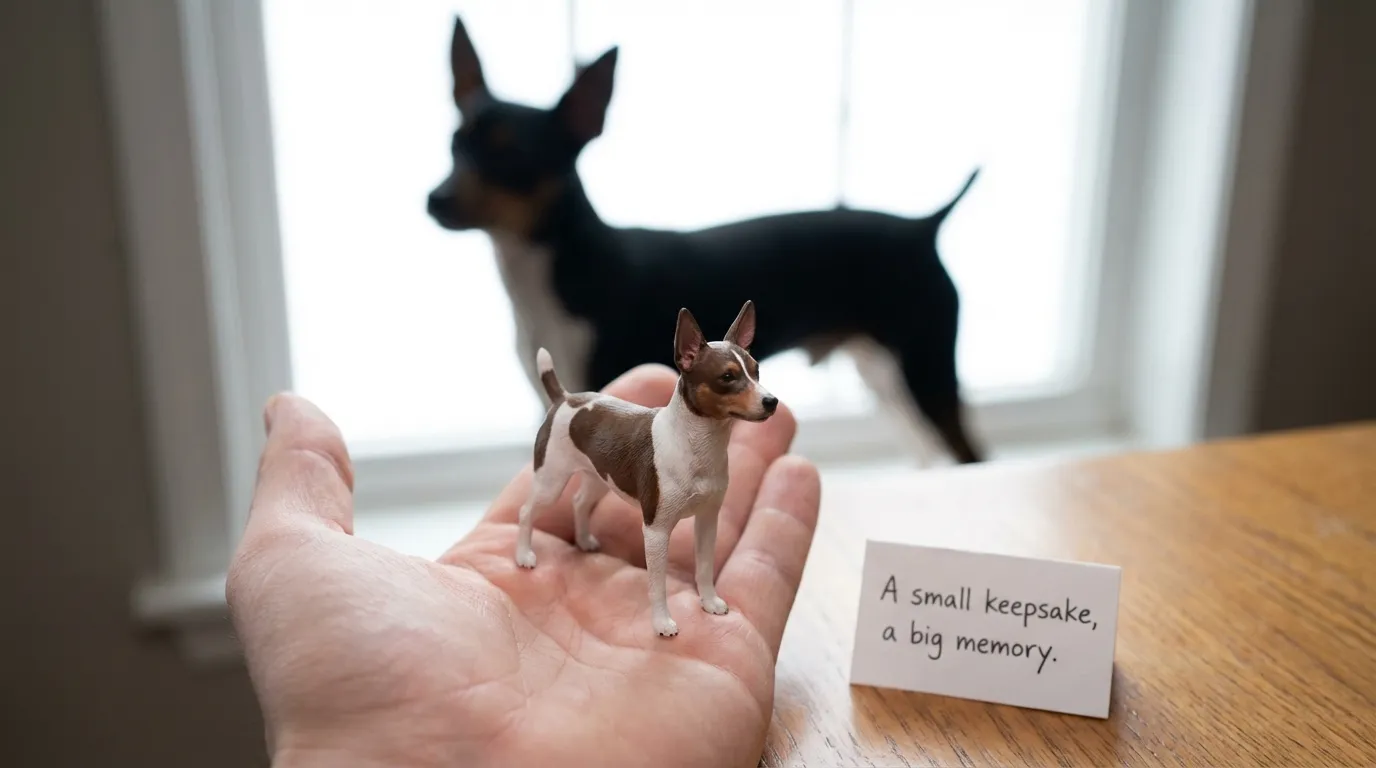
A 1:6 or 1:4 scale figurine of your Rat Terrier acts as a concentrated vessel for their memory. It condenses their massive personality into a totem that fits in your hands. It transforms the experience of grief from something that dominates the room into something you can hold, protect, and cherish.
"A memorial shouldn't shout across the room. It should whisper to you when you're ready to listen."
The Engineering of Soul: How We Capture the Spark
To understand why scale matters, you have to understand how we actually build these tributes. At PawSculpt, we don't use chisels, and we certainly don't use paintbrushes. We use light, resin, and data.
The Myth of the "Hand-Painted" Figurine
There is a misconception in the pet memorial market that "hand-painted" equals higher quality. As an engineer, I have to correct this. When you take a 3D model and cover it in acrylic paint, you are adding a layer of material that obscures detail. Paint has thickness. It fills in the fine texture of fur; it blunts the sharpness of a sculpted claw.
We use Full-Color 3D Printing (specifically PolyJet or MJF-style technology). Here is the shop-floor reality of what that means:
- Voxel-Level Control: We don't print a white shape and color it later. The machine deposits microscopic droplets of photopolymer resin that are the color. The pigment is embedded in the material itself, cured instantly by UV light.
- Sub-Surface Scattering: Real fur and skin interact with light in complex ways. By printing with translucent and opaque resins simultaneously, we can mimic the way light hits a Rat Terrier's white coat versus their black or tan markings.
- No Brushstrokes: A Rat Terrier's coat is sleek, tight, and often ticked with tiny spots of color on the skin. A paintbrush cannot replicate the randomness of natural ticking without looking like... well, paint. Our printers operate at layer heights often in the 25–30 micron range, allowing us to replicate those biological patterns digitally.
Digital Sculpting: The Modern Ritual
Before the printer ever fires up, the "soul" of the piece is found in the digital sculpting phase. This is where the artistry happens. Our 3D artists work in a virtual space, using styluses to push and pull digital clay.
For a Rat Terrier, this is critical. You can't just model a generic "small dog." You have to capture the tension.
Rat Terriers are springs waiting to uncoil. Even when they are standing still, their muscles are taut. A generic model looks like a stuffed animal. A true memorial sculpture captures the specific way your dog held their ears when they heard the treat jar, or the specific asymmetry of their hip when they sat.
We build the model from the inside out—skeleton, musculature, skin, then coat. This ensures that even at a smaller scale, the figurine has "weight." It feels grounded.
The "Pocket Pet" Paradox
Rat Terriers, Chihuahuas, and other small breeds are often called "pocket pets," yet their personalities are enormous. This creates a unique challenge for memorials.
If you have a Great Dane, you intuitively know a life-size statue is impossible. But with a Rat Terrier (typically 13–18 inches tall), a life-size print is technically feasible. However, just because we can print it, doesn't mean we should.
The Density of Memory
I often tell clients to think of the figurine as a focal point for a shrine or altar.
- At 1:1 Scale (Life-Size): The object competes with other items. It requires its own floor space or a massive clear section of a shelf. It becomes a piece of decor that gathers dust, rather than a sacred object.
- At 1:4 Scale (Approx. 4-5 inches): The object integrates into your life. It can sit on your desk while you work, keeping you company. It can rest on a bedside table. It invites touch.
When you hold a smaller, dense resin print, the weight feels substantial. There is a psychological phenomenon where heavy, small objects are perceived as more valuable—like gold bars or gemstones. By scaling the Rat Terrier down, we subconsciously elevate the object from "toy" to "treasure."
Technical Tradeoffs: Why Smaller Prints Often Look Sharper
From a manufacturing standpoint, printing large monolithic blocks of resin introduces risks that can compromise the aesthetic quality of the piece.
The Engineering Constraints
In the world of UV-cured photopolymers, we deal with forces like shrinkage and warping.- Heat Generation: The chemical reaction that cures the resin is exothermic (generates heat). In a massive, life-size print, this heat can build up, causing subtle distortions in the geometry.
- Support Structures: Every overhang (like a chin or a tail) needs support material during printing. On a life-size dog, these supports are thick and extensive. Removing them can leave "scars" that require heavy sanding, which alters the surface texture. On a smaller scale (4-6 inches), supports are needle-thin and leave almost no trace.
- Surface Quality: Large flat surfaces on big prints can sometimes show "stepping" or layer lines more clearly. At a reduced scale, the resolution of the printer packs more detail into every square inch. The fur texture looks tighter, crisper, and more realistic.
The Counterintuitive Insight: You actually see more detail in a 1:4 scale print than a 1:1 scale print because the density of the information is higher relative to the viewing distance.
Creating Your Sacred Space: A Guide to Scale
If you are building a memorial altar or a remembrance shelf, the scale of the figurine dictates the "energy" of the space. Here is how we categorize the sizes based on the spiritual intent of the owner.
The Scale Comparison Table
| Scale | Approx. Height (Rat Terrier) | Best For... | Spiritual Impact |
|---|---|---|---|
| 1:1 (Life-Size) | 13–16 inches | Garden memorials (stone/concrete, not resin) | Dominant. Creates a presence that commands the room. Can be unsettling indoors. |
| 1:2 (Half-Size) | 6–8 inches | Large mantles or dedicated solo shelves | Statuesque. Good for a centerpiece, but still feels like "decor." |
| 1:4 (Quarter) | 3.5–4.5 inches | The Sweet Spot. Desks, altars, bedside tables. | Intimate. Invites handling and close inspection. Feels like a talisman. |
| 1:6 (Miniature) | 2–3 inches | Travel keepsakes, shadow boxes. | Portable. Allows you to take the spirit of the pet with you. |
The Altar Aesthetic
For a Rat Terrier, the 1:4 scale is almost always the correct choice for a home altar. It leaves room for a candle, a collar, perhaps a small urn or a favorite toy. The figurine becomes the center of the collection, not the entirety of it."We are not trying to trick the eye into thinking the dog is still here. We are giving the heart a place to rest."
The Ritual of the Clear Coat
Once the full-color print comes out of the machine, it goes through a rigorous cleaning process to remove the support gel. But the final step is the most important for the longevity of the object: the Clear Coat.
We do not paint, but we do protect.
We apply a UV-resistant matte or satin varnish. This is the only manual "wet" step in our process. It serves a practical purpose—sealing the resin against humidity and skin oils—but it also serves a ritualistic one. It is the "anointing" of the object.
This coat deepens the colors. The blacks of your Rat Terrier’s spots become inkier; the tans become warmer. It gives the eyes a subtle glint of life without making them look cartoonishly wet.
Pro Tip for Owners: Because we use high-grade optical clear coats, you should treat your figurine like a camera lens. Dust it with a soft microfiber cloth. Do not use chemical cleaners. The connection to the object should be gentle.
Navigating the Grief of "Replacing"
One of the hardest hurdles for pet owners is the feeling of betrayal—the idea that getting a figurine is trying to "replace" the dog.
This is why the Spiritual/Metaphysical perspective is so vital. We are not replacing. We are acknowledging that the bond has changed form. The relationship has moved from the physical plane to the spiritual plane, and the figurine is simply the physical anchor for that new relationship.
According to the Association for Pet Loss and Bereavement, creating a physical focal point for grief can significantly aid in the healing process. It externalizes the pain, giving it a place to live outside of your own body.
A Note on "The Look"
Rat Terriers have a specific gaze—intense, intelligent, and fiercely loyal. When we digitally sculpt your pet, we spend 50% of the time on the eyes and the set of the ears.If the ears are too far back, the dog looks scared. Too far forward, and they look aggressive. We need to find that neutral, attentive "listening" state. That is the state where you want to remember them—eternally ready to hear your voice.
Frequently Asked Questions
Why don't you offer life-size prints for small dogs?
While technically possible, life-size prints often trigger the "Uncanny Valley" effect—they can feel unsettlingly "dead" rather than comforting. Furthermore, large resin blocks are prone to heat distortion during curing. A scaled-down version (1:4 or 1:6) feels more precious, like a jewel or a totem, and serves as a better focal point for meditation.Does full-color 3D printing fade over time?
Our prints are created with UV-cured resin and sealed with a high-grade UV-resistant clear coat. They are archival quality. However, just like a watercolor painting or a photograph, we recommend keeping the figurine out of direct, scorching sunlight (like a windowsill) to ensure the colors remain vibrant for generations.Can I see the digital model before you print it?
Absolutely. The digital sculpting phase is a collaboration. We provide a 3D digital proof that you can rotate on your computer or phone. You can check the specific spot patterns on your Rat Terrier’s back, the set of their ears, and their expression. We do not print until you say it’s perfect.How do I clean my 3D printed figurine?
Treat it with the same care you would a camera lens or a pair of glasses. Use a soft, dry microfiber cloth or a clean, soft makeup brush to gently dust the crevices. Avoid water, harsh chemicals, or submerging the figurine, as this can degrade the clear coat over time.Ready to Celebrate Your Pet?
Every pet has a story worth preserving. Whether you're honoring a beloved companion who's crossed the rainbow bridge or celebrating your furry friend's unique personality, a custom PawSculpt figurine captures those details that make your pet one-of-a-kind.
Free instant AI preview • 3D artist preview within 7 days • 5 free revisions
"We've seen families heal by holding something tangible. Grief needs an anchor, and sometimes the smallest anchors hold the strongest."
— The PawSculpt Team
In the end, the size of the tribute does not measure the size of the love. A small, perfect representation of your Rat Terrier—placed gently on a shelf, surrounded by light—can hold the entire weight of their legacy. It allows you to look at that spot on the bookshelf not with a sense of emptiness, but with a sense of connection. The space is no longer hollow; it is occupied by memory.