The Samoyed Smile: Why Geometry Matters More Than Color in White Dog Sculptures
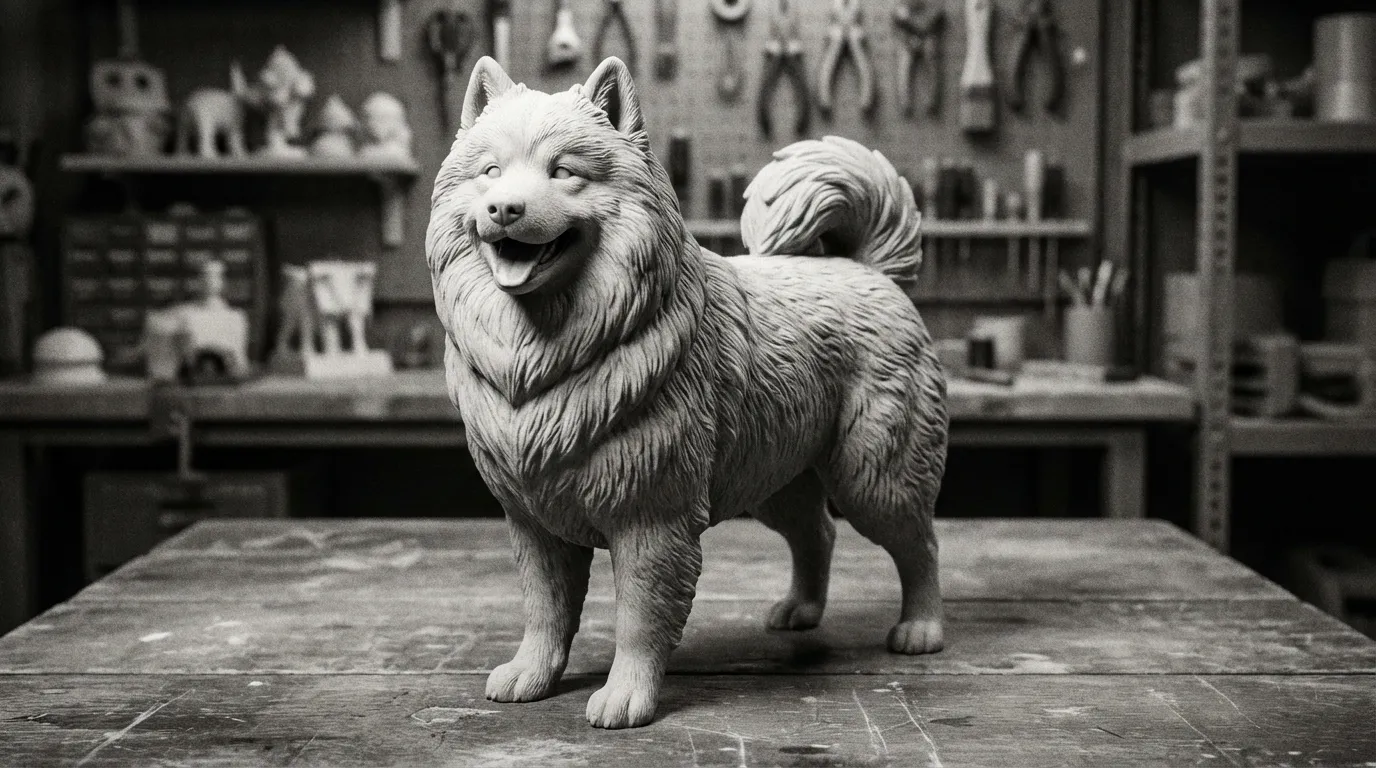
The late afternoon sun used to catch the guard hairs of his coat, turning him into a halo of light against the deep green of the hydrangeas. Now, looking at the small, stillness of the figurine on my desk, I don't just see a white shape; I see the specific way the light falls across the ruff of his neck, mimicking that exact garden memory. It is not the color white that brings him back to me, but the precise, calculated shadows trapped between the digital geometry of his fur.
Quick Takeaways
- White is not a color; it is a reflection. In sculpture, form must be exaggerated because you cannot rely on pigment to define features.
- Fur flow dictates the "color." The direction of digital sculpting strokes determines how light hits the final print, creating natural greys and highlights.
- The "Samoyed Smile" is a shadow trap. That famous upturned mouth is physically sculpted deep to catch shadows, not drawn on with black ink.
- Texture beats pigment. High-end custom pet figurines rely on 3D printed texture (topology) rather than surface paint to create realism.
The "Marshmallow Effect": Why Most White Dog Sculptures Fail
In my fifteen years working in additive manufacturing and high-end collectibles, I have seen thousands of attempts to replicate the majestic Samoyed, the fluffy Maltese, or the stoic Great Pyrenees. The vast majority of them suffer from what we in the shop call the "Marshmallow Effect."
When you look at a photograph of a white dog, your brain fills in a lot of gaps. You know the nose creates a snout; you know the legs are separate from the chest. But when you translate that into a physical object, specifically a 3D printed one, simply making the material white destroys the definition. Without distinct colors to separate the eyes from the mask, or the ears from the head, a poorly designed white sculpture becomes a shapeless, bleached blob.
The Physics of Light on Resin
Here is the counterintuitive insight that most people miss: To make a sculpture look white, you actually have to print it in grey.This sounds wrong, but hear me out. In the world of full-color resin 3D printing, we are working with a material that is slightly translucent before it is cured. If we print pure, absolute white (RGB 255, 255, 255), the light penetrates the surface, scatters, and softens every single detail we spent hours digitally sculpting. The sharp edges of the fur become soft. The eyelids vanish.
To combat this, we have to think like Renaissance marble sculptors. Michelangelo didn't paint his statues; he carved them so deeply that the shadows did the work for him.
"We don't sculpt the light. We sculpt the shadows, and the light simply has no choice but to follow."
Geometry is the New Color
When we sit down at the digital workstations to model a Samoyed, we aren't looking at the color of the dog. We are looking at the topology—the geometric surface map of the animal.
For a Tri-color Australian Shepherd, we can rely on the distinct patches of black, white, and copper to tell the viewer, "This is the ear," or "This is the tail." The color does the heavy lifting. For a Samoyed, the geometry must be perfect, or the likeness fails immediately.
The Engineering of the "Smile"
The hallmark of the breed is the "Sammy Smile." Biologically, this is an evolutionary trait; the upturned corners of the mouth prevent drool from freezing on the dog's face in Siberian temperatures. Artistically, it is a nightmare to capture without using a black pen.We solve this through deep-relief boolean operations. We don't just curve the lips up; we digitally carve a deep, triangular recess at the commissure of the lips. When the piece is 3D printed, that physical depth creates a pocket of permanent shadow.
If you look at a PawSculpt figurine under a magnifying glass, you won't see a painted black line. You will see a physical trench that light cannot reach. That is the difference between a toy and a piece of art.
Fur Flow and Directional Light
White fur is defined by "ambient occlusion"—the tiny, dark shadows that happen deep between hair strands where light can't reach.In our digital sculpting phase (using tools like ZBrush), we have to exaggerate the "clumping" of the fur. If we modeled every single individual hair strand, the 3D printer—even with its incredible 20-micron resolution—would blur them together into noise. Instead, we sculpt distinct "volumes" of fur.
- Primary Forms: We establish the rib cage, the skull shape, and the muscle mass.
- Secondary Forms: We carve the large masses of the coat—the mane, the feathering on the legs.
- Tertiary Details: This is where the magic happens. We carve deep V-shaped channels between fur clumps.
These channels are critical. They are what catch the light in your living room. Without these exaggerated valleys, a white dog figurine looks like it was dipped in wax.
The Technology: Why Brushes Can't Compete with Voxels
There is a romantic notion that "hand-painted" is always superior. As someone who loves traditional art, I respect the skill. But when it comes to replicating the translucent, refractive nature of polar bear or Samoyed fur at a small scale, paint is actually a hindrance.
The Thickness Problem
Acrylic paint has thickness. Even a skilled painter applies a layer that is 30 to 50 microns thick. When you apply that over a finely detailed texture, the paint fills in the microscopic valleys we just discussed. It acts like a filler, smoothing out the very texture we need to create shadow.Furthermore, white paint is opaque. It sits on top of the object.
The Full-Color 3D Printing Advantage
PawSculpt uses PolyJet/MJF-style technology. This is additive manufacturing where we jet tiny droplets of photopolymer resin that are instantly cured by UV light.Here is the game-changer: The color is not on top. The color is the object.
We can print a "voxel" (a 3D pixel) of pure white next to a voxel of light grey, next to a voxel of clear resin. This allows us to simulate subsurface scattering. We can print the outer tip of a fur tuft in translucent white and the inner root in a denser, opaque grey.
When light hits your figurine, it enters the resin, bounces around, and comes back out—just like light interacts with real fur. This gives the figurine an organic, "soft" look that hard acrylic paint can never achieve.
"Our printers don't cover up the details with pigment. They build the details out of pigment, layer by microscopic layer."
— The PawSculpt Team
The Art of "Fake" Shadows (Ambient Occlusion Baking)
Since we cannot rely on a 4-inch statue to cast the same shadows as a 50-pound dog, we have to cheat. We use a technique borrowed from video game design called Ambient Occlusion (AO) Baking.
During the digital coloring phase, before the file ever hits the printer, we run a simulation. The software calculates exactly where shadows would fall if the dog were standing under an overcast sky. It finds the deepest crevices—inside the ears, under the tail, between the toes.
We then instruct the printer to tint the resin in those specific crevices a very faint, cool grey (usually a mix of 5% Cyan and 3% Black).
Why Cool Grey?
Real shadows on white objects are rarely black. They are usually blue or violet because they reflect the ambient skylight. By printing these subtle blue-grey tones directly into the recesses of the fur, we trick your eye into seeing "deep white" rather than "dirty grey."| Feature | Standard "White" Figurine | PawSculpt Engineered Approach |
|---|---|---|
| Fur Texture | Smooth or lightly bumped; relies on surface paint. | Deeply sculpted geometry with exaggerated valleys for shadow capture. |
| Shadows | Painted on with black/grey wash (often looks dirty). | "Baked" into the resin using digital Ambient Occlusion and cool-tone gradients. |
| Eyes | Flat black dots painted on surface. | Modeled with physical curvature and printed with multi-color depth (pupil vs iris). |
| Material | Opaque plastic or ceramic. | Full-color resin with subsurface scattering capabilities. |
Post-Processing: The Clear Coat Factor
Once the print finishes, it emerges from the machine encased in a jelly-like support material. We carefully remove this using water jets and an ultrasonic bath. At this stage, the resin has a matte, almost chalky finish.
This brings us to the final, critical step for white dogs: The Clear Coat.
We apply a UV-resistant clear varnish to every piece. For dark dogs (Rottweilers, Labs), we often use a glossier finish to mimic the shine of a healthy coat. For Samoyeds and white breeds, we use a satin-matte blend.
The Refraction Issue
If we made a Samoyed figurine high-gloss, it would look like porcelain. It would reflect the room's light too harshly, creating "specular highlights" (bright white dots) that distract from the form.A satin finish breaks up the light. It allows the "baked-in" shadows we printed to be visible, while still giving the piece enough sheen to look premium and protected. This is a manual application, and it requires a steady hand to ensure no pooling occurs in those carefully sculpted fur crevices.
Lighting Your Figurine: A Guide for Owners
You have gone through the process. You sent us the photos, we sculpted the geometry, and we printed the memory. Now, where do you put it?
Because our work relies on geometry and shadow, lighting is everything.
The "Raking Light" Technique
Do not place your white dog figurine directly under a bright, overhead lamp. Direct, top-down light washes out detail (the same reason high noon is bad for photography).Instead, place the figurine where it receives raking light—light that hits it from the side or at a 45-degree angle. A bookshelf near a window is ideal. The side light will travel across the "hills and valleys" of the fur texture we created, casting real shadows into the recesses. This is when the figurine looks most alive.
"A sculpture without shadow is like a song without silence. It's the contrast that creates the feeling."
Frequently Asked Questions
Why do white dog figurines sometimes look like unpainted plastic?
This is the "Marshmallow Effect" mentioned earlier. It happens when the sculpture lacks surface depth. If the surface is too smooth, or the paint is too thick, light reflects evenly off the entire object, erasing the details. We solve this by digitally sculpting deep grooves (topology) that force shadows to appear, defining the shape.Can you capture the "biscuit" coloring on my Samoyed's ears?
Absolutely. This is where full-color 3D printing shines compared to hand-painting. We can print a gradient that fades from pure white to a soft toasted cream ("biscuit") over the span of a few millimeters. Hand-painting often results in a hard line where the color changes, but our printer mixes the colors voxel-by-voxel for a seamless transition.Does the white resin yellow over time?
This is a valid concern with any polymer. We use high-grade, UV-stabilized resins, and the clear coat we apply provides a second layer of UV protection. However, like any piece of fine art or photography, we recommend keeping the figurine out of direct, scorching sunlight (like a windowsill that gets 8 hours of noon sun) to preserve the pristine white tones for decades.How many photos do you need for a white dog?
For white breeds, quality matters more than quantity. We need photos taken in indirect natural light (like a cloudy day or in the shade). Do not use flash. Flash blows out the highlights on white fur, leaving us with a white circle and two eyes. We need to see the shadows in the coat to sculpt the texture accurately.Ready to Celebrate Your Pet?
Every pet has a story worth preserving, and for the white-coated wonders of the world, that story is written in light and shadow. Whether you're honoring a beloved Samoyed who's crossed the rainbow bridge or celebrating your Westie's unique personality, a custom PawSculpt figurine captures those details that make your pet one-of-a-kind.
Free instant AI preview • 3D artist preview within 7 days • 5 free revisions