The Tabby 'M': 3 Cultural Meanings Behind the Marking and How We Sculpt It (Myth vs. Biology)
The cardboard box in the corner of the attic smelled like cedar and old paper, but the worn collar resting on top still held the faint, dusty scent of him. You run your thumb over the fabric, remembering exactly how that little 'M' on his forehead used to crinkle when he watched birds through the window. It’s strange how a specific pattern of fur can become the map to a thousand memories.
Quick Takeaways
- The 'M' is biological camouflage — It is the result of the Agouti gene interacting with tabby patterning to break up the cat's outline in tall grass.
- Three major myths define it — Cultural history links the mark to the Virgin Mary, the Prophet Mohammed, and Ancient Egyptian Mau cats.
- Geometry matters more than color — In custom 3D modeling, the 'M' isn't just a drawing; it follows the complex topography of the brow bone.
- Full-color printing captures the blur — Unlike hand-painting, our voxel-jet technology reproduces the soft, gradient edges of natural fur markings.
The Universal Mark: More Than Just Fur
We have seen thousands of cat photos come through our digital workshop. Tabbies, specifically, make up a massive percentage of the beloved pets we are asked to immortalize. And almost every single time, the owner mentions the 'M'.
"Make sure you get his 'M' right," they say. "It was slightly crooked on the left side."
To the casual observer, a tabby is a tabby. But to us—and to you—that forehead marking is a fingerprint. It’s the focal point of the face. It’s where you kissed them goodnight.
As specialists in additive manufacturing and digital sculpting, we spend hours staring at the geometry of cat faces. We don't just see a letter; we see a collision of genetics, history, and complex surface topology. When we sit down to digitally sculpt a memorial piece, we aren't just copying a photo; we are trying to translate a biological marvel into full-color resin.
Here is what we have learned about that mysterious 'M'—from the ancient legends that explain it to the shop-floor engineering required to replicate it.
The Biology: The Agouti Gene and the "Wild Type"
Before we get into the legends, let’s look at the science. We often have to explain this to pet parents who are worried that their cat's specific shade of orange or gray won't translate to a figurine.
The 'M' isn't a separate marking; it is the anchor point of the tabby pattern. All domestic cats carry the genes for a tabby pattern. Even solid black cats have it hidden (you can sometimes see the 'M' on a black cat in bright sunlight—we call this "ghost striping").
The pattern is controlled by the Agouti gene. In a "wild type" scenario, this gene dictates that individual hairs are banded with light and dark colors. The tabby markings occur where the solid color takes over, overriding the agouti banding.
Why the Forehead?
Biologically, the forehead is a critical area for signaling and camouflage. In the wild ancestors of our house cats (like the African Wildcat, Felis lybica), that 'M' helped break up the outline of the head while the cat peered through tall grass. It’s evolutionary stealth technology."Nature doesn't draw straight lines. The 'M' is rarely perfect because it's designed to blend in, not stand out."
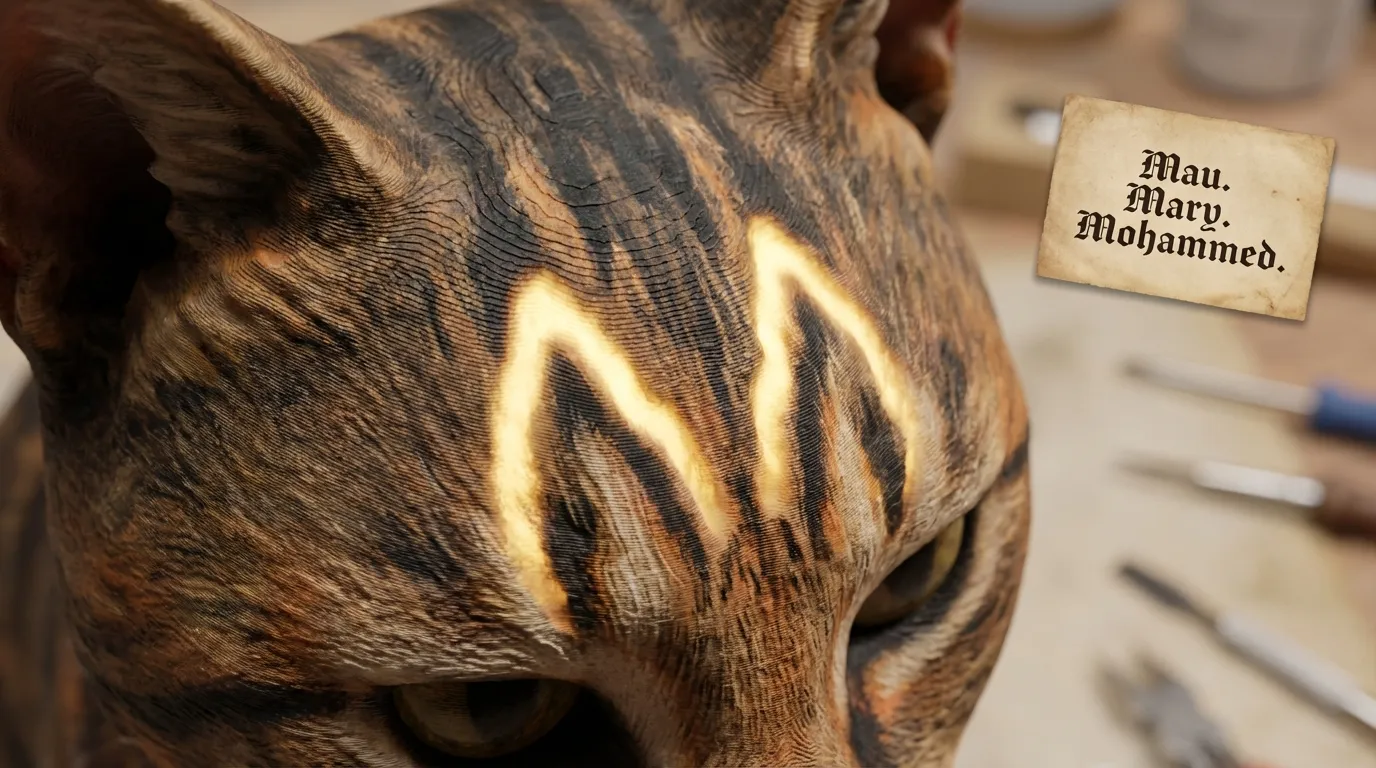
When we are digitally sculpting a cat in ZBrush or Blender, we have to respect this biology. A common mistake in amateur 3D modeling is making the 'M' look like a superhero mask—too sharp, too defined. Real fur has "noise." The edges of the 'M' feather out. The hairs transition from dark to light.
The Myths: Three Stories, One Mark
While we rely on the geometry of the skull to guide our digital sculpting tools, we can’t ignore the stories. The cultural weight of the 'M' is why so many of us feel such a deep connection to it. It transcends biology and enters the realm of the spiritual.
Depending on where you are in the world, that marking tells a different story of divine protection.
1. The Mau and the Moon (Ancient Egypt)
In Ancient Egypt, cats were revered, often associated with the goddess Bastet. But the 'M'? Some historical linguists and folklorists suggest it represents the word Mau, the Ancient Egyptian word for cat.There is a poetic symmetry here. The sound the animal makes (meow) became its name (Mau), which is visually stamped on its forehead (M). When we work on Egyptian Maus or Abyssinians, we often see a more primitive, wilder version of the marking—thinner, more vertical lines that recall those ancient statues.
2. The Virgin Mary (Christian Folklore)
A popular legend tells of a cold night in the stable at Bethlehem. The baby Jesus was shivering in the manger, and the blankets weren't enough. The farm animals tried to help, but they were too large or clumsy.A small tabby cat climbed into the manger, curled up next to the infant, and purred him to sleep. In gratitude, the Virgin Mary stroked the cat's forehead, leaving the initial of her name, 'M', as a permanent blessing of protection on the breed.
3. The Prophet Mohammed (Islamic Tradition)
There is a similar and equally beautiful story in Islamic tradition regarding the Prophet Mohammed and his favorite cat, Muezza.One legend says that a snake crawled into the Prophet's sleeve while he was dressing. The cat killed the snake, saving his life. The Prophet stroked the cat's forehead, bestowing the 'M' (and the ability for cats to always land on their feet). Another version says Muezza fell asleep on the sleeve of Mohammed's prayer robe. Rather than disturb the cat, he cut the sleeve off the robe.
The Shared Thread:
Notice the pattern? In every story, the 'M' is a badge of honor. It signifies that the cat is a protector, a comforter, or a divine companion. When we recreate this mark in our studio, we aren't just printing pigment; we're preserving that legacy of comfort.
The Engineering Challenge: Mapping the 'M'
This is where we put on our engineering hats. You might think, "It's just a letter on the forehead. How hard can it be to put on a figurine?"
In the world of high-fidelity 3D manufacturing, it is incredibly difficult to get right.
If you take a 2D photo of a cat and try to "project" it onto a 3D model, it distorts. The forehead of a cat is not a flat canvas. It has the brow ridge (supraorbital ridge), the temporal fossa (the dip at the temples), and the curve of the cranium.
The "Uncanny Valley" of Stripes
We have seen cheap, mass-produced figurines where the stripes look like they were painted on with a sharpie. They sit on top of the surface.Real fur has depth. The 'M' is formed by thousands of individual hairs pointing in different directions.
- The Center: Hairs point upward.
- The Sides: Hairs sweep outward toward the ears.
- The Bridge: Hairs point downward toward the nose.
If we just slap a texture map on the digital model without following this "grooming direction," the light hits it wrong. The figurine looks fake. It looks like a toy, not your cat.
Our Process: Digital Sculpting Meets Voxel Printing
At PawSculpt, we use a workflow that is radically different from traditional figurine making. We do not use molds, and we do not use paintbrushes.- Digital Grooming: Our artists use sculpting software to define the volume of the fur. We physically sculpt the ridges where the 'M' sits.
- Polypainting: We paint the color digitally, voxel by voxel (a voxel is a 3D pixel).
- Full-Color Resin Printing: This is the game-changer. Our printers jet tiny droplets of colored resin—Cyan, Magenta, Yellow, Black, White, and Clear—simultaneously.
Why this matters for the 'M':
Because we are printing the color into the material, we can create translucency. We can print a dark hair next to a light hair with a transition zone of semi-transparent resin in between. This mimics the way light scatters through actual fur (subsurface scattering).
| Feature | Traditional Hand-Painting | Full-Color 3D Printing (PawSculpt) |
|---|---|---|
| Gradient Control | Hard edges due to brush strokes | Smooth, atomized gradients |
| Symmetry | Relies on human hand stability | Mathematically precise symmetry (or asymmetry if the pet has it) |
| Texture | Paint fills in the details | Color follows the sculpted fur texture |
| Complexity | struggling with complex tabbies | Unlimited complexity for ticking and patterns |
The "Tyger" in the Living Room
There is a counterintuitive insight we’ve learned after years of doing this: The 'M' is rarely a perfect 'M'.
When owners send us photos, they often say, "He had a perfect M!" But when we zoom in on the high-resolution reference photos, we see the truth. Maybe the left leg of the 'M' was broken. Maybe the middle V didn't quite touch.
This asymmetry is what makes the face look alive.
We often have to have a delicate conversation with customers during the preview phase.
- Customer: "The M looks crooked."
- Artist: "If you look at this photo from 2018, you can see his pattern actually pulled to the right because of that cowlick he had."
When we correct it to be perfectly symmetrical, the owner almost always says, "It looks like him, but something is missing." When we put the "flaw" back in, they cry. "That’s him."
"Perfection is the enemy of recognition. It’s the broken lines and the crooked spots that bring the memory back."
How to Capture the Best Reference for Us
If you are planning to commission a custom figurine of your tabby, the quality of the 'M' depends heavily on the photos you provide. We can work miracles with blurry photos, but accurate geometry requires data.
The "Raking Light" Trick
The best photos for us aren't taken with a flash. Flash flattens the face and washes out the contrast between the light and dark hairs of the 'M'.Try to find (or take) photos where the light is coming from the side (raking light). This casts tiny shadows behind the fur clumps, showing us exactly how the hair flows over the brow bone.
The Top-Down View
Most people take photos of their cats from the front or slightly above. But a true "top-down" view of the head is gold for us. It allows our digital sculptors to see exactly where the 'M' stops and the neck stripes begin.Post-Processing: The Final Touch
Once the printer finishes its job, depositing millions of microscopic droplets of colored resin to form your pet, the model isn't done.
It comes out encased in a support material (like a gel). We carefully clean this away using water jets and specialized solutions.
At this stage, the 'M' looks matte, almost chalky. This is the nature of the raw resin.
The magic happens when we apply the Clear Coat. We do not paint over the colors; we apply a UV-resistant clear varnish. As soon as the clear coat hits the resin, the colors pop. The darks of the tabby pattern become deep and rich (like wet stone), and the lighter agouti bands shimmer.
This step is critical for preserving the "Agouti" effect. Without the clear coat, the light scatters off the surface too much, making the pattern look washed out. The clear coat allows light to penetrate slightly into the resin before bouncing back, giving the figurine that organic, fleshy look rather than looking like dry plastic.
You Are Not Alone in Remembering
We write this not just to explain our manufacturing process, but to validate what you’re feeling. If you find yourself staring at a spot on the sofa where a little orange or gray forehead used to rest, know that you aren't the only one.
We see it in every order queue. We see the obsession with getting that one marking right.
The 'M' is a biological quirk of the Agouti gene, sure. It’s a trick of camouflage. But it’s also the mark of the Mau, the blessing of Mary, the touch of the Prophet. And for you, it’s the target for a thousand kisses.
When we print that mark, layer by microscopic layer, we know we aren't just printing a letter. We’re printing a legacy.
Frequently Asked Questions
Why is the 'M' on my figurine slightly different from the photo?
We sculpt based on 3D geometry. Sometimes 2D photos flatten features or lens distortion makes the forehead look wider than it is. We aim for the structural truth of the pet's face. However, because we offer unlimited revisions on the digital model, we can adjust the pattern until it looks exactly right to your eye.Can you fix the 'M' if my cat had a scar or missing fur there?
Absolutely. This is the benefit of digital sculpting. Unlike a mold that produces generic cats, we can modify the digital mesh to include scars, ear nicks, or patches of missing fur before we ever send it to the printer.Does the color rub off the figurine?
No. We do not use surface paint. We use full-color resin 3D printing. The pigment is embedded inside the material itself—think of it like a stick of rock candy where the pattern goes all the way through. It is permanent, though we recommend keeping it out of direct harsh sunlight to ensure longevity.My cat was a "dilute" tabby. Can you match that faded color?
Yes. Traditional painting struggles with "dilute" colors (like cream or blue/gray) because they can look muddy. Our printers use a CMYK spectrum (Cyan, Magenta, Yellow, Black) plus White and Clear, allowing us to mix millions of colors, including soft creams, dilute grays, and champagnes with high precision.Ready to Celebrate Your Pet?
Every pet has a story worth preserving. Whether you're honoring a beloved companion who's crossed the rainbow bridge or celebrating your furry friend's unique personality, a custom PawSculpt figurine captures those details—like that perfect 'M'—that make your pet one-of-a-kind.
Free instant AI preview • 3D artist preview within 7 days • 5 free revisions