The Challenge of the Blur: How We Sculpt the Energy of a Malinois
"Motion is the only rest the driven soul knows." — Unknown.
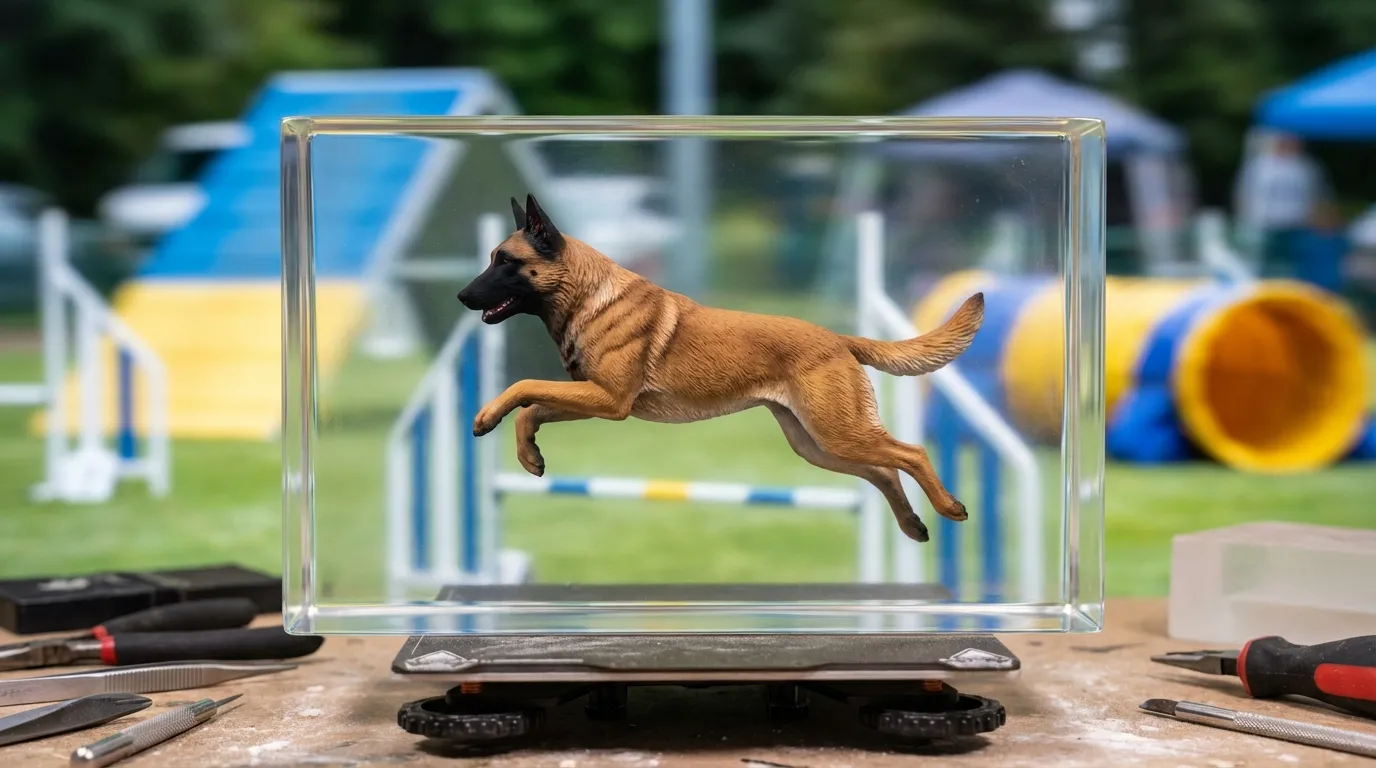
The backseat of the SUV isn't just a transport vessel; for a Belgian Malinois, it is a vibrating containment unit for pure kinetic potential. Even at a red light, you can feel the hum of energy radiating from the crate, a 3D printed pet sculpture waiting to explode into reality the second the latch clicks.
Quick Takeaways
- Static poses fail this breed — A Malinois standing square often looks unnatural; their essence is found in the torque of a turn or the compression of a jump.
- Video captures what photos miss — To get the perfect reference for a sculpture, record your dog in slow-motion (60fps) rather than trying to time a shutter click.
- The "Mask" requires voxel depth — The signature charcoal face mask of a Malinois isn't surface paint; it requires PawSculpt’s full-color printing to embed the pigment deep into the resin for a natural fade.
- Durability dictates orientation — The breed's fine bone structure and large ears present engineering challenges that require specific print orientations to prevent warping.
The Malinois Paradox: Sculpting Chaos
In the additive manufacturing world, we usually crave stability. We like flat surfaces, thick walls, and centers of gravity that sit low and heavy. Then, we meet the Belgian Malinois owner.
You don't want a paperweight. You want a physical manifestation of that time your dog cleared a six-foot wall or the precise millisecond before they hit the bite sleeve. The challenge with this breed isn't anatomy; it's physics. A Malinois is rarely interacting with the ground in a way that makes structural sense for a resin model. They are often balancing on one leg, mid-torque, with gravity acting as a mere suggestion rather than a law.
Most custom figurines fail the Malinois because they treat the dog like a Golden Retriever—happy, seated, stable. But a Malinois is a loaded spring. Even when they are in a "down-stay," the muscles in the hindquarters are engaged, ready to launch.
Our job, as digital sculptors and print engineers, is to capture that potential energy without making the final piece look like a fragile, anxiety-inducing spindly thing. We have to sculpt the intent of the dog.
The "Line of Action"
When our digital artists sit down with their stylus and ZBrush software, the first thing they look for in your reference photos is the "Line of Action." This is an imaginary line that runs through the spine, from the nose to the tip of the tail.
In a Bulldog, that line is usually a flat brick. In a Malinois, it’s a whip.
If we sculpt the spine straight, the dog looks dead. We have to induce an "S-curve" or a "C-curve" into the torso. This mimics the compression of the ribcage as the dog banks into a turn. It’s a subtle distortion—sometimes we actually exaggerate the curve by 5% to 10% because, on a small scale (like a 6-inch figurine), reality looks stiff. The exaggeration sells the motion.
"A Malinois doesn't just run; they flow through the air. If the sculpture touches the ground too heavily, we've missed the point."
The Engineering of the "Black Mask" (Why We Don't Paint)
Here is where the shop talk gets technical, but if you own a Malinois, you appreciate precision. One of the defining features of the breed is the black mask—that carbon-charcoal fade that covers the muzzle and eyes, blending into the rich mahogany or fawn of the neck.
If you try to hand-paint this, it looks like a cartoon bandit mask. Paint sits on top of the surface. It blocks light. Fur doesn't work like that. Fur is translucent layers of protein.
Voxel-Level Pigmentation
At PawSculpt, we use full-color PolyJet-style technology. We aren't extruding plastic filament (FDM) like a hobbyist printer, and we aren't painting a white model. We are jetting millions of droplets of photopolymer resin that are instantly cured by UV light.
Crucially, we can control the color of every single droplet (voxel).
To create that Malinois mask, we don't print a layer of black on top of brown. We actually mix the black resin droplets into the brown resin droplets at a microscopic level, creating a volumetric gradient. The color exists inside the material, about 200–300 microns deep.
- Subsurface Scattering: Light penetrates the clear coat and the top layer of resin, bouncing around inside the pigment before reflecting back to your eye. This gives the "coat" a depth that looks organic, not plastic.
- The Brindle Complexity: For Dutch Shepherds or brindle Malinois mixes, the striping isn't a hard line. It's a dithering of dark and light hairs. Our printers handle this by "dithering" the resin placement, creating a soft edge that mimics real fur patterns.
The Structural Integrity of "The Flying Dog"
A Malinois on a bite suit is often supported by nothing but its back legs and the sheer force of its jaw. Translating that action shot photography into a freestanding object is an engineering nightmare.
The Center of Gravity Problem
If you send us a photo of your dog in mid-air catching a frisbee, we can digitally sculpt it exactly as it is. But gravity works on figurines too. If we print it, it will fall over.
We solve this using two main techniques:
- The Tactical Base: We don't just glue the dog to a flat disk. We sculpt the environment to support the physics. If the dog is banking hard left, we might sculpt a patch of tall grass or a training incline that connects with the dog's flank or tail, providing a third point of contact that is invisible to the casual observer but crucial for structural stability.
- Internal Hollowing and Weighting: We can print the upper body of the dog hollow (with a 2mm wall thickness) while printing the legs and base 100% solid. This shifts the center of gravity downward. It’s a trick we learned from aerospace engineering—lighten the payload, reinforce the landing gear.
The Ear Vulnerability
The ears of a Malinois are large, thin, and upright. In the resin printing world, we call these "high aspect ratio features." They are prone to two failure modes:
- Warping during cure: As the resin cures, it shrinks slightly. Long, thin features can bow inward.
- Snap hazards: They are the first thing to break if the model tips over.
We mitigate this during the digital sculpting phase by slightly thickening the base of the ear (the tragus area) and tapering it up. We also often print the head oriented slightly downward so the ears "grow" towards the print bed, rather than hanging off into empty space where they require heavy support structures that leave scars.
Capturing the "Mali Stare"
You know the look. It’s not just eye contact; it’s a laser lock.
In traditional miniature painting, eyes are the hardest part. One slip of the brush and the dog looks cross-eyed or deranged.
With our digital workflow, we model the eye as a multi-part geometry. We sculpt the cornea (the clear lens) over the iris. Because we are printing in full color, we can print the iris with the specific amber-to-dark-brown gradient typical of the breed, and then print a clear, high-gloss resin over it in a single pass.
This creates a real "lens" effect. The eye has a wet, glassy shine because it is literally made of clear material, not just a dot of white paint acting as a highlight. When you turn the figurine, the highlight moves, following the light source in your room. It captures that intense, high-drive intelligence.
Action Shot Photography: The Blueprint
The quality of the final 3D print is directly tied to the reference material. However, taking a photo of a Malinois is like trying to photograph a bullet.
We often receive blurry photos where the paws are just smudges of motion. While we can work with these, they force the artist to guess at the anatomy.
The Video Protocol
- Set up the camera at the dog's eye level (get on the ground).
- Run the dog through their commands—heel, sit, bite, jump.
- Later, scrub through the video frame-by-frame. You will find that perfect split-second where the muscles are fully flexed, the ears are pinned back, and the tail is acting as a counterbalance.
- Screenshot that frame. That is your reference.
| Feature | Poor Reference | Ideal Reference |
|---|---|---|
| Lighting | Backlit (dog looks like a silhouette) | Overcast daylight (soft shadows, clear coat color) |
| Angle | Top-down (standing over the dog) | Eye-level (camera on the ground) |
| Action | Motion blur on paws | Sharp shutter or 4K video frame extraction |
| Coat | High contrast filter applied | No filters, natural lighting to show mask gradients |
"We don't just look at the dog's outline; we look at the shadows on the ribcage. That tells us how hard the dog is breathing."
— The PawSculpt Team
Post-Processing: The Clear Coat Finish
Once the print comes off the machine, it isn't done. It’s covered in a wax-like support material that held up the chin and belly during printing.
We use a water-jet station to blast away this support material. This is a delicate operation. The pressure that cleans the flank could snap the tail. It requires a "feather touch"—hands that know exactly how much PSI a resin leg can take.
After cleaning and UV curing (to harden the resin fully), we apply a technical clear coat.
For a Malinois, we often use a satin finish.
- Gloss looks too wet and toy-like for the body.
- Matte flattens the rich mahogany colors and kills the definition of the muscles.
- Satin is the sweet spot. It mimics the sheen of a healthy, well-conditioned coat under the sun. It highlights the muscle definition—the triceps, the vastus lateralis—without making the dog look like it's made of glass.
Case Studies: The Many Modes of the Malinois
We've printed hundreds of these dogs, and rarely are two alike. The breed standard is just a suggestion; the personality is the rule.
The Working K9
For police and military K9s, the gear is as important as the dog. We digitally model the specific harness, the badge, and even the wear-and-tear on the bite collar. The challenge here is "layer separation"—ensuring the harness looks like it's sitting on the fur, compressing it slightly, rather than merged into the skin. We use "ambient occlusion" in the color map to create fake shadows under the harness straps, adding depth.The Dock Diver
This is all about extension. The dog is a straight arrow. We have to reinforce the base significantly here, often using a "splash" of water (printed in semi-translucent blue-tinted resin) to act as the structural support for the flying body.The "Velcro" Malinois
Despite the drive, many owners want to capture the softer side. The "Mali Lean"—where they press their entire body weight against your leg. For these, we focus on the face. The ears are usually softer, slightly out to the side (the "airplane ears" of happiness), and the mouth is open in a loose, tongue-lolling pant. Here, we spend extra time sculpting the tongue to give it that gravity-defying curl.Frequently Asked Questions
Can you sculpt my dog's specific harness or collar?
Absolutely. Since we digitally sculpt every piece from scratch, we aren't limited to generic molds. We can model tactical vests, E-collars, or that one specific frisbee they destroyed. We just need clear reference photos of the gear (front, back, and side) to get the buckles and straps right.My Malinois has a very dark face mask. Will it print as a solid blob?
This is a common fear with traditional painting, but not with our process. Because we print color into the resin, we can maintain "specular highlights"—the way light reflects off a black nose or black fur. Even if the face is jet black, you will still see the geometry of the nostrils, the lips, and the eyebrows.How fragile are the ears on the figurine?
We have to be honest: they are the Achilles' heel of the model. While the UV-cured resin is tough (similar to a hard acrylic), the thin geometry of a Malinois ear makes it susceptible to snapping if dropped. We treat these as high-end collectibles, not toys. We recommend placing them on a stable surface, ideally in a display case or on a mantelpiece where they won't be bumped.Do I need a professional photo of my dog?
No, and sometimes professional photos are actually harder to work with if they are heavily edited or filtered. We prefer honest, well-lit smartphone photos. The key is angles. We need to see the profile, the face straight on, and the markings on the back. A video walk-around of your dog (while they are standing still for a treat) is the gold standard for our artists.Ready to Celebrate Your Pet?
Every pet has a story worth preserving, but a Malinois has an energy that demands to be captured in motion. Whether you're honoring a retired K9 hero or celebrating the chaotic joy of your current agility partner, a custom PawSculpt figurine freezes that "blur" into a permanent, tangible memory.
Free instant AI preview • 3D artist preview within 7 days • 5 free revisions