Your Russian Blue's Missing Story Can Still Lead to a Ritual That Heals
The soft clink of a basement radiator and the missing jingle of tags can turn Russian Blue grief acceptance into something physical five years later—especially when the story ended without answers.
Quick Takeaways
- Stop chasing a perfect ending — healing often begins when you honor uncertainty directly
- Build a sound-based ritual — use daily cues to replace painful absence with chosen remembrance
- Name the hidden emotions — guilt, anger, and fear of forgetting need specific outlets
- Choose one tangible anchor — for some families, custom pet figurines help memory stay detailed, not abstract
Why a Missing Story Hurts Differently
Most pet loss articles assume you had a clear ending: illness, euthanasia, a final goodbye, maybe even ashes in a box on the mantle.
But with a missing pet, especially one never found, grief behaves differently. It resists chronology. There is no confirmed last moment, no witnessed transition, no neat line between “before” and “after.” That is why pet loss ritual five years later can still feel not only valid, but necessary.
And honestly, this is the part many people around you won’t understand.
A Russian Blue leaves a particular soundtrack behind. The light footfall across hardwood. The brief chirrup from the hallway. The metallic tap of jumping onto a dryer or basement storage shelf. When that sound disappears without explanation, the mind keeps listening. It scans for evidence. It bargains with ordinary noise.
We’ve heard this pattern from pet families again and again: the grief is not only about absence. It is about unfinished narrative. Human beings are meaning-making creatures. When a story has no final page, we keep trying to write one in our heads.
That is the missed angle in most grief guides. The wound is not simply “time passed and you still feel sad.” The wound is that your memory has been forced to carry two impossible jobs at once:
- Preserve love
- Solve the mystery
Those jobs conflict.
One keeps your cat close. The other keeps your nervous system on alert.
The overlooked burden of ambiguous loss
Psychologists sometimes use the term ambiguous loss to describe a loss without full confirmation or closure. It matters here. A pet who vanished can remain emotionally “unfiled” for years.
You may have done all the practical things back then—posters, calls, shelter checks, neighborhood walks at dusk, social media posts, maybe even returning to the same block months later because a shape in the distance looked familiar. The body remembers that vigilance long after other people assume the event is over.
A family we heard from described this exact pattern with their Russian Blue: every time the furnace kicked on in the basement, they half-expected to hear the old scratch at the door. Five years later, they weren’t “stuck.” They were still reacting to a story that had never resolved.
That distinction matters. Deeply.
"Unanswered loss keeps asking questions long after everyone else has left the room."
Why Russian Blue grief can feel especially sharp
We’ll be careful here—every cat is an individual. But anyone familiar with the breed knows that Russian Blues often create highly patterned bonds. According to the American Kennel Club's Russian Blue breed guide, they’re often observant, loyal, and attached to routines.
That means the grief can be unusually environmental. Not just emotional. Environmental.
You don’t only miss the cat. You miss:
- The exact hour they waited by the stairs
- The specific trill before breakfast
- The weight pattern on one side of the couch
- The small inspections of laundry baskets, cardboard boxes, basement shelves
Routine is where Russian Blues often live most vividly in memory. So when the ending is missing, the routine can become a loop instead of a remembrance.
The mistake most people make
The mistake most people make is trying to “finally move on” by forcing certainty where none exists.
They ask themselves questions like:
- Was he cold?
- Did she suffer?
- Should I have searched longer?
- Did I miss a sign that day?
- If I create a memorial now, am I admitting hope was foolish?
None of those questions can be answered cleanly. And yet they can dominate grief for years.
What helps more is a subtle but powerful shift: stop treating certainty as the prerequisite for ritual.
You do not need the ending to honor the relationship.
That sounds simple. It isn’t. But it is the hinge this whole process turns on.

Russian Blue grief acceptance starts with the story you can actually tell
Acceptance is a loaded word. We’re not huge fans of the version that implies emotional tidiness, as if love can be filed away after enough maturity and self-discipline.
A better working definition for Russian Blue grief acceptance is this: you stop demanding a complete explanation before allowing yourself to remember with peace.
That’s the standout idea here.
The two-story method
In our experience working with pet families, one of the most useful tools is what we call the two-story method. It separates fact from fear.
Write two versions of your pet’s story.
Story one: what you know
Keep it strict. No speculation.
For example:
- He loved warm laundry
- He sat on the basement steps during storms
- He made that short chirping sound before dinner
- He disappeared in late spring
- We searched for weeks
- We did not find him
That list may look almost too simple. Good. Simplicity prevents the mind from slipping into punishment.
Story two: what your mind keeps adding
This is the hard part. You write the feared possibilities, the guilt loops, the self-accusations.
For example:
- I should have checked the door again
- Maybe he thought we abandoned him
- Maybe his last hours were frightening
- If I build a ritual now, people will think I’m being dramatic
This second list is often where the emotional charge lives.
And here’s the counterintuitive insight: healing does not require deleting story two. It requires labeling it accurately. Not as truth. As grief-generated narrative.
That shift reduces shame and increases clarity.
A short evening vignette
It’s 6:40 p.m. The dryer stops with a dull thud in the basement, and for one half-second your shoulders lift because that used to be the cue—he’d appear, silent and silver-blue, before the folding was done. You stand there with a towel in your hands, not crying exactly, just suspended. Instead of pushing the moment away, you say out loud, “That was your time,” place the folded towel in one chosen basket, and light a candle upstairs for ten minutes.
That’s a ritual. Small, precise, repeatable.
Not dramatic. Effective.
Why rituals work better than “closure”
We’ll be direct: closure is overrated. Ritual is more useful.
Closure suggests an ending. Ritual creates a container.
That container helps the brain do three things:
- Recognize a trigger
- Assign meaning to it
- Move through it without spiraling
This is why people often feel surprisingly steadier after a memorial act done years later. The ritual doesn’t erase longing. It gives longing a place to go.
If you want outside support from people who specialize in pet bereavement, the Association for Pet Loss and Bereavement is worth noting. Their resources can be especially helpful when your grief involves unresolved endings.
What acceptance does not mean
Let’s clear away a few myths.
Acceptance does not mean:
- You stop checking cats from a distance
- You stop wondering on anniversaries
- You throw away all hope and become emotionally efficient
- You love your next pet “correctly” by never comparing
It means something more modest and more humane: the uncertainty no longer runs the entire household inside your head.
That’s progress. Real progress.
The emotions few people admit after a missing pet
Here is where most articles get too polite. They stay at the level of “sadness,” which is real but incomplete.
The families who talk to us most openly often describe a more layered interior life. And once named, those emotions become far less frightening.
Guilt about what you did—and what you didn’t do
Many pet owners feel guilty about one practical choice that now seems unforgivable in hindsight: a door left ajar, a repair person coming in, a move, a guest, an open garage, a missed hunch, a shorter search on one particular day.
This is more common than people admit.
One customer described replaying a single sound for years—the screen door snapping shut. Not because that sound caused the disappearance with certainty, but because grief wanted a culprit, and the easiest culprit was the self.
Here’s the comfort we think matters most: guilt creates the illusion of control. If it was your fault, then the world is at least explainable. That is why guilt can feel strangely preferable to uncertainty.
But it’s still a trap.
A better practice is to write one sentence that reflects responsibility accurately, not cruelly: “I made decisions with the information and capacity I had that day.” Read it whenever your mind starts rewriting history with impossible standards.
Relief mixed with sadness
This one surprises people, and then it relieves them.
If your missing-cat story involved months or years of searching, false sightings, constant alertness, and the chronic ache of “maybe today,” you may have felt relief mixed with sadness when you finally stopped active searching or allowed yourself to memorialize your Russian Blue.
That relief does not make your bond shallow.
It means your nervous system was exhausted.
We see this often with delayed rituals. The act of finally creating a memorial—framing the favorite photo, donating supplies, commissioning a keepsake—can bring tears and relief in the same afternoon. That combination can feel morally confusing, but it is normal.
"Relief after uncertainty is not betrayal. It is the body unclenching."
Fear of forgetting the real cat
This may be the most under-discussed pain of all: fear of forgetting.
Not forgetting that your Russian Blue existed. Forgetting the exactness.
The sound of paws landing lightly but not timidly. The shape of the ears in profile. The watchful expression from the basement stairs. The odd little habit of supervising laundry as if lint were a matter of governance.
Five years later, many owners realize what terrifies them is not grief itself. It is memory blur.
That’s why tangible rituals matter. They hold detail in place.
For some families, that means a written sensory inventory. For others, a printed album. For others, a memorial keepsake that captures posture, markings, and presence in three dimensions.
We’ll say this plainly because it has come up in thousands of conversations: a photo often preserves appearance, but an object in space can preserve relationship perspective. You walk past it. You notice the tilt. You remember the height. Different part of the brain.
Feeling judged by people who “don’t get it”
Some owners wait five years because they assume others will find a delayed ritual excessive. Maybe friends think “it was just a cat.” Maybe family members have quietly signaled that grief should have a deadline.
That social pressure produces shame about grief intensity.
We don’t think shame should be running this conversation.
A private ritual is still legitimate. A small one counts. An annual one counts. A ritual no one else sees still counts.
And if someone questions why you’re doing this now, the clean answer is: “Because unresolved love doesn’t follow their calendar.”
Anger, too
Yes, anger.
At the neighborhood. At bad luck. At the person who swore they saw your cat and didn’t call back. At yourself. At the randomness of ordinary afternoons. At how quickly the world resumed making coffee and traffic and grocery lists while your own internal world had gone ragged.
Anger can be easier to manage when it’s given a job.
Good jobs for anger:
- Write the angry version in a notebook you keep sealed
- Walk a set route for 20 minutes whenever agitation spikes
- Donate or volunteer in a way that converts helplessness into contribution
- Set a memorial task with a defined end point
Bad jobs for anger:
- Interrogating your memory at 2 a.m.
- Using social comparison to punish yourself
- Telling yourself you’re “too much” for still caring
Pet loss ritual five years later: what actually helps
A delayed ritual should not imitate a funeral if that doesn’t fit your story. That is the first editorial cut we’d make.
Our top pick is a ritual that addresses the specific injury of a missing story: uncertainty, interrupted routine, and fear of memory erosion.
Choose a ritual format based on what hurts most
Not all rituals do the same work. Match the form to the pain point.
Here’s a practical overview:
| If this is the hardest part | Best ritual type | Why it works | Time needed |
|---|---|---|---|
| Unanswered questions | Letter ritual | Gives your mind a place to stop explaining | 20-30 minutes |
| Missing daily routine | Sound-based evening ritual | Replaces involuntary trigger with intentional remembrance | 10 minutes daily |
| Fear of forgetting details | Sensory memory archive | Preserves exact habits, sounds, and visual cues | 30-60 minutes |
| Need for tangible presence | Physical memorial object | Restores spatial memory and grounded connection | Ongoing |
| Guilt and self-blame | Responsibility release ritual | Separates care from impossible hindsight | 15-25 minutes |
The standout here is the sound-based ritual, especially for Russian Blue owners.
Why sound? Because many grief triggers are auditory before they are cognitive. You hear the heater click, the collar jingle you know is no longer possible, the phantom jump onto a cardboard box. The body reacts first. A ritual that uses sound can intercept that process.
The sound-based ritual we recommend most
This is one of the best delayed-grief tools we’ve seen because it is concrete and not overly sentimental.
Step 1: Pick one recurring household sound
Choose a sound that reliably reminds you of your cat:
- Dryer stopping
- Basement radiator clinking
- Ice maker dropping cubes
- Evening alarm
- Front door latch
- The creak of a stair
Step 2: Pair it with one intentional action
For 14 days, every time that sound occurs at the chosen hour, do one small act:
- Touch the photo frame
- Read one line from your memory list
- Say their name aloud
- Place one treat outside for local rescue cats (if appropriate and safe)
- Light an LED candle
- Sit in the pet’s favorite spot for two minutes
Step 3: End it on purpose
After 14 days, decide whether this becomes:
- A weekly ritual
- A monthly ritual
- An anniversary ritual only
The key is that you choose the duration. Grief often feels powerful because it is unbounded. Structure creates relief.
The “missing chapter” ritual
This one is especially good if the lack of a final moment keeps intruding.
- Write a title at the top of a page: “The Chapter I Never Got”
- On the left side, write questions that will remain unanswered
- On the right side, write what I know about your life with us
- Read only the right side aloud
- Fold the page and place it under a stone, candle, or keepsake
This ritual is effective because it refuses to let uncertainty become the main biographer of your cat’s life.
That matters more than people realize.
A day-in-the-life ritual in real terms
Morning, 7:10. The coffee grinder starts, and that used to be the sound that brought him to the kitchen doorway—alert, restrained, somehow elegant even when asking for breakfast. Now you hear the grinder, place your hand on the windowsill where he watched birds, and read one sentence from a note card: “You inspected every morning like it was your profession.” Then you go on with the day.
No hour-long ceremony. No pressure to cry.
Just a deliberate bridge between memory and motion.
When a physical object helps more than a journal
We love writing. We also know its limits.
A journal is excellent for complexity. It is less effective for spatial recall. And with cats—especially graceful, observant breeds like Russian Blues—posture is part of the memory.
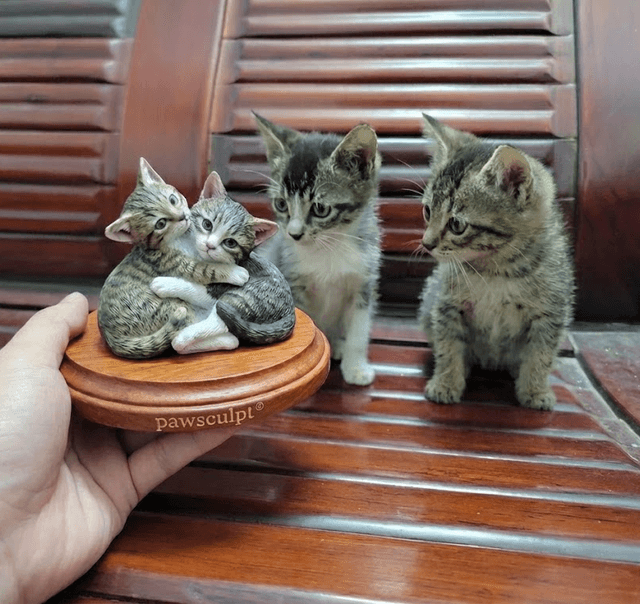
This is where some families choose a framed photo, clay paw print, shadow box, or a three-dimensional keepsake. And increasingly, people come to PawSculpt for 3D pet sculptures because they want something more physically present than paper but more personal than generic memorial decor.
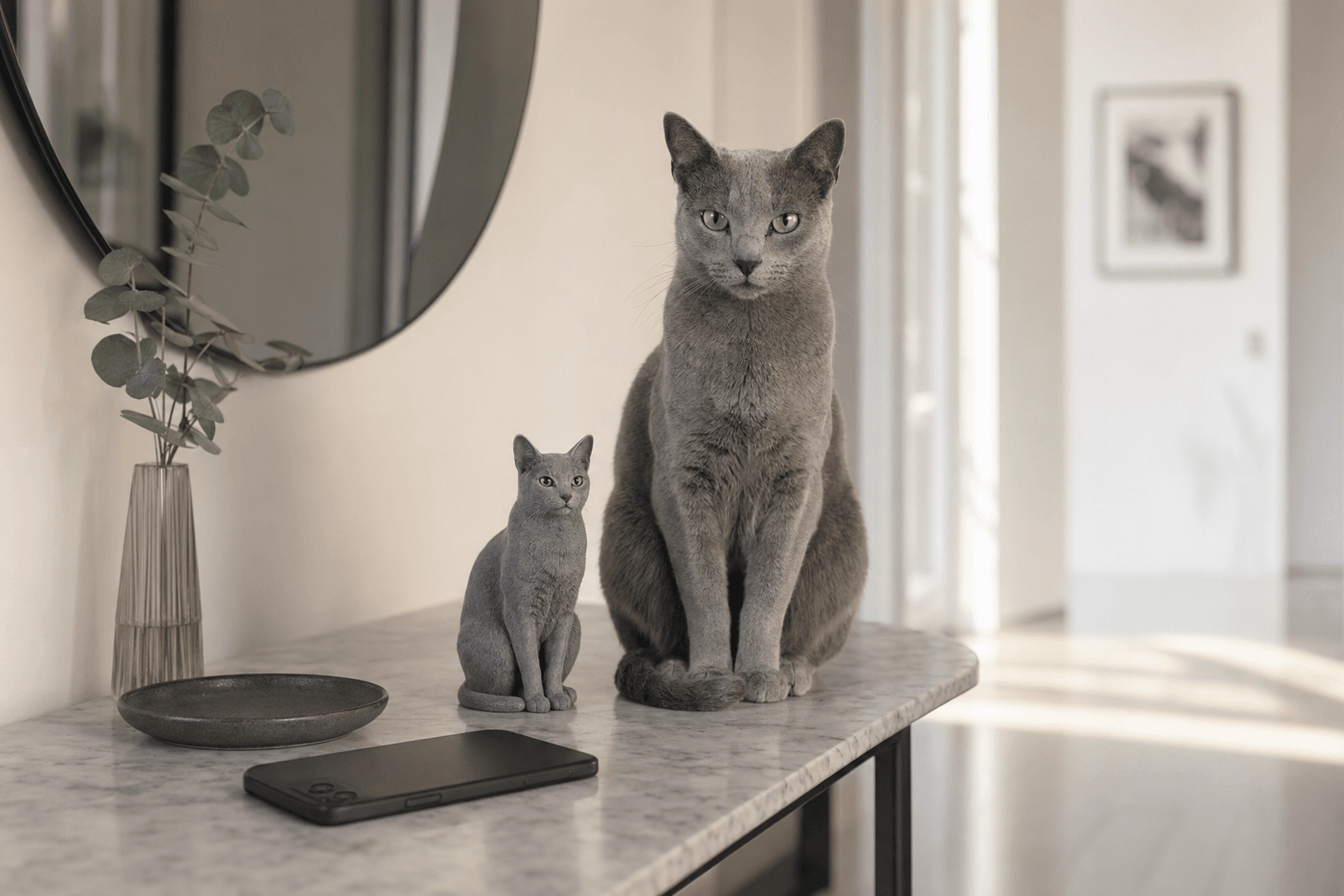
Worth noting: PawSculpt’s figurines are digitally sculpted by master 3D artists, then precision 3D printed in full color. The color is printed directly into the full-color resin, not added afterward, and a protective clear coat gives the piece durability and sheen. That means the result can preserve markings and expression with a level of specificity many families find emotionally grounding.
Not for everyone. But for the right family, very powerful.
"When a pet's ending is uncertain, preserving the details becomes an act of emotional truth, not decoration."
— The PawSculpt Team
Building a memorial that honors uncertainty instead of fighting it
Most memorial advice pushes certainty: dates, ashes, final photos, a clear narrative arc. If your Russian Blue’s story is incomplete, trying to fit that template can make you feel worse.
Our recommendation is different. Build a memorial that includes the unfinishedness.
That usually means choosing elements that say: “You were here. You mattered. We do not know everything. We still honor you.”
The best memorial elements for a missing Russian Blue
Our edited shortlist:
1. A sensory inventory
This is our favorite low-cost option because it rescues memory from abstraction.
Write down:
- Three sounds
- Three movements
- Three places
- Three quirks
- One phrase you used with them
Example:
- Sound: chirrup at dinner
- Movement: paused before leaping, then absolute precision
- Place: basement landing during storms
- Quirk: inspected every paper bag
- Phrase: “Supervise from there, then?”
This list often becomes more emotionally valuable than a long letter because it captures the living texture of the pet.
2. A location-based ritual
If your cat had one unmistakable spot, use it.
Maybe it was the basement step, top of the dryer, end of the bed, or a window with afternoon heat. Clean it. Place a candle, stone, small photo, or flower there. Return monthly.
Specificity beats grandeur.
3. A memory object with form
A memory object helps when your fear is that the cat is becoming visually generic in your mind.
This can be:
- Framed portrait
- Paw imprint
- Personalized ornament
- Custom figurine
- Small shelf memorial
One order that stuck with us came from a family who had very few photos of their Russian Blue from the final year, but they had several strong older images from household routines—on the washing machine, peering down stairs, curled in a very particular S-shape. Their goal wasn’t perfection. It was recognition. They wanted to walk by and think, “There you are.”
That is a different standard than “closure.” It’s often a better one.
What to expect if you choose a figurine memorial
If you’re considering a figurine, we think readers deserve practical guidance, not vague sentiment.
A good memorial figurine works best when you provide:
| Photo element | Why it matters | Best approach |
|---|---|---|
| Clear face shot | Captures expression and eye shape | Natural light, eye-level angle |
| Side profile | Shows muzzle, ears, and head proportions | Avoid blur and heavy shadows |
| Full-body image | Helps with posture and tail position | Choose a familiar pose if possible |
| Color-accurate photo | Preserves coat tone and markings | Use daylight over yellow indoor light |
| Favorite stance or habit | Adds personality, not just likeness | Include “watching,” “curled,” or “perched” pose references |
At PawSculpt, the figurines are hand-modeled digitally with care, then brought to life through full-color 3D printing. That distinction matters because it allows artists to work from your photos and recreate personality through digital sculpting before the piece is printed in full-color resin. The final clear coat protects the printed color and surface.
If you want current service details, photo guidance, or guarantees, it’s best to review them directly at PawSculpt’s custom pet figurine page.
The memorial wording that helps most
Skip euphemisms if they irritate you. Skip anything that sounds borrowed.
Try one of these instead:
- You were never ordinary here
- We still hear your hour
- Missing is not the same as forgotten
- Your story stays with us, even where it is unfinished
- We loved the life we knew
These lines work because they don’t pretend certainty. They honor relationship over explanation.
Russian Blue grief acceptance in the household: routines, other pets, and anniversaries
A ritual is not just a private emotional exercise. It often changes the whole household atmosphere.
That’s especially true if other pets are involved, or if family members grieve in completely different styles.
What happens to routines after years of unresolved grief
Five years later, many homes still organize themselves around a ghost-routine without noticing it.
We’ve seen families who still:
- Avoid moving one food mat
- Keep a basement door cracked “just in case”
- Leave one shelf untouched
- Feel uneasy changing furniture near a favorite perch
- Rush to the door when hearing a similar meow outside
None of this is irrational in a moral sense. But it can become emotionally costly if left unexamined.
The better approach is to decide, consciously, what stays and what changes.
Try this household edit:
- Keep one intentional memorial routine
- Release one accidental grief habit
Example: keep the monthly candle on the basement stairs, but remove the old empty bowl that triggers daily distress.
That ratio works well because it preserves connection without letting grief colonize every room.
If other pets are part of the story
Remaining pets often respond to household change, routine shifts, and owner stress. We’re not vets, so for behavioral or health concerns, your veterinarian is the right resource. But from a memorial standpoint, there are patterns worth noting.
Some pets seem unsettled around anniversaries because owner behavior changes first—different tone of voice, altered schedule, tears, extra stillness. They read us closely.
This quick table can help families interpret what they’re seeing:
| Behavior in remaining pet | What it may mean | Helpful response |
|---|---|---|
| Restlessness near old pet spots | Reading owner cues or habit memory | Keep routine stable; use calm voice |
| Sniffing stored items repeatedly | Normal investigation | Allow brief access, then store intentionally |
| Increased clinginess | Sensitivity to your emotional state | Add 10-15 minutes of predictable attention |
| Avoiding memorial area | Object or scent feels unfamiliar | Move memorial to a quieter location |
| No visible reaction | Also normal | Don’t force interaction with memorial rituals |
The commonly overlooked point: your current pet does not need to “participate” in the ritual for it to be valid. We’re not huge fans of staging emotional symbolism with animals if it stresses them.
Anniversary grief and the sound calendar
People expect grief spikes on dates. They miss the role of seasonal sound cues.
A missing Russian Blue may come roaring back emotionally not only on the disappearance date, but when:
- The furnace starts for winter
- The basement dehumidifier hums again
- Spring windows open
- Holiday decorations come out of storage
- A storm hits with the same rhythm as that week years ago
This is why some owners feel blindsided and say, “I thought I was past this.”
You’re not back at the beginning. You’re hearing a memory soundtrack.
Plan for it. That’s the mature move.
A simple annual plan
Create a three-part pet loss ritual five years later schedule:
- One date-based ritual
- One sound-based ritual
- One contribution ritual
This structure works because it distributes grief into memory, embodiment, and action.
And action matters.
"Memory settles more gently when it has somewhere to go."
How to preserve the real details before they blur
If your biggest fear is forgetting, act there first. Don’t wait until the memories feel fully stable. They won’t.
We’ve worked with enough pet families to say this confidently: the details people think are unforgettable are often the first to soften around the edges. Not the name. Not the big milestones. The ordinary specifics.
That is exactly why preserving them is such a strong ritual.
Create a “five senses” memorial file
Even if your opening memory is mostly about sound, build out all five senses. This gives the brain more retrieval paths.
Use these prompts:
Sound
- What exact noise meant they were entering the room?
- What pre-meal sound did they make?
- What object did they knock, scratch, or land on distinctively?
Sight
- What was unmistakable about posture?
- How did their face look when alert, annoyed, half-asleep?
- What room light made their coat look most like itself?
Touch
- Dense coat or silky?
- Warm weight on lap or light perch-and-go contact?
- Did they lean, knead, press, or just hover nearby?
Smell
- Blanket, sun-warmed fur, clean laundry, basement cardboard, old cushion
- This one surprises people. Smell can unlock memory fast.
Rhythm
- What times belonged to them?
- What pattern of following, waiting, watching, or vanishing into another room was theirs alone?
This is not busywork. It is memory stabilization.
Our edited ranking of memorial formats
Not all memorials preserve the same kind of truth. Here is our honest ranking by emotional function:
| Memorial format | Best for | Main strength | Possible limitation |
|---|---|---|---|
| Sensory inventory | Preserving exact memory | Fast, intimate, specific | Private, not visual |
| Photo book | Chronology and shared storytelling | Easy to revisit with family | Can flatten personality into images |
| Donation ritual | Turning pain into action | Restores agency | Less personal if used alone |
| Shelf memorial | Daily visual remembrance | Simple, grounded | May fade into background |
| Custom figurine | Spatial presence and detail recognition | Strong physical recall, deeply personal | Requires selecting strong reference photos |
The standout for fear of forgetting is usually a combination: sensory inventory plus one physical object.
That pairing covers both language memory and visual-spatial memory.
Why a figurine can feel surprisingly healing
We’ll keep this balanced. A figurine is not therapy. It won’t replace grieving work. And not every family wants one.
But we have seen one clear pattern: for owners whose grief is tied to missing detail, a thoughtfully made figurine can interrupt the panic of mental blur.
Because it says, in effect: here are the ears, the tilt, the coat tone, the stance. Here is evidence that your memory still has shape.
PawSculpt is especially relevant for that kind of memorial because the process is built around full-color 3D printing technology and digital sculpting from real pet photos. The colors and markings are reproduced directly in the resin itself, then protected with a clear coat. That gives the finished piece a vivid, authentic appearance—with natural fine texture rather than an unnaturally slick “perfect plastic” look.
For many families, that realism is the point.
If you don’t have many photos
This is common with missing pets, especially if the loss happened years ago or on an ordinary day.
Use this hierarchy:
- One clear face photo
- One body reference
- One memory note about posture
- One note about expression
- One note about favorite environment
Even limited references can still support a meaningful memorial. The goal is not forensic precision. It is recognizable truth.
What healing can look like five years later
Not dramatic transformation. Not one ritual and suddenly peace descends like a movie ending.
Usually it looks smaller than that.
You hear the basement radiator tick and don’t brace quite as hard.
You say your cat’s name without immediately switching topics.
You can tell the story to someone new and spend more time on who they were than on how they disappeared.
That’s often the real marker of Russian Blue grief acceptance: the relationship becomes more vivid than the unresolved ending.
The permission many people need
If no one has said this to you plainly, let us.
You are allowed to create a pet loss ritual five years later.
You are allowed to do it because the photos are fading.
Because the old sounds still get you.
Because your current season of life has finally made room for the grief you postponed.
Because uncertainty stayed in your body longer than anyone realized.
Because love without a final chapter still deserves an archive.
And because remembrance is not lateness. It is timing.
Closing the chapter you never got to write
That basement radiator will probably clink again. The house will offer another false echo, another tiny acoustic trick, another moment when your body listens before your mind catches up. But now that moment can become a cue instead of a wound.
Start small. Tonight, choose one sound, one sentence, and one place in your home that belonged to your Russian Blue. When the sound happens, say the sentence there. Do it for two weeks. Then decide what stays.
If you want, add a tangible anchor—a photo, a note card, a shelf object, or a custom piece that holds the details steady. Some families find comfort in albums. Others in donations. Others in memorial keepsakes for cats that preserve posture and markings through digital artistry and full-color 3D printing.
The point is not to finish the mystery. It is to stop letting the mystery have the final word.
Missing is a kind of ending we never choose. Ritual is how we answer it anyway.
Frequently Asked Questions
Is it normal to grieve a missing cat five years later?
Yes. A missing pet often creates ambiguous loss, which means your mind never received a clear ending. That can keep grief active much longer than people expect, especially when routines and sound triggers still bring your cat vividly to mind.
What is a good pet loss ritual five years later?
The best ritual is usually small, specific, and repeatable. Pair one familiar household sound—like a dryer stopping or a stair creaking—with one intentional act, such as reading a memory line, lighting a candle, or touching a photo frame. That gives the trigger somewhere to go.
How do I work on Russian Blue grief acceptance?
Start by separating what you know from what grief keeps imagining. Then preserve the details that made your Russian Blue distinct: sounds, posture, routines, favorite places, and expressions. Acceptance is less about certainty and more about remembering without being swallowed by the unanswered part.
Is it normal to feel guilty after a cat goes missing?
Very normal. Many owners fixate on one decision and replay it for years because guilt feels more controllable than uncertainty. If this is happening to you, write a factual version of events and a separate list of fears—seeing them side by side can be clarifying.
Can a custom figurine help with pet grief?
For some families, absolutely. A figurine can hold visual and spatial details that photos sometimes don’t—stance, scale, ear set, expression. If that kind of tangible reminder feels comforting, exploring personalized pet memorial figurines may be worthwhile.
Ready to Celebrate Your Pet?
Every pet has a story worth preserving. Whether you're honoring a beloved companion who's crossed the rainbow bridge or celebrating your furry friend's unique personality, a custom PawSculpt figurine captures those details that make your pet one-of-a-kind.
For families navigating Russian Blue grief acceptance, a tangible memorial can help transform blurred memory into something you can see, hold, and keep close.
Create Your Custom Pet Figurine →
Visit pawsculpt.com to learn more about our process and guarantees