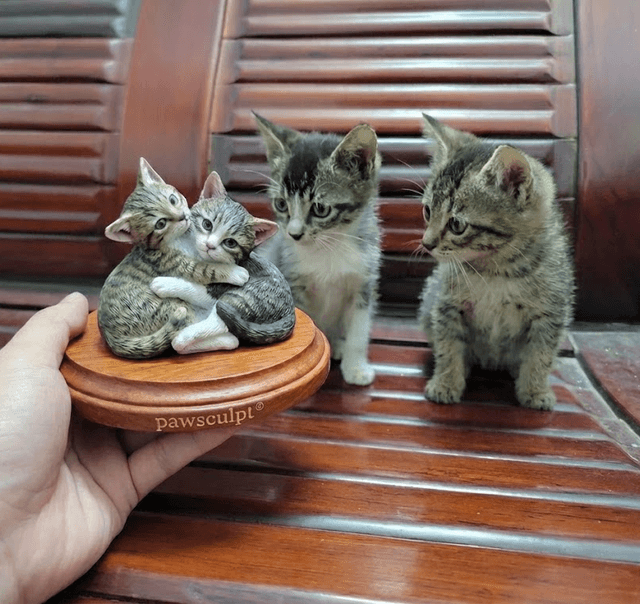
When Travel Loss Splits You Apart, a Calico's Couch Spot Can Bring You Back
The porch light cuts a gold square across the doormat while a Calico cat grief couple stands there with keys still in hand, both staring at the empty couch visible through the window—the pale dent in her usual spot somehow louder than the airport they just left.
Quick Takeaways
- Name the split early — couples grieve pet loss on different clocks and in different styles
- Preserve the specific spot — photograph the couch dent, blanket fold, and light pattern first
- Talk about guilt directly — relief, regret, and second-guessing often hide under arguments
- Choose one tangible anchor — some families use albums, others explore custom pet figurines for daily comfort
Why pet loss during travel can split a couple faster than people expect
Most articles about mourning a pet talk about sadness. Fair enough. But pet loss during travel creates a different fracture line, and we’ve seen it repeatedly in our work with memorial orders: one person is grieving the animal, and the other is grieving the animal plus the missed goodbye, the disrupted routine, the logistics, the guilt of being away, the surreal re-entry through the front door.
That stack of emotions matters.
A couple can look “fine” to other people because they’re doing practical things—unpacking, texting relatives, calling the vet, washing travel clothes that still smell faintly of hotel detergent. Yet underneath, they’re interpreting the same loss through entirely different frames. One may want to talk immediately. The other may go dead practical for 72 hours. One may replay the final medical update. The other may fixate on the cat’s blanket left on the couch, still holding a flattened oval where she curled under afternoon light.
We’ll be direct: difference is not dysfunction. But if you don’t name the difference, it can harden into resentment.
The overlooked fracture: not being there at the exact moment
Here’s the part many couples feel but rarely say aloud: the pain is not only “we lost her.” It is also “we were somewhere else when life changed at home.” Travel intensifies helplessness because your body was in transit while your attachment system was already back in the living room.
One family we worked with had been returning from a delayed flight when they got the call that their senior calico had taken a sharp turn. By the time they reached home, the carriers by the door and the half-folded throw on the couch looked almost staged—as if the apartment had paused without them. They didn’t argue about the cat at first. They argued about whether they should have canceled the trip a week earlier.
That’s the real split.
And it often shows up as side arguments:
- “Why didn’t you answer the sitter faster?”
- “I told you she seemed off before we left.”
- “You only want to talk about the vet bill.”
- “You’re acting like we did something wrong.”
These are grief sentences wearing everyday clothes.
Counterintuitive insight: the couch spot may matter more than the ashes—at first
This surprises people, but in the first days after loss, micro-locations often carry more emotional force than formal memorial objects. The couch cushion. The sun patch by the window. The scratched armrest. The place where black, orange, and white fur caught the light at 4:30 every afternoon.
Why? Because grief is highly visual and spatial. Your brain doesn’t just miss the pet; it misses the pattern. The composition of the room changed.
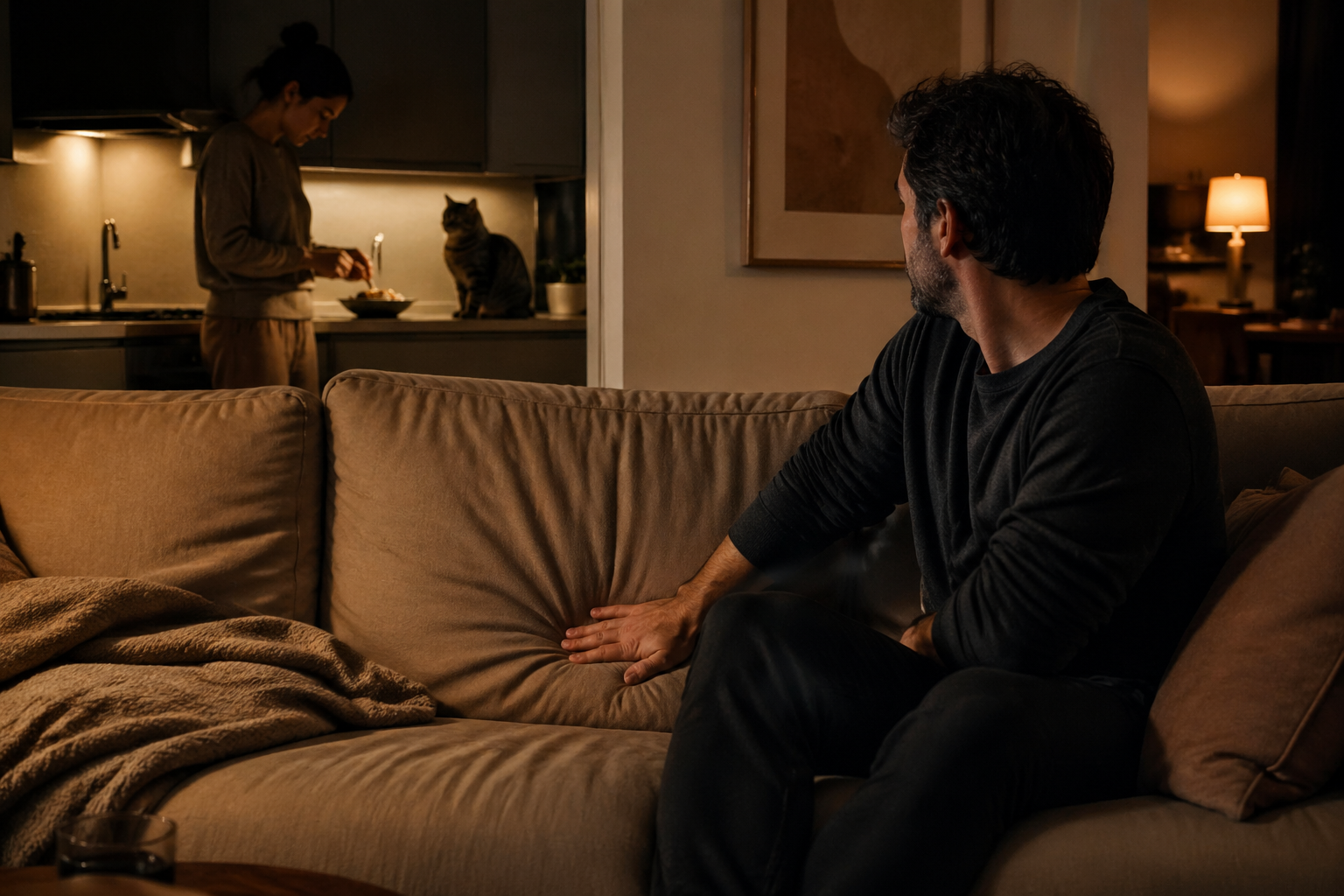
That’s why some couples feel disconnected when one partner wants to “tidy up” quickly and the other wants everything left exactly where it was. Neither response is wrong. They’re responding to different needs:
- One needs order to stay functional
- The other needs evidence to keep memory from blurring
If this is your home right now, don’t decide by instinct. Decide by design.
What to do in the first 48 hours if you lost your pet while traveling
Within the first two days home, do these four things before you wash, donate, store, or rearrange anything:
- Photograph the ordinary spaces
- Record a 60-second room video
- Separate medical decisions from relationship conversations
- Delay major cleanup for one night if possible
So what? Because grief fog is real. By day four or five, details that felt unforgettable can already start dissolving.
"The room changes before the heart catches up."
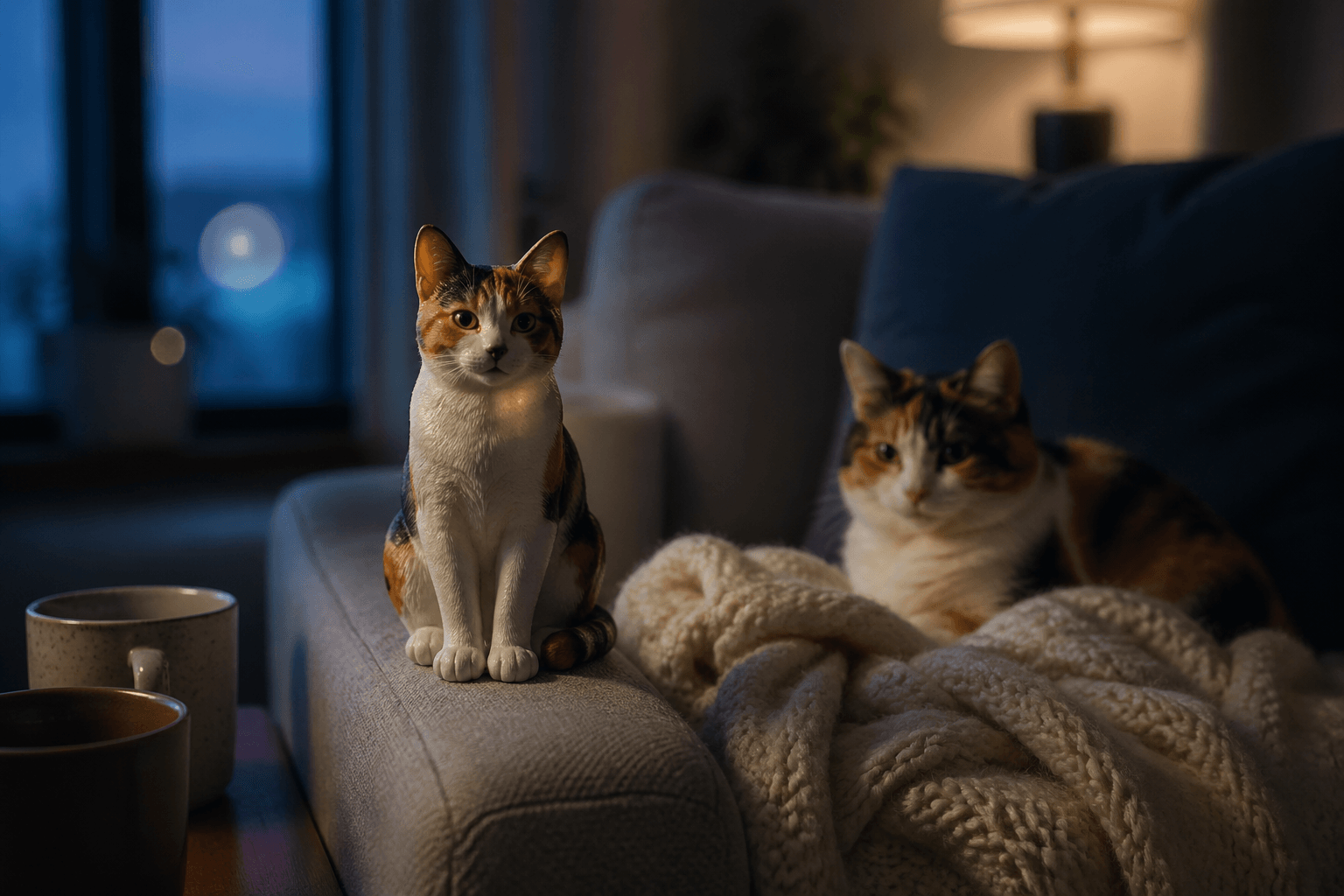
The calico factor: why these cats leave such a vivid visual imprint
A calico does not disappear from a room quietly. We mean that literally. Calico coloring—the scattered contrast of orange, black, white, cream, rust, charcoal—creates visual memory that burns deeper than people expect. In homes with pale upholstery or warm wood floors, a calico becomes part of the architecture of light.
This is not sentimentality. It’s perception.
Why calico grief often feels unusually image-heavy
In our years working with pet families, we’ve noticed that people mourning calicos often send especially detailed photo notes: “Her left cheek had a small peach patch.” “The back paw was white but only to the ankle.” “Her tail looked darker at dusk.” That level of specificity isn’t fussiness. It’s the brain trying to protect identity through pattern.
For a Calico cat grief couple, those markings can become part of the disagreement, too. One partner may say, “I just want one nice photo.” The other says, “No, the exact asymmetry matters.” Honestly, the second person has a point.
A calico’s identity often lives in placement, not just color:
- A black cap over one ear
- A split-color nose
- A tiny orange flare near the shoulder
- White socks that stop unevenly
- A cream patch visible only when she curled on one side
That’s why generic memorial advice can feel thin. “Make a scrapbook” is fine. But if it doesn’t help you preserve the exact topography of your cat’s face and body, it may not satisfy the part of grief that fears visual forgetting.
What couples miss: one person remembers behavior, the other remembers form
Here is a commonly overlooked aspect that saves couples a lot of frustration: in many pairs, one person stores love narratively and the other stores it visually.
One remembers:
- the sound of the chirp before dinner
- the timing of the hallway trot
- the weird obsession with one chair
The other remembers:
- the warm white triangle over the nose
- the way the spine curved into the couch seam
- the exact amber-green cast in the eyes near sunset
Both are memory. Both are valid. But they produce different needs after loss.
A customer once told us she wanted “a real memorial,” while her partner insisted they already had photos. What she meant, once they slowed down enough to say it clearly, was that photos captured moments but not presence at scale—not the three-dimensional way their calico occupied space on the arm of the couch, chin slightly lifted, one forepaw tucked under like a folded glove. Once they understood the difference, the conversation softened.
Build a “visual memory file” before details fade
If your cat has recently passed, create a visual memory file within one week. This is one of the most practical things you can do.
Include:
- 5-10 unfiltered photos in natural light
- 2 profile angles
- 1 top-down view showing back pattern placement
- 1 close-up of eyes and nose
- 1 photo in the favorite resting place
- Notes on scale (small frame, sturdy chest, long tail, etc.)
- Written color notes using ordinary language: peach, soot-black, ivory, smoke-gray
This is useful whether you make a photo book, commission art, or simply want a reliable archive.
The Association for Pet Loss and Bereavement can also be a meaningful support if the emotional load feels too heavy to carry alone—especially when the grief is complicated by travel, guilt, or conflict at home.
A quick reference: what people usually regret losing first
The table below shows the details grieving couples most often tell us they wish they had documented sooner.
| Memory Detail | Why It Fades Fast | Best Way to Preserve It | Why It Matters Later |
|---|---|---|---|
| Couch sleeping position | Routine feels “obvious” until the room changes | Wide photo plus side-angle photo | Recreates physical presence |
| Exact fur patch placement | Brain simplifies patterns under stress | Close-ups in daylight | Protects identity, especially for calicos |
| Eye color in natural light | Indoor lighting distorts tone | Window-light portrait | Prevents generic-looking keepsakes |
| Body scale | Photos flatten size | Include a lap, cushion, or armrest for reference | Helps memory stay proportional |
| Favorite texture object | Blankets get washed or moved | Photo of blanket, bed, or chair fabric | Links memory to touch and place |
Guilt, relief, and the arguments nobody wants to admit
Let’s talk about the emotion that blows up more relationships after pet loss than sadness does: guilt.
Not vague guilt. Specific guilt.
Guilt that you traveled.
Guilt that you didn’t cancel.
Guilt that you trusted the sitter.
Guilt that you trusted the vet.
Guilt that you came home relieved the medical crisis was over—and then felt sick for feeling relief.
That last one matters.
Relief mixed with grief is normal, and yes, it can feel awful
If your cat had been declining, managing chronic illness, or entering an unstable final stretch, you may have felt a brief, involuntary drop in tension when it was over. Then came the backlash: “What kind of person feels relief when their cat dies?”
A loving one. That’s the answer.
The relief is often relief that their suffering ended, relief that constant vigilance stopped, relief that your nervous system can finally unclench. It does not cancel sorrow. It sits beside it. Messy, but real.
We’ve seen couples get stuck here because one person admits relief and the other hears it as coldness. But the truth is more humane than that. The person who feels relief may have been carrying anticipatory grief (grief before the death) for weeks or months.
Try this sentence if you need it:
“I’m not relieved she’s gone. I’m relieved she isn’t struggling anymore.”
That distinction can change the whole conversation.
Second-guessing euthanasia timing can become a relationship proxy war
Another rarely admitted experience: second-guessing euthanasia timing can attach itself to deeper couple dynamics. One person believes they acted too soon. The other believes they waited too long. After travel loss, this gets sharper because absence creates blank space—and blank space invites self-punishment.
We’re not veterinarians, so for medical specifics, lean on your clinic and reputable veterinary resources like the AVMA’s pet loss support guidance. But emotionally, here’s what helps: stop treating hindsight as evidence.
Hindsight is not evidence.
It is edited footage.
A family we worked with spent two weeks circling one question: “If we had come home a day earlier, would she still be here?” Underneath was a harsher private fear: “Did our trip matter more to us than she did?” Once they said the real sentence out loud, they could finally grieve the cat instead of cross-examining each other.
The mistake most couples make in the first week
They try to reach agreement before they’ve reached language.
Don’t aim for consensus immediately. Aim for accurate naming.
Use this framework:
- I feel guilty about…
- I keep replaying…
- What I’m afraid you think about me is…
- What I need from you tonight is…
That last one is practical and underrated.
Sometimes the need is:
- “Sit with me on the couch for ten minutes.”
- “Don’t put away her blanket yet.”
- “Please handle the calls tomorrow.”
- “Please stop trying to solve this tonight.”
Clean requests prevent symbolic fights.
"Grief turns small household choices into moral drama."
A table for the hard feelings that masquerade as conflict
This table is blunt on purpose. It can help you identify what’s really happening during a fight.
| What It Sounds Like | What It May Actually Mean | What Helps in the Moment |
|---|---|---|
| “Why didn’t you answer faster?” | I feel powerless and need someone to blame | Pause, name fear before facts |
| “You want to throw everything away.” | I’m scared memory will disappear | Preserve first, sort later |
| “You’re acting weirdly calm.” | I’m afraid we loved her differently | Ask how grief is showing up physically |
| “We should’ve come home sooner.” | I’m trapped in counterfactual thinking | Write facts versus guesses |
| “I can’t look at the couch.” | The visual trigger is overwhelming | Cover it temporarily, don’t erase it yet |
The couch spot is not just sentimental—it’s a grief anchor
This is the angle most memorial guides miss: objects are not always the primary anchor; locations are. And within a home, a cat’s favorite couch spot often becomes the strongest grief anchor because it blends shape, light, habit, and witness. You saw your cat there hundreds of times without trying. Repetition built meaning.
That’s why the empty spot can feel strangely more piercing than the collar in a drawer.
Why place-based memory is powerful
Memory researchers often describe recall as cue-dependent. In plain English: your brain remembers better when the cues are intact. For pet grief, those cues are often visual and environmental:
- angle of afternoon light
- throw blanket texture
- dip in the cushion
- cat hair caught on dark fabric
- scratch marks at the armrest edge
This is one reason couples can feel “hit” at different times. The partner who returns to the living room at 5 p.m. gets ambushed by the exact light in which the cat usually appeared. The partner doing laundry in the bedroom may not feel the same surge until later, when they find a single tri-colored hair caught in the seam of a travel bag.
One isn’t coping better. Their cues are different.
What to preserve from the couch spot before changing the room
You do not need to freeze your house forever. But before you wash, rotate, replace, or redecorate, preserve the scene.
Take:
- A wide room photo showing the couch in context
- A close-up of the cushion dent
- A photo at the usual time of day when light falls there
- A shot including nearby objects—lamp, side table, blanket, window
- One image with scale, such as your hand beside the sleeping spot
If the blanket carries a strong scent and that’s comforting, place it in a breathable cotton bag for a short period rather than sealing it in plastic immediately. If scent is distressing, ask your partner to store it out of sight for one week before making permanent decisions.
And yes, you can preserve the place without becoming trapped by it. That’s the balance.
A more useful memorial question
Instead of asking, “What should we do with her things?”, ask:
“What part of her presence are we most afraid of losing?”
The answer guides the memorial.
If the answer is:
- Her face — prioritize close portrait preservation
- Her exact coloring — prioritize accurate visual reference
- Her couch posture — prioritize a three-dimensional keepsake or sketch
- Her routine in the room — prioritize environmental photos and videos
- Her sound — prioritize audio clips and narrated memory recordings
This one reframing has helped many families stop making random memorial purchases that don’t actually address the pain point.
Where a figurine can help, specifically
Some families choose framed photos. Some plant a memorial garden. Some keep the collar beside an urn. And some want a tangible, place-based memorial—something that can return a visual focal point to the room without pretending nothing changed.
That is where thoughtful 3D pet sculptures can do real emotional work.
At PawSculpt, our team has learned that the families most comforted by a figurine are often not looking for “decor.” They’re looking for spatial recognition. A custom piece placed near the couch, shelf, or window can give the eye somewhere to land when the original spot feels unbearable in its emptiness.
Because PawSculpt pieces are digitally sculpted by master 3D artists, then precision 3D printed in full color, they can preserve details that matter a lot in calico grief—the asymmetrical blaze, the uneven white sock, the warm rust patch over one shoulder. The color is printed directly into the full-color resin, not added on top later, and the natural fine texture is protected with a clear coat. That matters if you care about markings looking integrated rather than surface-applied.
We’ll be real: not every grieving household wants that right away. Some need three weeks. Some need six months. But for the right family, a memorial keepsake created from photos can turn a vague fear of forgetting into something more stable.
"When families grieve a visually distinctive pet, accuracy becomes comfort. The smallest marking can carry the weight of recognition."
— The PawSculpt Team
What We Wish We Knew Sooner
This is the candid sidebar we wish more pet-loss articles included—the behind-the-scenes truths that come up again and again.
1) People rarely regret taking too many reference photos
They regret taking too few. Especially profile views, top views, and scale references.
A phone camera roll full of ordinary shots may feel excessive now. Later, it becomes the archive that lets you remember the body, not just the face.
2) “One good photo” is almost never enough for calicos
Here is something most people don’t realize until they try to preserve a calico accurately: front-facing photos flatter complexity. You need side angles and body shots because calico identity often lives in the distribution of color across the torso, hips, tail, and shoulders.
This applies whether you’re commissioning a portrait, creating a photo book, or exploring custom pet figurines.
3) The first memorial choice is often the wrong one
Not because people are foolish. Because they’re trying to soothe panic, not answer the real question.
We’ve seen families order generic jewelry, mass-produced frames, or text-heavy plaques in the first 72 hours—then realize what they truly wanted was not wording but likeness. Or not the collar, but the curled sleeping pose. Slow down enough to identify the missing element.
4) Couples need separate grief tasks, not just shared rituals
This one surprises people.
The standard advice is “do something together,” and yes, shared rituals matter. But what actually reduces friction is often parallel roles:
- one person gathers photos
- one writes the timeline
- one handles vet paperwork
- one preserves the couch scene
- both choose one ritual together
Division of labor lowers emotional overload.
5) The room should change gradually, not all at once
A hard reset can feel efficient and then backfire.
We’re not huge fans of immediate total cleanup unless the environment is medically necessary to sanitize. A staged transition works better for many homes:
- Day 1-3: document everything
- Week 1: remove only distressing items
- Week 2-3: choose what stays visible
- Month 1+: reconfigure the room intentionally
That pacing gives the nervous system time to catch up.
How to help a Calico cat grief couple reconnect instead of retreat
This is where the article gets practical. If you and your partner are feeling miles apart after losing your cat during travel, the goal is not to grieve identically. The goal is to build shared recognition.
Recognition means: “I can see what this loss is doing to you, even if it’s different from what it’s doing to me.”
Try the 20-minute debrief, not an endless emotional summit
Long late-night grief talks often go badly when both people are exhausted. We’ve seen better results from a 20-minute debrief structure for the first two weeks.
- What hit me today
- What I avoided today
- What memory I don’t want to lose
- What I need tonight
No interruptions. No fixing. No rebuttal.
Why it works: contained conversations lower defensiveness. And grief often gets sharper, not clearer, after the 25-minute mark when people are depleted.
Create one shared memorial task and one separate one
Don’t make the entire grieving process collaborative. That creates pressure.
Better:
- Shared task: choose five defining photos together
- Separate task: each write a private note about the cat’s most vivid habit
Then exchange only if you want to.
One couple we remember had entirely different memory styles. One wrote three paragraphs about the calico’s evening stare from the couch arm. The other assembled a folder of side-profile photos because “the left side of her face was her.” They thought they were incompatible. They were actually preserving different halves of the same cat.
Use “memory language” instead of “decision language”
Decision language sounds like:
- What are we doing with the stuff?
- Are we keeping this?
- Should we order something?
- When are you moving the bed?
Memory language sounds like:
- What part of her do you see when you look at this spot?
- Which photo feels most like her in motion?
- What detail do you think outsiders wouldn’t notice but we would?
- What would feel comforting here, and what would feel performative?
The second set goes deeper, faster.
A practical comparison of memorial options
Different forms of remembrance serve different emotional needs. This chart helps you choose based on what you’re actually missing.
| Memorial Option | Best For | What It Preserves Best | Potential Limitation |
|---|---|---|---|
| Photo book | Story-driven grievers | Timeline, expressions, events | Can flatten body scale and texture |
| Framed portrait | One iconic image | Face and mood | Often misses full-body markings |
| Saved couch blanket | Touch-oriented grievers | Texture, scent, routine | Fragile over time; can become distressing |
| Clay paw print or ink print | Symbolic remembrance | Scale of paw, physical trace | Doesn’t capture visual identity |
| Full-color custom figurine | Visual and spatial grievers | Markings, posture, three-dimensional presence | Requires good reference photos |
What photos work best if you want a realistic keepsake later
Even if you’re not ready now, gather the right images now.
For any accurate visual memorial—especially a figurine—these photo principles matter:
- Natural daylight beats yellow lamp light
- Eye-level angles beat top-down snapshots
- Sharp side profiles matter more than people expect
- Unedited color is better than heavily filtered photos
- Include body shots, not just face shots
At PawSculpt, the work begins digitally. Skilled 3D artists model the pet from your references, then advanced full-color 3D printing technology reproduces the markings directly in resin, voxel by voxel (tiny units of color and form built into the material itself). The only manual finishing step is applying a protective clear coat for sheen and durability. That’s why clear, honest photos matter—they drive the likeness.
You can explore the current process details, examples, and service information at PawSculpt’s custom figurine page, rather than relying on outdated article specifics.
If one of you wants another pet and the other panics
This happens more than people admit.
Sometimes travel-related loss makes one partner desperate for life and motion in the house again. The other feels physically sick at the idea, or ashamed for not wanting a “replacement.” That anxiety about getting another pet is common, especially when the home still feels visually arranged around the cat who died.
Do not make a new-pet decision in the raw aftermath if you’re divided.
Instead, ask:
- Do we miss care-taking, or do we miss her specifically?
- Are we seeking companionship, repair, or distraction?
- Would fostering later feel gentler than adopting immediately?
There’s no medal for speed here. And no moral failure in waiting.
"You do not honor a pet by rushing your heart into a vacancy."
Rebuilding the room, and yourselves, after pet loss during travel
At some point, the porch light goes off, the suitcases get unpacked, and the home has to become livable again. Not “over it.” Just livable.
That transition deserves more intention than most people give it.
The three-phase room reset that tends to work
We’ve watched many families navigate this, and the most stable approach usually has three phases.
Phase 1: Preserve
For the first few days, focus on documentation, not redesign.
- photograph the couch spot
- save favorite photos into one folder
- collect any notes from the sitter or vet
- write down the exact words you keep repeating
This phase lowers panic.
Phase 2: Soften
Around week one or two, reduce the sharpest triggers without erasing memory.
- fold the blanket instead of removing it forever
- place one framed photo near the couch
- move the food bowls out of sight
- keep one toy in a meaningful visible place
This phase lowers shock.
Phase 3: Reassign
After a few weeks or longer—there is no perfect date—give the area a new role while acknowledging the old one.
- add a plant near the window she loved
- place a book stack or lamp where your eye needs balance
- create a small shelf of remembrance
- position a tangible keepsake where the empty visual gap feels largest
This phase lowers dread.
Why tangible memorials can steady a travel-loss story
Travel loss often leaves a narrative problem: there was no complete goodbye scene. No final sequence your mind can settle into. That missing sequence can keep the grief jagged.
A tangible memorial can help because it creates a new scene of attachment. Not a replacement. A new reference point.
One customer told us she could not stop staring at the empty couch arm where her calico used to perch like a lookout. A photo felt too flat for that specific ache. What helped, eventually, was placing a realistic keepsake on a nearby shelf at roughly the same sightline. Not because it fooled her. Because it gave her gaze somewhere gentler to rest.
That distinction is important. The best memorials do not pretend the loss did not happen. They organize memory so it feels bearable inside a room.
If your grief feels bigger than your support system understands
Some people are met with tenderness after pet loss. Others are met with minimization—especially if the death happened while traveling and outsiders reduce it to “bad timing.” If you feel judged by others, or embarrassed by how intense this is, that reaction is more common than you think.
Look for support that understands the human-animal bond specifically:
- a pet-loss support group
- a vet practice that offers bereavement resources
- a counselor comfortable with disenfranchised grief (grief others don’t fully validate)
- communities like Rainbow Bridge pet loss support if you need a place where no one rolls their eyes at the depth of your attachment
And if your relationship is taking hits, couple’s counseling is not overkill. Sometimes a third party simply helps translate the grief dialect each of you is speaking.
Closing the distance the empty couch created
That couch spot may stay vivid for a long time—the pale fabric, the shadow line at dusk, the space where her calico coat used to turn the whole room into a composition of rust, ink, and white. You do not need to rush yourself past that image. But you also do not need to let the image become a wall between you.
Start smaller than people think. Take one honest photo of the spot today. Then ask your partner one clean question: “What detail are you most afraid of forgetting?” Not “Are you okay?” Not “Should we move on?” Just that.
Because that question does something powerful. It turns two separate griefs toward the same subject.
And once you know the detail—her shoulder patch, her tucked paw, her evening perch, the exact curve she made in the cushion—you can preserve it on purpose. In a photo folder. In a written memory. In a framed scene. In a keepsake that returns form to absence.
Home will not look the same. That’s true. But with care, it can stop feeling like the place where you lost her and start becoming, again, the place where you still recognize her.
Frequently Asked Questions
Is it normal for couples to grieve pet loss differently?
Yes. It’s extremely common for one partner to become talkative and emotionally explicit while the other goes practical, quiet, or even task-focused. Those differences can feel personal, but they usually reflect coping style—not the depth of love.
Why does pet loss during travel feel especially upsetting?
Because the loss is layered. You’re not only grieving your cat; you’re dealing with absence, interrupted routines, missed moments, and often a painful sense of helplessness. Pet loss during travel can also create a narrative gap—your mind keeps trying to fill in the goodbye you didn’t get.
Is it normal to feel guilty or relieved after a cat dies?
Yes, and this is one of the least discussed parts of grief. If your cat had been declining or suffering, relief may come from knowing the struggle ended. That feeling can exist alongside deep sorrow; it doesn’t cancel love.
What should I save first after my cat passes away?
Preserve the ordinary visuals before you touch anything else: the couch spot, favorite blanket, food station, window perch, and clear unfiltered photos from multiple angles. If your cat was a calico, prioritize side views and body shots so the exact distribution of markings doesn’t fade in memory.
Can a custom pet figurine actually help with grief?
For many families, yes—especially visual grievers. A realistic figurine can become a stable grief anchor, giving form to details your mind is afraid of losing. It won’t be the right choice for everyone immediately, but it can be deeply comforting when accuracy and presence matter most.
Ready to Celebrate Your Pet?
Every pet has a story worth preserving. Whether you're honoring a beloved companion who's crossed the rainbow bridge or celebrating your furry friend's unique personality, a custom PawSculpt figurine captures those details that make your pet one-of-a-kind.
For a Calico cat grief couple, that can mean preserving the uneven white sock, the rust-colored cheek patch, or the exact couch pose your eyes still search for at dusk. If a tangible memorial feels right, PawSculpt offers a thoughtful way to hold onto likeness—not as a substitute for grief, but as a companion to it.
Create Your Custom Pet Figurine →
Visit pawsculpt.com to learn more about our process and guarantees