
Architecture of a Safe Space: Design Tips for the Anxious Whippet
The squirrel chattered from the oak branch, and instantly, Luna froze mid-stride near the hydrangeas. Her ribcage expanded with a sharp intake of breath, that classic sighthound statue pose dissolving into a tremble as the trigger stacked onto an already stressful morning. It wasn't just a squirrel; to a sensitive Whippet, it was an intrusion into her sanctuary, turning a simple backyard break into a complex puzzle of anxious dog care.
Quick Takeaways
- Elevation is security — Whippets calm down when they can observe from a high vantage point.
- Clear sightlines matter — Reduce anxiety by arranging furniture so your dog can see exits clearly.
- Texture dictates comfort — Thin-skinned breeds need specific fabrics to feel physically safe.
- Celebrate their quirkiness — Capture their unique personality with custom keepsakes from PawSculpt that honor their sensitivity.
- Temperature is emotional — A cold Whippet is almost always an anxious Whippet.
The Sighthound's Visual Fortress
Most guides on calming dog environment design focus on sound—white noise machines or classical music. While those help, they miss the fundamental biology of the Whippet. These are sighthounds. Their primary interface with the world is visual.
When a Whippet is anxious, they aren't just scared; they feel visually exposed.
We realized this with a client's dog, Barnaby. He paced incessantly in a living room that, to human eyes, looked cozy. The problem? The sofa faced away from the door. He couldn't see who was entering without turning his head, and the high back of the couch blocked his peripheral vision.
"Anxiety in sighthounds is often a spatial problem masquerading as a behavioral one."
The "Sniper's Nest" Principle
Whippets don't want to hide in a dark hole (like many terriers); they want a "sniper's nest." They need to be high up, with a backstop behind them and a clear view of the room's entry points.Actionable Step: Instead of placing the dog bed in a low corner, try an elevated cot or clear off a designated spot on the back of a sofa that faces the room's main entrance. This gives them "tactical superiority." They can see threats coming, which paradoxically allows them to sleep deeper.
Thermal Safety: The Architecture of Warmth
You cannot separate whippet separation anxiety from physical discomfort. Because they lack the subcutaneous fat and double coat of other breeds, a draft that you can't feel feels like an ice bath to them.
Physical cold triggers the sympathetic nervous system—the fight or flight response. If your Whippet is shivering, their body is already dumping adrenaline into their bloodstream.
The Micro-Climate Strategy
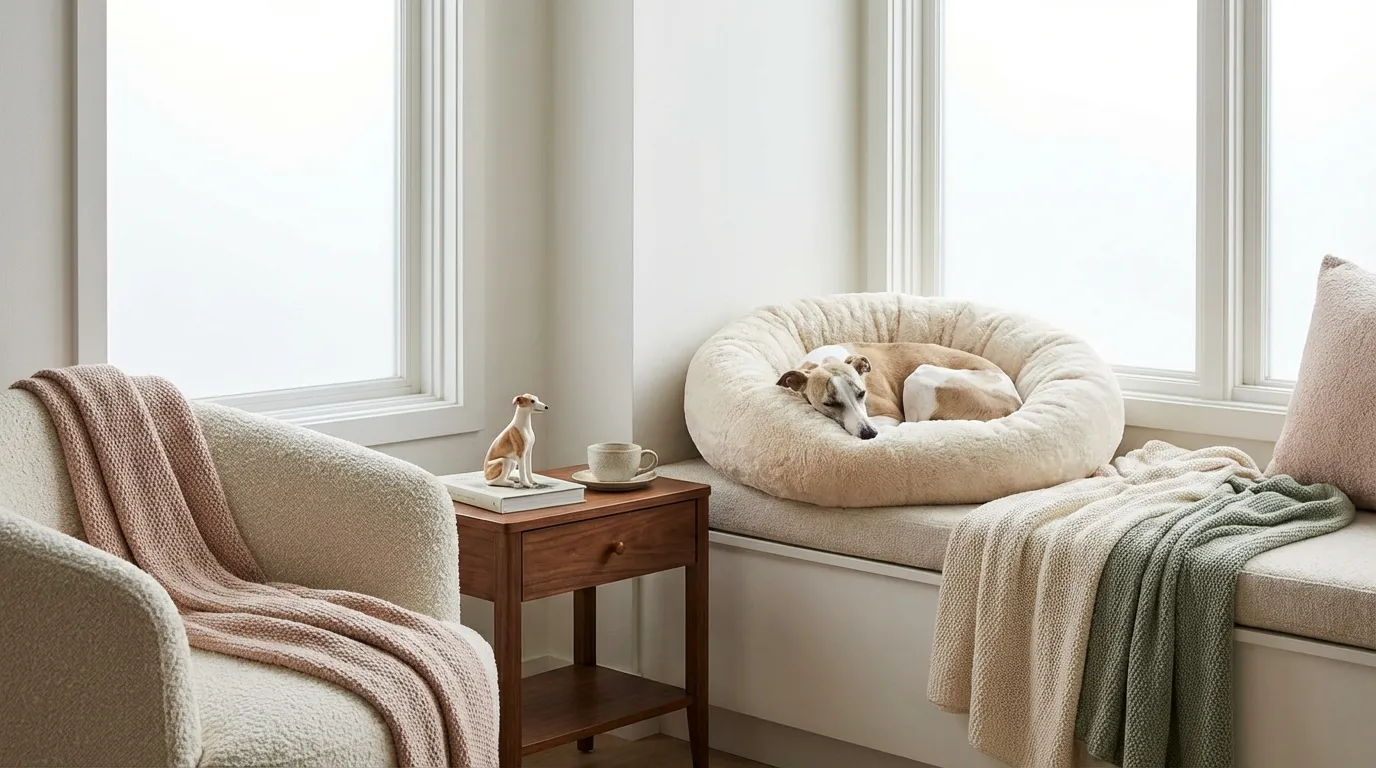
Don't just rely on the central thermostat. Create "micro-climates" of safety.We recommend the Cave Method. Standard flat beds leave a Whippet exposed to air currents. Burrow beds or "clam" style beds trap body heat. But here’s the counterintuitive tip: Elevate the cave.
Cold air sinks. A cave bed on a hardwood floor is significantly colder than one raised six inches off the ground.
| Bedding Material | Thermal Retention | Tactile Comfort (Whippet) | Best For |
|---|---|---|---|
| Sherpa / Faux Lambswool | High | High | Winter nesting & deep anxiety days |
| Microfiber / Velvet | Medium | Very High (Softest) | Everyday lounging; gentle on thin skin |
| Canvas / Heavy Cotton | Low | Low (Too rough) | Not recommended for direct contact |
| Orthopedic Memory Foam | High (reflects heat) | Medium | Older Whippets with joint stiffness |
Visualizing the Exit: Reducing Trapped Feelings
Anxiety often stems from feeling trapped. A Whippet's instinct when frightened is to run—fast. If your furniture arrangement creates dead ends or tight squeezes, you are inadvertently raising their cortisol levels.
The Loop Layout:
Arranging your space so there are always two ways out of a room can work wonders. If you have a coffee table, ensure there's ample space on both sides. If they feel they can escape a situation, they are less likely to react aggressively or fearfully to it.
"We've found that capturing a pet's likeness isn't just about the physical form—it's about preserving that specific tilt of the head that says 'I'm listening, but I'm nervous.' Our digital sculptors look for that soul in the eyes."
— The PawSculpt Team
The Role of Scent in "Safe Zones"
While sighthounds are visual, anxious dog care must be multisensory. We often scrub our homes to smell like "clean linen" or "lemon fresh." To a dog, these are chemical assaults.
A truly safe space smells like you.
The "Dirty Laundry" Hack:
When you leave the house, the most comforting item you can leave isn't a toy—it's a worn t-shirt. But don't just toss it on the floor. Place it inside their "safe zone" or elevated bed.
Studies on canine cognition suggest that the scent of a familiar human can significantly lower heart rates in anxious dogs. It acts as an olfactory anchor when the visual anchor (you) is missing.
Celebrating the Sensitive Soul
It's easy to get frustrated with a Whippet's anxiety. The trembling, the refusal to walk in the rain, the velcro-dog tendencies. But these traits are the flip side of their incredible sensitivity and emotional intelligence.
Many of the families we work with at PawSculpt choose to immortalize their Whippets not in a standard "show dog" pose, but in a pose that reflects their true nature—perhaps curled in a tight "shrimp" circle or looking up with those soulful, worried eyes.
Using full-color 3D printing technology, we're able to replicate the exact brindle pattern or the specific white blaze on a nose that you've kissed a thousand times. Unlike generic statues, a custom piece acknowledges that this specific dog, with all their anxieties and quirks, is a masterpiece worth preserving.
The "Decompression Protocol" for Returns
How you enter your home defines the architecture of their anxiety for the next hour.
If you walk in with high energy, high pitch, and chaotic movement, you are validating their frenzy. You are telling them, "Yes, the separation was a big deal!"
- Walk in the door.
- Put your keys down.
- Take off your coat.
- Ignore the dog. (We know, it's hard).
- Only when they have stopped vibrating and all four paws are on the floor do you offer calm, low-tone affection.
This restructures the "reunion" from a high-stress event to a non-event. It lowers the emotional ceiling of the household.
"Calm isn't something you command. It's an environment you construct."
Lighting the Way
Whippets can be surprisingly afraid of shadows. Their vision is tuned to detect movement in low light, which means a flickering candle or a ceiling fan casting a rhythmic shadow can look like a predator.
For the anxious Whippet, diffused lighting is best. harsh overhead lights can create sharp, scary shadows. Uplighting (lamps that shine toward the ceiling) fills the room with a gentle, shadow-free glow that helps them settle during the evening "witching hour."
Conclusion
Back in the yard, Luna eventually stopped trembling. She didn't stop because I told her to "calm down." She stopped because she was able to retreat to the patio—a slightly elevated deck where she could see the squirrel, see the back door, and feel the warmth of the sun on her back.
She found her architecture of safety.
Designing for a Whippet isn't about expensive renovations. It's about empathy. It's about getting down on your hands and knees to see the world from their height, feeling the draft they feel, and understanding that their sensitivity is what makes them such profound companions.
Whether it's adjusting a sofa or creating a tangible memory with a custom figurine, loving a nervous dog means embracing them exactly as they are—trembles and all.
Frequently Asked Questions
How do I stop my Whippet from pacing?
Pacing is often an attempt to find safety or a "patrol" instinct gone wrong. Instead of verbally correcting the behavior, try providing a high vantage point (like a sofa back or elevated bed) where they can see the whole room and exits. This satisfies their sighthound instinct to observe threats and often allows them to settle.Why is my Whippet shaking inside the house?
Whippets have very low body fat and thin coats. Shaking is often a physiological response to cold, which triggers the nervous system to mimic anxiety. Before assuming it's fear, ensure they have a warm, elevated "cave" bed or a sweater, even indoors. A warm Whippet is usually a calmer Whippet.Do calming coats work for Whippets?
Compression wraps (like Thundershirts) can work surprisingly well for Whippets because they are highly tactile dogs. The gentle pressure releases endorphins, similar to swaddling a baby. However, because of their unique deep-chested anatomy, ensure the fit is correct to avoid chafing near the armpits.How can I help my Whippet with separation anxiety?
Desensitization is key. Start by practicing your "departure cues" (picking up keys, putting on shoes, grabbing your bag) without actually leaving the house. Do this 10 times a day until the dog stops reacting to the keys. According to the American Kennel Club, desensitizing these triggers is a crucial first step.Ready to Celebrate Your Pet?
Every pet has a story worth preserving. Whether you're honoring a beloved companion who's crossed the rainbow bridge or celebrating your furry friend's unique personality, a custom PawSculpt figurine captures those details that make your pet one-of-a-kind.
Free instant AI preview • 3D artist preview within 7 days • 5 free revisions