
One Change That Helps: The Senior Pug's Disaster Preparedness Kit Every Busy Owner Needs
Why does senior dog care suddenly feel urgent when you spot your pug’s old harness hanging from a nail in the attic, one frayed strap catching the light? Disaster preparedness gets real the moment an ordinary object starts looking like a countdown.
Quick Takeaways
- Build for movement, not storage — keep your pet emergency kit grab-ready by the door.
- Pack for your pug’s body, not a generic dog — airway, heat, and mobility matter most.
- Reduce decision fatigue — pre-write feeding, medication, and vet notes before a crisis.
- Preserve what you’d hate to lose — keep current photos and consider custom pet figurines for tangible memory.
- One small change wins — duplicate your senior pug essentials so one kit always stays complete.
The one change busy owners miss in disaster preparedness
Most disaster preparedness checklists for dogs are technically fine and practically useless.
We’ll be blunt, because that’s more helpful: a list that lives in your notes app and a tote buried in the hall closet will not save you time when the power cuts out, the weather alert blares, and your senior pug is already breathing harder because your stress travels straight down the leash. What busy owners need is not a longer checklist. It’s frictionless access.
That’s the change.
Not “buy more supplies.” Not “be more organized.” Set up a two-zone kit system so your senior pug’s essentials live where real life happens: one compact grab-kit by the exit, one restock bin elsewhere. We’ve seen enough pet-family routines—through conversations, memorial orders, celebration pieces, and the stories people tell us after storms, evacuations, and rushed hotel stays—to know this is the part most guides skip. They talk about what to own. They don’t talk about where panic makes your body go.
And your body goes to the door.
Why this matters more for pugs than for many other dogs
A young, athletic dog can sometimes absorb your mistakes. A senior pug usually can’t.
Pugs are a brachycephalic breed, which means their short muzzle can make breathing more vulnerable under heat, exertion, and stress. Age piles on top of that. Add arthritis, vision changes, hearing loss, medication schedules, and the stubborn little rituals older dogs depend on, and suddenly a generic pet emergency kit starts looking flimsy.
According to the American Kennel Club’s breed guide for pugs, owners should pay close attention to breathing and heat sensitivity. In a disaster setting, that’s not a side note. That’s core planning.
Here’s the overlooked part: the emergency itself is often not the hardest thing for a senior pug. The disorientation is. Strange flooring. New smells. Stairs in an unfamiliar rental. A water bowl moved three feet to the left. The carrier you only pull out for vet visits. For older dogs, proximity and routine aren’t luxuries—they’re stabilizers.
We remember one customer telling us her pug handled the storm itself better than the motel room after. At home, he slept in the right-hand corner beside an armchair no one else used. In the motel, he paced between the bed and the bathroom door, confused by the empty gap where “his corner” should have been. That’s a senior dog problem in a nutshell: space matters.
"The hardest part of an emergency is often the part no checklist names—disruption."
The mistake most busy owners make
They build one perfect kit, seal it, and feel done.
Bad move.
The real-world problem is that a single kit gets “borrowed from.” A roll of poop bags disappears for a normal walk. The spare medication pouch gets used on a weekend trip. The collapsible bowl lands in the car and never comes back. Over time, the emergency kit turns into a half-kit, then a memory of a kit.
What actually helps more than a bigger kit is duplicate essentials.
For a busy owner, duplication beats discipline almost every time. One leash stays clipped in the entry kit. Another lives in the car. One medication list in the pouch. Another in your phone wallet case. One jar of food in rotation. Another sealed backup dated and checked monthly.
It sounds less elegant. It works better.
The attic test
Here’s our simple test. Picture yourself going up into the attic, garage, or back closet to find emergency supplies while your senior pug is coughing, circling, or resisting the harness. If your plan requires stairs, digging, or remembering where you “put that one folder,” it’s not a plan. It’s a hope.
And hope is not a system.
Building a pet emergency kit for senior pug care
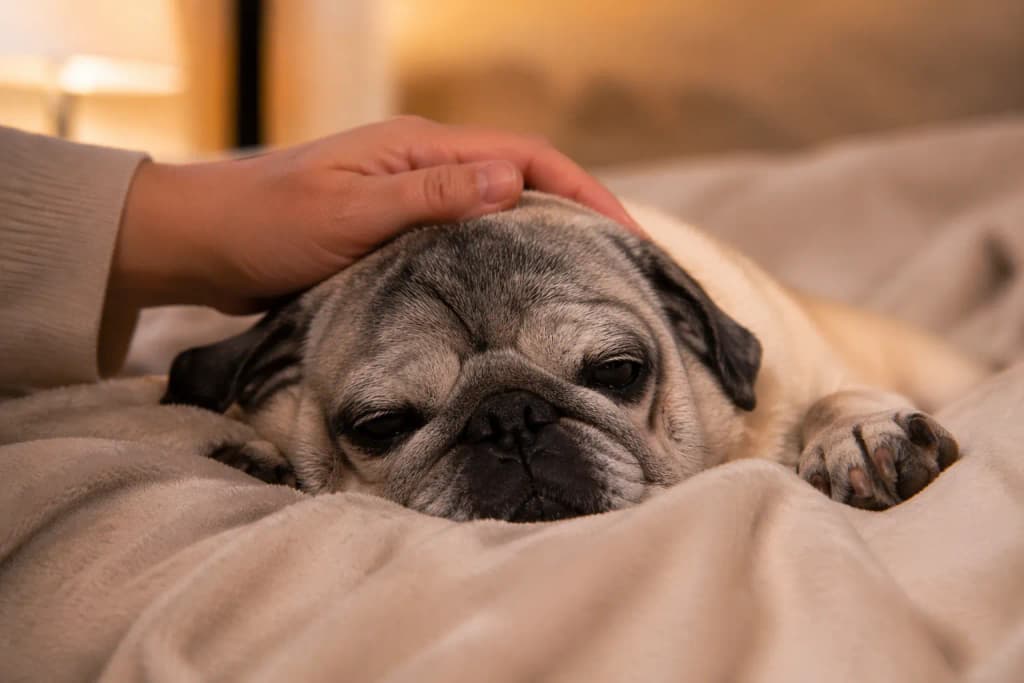
A real pet emergency kit for an older pug should solve three problems fast: breathing stress, routine disruption, and owner overload.
Everything else is secondary.
The grab-kit: what should live by the exit
Your grab-kit needs to be small enough to carry while also managing your dog. If it’s bulky, you’ll postpone putting it together or you’ll leave it behind in a rush. We’re not huge fans of giant “all-in-one” bins for apartment dwellers or busy households. Compact beats comprehensive if comprehensive stays in the closet.
Start with these:
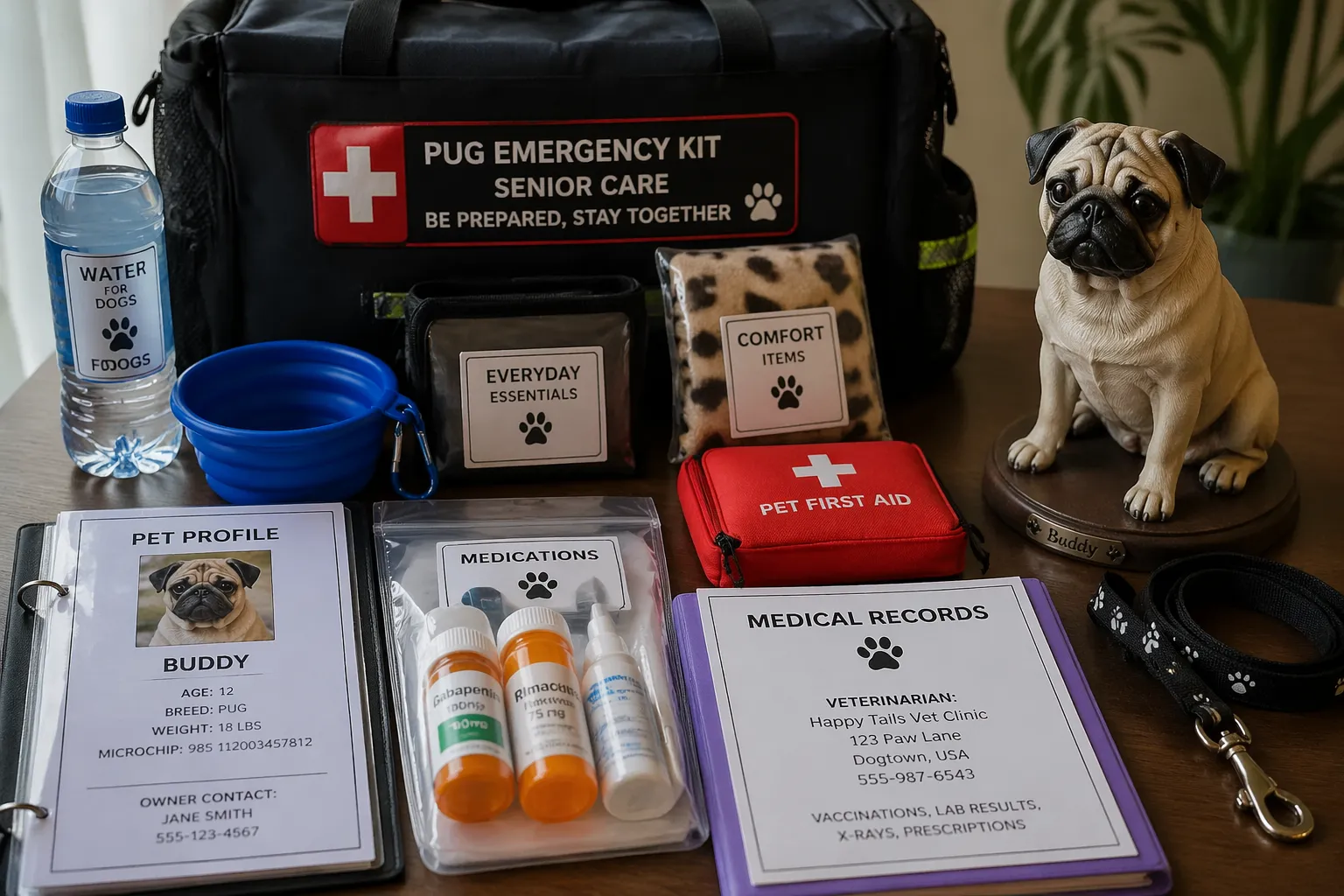
- 3 days of food, portioned into labeled bags or small containers
- 3 to 7 days of medications, clearly labeled with dosage instructions
- A slip lead or backup leash
- Harness that your pug already wears comfortably
- Collapsible bowl for water
- Small bottle of water
- Absorbent pee pads or a towel
- Vet contact card and emergency clinic info
- Printed care sheet with feeding times, medications, allergies, mobility needs
- Recent photos of your pug on your phone and printed
- Comfort item that smells like home—a blanket square works better than a bulky bed
- Cooling aid like a cooling towel or small fan if climate risk is relevant
- Waste bags
- Soft muzzle only if recommended by your vet and your dog is trained to tolerate it
That printed care sheet is gold. Honestly, it’s one of the most underrated parts of senior dog care.
If someone else has to help your pug—a neighbor, hotel staff member, family friend, emergency responder—you do not want to verbally explain “half a tablet with food, but only after he settles, and don’t let him gulp water too fast.” You want it written down in plain English.
The restock bin: where the backup lives
Your restock bin can live in a closet, laundry room, or another easy-access place. This one holds the extras:
- Additional food
- Extra medications if your veterinarian approves advance supply
- Spare blanket
- Cleaning supplies
- Duplicate paperwork
- Extra batteries or charger for small cooling devices
- Backup harness or booties if your dog uses them
- Crate label, if crate evacuation is part of your plan
This division matters because it protects the part you’ll actually grab. The restock bin supports the grab-kit. It doesn’t replace it.
A senior pug kit needs custom choices
Here’s where generic advice falls apart. Pug care in an emergency is body-specific.
A Border Collie’s emergency kit and a senior pug’s emergency kit should not look the same. Your dog’s face shape, stamina, temperature tolerance, and joint comfort change the whole equation.
This quick table shows the difference between “standard dog kit thinking” and “senior pug reality.”
| Need Area | Generic Dog Advice | Senior Pug Reality | What to Pack |
|---|---|---|---|
| Exercise | Walk to burn stress | Overexertion can worsen breathing | Short potty breaks, slow pacing |
| Heat | Keep water available | Heat can escalate respiratory strain fast | Cooling towel, shade plan, fan |
| Feeding | Bring kibble | Stress can upset routine and appetite | Measured portions, familiar treats |
| Mobility | Dog will adapt | Older pugs may slip, hesitate, or freeze | Towel, non-slip mat, ramp if used |
| Handling | Standard collar/leash is fine | Airway pressure matters more | Comfortable harness, backup slip lead |
The counterintuitive item most people forget
Pack a small non-slip mat or shelf liner.
Not flashy. Not expensive. But for senior dogs, slick floors can be a disaster multiplier. Hotel tile, gas station concrete, vinyl flooring in a relative’s house—those surfaces can turn a mildly arthritic dog into a frightened statue.
We’ve heard this over and over from pet families. Not “I wish I had one more toy.” More like: “He wouldn’t move once his feet started sliding.”
A foldable non-slip square creates an instant island of confidence. Set it down near food and water. Put it beside the bed. Use it at the door. Spatially, it gives your dog a known place inside an unknown room.
That’s not sentimental. That’s functional.
Disaster preparedness for busy owners starts with the room, not the bag
Here’s the angle most disaster articles miss: your senior pug experiences emergencies through space.
Not as a concept. As distance.
The hallway is too long. The stairs are steeper than usual. The crate sits too far from you. The new room has no familiar corner. The chair where your dog usually naps isn’t there, and now there is nowhere to anchor the body.
Busy owners often focus on supplies because supplies are countable. But your pug will care just as much about layout.
Map the “safe square” in every place you might land
Do this once, before you need it.
Think through the spaces your pug might realistically end up in:
- your car
- a friend’s guest room
- a hotel room
- a family member’s living room
- a shelter or temporary accommodation
In each one, identify where you would create a safe square—a small zone where your dog can eat, rest, and settle with minimal movement.
That zone should ideally include:
- one wall behind them
- low foot traffic
- no direct vent blasting air
- water within one step
- non-slip surface
- visibility of you, if your dog prefers closeness
A family we worked with after a wildfire evacuation described this perfectly. Their older pug refused the roomy center of the bedroom and chose the six-inch space between a suitcase and the nightstand. Why? Because it felt bounded. Protected on three sides. Dogs, especially aging ones, often settle better in defined edges than in open floor.
That’s why “give them lots of room” is sometimes bad advice. The mistake most people make is assuming open space feels freeing. For anxious seniors, it can feel exposed.
"Older dogs often calm down faster in a small, defined space than in a large, empty room."
Set up the leash path now
This sounds minor until it isn’t.
Walk the path from your dog’s usual resting spot to your exit. What’s in the way?
- a basket in the hall
- slick runner rug
- baby gate
- narrow turn at the laundry room
- shoes piled near the door
- stairs with no traction
If your pug is already slower, stiff in the morning, or vision-impaired, these little obstacles matter more during an emergency. In our experience, the first 90 seconds are where people lose the most time—not because they don’t love their dog, but because real homes are cluttered in real ways.
Do one ruthless edit. Remove or reposition anything that would slow your exit route.
That’s the kind of senior dog care nobody posts pretty photos about. It may be the most useful thing you do all year.
Why familiar scent beats extra gear
If you only have room for one comfort item, skip the cute toy and choose a sleep-scented fabric piece—part of a blanket, pillow cover, or crate pad your dog already uses.
What actually helps more than novelty is olfactory continuity. Dogs build location security through smell. In a strange room, a familiar scent can do more to lower arousal than an extra accessory.
The ASPCA’s emergency planning guidance for pets reinforces the importance of preparing practical essentials before a disaster hits. We’d add one lived-in detail from the trenches: don’t wash the comfort fabric right before packing it. Fresh laundry smells clean to you and wrong to your dog.
A senior dog care routine that survives disruption
Preparedness isn’t just about escaping the house. It’s about keeping your dog stable 48 hours later, when exhaustion sets in and the adrenaline drops.
And this is where many busy owners get blindsided.
The first day is noise, motion, messages, chargers, check-ins, logistics. The second day is when your senior pug starts showing you what the disruption actually cost: skipped meals, constipation, shallow sleep, clinginess, pacing, accidents, refusal to settle, or that stubborn statue mode where they just stop cooperating.
Build a “minimum viable routine”
You do not need to recreate your entire home life during a disruption. You need a minimum viable routine—the smallest version of normal that keeps your pug regulated.
For most senior pugs, that routine has four anchors:
- Medication at the same clock times
- Food in the same sequence and bowl style
- Potty breaks on a predictable interval
- One settled rest zone with familiar scent
That’s it.
People often over-focus on exercise and enrichment during emergencies. We get why. You want to help. But for many older pugs, what helps more than “keeping them busy” is protecting rhythm.
A customer once told us she spent the first evacuation evening trying to entertain her dog with treats, toys, and affection. Nothing worked. What finally worked was placing his usual little mat beside the bed, giving his medication at the normal time, dimming the room, and sitting on the floor in the same position she used at home. He slept within twenty minutes.
The insight? Routine is spatial as much as temporal. Not just when—but where, and in what sequence.
The 3-card system busy owners swear by
If your schedule is packed, create three index cards and put them in your grab-kit.
Card 1: Daily care
- Feeding times
- Food amount
- Medication schedule
- Water notes
- Mobility support notes
Card 2: Medical snapshot
- Vet name and number
- Emergency clinic
- Diagnoses
- Current meds
- Allergies
- Microchip info
Card 3: Behavior and comfort
- How your dog signals distress
- What calms them
- Triggers to avoid
- Sleep preferences
- Handling notes
Why cards instead of one long document? Because exhausted people skim. Helpers skim. You skim. Separate cards reduce cognitive load.
And yes, put the same information on your phone. But paper survives low battery, weak signal, and the weird fog that stress puts in your brain.
Watch for delayed stress, not just obvious panic
Not every senior dog reacts dramatically.
Sometimes the warning signs are subtle:
- refusing to lie down fully
- standing in corners
- taking treats but not meals
- staring at doors
- more frequent panting at rest
- waking every hour
- little tremors in the front legs
- clinginess that looks “sweet” but is actually anxiety
Pugs deserve extra caution here because breathing changes can be easy to dismiss until they’re not. We’re not vets, so any significant respiratory distress, overheating, collapse, blue-tinged gums, or worsening symptoms should mean veterinary help right away.
But day-to-day, your best move is observation. Don’t just ask, “Is my dog okay?” Ask:
- Can my dog settle?
- Can my dog swallow and rest normally?
- Can my dog move confidently on this surface?
- Can my dog sleep near me without constant repositioning?
Those questions tell you more than a wagging tail.
A simple senior pug care schedule during disruption
Use this as a baseline and adapt it to your vet’s guidance and your dog’s habits.
| Activity | Frequency | Duration | Why It Matters for a Senior Pug |
|---|---|---|---|
| Water check | Every 2-3 hours | 1 minute | Prevents gulping, overheating, and missed intake |
| Potty break | Every 4-6 hours | 5-10 minutes | Reduces accidents and stiffness from holding |
| Medication review | Morning/evening or as prescribed | 2 minutes | Prevents missed doses during schedule chaos |
| Rest zone reset | 2 times daily | 3 minutes | Keeps bedding, scent item, and traction consistent |
| Calm contact time | 2-3 times daily | 10-15 minutes | Helps regulate stress without overhandling |
What We Wish We Knew Sooner
This is the candid part—the stuff our team has heard too many times to ignore.
- A “good dog” can still unravel in a strange room. Obedience at home doesn’t predict regulation in displacement.
- Older dogs don’t always protest loudly. Sometimes they just stop moving, stop eating, or stare.
- Packing extra toys is overrated. Packing the right mat, meds, and notes matters more.
- The carrier shouldn’t appear only for vet visits. That teaches dread, not safety.
- Your stress changes your dog’s breathing. Especially in pugs. If you rush, they often rush too.
- A duplicate kit costs less than one emergency mistake. Missed meds, forgotten food, wrong leash—it adds up fast.
This sidebar exists because polished advice often leaves out the messy truth. And the messy truth is what actually saves time.
"Preparedness for a senior pug isn’t about owning more things. It’s about removing the tiny barriers that become huge in a crisis."
— The PawSculpt Team
Pug care in evacuation, sheltering, and hotel stays
Disaster planning looks different depending on where you end up. A shelter cot, a roadside motel, a cousin’s den, your parked car during a temporary wait—each setting asks different things of an older pug.
If you evacuate by car
Cars are transitional spaces. They’re also physically awkward for senior dogs.
The big mistake is assuming the car is just transport. In real emergencies, the car becomes a waiting room, feeding station, cooling station, and sometimes a temporary refuge. So set it up that way.
Keep these in the vehicle if climate and safety allow:
- spare towel
- seat cover or blanket
- bottled water
- collapsible bowl
- backup leash
- cooling towel
- printed care card
- small non-slip mat
And here’s the part people overlook: entry and exit height. A senior pug jumping repeatedly in and out of a vehicle is a strain point. If your dog already hesitates, practice a lift plan now or use a ramp if that’s already familiar.
One order that stuck with us came from a family who said their older pug handled evacuation only because they had rehearsed the car routine on calm weekends. Same blanket. Same side of the back seat. Same harness. Same settling phrase. That’s not overkill. That’s preloading comfort.
If you stay in a hotel
Hotels are rough on older dogs because they combine unfamiliar scent, echo, hard flooring, and doors that keep announcing strangers.
- Rest zone first
- Water second
- Potty path third
- Everything else last
Don’t scatter your dog’s items around the room. Cluster them tightly in one area. Spatially, that tells your dog where life is happening. If the food bowl is near the window, the bed near the desk, and the comfort blanket near the bathroom, you’ve accidentally made the whole room a search task.
We recommend choosing a corner where your dog can see you but won’t be startled by every hallway sound. A chair no one sits in, the space between the bed and wall, the far side of the nightstand—those semi-enclosed pockets often work best.
And skip the housekeeping-style room fresheners if you can. Clean-smelling to humans, irritating to some dogs.
If you shelter with friends or family
This can be emotionally easier for you and harder for your pug.
Why? Because people mean well and create too much social pressure. Extra greetings. Extra petting. New rules. Children wanting interaction. Other pets closing distance too fast.
Your job is to protect your dog’s space without apologizing for it.
Try this script:
- “He settles better if we keep his mat in one spot.”
- “Please let him come to you.”
- “He’s older, so we’re keeping his routine really plain.”
- “He needs short, calm potty breaks instead of excitement.”
Direct. Kind. Clear.
The thing about busy owner life is that you’re often used to making things work around everyone else. In an emergency, flip that. Build around your dog’s limits first.
The emotional layer nobody wants to talk about
Let’s say the worst part doesn’t happen. Your home is intact. Your dog is safe. The storm passes. The power returns.
You can still feel wrecked.
That’s normal.
Preparedness conversations often act as if the only meaningful outcome is survival. But if you’ve ever reached for your senior pug in the dark to count breaths, or slept lightly with one ear tuned to every shift of their body on a strange floor, you know the truth: crises create a kind of anticipatory grief. Not full loss. Not exactly fear. Something in between. A sharpened awareness of fragility.
And older pugs bring that awareness close.
We see this in the stories families share with us all the time. A figurine order placed not after loss, but after a close call. A customer saying, in so many words, “I realized I don’t want to wait.” That instinct makes sense. Emergencies strip away the illusion that you have endless ordinary days.
"Sometimes preparedness is really love admitting time has texture."
Why tangible memory matters even before loss
Some families keep emergency binders. Some save voicemails from the vet. Some make photo books after a health scare. Others choose a physical keepsake while their dog is still here and gloriously opinionated.
That’s one reason PawSculpt resonates with so many pet owners. Our team creates museum-quality custom pet figurines, digitally sculpted by master 3D artists and brought to life through full-color 3D printing technology. The color is printed directly into the full-color resin itself, then protected with a clear finish—so the markings, wrinkles, and beloved quirks feel preserved in a way that’s tactile, dimensional, and honest to the animal.
Not plastic-perfect. Realer than that.
For senior pugs especially, the details matter: the tilt of the chest, the compact stance, the dark velvet mask, the way age softens the expression around the eyes. Those are not generic dog features. They are biography in shape and color.
We’re not saying a figurine is part of a disaster kit. It isn’t. We are saying that a close call often clarifies what you want to preserve. If that idea speaks to you, exploring 3D pet sculptures on pawsculpt.com is one meaningful route among many.
Take the photos now, not later
This is practical and emotional at the same time.
Most people have hundreds of dog photos and almost none that are truly useful for identification or detailed preservation. You want both.
Take:
- one full-body side view
- one front-facing standing shot
- one close-up of face and chest
- one top-down shot showing body shape
- one image beside a familiar object for size context
- one short video capturing gait and breathing at rest
These photos help if your dog gets separated. They also help if you ever want a keepsake that captures the right details—whether that’s a framed portrait, a photo book, or one of the custom figurines families turn to after realizing snapshots alone didn’t hold enough dimension.
Do this on a normal day. Good light. Calm dog. Familiar surface. Not during the emergency.
How to make disaster preparedness stick when you’re already overloaded
You don’t need a perfect system. You need one you’ll actually maintain.
That’s the heart of this whole article, honestly. Busy owners are drowning in advice that assumes unlimited bandwidth. But preparedness that depends on motivation will fall apart. Preparedness that depends on placement, duplication, and habit stacking has a fighting chance.
Use the “Sunday reset” method
Give your disaster kit a 10-minute weekly reset tied to something you already do—laundry, meal prep, trash night, calendar review.
Check:
- food freshness
- medication supply
- water bottle swap
- paper card updates
- leash/harness present
- comfort fabric still in place
- printed photos current
That’s enough.
Not a full audit. Not a spreadsheet. Just enough maintenance to keep the kit real.
Put expiration dates where your eyes go
The medicine bottle can be in the pouch. But the reminder needs to be where you’ll see it:
- on the inside of the hall closet door
- in your calendar as a monthly repeat
- on a sticky note near dog food storage
- in a shared family phone reminder
The problem isn’t ignorance. It’s visual absence. Things that disappear from sight disappear from behavior.
Rehearse once every season
Not a dramatic drill. Just a dry run.
Leash the dog. Pick up the grab-kit. Walk to the car or the door. Time it. Notice where your dog hesitates. Notice what you forgot. Notice if the harness is too snug now, or the medication card is outdated, or the cooling towel has wandered off.
Five minutes. Four times a year.
That one rehearsal will teach you more than ten saved posts.
A realistic maintenance chart for a busy owner
Here’s a simple way to divide tasks without letting them rot.
| Task | How Often | Time Needed | What Most People Miss |
|---|---|---|---|
| Check medications | Weekly | 2 minutes | Refills and dosage notes change quietly |
| Rotate food/water | Monthly | 5 minutes | Old kibble and stale water ruin the plan |
| Update photos | Every 3-6 months | 10 minutes | Seniors change shape faster than you think |
| Practice exit route | Seasonally | 5 minutes | Obstacles appear in hallways over time |
| Review comfort items | Monthly | 2 minutes | Washed or relocated items lose scent value |
If your pug has multiple health issues
Then simplify harder, not softer.
Older dogs with medications, mobility support, diet restrictions, or recurring respiratory concerns can make owners feel like their kit has to become a mobile hospital. It doesn’t. Your job is to build a bridge to veterinary support, not to replicate a clinic.
Prioritize:
- medication continuity
- hydration access
- temperature management
- traction
- paperwork
- transport readiness
That order matters.
And if your dog’s needs are medically complex, ask your veterinarian to help you create a brief emergency summary. You do not want to improvise that at midnight with low phone battery.
What preparedness looks like after the crisis passes
This is the section almost no one writes, and it matters.
After an emergency, don’t just unpack. Debrief.
The leash goes back on the hook. The bowls return to the kitchen. The attic door shuts. Life tries to round off the sharp edges and tell you it’s over. But if you don’t review what happened within 72 hours, you’ll lose the useful lessons.
Ask:
- What did we reach for first?
- What took too long to find?
- Where did our dog hesitate?
- What made settling easier?
- What did we pack and never use?
- What did we wish we had duplicated?
Write it down. Short notes. Real notes.
One family told us their biggest lesson after a storm wasn’t “buy more stuff.” It was “move the kit out of the hall closet and into the bench by the door.” That single spatial correction changed everything for the next season.
Preparedness improves through honesty, not ambition.
And if the event shook you more than you expected, don’t dismiss that. Sometimes a near miss changes how you see your dog’s age. It sharpens your attention. It makes ordinary routines glow a little differently. The slow walk to the water bowl. The familiar grunt before settling. The shape of your pug curled against the base of the couch in the same old corner. You notice space differently after fear has been through it.
That awareness can become anxiety. Or it can become care.
There’s a difference.
Care says: I will make the path clearer. I will write the notes down. I will duplicate the medication pouch. I will take the good photos. I will preserve what matters while I can.
If part of that preserving includes a tangible piece of your pet’s story, many families explore memorial keepsakes and celebration pieces through PawSculpt’s blog and custom figurine options. Not because an object replaces a living dog. Nothing does. But because shape, color, posture, and expression carry memory in a way flat images sometimes can’t.
The next small move matters most
Go to the place where your current pet emergency kit lives—or where it would live if you finally assembled it. Stand there and be honest.
Is that where you would reach in the first minute?
If not, change that today.
Move the grab-kit by the exit. Add the non-slip mat. Write the three cards. Duplicate the leash and medications if your vet approves. Take fresh photos this week, not “sometime.” Then walk the route from your pug’s favorite resting spot to the door and clear whatever interrupts it.
That’s the real answer for a busy owner caring for an older dog. Not perfection. Proximity.
The harness in the attic can stay a memory. Your plan shouldn’t.
Frequently Asked Questions
What should be in a pet emergency kit for a senior pug?
A strong pet emergency kit for a senior pug includes the basics—food, medications, water, leash, harness, and vet information—but it should also account for age and breed-specific needs. Add a printed care card, a scent-familiar comfort item, recent identification photos, and something that improves footing, like a compact non-slip mat.
If your pug has breathing issues, mobility limitations, or special feeding needs, build around those first. Generic checklists are a starting point, not the finish line.
How often should I update my senior dog's disaster preparedness kit?
For most households, weekly medication checks and a monthly supply refresh work well. Food, water, and comfort items need regular review, while photos and paperwork should be updated every three to six months—or sooner if your dog’s appearance or health changes noticeably.
Senior dogs can change faster than people expect. A harness fit, medication dose, or body shape that was accurate in spring may be off by fall.
Why do senior pugs need different disaster preparedness plans?
Because pug care is not interchangeable with general dog care. Senior pugs often have less heat tolerance, more respiratory sensitivity, and more difficulty on slippery or unfamiliar surfaces. They also tend to rely heavily on routine and spatial familiarity.
That means your plan should emphasize calm transport, traction, cooling, and predictable setup. Open-ended advice like “bring comfort items” is too vague to be useful.
What is the best disaster preparedness tip for a busy owner?
Keep a small grab-kit by the exit and a separate restock bin elsewhere. That single change removes the biggest failure point: delay. Busy owners don’t need a perfect system; they need one that works when they’re stressed, interrupted, and moving fast.
If it takes more than a few seconds to reach your kit, it’s in the wrong place.
Should I practice evacuation with my senior pug?
Yes—gently and without turning it into a stressful event. A short seasonal rehearsal helps your dog recognize the harness, the route, the car setup, and the rhythm of leaving and settling.
For a senior pug, familiarity lowers strain. Practice on calm days so emergency movement doesn’t feel like total chaos.
Are custom pet figurines only for memorials?
Not at all. Many families choose them to celebrate a living pet, especially during the senior years when the little details feel especially precious. After a close call, some owners want something tangible that honors the exact posture, markings, and expression they know so well.
PawSculpt creates these as digitally sculpted, full-color resin 3D prints, which is why surface markings and color patterns can feel so faithful to the real dog.
Ready to Celebrate Your Pet?
Every pet has a story worth preserving. Whether you're honoring a beloved companion who's crossed the rainbow bridge or celebrating your furry friend's unique personality, a custom PawSculpt figurine captures those details that make your pet one-of-a-kind.
For families focused on senior dog care, that kind of preservation can feel especially meaningful—the compact stance, the graying muzzle, the expression you know from across the room. If you want a tangible way to hold onto those details, PawSculpt offers a beautiful option grounded in digital artistry and full-color 3D printing.
Visit pawsculpt.com to learn more about our process and guarantees