
How a Worn Squeaky Toy Became a Renaissance Painting: One Family's Art-Inspired Tribute to Their Golden Retriever
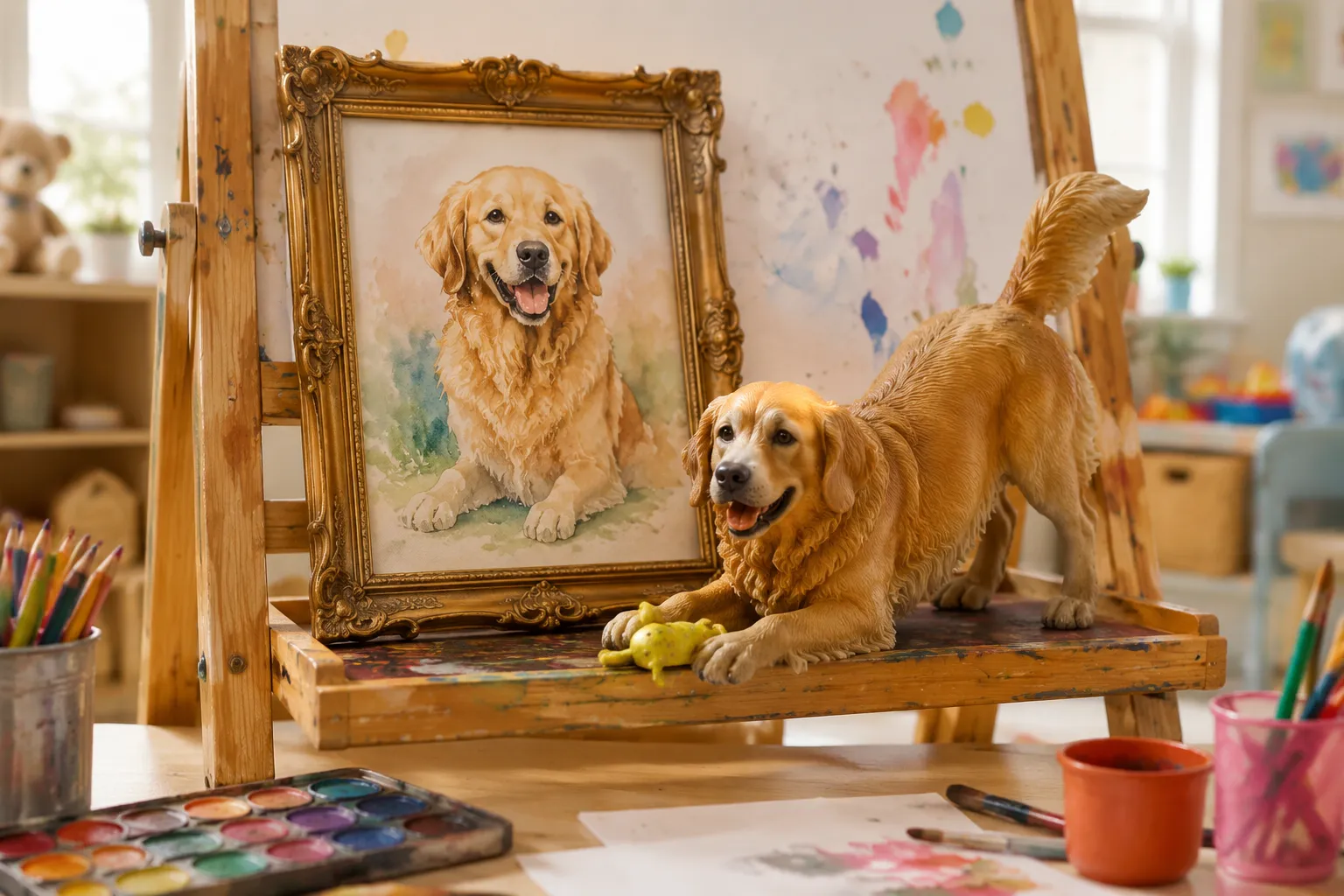
The squeaky toy still smelled like him — that faint mix of grass, drool, and sun-warmed rubber — when seven-year-old Mia found it under the porch steps, three weeks after Cooper died. Her mom didn't know it yet, but that flattened orange duck would become the centerpiece of the most unusual Golden Retriever memorial for kids their family had ever imagined.
Quick Takeaways
- Children grieve in fragments, not stages — give them a physical object to anchor the memory.
- Turn an everyday item into the tribute — a worn toy or blanket carries more emotional weight than a photo.
- Build a memorial together over weeks — shared creation processes grief better than one-time gestures.
- Tangible keepsakes help kids "see" love — families often choose a custom pet figurine to give grief a shape small hands can hold.
- Name the hard feelings out loud — guilt, relief, and anger are all normal parts of losing a pet.
Why a Squeaky Toy Outperforms a Photo Frame (Especially for Kids)
Here's something we've noticed across thousands of pet families: adults reach for photographs, and children reach for objects.
There's a reason for that gap, and it isn't random. A child's memory before age ten leans heavily on the sensory and the tactile. They don't remember Cooper as a series of posed images. They remember him through the squeak of a toy at 6 a.m., the smell of his ears, the weight of his head landing on their lap during cartoons.
So when a family loses a dog, the well-meaning instinct is to frame a nice photo and call it a memorial. For a grieving adult, that often works. For a grieving second-grader, a photo can feel strangely flat — a picture of a feeling they can't touch.
The family we'll follow through this article (we'll call them the Reyes family, sharing their story with permission and a few details changed for privacy) figured this out almost by accident. Mia didn't want the framed beach photo her parents offered. She wanted the duck. The gross, deflated, one-eye-chewed-off duck that still carried Cooper's smell.
"Children don't memorialize what a pet looked like. They memorialize what a pet felt like."
That instinct — to preserve the object rather than the image — turned out to be the smartest grief decision the Reyes family made. And it's the thread we'll pull on for the rest of this piece.
The cause-and-effect chain most parents miss
Walk through the logic with us, because it matters:
- A young child's grief attaches to sensory triggers (smell, sound, texture).
- Those triggers fade faster than parents expect — that orange duck will lose Cooper's scent within a month or two.
- When the trigger disappears, kids panic quietly, afraid they're forgetting.
- A durable, transformed version of that object short-circuits the panic.
That step three is the part nobody warns you about. The fear of forgetting hits children harder than the loss itself. A six-year-old can accept that Cooper is gone. What terrifies them is the day they can't remember exactly how his fur felt.
So the practical move isn't "help your child say goodbye." It's "help your child build something that can't be forgotten." Big difference. One is an event. The other is a project — and projects are where kids do their best healing.
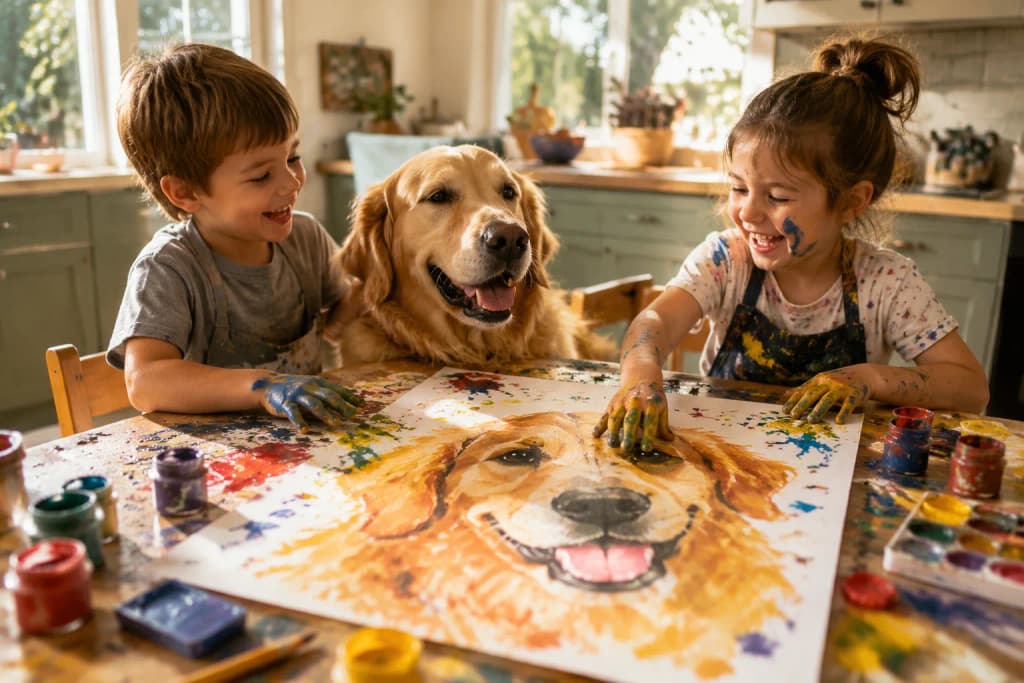
Turning Grief Into a Project: The Art-Inspired Pet Tribute Framework
The Reyes family didn't set out to create an art-inspired pet tribute. Mia's dad, an engineer by trade, just wanted to stop the crying at bedtime. What he stumbled into was a structured, multi-week process that child psychologists would recognize as textbook healthy grieving.
Let's break it into the framework they used, because you can copy it almost exactly.
Step 1: Capture before it fades (first 7 days)
The clock starts the moment your pet passes. Scent, specifically, has a short shelf life.
Within the first week, do this:
- Seal the smell. Put the unwashed toy, collar, or blanket into a ziplock bag. Don't wash anything. The scent is a finite resource and you're rationing it.
- Record the sounds. If you have old phone videos, save the ones with audio — the bark, the toenails on the kitchen floor, the specific squeak of that specific toy.
- Photograph the object from every angle. Not the dog. The object. You'll understand why in Step 4.
The American Veterinary Medical Association notes that involving children directly in memorial activities helps them process loss in age-appropriate ways, rather than being shielded from it. The AVMA's guidance on pet loss is worth a read if you're navigating a child's first death experience.
Here's the counterintuitive part: most parents instinctively clean up after a pet dies. They wash the bed, donate the toys, erase the evidence because the reminders hurt. For an adult, that can bring relief. For a child, you may be throwing away their grief tools. Pause before you purge.
Step 2: Let the child lead the medium (week 2-3)
Mia chose the duck. Your kid might choose a tennis ball, a leash, a specific spot on the couch. Whatever they fixate on — that's the raw material. Don't redirect them toward something you think is more "appropriate" or photogenic.
The Reyes family's breakthrough came when Mia asked a question that stopped her parents cold: "Can we make Cooper's duck fancy, so it never gets thrown away?"
That's a child telling you exactly what she needs. She needed permanence. She needed the object elevated from "trash that smells like my dog" to "treasure that honors my dog."
"When a grieving child asks to make something 'fancy,' they're really asking you to promise it will last forever."
Step 3: Choose your transformation style
This is where the "Renaissance painting" idea was born. Mia's older cousin, a teenager obsessed with art history, joked that the duck looked like it belonged in a museum. The family ran with it — they'd transform Cooper's humble, slobbered-on toy into a piece of "fine art."
There are several ways families turn an ordinary object into a lasting tribute. Here's how the main options compare:
| Tribute Style | Effort Level | Best For | What It Preserves |
|---|---|---|---|
| Framed shadow box | Low | Young kids, fast comfort | The original object itself |
| Memorial journal | Medium | Verbal/writing kids | Stories and feelings |
| Custom figurine | Low (you send photos) | All ages, permanence | Pet's actual likeness |
| DIY art recreation | High | Crafty families, teens | Shared creative time |
| Garden installation | Medium | Outdoor families | A place to visit |
The Reyes family ended up combining three of these — the shadow box for the real duck, a memorial journal for Mia's words, and a custom figurine of Cooper holding that very duck. More on why that combination worked so well in a moment.
The Renaissance Painting That Started as a Chew Toy
Let's go back to the backyard, because this is where the project came alive.
On a Saturday morning that smelled like cut grass and the first warm rain of spring — the exact smell of every afternoon Cooper used to flop in the yard — the Reyes family laid everything out on the patio table. The duck. A stack of printed photos. Markers, a blank journal, and a laptop.
Mia's job was to be the "art director." She decided Cooper should be remembered not lying down or sleeping, but mid-pounce, duck in mouth, ears flying. The way he looked happiest. The way she wanted to remember him forever.
This is the commonly overlooked aspect of pet memorials that we wish more families understood: the best tributes capture the pet in motion and joy, not in repose. So many memorials default to the sleeping, peaceful, "at rest" pose. But that's an adult's vision of death and dignity. A child wants to remember the chaos, the zoomies, the ridiculous joy.
"A peaceful sleeping pose comforts the adult. A goofy mid-zoomie pose comforts the child."
Why the "fancy" transformation matters psychologically
When you take a child's grief object and elevate it — frame it, sculpt it, turn it into "art" — you're doing something profound. You're externally validating that their love was important. That this dog mattered enough to be treated like a masterpiece.
Think about what hangs in museums: things humans decided were worth protecting forever. When Mia called Cooper's duck a "Renaissance painting," she was assigning it that same status. She was saying: this love deserves a frame, a pedestal, a permanent place.
Honestly, that reframe does more emotional work than a hundred "it's okay to be sad" conversations. Kids don't want to be told their feelings are valid. They want to see it. Build something. Put it on a shelf. Light it like a museum exhibit.
Where PawSculpt entered the Reyes family's story
After building the shadow box and starting the journal, Mia still wanted one thing: to see Cooper himself, not just his stuff. A photo wasn't enough — she'd already told them that.
This is the point where a lot of families discover custom figurines. The Reyes family sent in a handful of photos of Cooper mid-play and asked for him to be captured holding the orange duck. The result was a full-color resin sculpture — Cooper's actual golden coat, his specific markings, that toy in his mouth — that Mia could hold in both hands.
What makes this work for children specifically is the dimensionality. At PawSculpt, pets are digitally sculpted by master 3D artists and then precision 3D printed in full color, so the figure has real weight and form. A child can turn it, hug it, set it on a nightstand. The color is printed directly into the resin itself, voxel by voxel, then sealed with a clear protective coat — so it holds up to small, frequent, loving hands.
We're not saying a figurine is the answer for every family. Some kids bond more with the journal, others with the garden stone. But for a child whose grief is tactile — who needs to touch the memory — a three-dimensional keepsake fills a gap that flat photos simply can't.
"We've learned that a child doesn't want a picture of their dog. They want their dog back in their hands, even just a little."
— The PawSculpt Team
What No One Tells Kids (Or Parents) About These Feelings
Now for the part of grief that families whisper about, if they say it at all.
When you're guiding a child through losing a pet, you'll run into emotions that don't fit the tidy "sad, then better" narrative. And if you don't name them, kids assume something is wrong with them.
The guilt nobody admits to
Here's one we see constantly. After a long illness or a hard decision about euthanasia, families — including children — often feel a flash of relief. The 2 a.m. medication schedule is over. The worry is over. The watching-them-suffer is over.
And then, almost immediately, the guilt arrives like a wave.
That relief you felt when Cooper stopped struggling for breath? It doesn't mean you wanted him gone. It means you loved him enough to be glad his pain ended. Relief and grief are not opposites — they're roommates. They live in the same house, and they show up at the same time more often than anyone admits.
Children feel this too, but they don't have the words. A kid might say "I'm glad I don't have to give Cooper his yucky pills anymore" and then burst into tears, confused by their own mouth. Your job isn't to correct them. It's to say: "Yeah. Me too. We can be glad he's not hurting AND miss him so much it aches. Both are true."
The guilt about feeling better
A few months in, the Reyes family hit another wall. Mia laughed at something — really laughed, for the first time since Cooper — and then immediately looked stricken, like she'd done something wrong.
Guilt about moving on is one of grief's cruelest tricks, and it hits kids surprisingly hard. They worry that being happy again means they didn't love their dog enough. That a good day is a betrayal.
What helped wasn't reassurance. It was reframing. Mia's mom told her: "Every time you laugh, that's Cooper's love still working. He'd be so mad if his duck made you sad forever. He'd want it to make you smile."
The figurine helped here in an unexpected way. Because it captured Cooper playing, not sleeping, it gave Mia permission to associate him with joy instead of loss. She'd pick it up and smile instead of cry. That's not avoidance — that's healthy integration, and it's the goal.
A quick map of the feelings you might meet
Grief in families rarely moves in a straight line. Here's a rough guide to what tends to surface and what actually helps:
| Feeling | When It Often Shows Up | What Actually Helps |
|---|---|---|
| Relief (then guilt) | First days after loss | Name both feelings as normal, out loud |
| Fear of forgetting | Weeks 2-6 | Preserve scent + create a permanent keepsake |
| Guilt about laughing | Months 1-4 | Reframe joy as the pet's love "still working" |
| Anger ("not fair") | Anytime, often sudden | Allow it; don't rush to fix or explain it away |
| Anxiety about a new pet | Months 6+ | Make clear a new pet honors, not replaces |
The American Society for the Prevention of Cruelty to Animals offers solid, free pet loss support resources if your family needs more than a blog post can give — and sometimes families do. There's no shame in that.
Building the Creative Pet Memorial Journal (A Step-by-Step You Can Copy)
The shadow box preserved the duck. The figurine captured Cooper. But the creative pet memorial journal is where Mia did the deepest work — and it's the piece we recommend most often to families with kids, because it costs almost nothing and grows over time.
A memorial journal isn't a diary. It's a structured, prompt-driven book that gives a child somewhere to put feelings that are too big for conversation.
What goes in it
Don't just hand a kid a blank notebook and say "write your feelings." That's overwhelming and they'll freeze. Structure it. Here's the format the Reyes family used, one page per prompt:
- The first page is a drawing, not words. Have your child draw their pet doing their favorite thing. Mia drew Cooper mid-pounce, of course.
- A "smells like" page. What did your pet smell like? Mia wrote: "grass and warm bread and a little bit of pond." This page becomes priceless once the real scent is gone.
- A "sounds like" page. The squeak, the bark, the snore.
- A "things I want to tell you" page. Open-ended. Let it sit blank if needed; kids return to it.
- A "funny thing you did" page. Grief journals get too heavy without humor. Mandate a funny memory.
- A "what I learned from you" page. This one's for slightly older kids and it's where the real growth lives.
The genius of the journal is that it's revisitable. Unlike a one-time funeral or a single conversation, a child can return to it at six, at nine, at thirteen — adding new pages as their understanding of loss matures.
"A memorial journal is the only tribute that grows up alongside the child."
The pages parents are scared to include
Here's our slightly controversial take: include the hard pages too.
Most grief journals for kids stay relentlessly sweet. But a child who felt anger — at the vet, at the disease, at the dog for leaving, at themselves — needs a place for that. Add a page that simply says: "Write or draw something that makes you mad about this."
One family we worked with had a little boy who scribbled an entire black page, pressing so hard he tore through three sheets. His mom almost stopped him. She didn't. That black page, she told us later, was the moment he finally started sleeping through the night again. Anger that gets expressed stops leaking out sideways as nightmares and tantrums.
A simple build timeline
You don't do this in one sitting. Spread it out — the spacing is the therapy.
| Week | Journal Focus | Why This Timing |
|---|---|---|
| Week 1 | Drawing + smell/sound pages | Capture sensory memory before it fades |
| Week 2-3 | Funny memories + favorite things | Reintroduce joy gently |
| Week 4-6 | Anger + hard feelings pages | Child is ready to go deeper now |
| Month 2-3 | "What I learned" + letters | Begin integration and meaning-making |
| Ongoing | Add pages on anniversaries | Grief revisits; give it a home |
Why "Doing It Together" Beats Any Single Keepsake
If there's one insight we'd tattoo on every grieving family's heart, it's this: the healing is in the making, not the made.
The Reyes family's figurine sits on Mia's shelf and she loves it. But when we followed up months later, what she talked about wasn't the sculpture itself. It was the Saturday in the backyard. The markers. Her dad letting her be the "art director." Her cousin's museum joke. The smell of rain coming.
The tribute was the excuse. The togetherness was the medicine.
This is why we gently push back when a parent rushes to order a memorial keepsake the day after a pet dies, hoping to fix the pain fast. There's nothing wrong with a custom pet sculpture — families tell us all the time how much comfort the finished piece brings. But if you skip the shared process and just hand a child a finished object, you've given them a thing instead of an experience.
The most powerful approach we've seen combines both:
- The process (journaling, building, choosing photos together) does the active grief work.
- The permanent keepsake (a figurine, a framed object) becomes the lasting anchor once the active grieving settles.
Think of it as a sequence, not a choice. First you grieve together with your hands busy. Then you keep something that lasts.
The mistake most families make
The error we see most often? Treating the memorial as a finish line. "We did the tribute, so now we're done grieving."
Grief doesn't work on a project timeline. A child who seemed totally fine after building the shadow box may fall apart eight months later when a classmate gets a puppy, or when they smell wet grass and rain and it all comes flooding back. That's not regression. That's grief doing its normal, lifelong, wave-shaped thing.
Keep the journal accessible. Keep the figurine where small hands can reach it. The tribute isn't the end of grief — it's the friend that walks alongside it.
What to Expect If You Choose a Custom Figurine
Since we've mentioned figurines a few times, here's a straight, no-fluff rundown of how the process generally works and what makes a good result — without overpromising on specifics that change over time.
What photos actually work best
This is the number-one thing families get wrong. The quality of your figurine depends almost entirely on the photos you provide. Here's what gives the 3D artists the most to work with:
| Photo Element | What to Aim For | Common Mistake |
|---|---|---|
| Lighting | Bright, natural daylight | Dark indoor / flash glare |
| Angle | Eye-level with the pet | Shot from far above |
| Detail | Close enough to see fur markings | Tiny, faraway subject |
| Quantity | 3-5 photos, multiple angles | A single blurry photo |
| Expression | The pet's signature look | Generic, stiff poses |
If your pet has already passed and you only have a handful of imperfect photos, don't panic. Skilled 3D artists work with what families have all the time — that's the reality of memorial work. Send your clearest shots and describe the details that matter: the exact gold of the coat, the way one ear flopped, the favorite toy.
How the creation works (the honest version)
Your pet's likeness is digitally sculpted by master 3D artists, then brought to life through full-color 3D printing in resin. The color isn't painted on top — it's part of the material itself, printed directly into the piece. The only hands-on step at the end is applying a clear protective coat for durability and a subtle sheen.
The result has an authentic, lifelike quality — vibrant full color with a natural fine texture, not a glossy mass-produced plastic look. For specifics on turnaround, revisions, and guarantees, it's best to check pawsculpt.com directly, since those details get updated regularly and we'd rather you have current info than a number we made up here.
Care so it lasts for the child's whole childhood
A few practical notes, since these will be handled by kids:
- Keep it out of direct, constant sunlight to preserve color vibrancy over many years (the resin is UV-resistant, but no material loves a sunny windowsill forever).
- Dust with a soft dry cloth. Skip harsh cleaners on the clear coat.
- Let kids hold it. It's meant to be touched. A keepsake locked in a cabinet doesn't comfort anyone.
Frequently Asked Questions
How do I help my young child grieve the loss of our Golden Retriever?
Give them something to do with their hands, not just something to look at. Build a memorial journal together, preserve a favorite toy before its scent fades, and create a lasting keepsake like a figurine. Most importantly, name the confusing feelings — guilt, relief, anger — out loud so your child knows they're normal.
Is it normal for kids to feel relief or even laugh after a pet dies?
Completely normal, though it often surprises parents. After a long illness, relief that the suffering ended sits right next to the grief — they're roommates, not opposites. And when a child laughs again, that's healthy integration, not betrayal. Tell them their pet would want that joy.
What should I do with my pet's old toys and blanket?
Resist the urge to immediately wash or donate them. For a grieving child, the scent on an unwashed toy is a finite, precious grief tool. Seal one item in a ziplock bag to preserve the smell as long as possible, and consider transforming a favorite object into a permanent tribute.
What photos work best for a custom pet figurine?
Bright, natural daylight, shot at the pet's eye level, close enough to capture fur markings and that signature expression. Three to five photos from different angles give the 3D artists the most to work with. If your pet has passed and photos are limited, send your clearest ones and describe the details that matter.
Should I order a memorial keepsake right away?
There's no deadline. The deepest healing happens in the shared process — journaling, choosing photos, building something together. Many families do that active grief work first, then choose a permanent keepsake once the initial wave settles. The keepsake is the anchor that lasts, not a finish line for grief.
Ready to Celebrate Your Pet?
Every pet has a story worth preserving. Whether you're building a Golden Retriever memorial for kids or simply celebrating a furry friend's goofiest, most joyful self, a custom PawSculpt figurine captures the details that made your pet unmistakably them — the specific gold of their coat, the favorite toy, the look only your family would recognize.
Visit pawsculpt.com to learn more about our process, preview turnaround, flexible revisions, and quality guarantee.