
Her Collar, Her Favorite Meal, and a Stoic Way to Carry On After Your German Shepherd
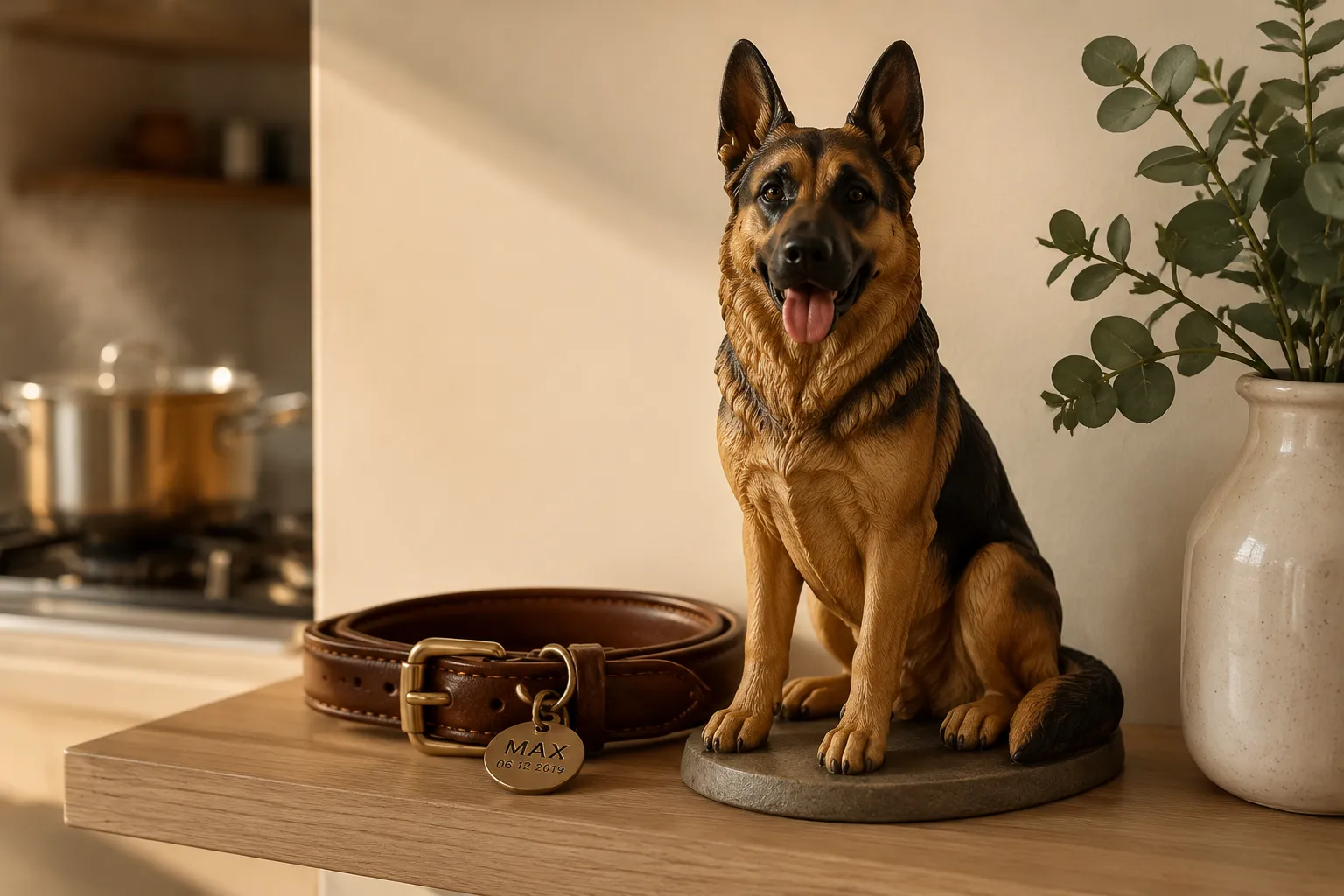
Up in the attic, a leather collar surfaces from a cardboard box, and the tag still turns when you flick it. This is where a German Shepherd memorial usually begins—not with a plan, but with a smell.
Quick Takeaways
- Grief follows no schedule — let the waves come instead of forcing yourself "back to normal."
- Turn one object into an anchor — her collar or food bowl gives your hands something to hold.
- Stoic practice helps more than positivity — focus on what you control, release what you can't.
- Tangible keepsakes ease the fear of forgetting — some families preserve her likeness through custom pet figurines that capture her exact markings.
- Relief and guilt can coexist — feeling lighter after her suffering ended does not mean you loved her less.
Why Losing an Old German Shepherd Carries a Different Weight
There's a particular grief reserved for the dogs who grew old with us. Not the sudden loss, though that has its own cruelty. We mean the slow goodbye. The thirteen years. The gray that crept up her muzzle until one morning you realized she was mostly white.
A German Shepherd who reaches old age has watched your whole life unfold. She was there for the job changes, the move, the relationship that ended and the one that lasted. She learned the sound of your car from three blocks away.
So when she goes, you're not just mourning a pet. You're mourning a witness.
Here's something we've noticed in our years working with grieving families: the people who lose senior dogs often feel guiltier than those who lose young ones. It seems backward. You had more time, after all. But that extra time built deeper grooves. More routine. More smell memory.
And Shepherds in particular bond with an intensity that borders on the unsettling. The breed was built for partnership—herding, guarding, working at your side all day. The American Kennel Club describes them as confident, courageous, and deeply loyal, dogs that attach to one person or family with their whole being. When that attachment outlives the body, it has nowhere to go.
That's the part nobody warns you about. The love doesn't stop just because the recipient did.
"You're not just mourning a dog. You're mourning the only one who knew every version of you."
The smell is the last thing to fade
Walk into a room where a Shepherd lived for over a decade and you can still find her. That warm, slightly earthy scent in the carpet. The corner of the couch that holds it strongest. The collar in the attic that, even after months, releases a ghost of her when you bring it to your face.
Smell bypasses logic. It goes straight to the oldest part of your brain, the part that doesn't know she's gone. You'll be fine for hours, then catch a whiff of her bed and feel the floor drop out.
This is normal. It's also, strangely, a gift. That scent is proof she was real, that the weight of her against your leg actually happened. Don't rush to wash it away. You can always clean the blanket later. You can't get the smell back once it's gone.
A Stoic Grief Framework: Carrying the Loss Without Being Crushed by It
Most grief advice tells you to feel your feelings. Good advice, as far as it goes. But it leaves you standing in the wreckage with no idea what to do with your hands or your mornings.
The ancient Stoics offer something more structural. Not a way to feel less—that's a common misreading of Stoicism—but a way to think clearly while you feel everything. Marcus Aurelius wrote his private journals while burying children and waging wars. Seneca lost friends, fortunes, and eventually his own life to politics. These men knew loss intimately.
A Stoic grief framework rests on three ideas. We'll be real with you: none of them will make the ache disappear. But they give the ache somewhere to live besides your chest.
1. The dichotomy of control
Epictetus taught that some things are up to us and some are not. Our judgments, our actions, our responses—ours. Almost everything else—including the lifespan of a dog with a body that wears out—is not.
Here's why this matters at 2 a.m. when you're replaying her last week. You cannot control that she got old. You couldn't control the tumor, the hips, the heart. What you can control is how you honor what she gave you.
The mistake most grieving owners make is spending their energy on the uncontrollable—the what-ifs, the timing, the imaginary alternate endings. Redirect that energy toward what's still in your hands. A memorial. A walk on her favorite trail. A bowl of the food she loved.
2. Premeditatio malorum—you always knew this day would come
The Stoics practiced imagining loss before it arrived. It sounds morbid. It's actually the opposite. By acknowledging that everything we love is borrowed, we love it more fiercely while we have it.
You knew, somewhere, the day you brought home that eight-week-old puppy that you were signing up for this exact heartbreak. Dogs don't live as long as we do. That math was always there.
This doesn't mean you should have braced harder. It means the grief you feel now is the receipt for a love you chose with eyes open. The pain is proportional to the gift. That's not a tragedy. That's the deal we make, knowingly, every time.
3. Amor fati—loving even the part that hurts
Nietzsche borrowed this from the Stoics: love your fate. Not just accept it. Love it. The whole arc, including the ending.
This is the hardest one. How do you love the fact that she's gone? You don't, not the gone part. But you can love that her story had a shape, a beginning and a middle and an end, and that you were the center of all three.
"The price of thirteen good years is one terrible day. We'd pay it again."
A quick table to keep these straight when your head is foggy, because grief makes everyone forgetful:
| Stoic Principle | What It Means | What You Do With It |
|---|---|---|
| Dichotomy of control | Separate what's yours from what isn't | Stop replaying the timeline; build a memorial instead |
| Premeditatio malorum | You always knew loss was coming | Let the pain validate the love, not the failure |
| Amor fati | Love the whole story, even the end | Tell her story out loud; don't edit out the goodbye |
Her Collar: Turning a Worn Object Into an Anchor
The Stoics believed in physical reminders—a coin, a ring, a written maxim carried in a pocket. Grief, too, needs an anchor. Something your hands can find.
For most German Shepherd families, that anchor is the collar. It carries her smell. It holds the scratches from the day she rolled in something awful. The buckle is worn smooth where your thumb pressed it a thousand times.
A pet collar keepsake isn't sentimental clutter. It's a tool. When the grief swells and you don't know what to do with your body, you hold the collar. It gives the feeling a place to land.
Practical ways to preserve a collar
Don't just toss it back in the attic box. Here's what actually works, in order of effort:
- Photograph it first — front, back, the tag, the worn spots. Do this within the first week before anything fades or gets misplaced.
- Decide on display vs. storage — a shadow box on the wall keeps her present; a sealed bag in a drawer preserves the scent longer.
- Don't clean it yet — the dirt and smell are part of the record. You can always clean later; you can't un-clean.
- Consider a dual purpose — some families clip the tag onto a new dog's collar years later, a quiet passing of the torch.
A customer once told us she kept her Shepherd's collar looped around the gearshift of her car for a full year. Every time she drove, her hand found it. By the time she finally moved it to a frame, she was ready. The object did its job.
Myth vs. Reality
Let's bust a few things that grieving owners get told, often by well-meaning people who've never sat in this particular dark.
| The Myth | The Reality |
|---|---|
| "Get rid of her things quickly so you can move on." | Removing objects too fast often prolongs grief by denying you a transition. Keep what comforts you. |
| "Strong people don't fall apart over a dog." | The depth of grief reflects the depth of attachment. Falling apart is evidence of a bond worth having. |
| "Getting a new dog will fix it." | A new dog is a new relationship, not a replacement. Rushing it can breed resentment toward an innocent puppy. |
That middle one matters most for Shepherd people. This is a breed that pulls disabled veterans out of dark places, that works search and rescue, that guards families. The toughness of the dog seems to set an unfair standard for the human. Your grief is not weakness. It's the cost of having loved something built for loyalty.
Her Favorite Meal: Ritual as a Stoic Practice
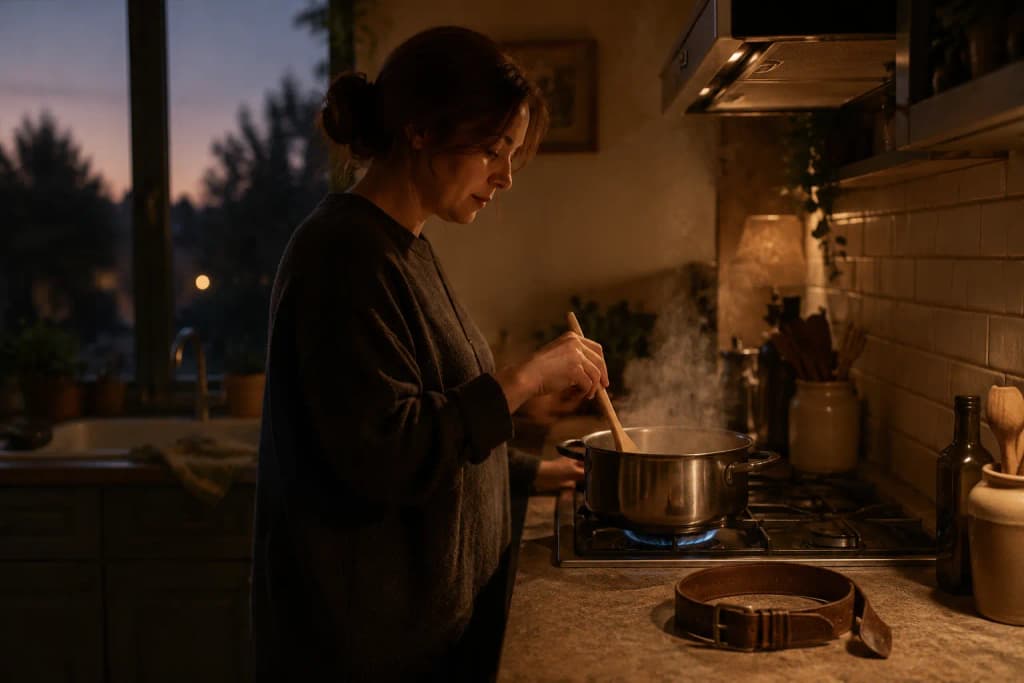
Here's an idea that surprises people. One of the most healing things you can do is cook her favorite meal one more time.
Not for a dog who isn't there. For you. And for the ritual of it.
Maybe it was a scoop of plain boiled chicken over her kibble on her birthday. Maybe she lost her mind for a particular brand of liver treat. Maybe, at the end, when her appetite faded, she'd only eat scrambled eggs warmed in your palm.
The Stoics practiced deliberate rituals to mark what mattered. Marking her favorite meal does something a photo can't—it engages smell and taste and the muscle memory of your hands. The kitchen fills with the scent that used to bring her skidding across the tile.
Why ritual works when words don't
Grief is largely pre-verbal. It lives below language. That's why talking about it sometimes feels useless, and why doing something often helps more than saying something.
A ritual gives shape to formless pain. It has a beginning (gathering the ingredients), a middle (the cooking, the smell rising), and an end (sitting with it). That shape is exactly what the chaos of loss is missing.
Some families do this on the anniversary of her passing. Some do it on what would have been her birthday. One family we worked with cooks their Shepherd's favorite—a ridiculous amount of plain ground turkey—every Thanksgiving, and they tell stories about her while it browns. The smell brings her into the room.
"Ritual doesn't bring them back. It brings you somewhere you can hold them again."
The actionable version: Pick one meal. Pick one date. Make it. Sit with the smell for the full fifteen minutes it lingers. Let the kitchen do what your words can't.
This is also where the practical Stoic in you takes over from the philosopher. You don't wait to feel ready. You schedule it. You buy the turkey. You turn on the stove. The feelings follow the action, not the other way around.
The Emotions Nobody Admits After an Old Dog Dies
Now we need to talk about the feelings you might not have said out loud. The ones that make you wonder if something's wrong with you. Nothing is wrong with you. These are some of the most common things we hear, and almost nobody admits them first.
The relief you're ashamed of
If your German Shepherd declined slowly—and old age usually means slowly—the end may have brought a flicker of relief. Relief that the 4 a.m. accidents stopped. Relief that you no longer have to lift sixty pounds of dog who can't stand. Relief that her pain ended.
And then the guilt arrives like a fist.
Listen. That relief doesn't make you a monster. It makes you someone who watched a creature you adored struggle, and who was exhausted from carrying her—literally and otherwise. The relief is about her suffering ending and about your own depletion. Both can be true. Relief and grief are not opposites. They're roommates.
Second-guessing the timing
This one haunts senior-dog owners specifically. Did we wait too long? Did we do it too soon? Was she telling us she wasn't ready, or were we the ones who weren't ready?
You will never have a clean answer, because the question is unanswerable. Here the Stoic dichotomy of control becomes a life raft. You made the most loving decision you could with the information you had, in a body you couldn't fix. That decision is now in the past—outside your control.
Veterinary professionals widely agree that erring slightly early to prevent suffering is the kinder error. If you must second-guess, second-guess in that direction. For guidance on quality-of-life assessment, organizations like the Association for Pet Loss and Bereavement offer resources and support that can ease this particular torment.
The anger nobody expects
Some people get angry. At the vet. At themselves. At the disease. At the dog, even, for getting old, which feels insane and then makes you feel worse. At people whose dogs are still alive and healthy.
Anger is grief with nowhere to go. It's the energy of love that can't reach its target anymore. Let it move through you—go for the walk, split the firewood, drive with the windows down. Don't aim it at the people trying to help, and don't let it calcify into something you carry for years.
The fear of forgetting
This is the quiet terror underneath a lot of memorial-making. What if I forget the exact angle of her ears? The specific brown of her eyes? The way she sighed when she finally lay down?
This fear is why tangible keepsakes matter so much. Memory is unreliable—it edits, it fades, it blurs the details you swore you'd keep. A photo helps. A physical likeness helps more, because you can hold it.
| Emotion | Why It Happens | What Helps |
|---|---|---|
| Relief | Caregiving exhaustion + end of her suffering | Name it without judgment; it coexists with love |
| Second-guessing | The decision is final and unanswerable | Apply the dichotomy of control; release the past |
| Anger | Love with no target left | Physical movement; don't aim it at helpers |
| Fear of forgetting | Memory naturally fades | Preserve details now—photos, recordings, a figurine |
"We've seen families heal the moment they have something solid to hold. Grief without an anchor just drifts."
— The PawSculpt Team
Building Something You Can Hold: Memorials That Actually Comfort
There's a hierarchy to memorials, and most people don't realize it until they're standing in it. Photos comfort the eyes. Stories comfort the ears. But the deepest comfort, for a lot of grieving owners, is tactile. Something with weight. Something you can pick up on a hard day.
The Stoics understood the power of the physical token. So did the Egyptians who buried their cats with care, and the Victorians who wove lockets from a loved one's hair. The impulse to make grief solid is ancient and human.
What families actually do
Here are real memorial approaches, with honest notes on each:
- Memorial garden — Plant something where her favorite sunny spot was. Low cost, high ongoing involvement. Best if you own your home and aren't moving.
- Paw print casting — Often done by the vet at the end. Deeply personal, but only captures one small piece of her.
- Photo book — Forces you to revisit and curate, which is its own gentle therapy. Best done a few weeks out, not in the raw early days.
- Custom figurine — Recreates her in three dimensions, markings and all. Best for the fear-of-forgetting feeling, because it captures her whole form.
- Donation in her name — To a Shepherd rescue or a working-dog organization. Turns grief outward into good.
You don't have to choose just one. Many families layer them over the first year as different needs surface.
Where a figurine fits
We'll be honest about what we do, since this is our world. At PawSculpt, we recreate pets through advanced full-color 3D printing. Your Shepherd's likeness is digitally sculpted by master 3D artists from your photos, then precision-printed in full-color resin where the color is part of the material itself, not a coating on top. A clear protective coat gives it durability and a soft sheen.
What that means for you: the saddle pattern across her back, the tan points above her eyes, the specific shape of her ears—those markings get reproduced directly in the resin. The result has an authentic texture, a fine natural grain from the printing process, rather than a glossy mass-produced plastic look.
We're not the only option, and we'd never pretend a figurine fixes grief. But for the owner terrified of forgetting the exact tilt of her head, a 3D pet sculpture does something a flat photo can't. You can hold it. You can put it where her bed used to be.
The families who tell us it helped most aren't the ones who put it on a shelf and walk away. They're the ones who pick it up. Who let their hands remember her shape. The object becomes an anchor, exactly the way the Stoics used their physical reminders.
What makes good source photos
If you do go the figurine route—with us or anyone—the result is only as good as your photos. A few things that genuinely matter:
- Eye-level shots beat looking-down shots; get on the floor the way you did when she was alive.
- Natural daylight shows true coat color better than indoor lighting, which yellows everything.
- Multiple angles—front, both sides, a clear face shot—give the artists what they need to build her in the round.
- Sharp focus on the face, especially the eyes and ear set, since that's where her individuality lives.
If you're reading this while she's still with you, take these photos now. Today. It's the most practical advice in this whole piece, and the one people wish they'd heard sooner. For the full process and options, PawSculpt's memorial keepsakes page walks through the details.
How the Days Actually Unfold: A Grief Timeline
People want to know how long this lasts. We can't give you a number that's true for everyone, and anyone who does is selling something. But we can tell you the rough shape, based on what we hear from thousands of families and what grief researchers broadly observe.
| Phase | Typical Timeframe | What It Feels Like | What Helps |
|---|---|---|---|
| Shock | First 48–72 hours | Numb, mechanical, unreal | Lean on routine; let others handle logistics |
| Acute grief | First 3–6 weeks | Waves, ambush by smell or sound | Rituals; the collar anchor; talking |
| Reorganization | 2–6 months | Functional but hollow; guilt about good days | Memorial projects; the favorite-meal ritual |
| Integration | 6–18 months | She becomes a warm presence, not just a wound | Storytelling; helping other grieving owners |
A word on that "guilt about good days." Around the few-month mark, you'll have a whole afternoon where you forget to be sad. Then you'll remember, and feel like you betrayed her.
You didn't. Laughing again isn't disloyalty. It's the integration phase doing its quiet work. She'd want the couch to have a happy person on it again. You know she would.
The timeline above is a guide, not a rule. Grief that lingers severely past these ranges—where you can't function for many months—sometimes signals complicated grief, and we're not therapists, so please reach out to a grief counselor if that's you. There's no medal for suffering alone.
The Practical Stoic's Memorial Checklist
Let's get organized, because the no-nonsense part of you needs a list and the philosophical part has had enough abstraction. Here's a concrete sequence for the first month:
- Days 1–3: Don't make big decisions. Photograph her collar, bed, and bowl exactly as they are. Eat. Sleep if you can.
- Week 1: Choose your anchor object. Decide what stays out and what gets stored. Resist the urge to purge.
- Week 2: Gather and back up every photo and video you have. This protects against the fear of forgetting.
- Weeks 3–4: Pick one ritual (the favorite meal, the favorite trail) and put a date on the calendar.
- Month 1–2: Begin one lasting memorial—a garden, a photo book, or a figurine that preserves her likeness.
- Ongoing: Tell her stories. Out loud. To anyone who'll listen. This is how the love finds a new place to go.
Notice that almost every step is something you control. That's the Stoic point. You can't control that she's gone. You can control how deliberately you carry her forward.
Closing: Back to the Attic
So you're still up in the attic, collar in hand, the tag turning under your thumb. The smell of her rises one more time—dust and cedar and that warm animal musk you'd know anywhere.
Here's what's different now. That collar isn't a relic of something ended. It's an anchor for something continuing. The love didn't die with the body. It just needs new places to live—in the ritual of her favorite meal, in the stories you tell, in the German Shepherd memorial you're about to build with your own hands.
The Stoics would tell you that you always knew this day would come, and that knowing was the price of thirteen extraordinary years. They'd tell you to love even this part. Hard advice. True advice.
Take the photos you've been putting off. Cook the meal. Keep the collar where your hand can find it. And when you're ready—not before—make something solid you can hold, so that the exact tilt of her head outlives your memory of it.
She was your witness. Now you get to be hers.
Frequently Asked Questions
How long does grief last after losing a German Shepherd?
There's no universal timeline, but the rough shape tends to be intense waves for the first three to six weeks, a hollow functional period for several months, and gradual integration over six to eighteen months. Senior-dog owners often grieve longer because more years means deeper routines and stronger smell memory. If you can't function after many months, please talk to a grief counselor.
Is it normal to feel guilty or relieved after my old dog passed?
Completely normal, and more common than almost anyone admits. After a long decline, relief that your dog's suffering ended—and that your own caregiving exhaustion is over—often arrives alongside grief. The guilt that follows the relief is grief's cruelest trick. Feeling lighter does not mean you loved her less.
What's the best thing to do with my German Shepherd's collar?
Photograph it from every angle within the first week. Then choose between displaying it in a shadow box where you'll see her daily, or storing it sealed to preserve her scent longer. Don't clean it right away—the dirt and smell are part of the record, and you can always clean it later but never un-clean it.
How does a Stoic grief framework actually work for pet loss?
It rests on three moves: separate what you control from what you don't, accept that loss was always part of the deal you made, and love the whole arc of her story including the ending. It doesn't ask you to feel less. It gives the feelings a clearer structure so they don't overwhelm you.
What photos should I take for a custom pet figurine?
Get on the floor for eye-level shots, use natural daylight to capture true coat color, and take multiple angles—front, both sides, and a sharp face shot. The face, eyes, and ear set carry most of your dog's individuality. If your pet is still with you, take these photos today rather than waiting.
Will getting a new dog help me move on?
A new dog is a new relationship, not a replacement, and rushing it can breed quiet resentment toward an innocent puppy who isn't her. Some people are ready in weeks, others in years, and a few never want another. There's no right answer—just don't let anyone pressure you into a timeline that isn't yours.
Ready to Celebrate Your Pet?
Every pet has a story worth preserving. Whether you're honoring a beloved companion who's crossed the rainbow bridge or building a lasting German Shepherd memorial that captures her exact markings and the tilt of her head, a custom PawSculpt figurine recreates those details that made her one-of-a-kind—digitally sculpted by master 3D artists, then brought to life through full-color 3D printing.
Visit pawsculpt.com to learn more about our process, preview turnaround, and quality guarantee