
What to Expect When You Order: A First-Timer's Timeline for Your Custom Corgi Figurine
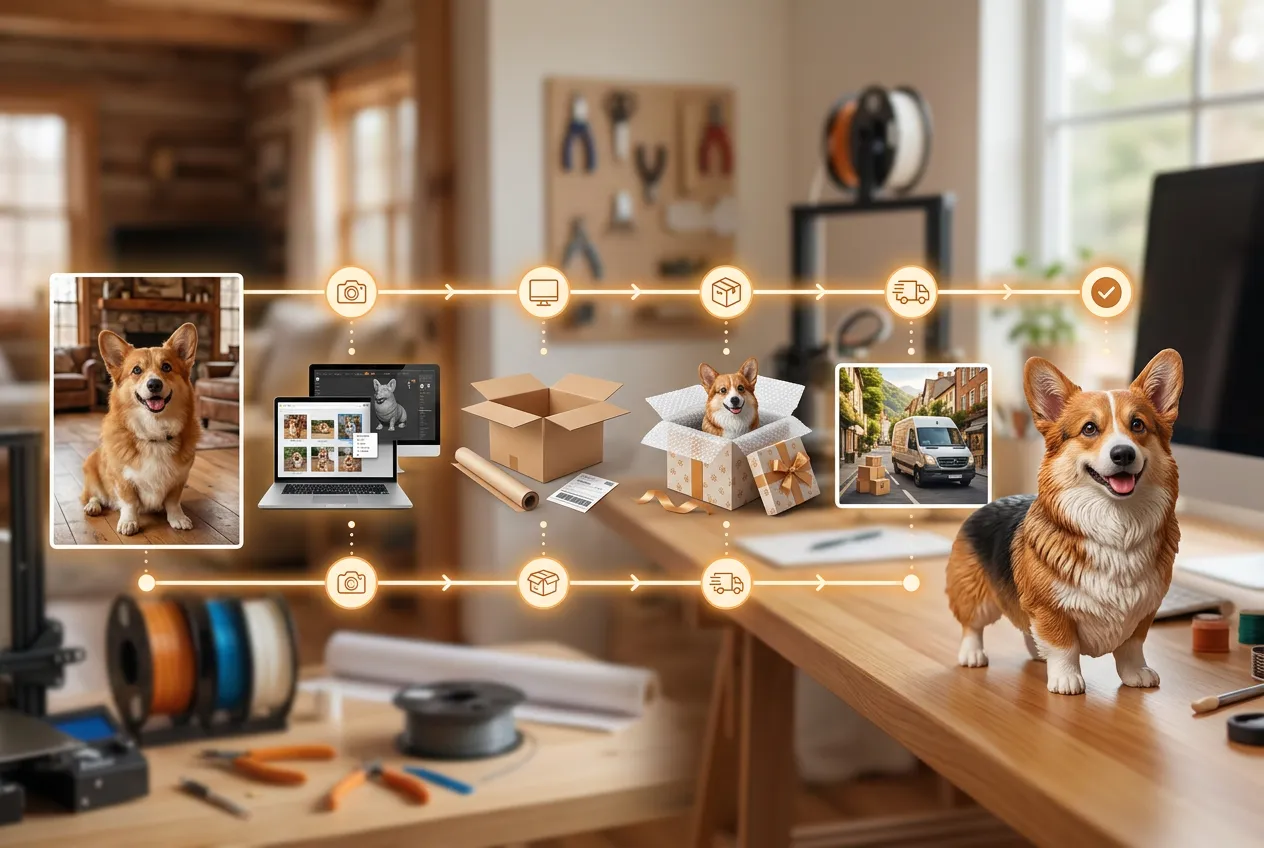
Your fingernails tap the edge of your phone at 11 p.m., four corgi photos open in your bedroom, and you're wondering which one captures that ridiculous sploot your dog does—because you just discovered the custom pet figurine ordering process and you want everything about it to be perfect.
That impulse? We hear about it every single week.
Quick Takeaways
- Your photos matter more than you think — the right reference images shape every curve and marking of your figurine
- The process is collaborative, not passive — you'll review a digital preview and request adjustments before anything is printed
- Full-color 3D printing isn't what most people picture — color is embedded directly in the resin, not applied afterward
- Expect an emotional reaction you didn't plan for — many owners who order their custom figurine at PawSculpt say the unboxing hit harder than they expected
- Corgi-specific details need corgi-specific photos — those short legs, that big chest, and the exact ear tilt all require intentional angles
Why Ordering a Custom Corgi Figurine Feels Different Than You'd Expect
Here's what nobody tells you about ordering a custom figurine of your pet: the hardest part isn't waiting. It isn't the cost. It isn't even choosing between the seventeen thousand photos on your camera roll.
The hardest part is sitting with the question underneath it all—why do I want this so badly?
Maybe your corgi is right there on the couch next to you, snoring like a tiny chainsaw, and you just want to freeze that specific version of them. Or maybe the couch is empty now, and the indent where they used to sleep hasn't quite filled back in. Either way, you're here because something in you wants to hold on to a shape, a presence, a thing that proves they were real and exactly the way you remember.
You're not alone in that. We've processed thousands of orders at this point, and the common thread isn't breed or budget—it's the moment someone decides their pet deserves to exist in three dimensions on a shelf, a desk, a nightstand. That decision is personal. And the process that follows it should feel personal, too.
So let's walk through what actually happens—step by step, stage by stage—when you order a custom corgi figurine for the first time. Not the marketing version. The real version, including the parts that might surprise you.

Step One: Choosing Your Reference Photos (And Why Most People Overthink This)
You'd think the people who send us twenty photos get the best results. Counterintuitively, they often don't—at least not at first. Here's why: when you flood a sculptor's screen with images, they have to guess which version of your corgi you consider "the real one." The alert ears from photo three? The relaxed face from photo twelve? The slightly chunkier body from last winter?
The single most helpful thing you can do is pick 3–5 photos that show the same version of your dog. Same approximate weight, same energy, same era.
What Makes a Great Reference Photo for a Corgi
Corgis are notoriously tricky to photograph well for figurine purposes—and we say this with deep affection for the breed. Their proportions are unusual. Those legs are shorter than your brain wants to believe. The chest-to-hip ratio is dramatic. And depending on whether you've got a Pembroke or a Cardigan, the tail situation changes everything.
Here's what our digital sculpting team looks for:
| Photo Angle | Why It Matters | Corgi-Specific Tip |
|---|---|---|
| Front-facing | Captures ear set, facial markings, chest width | Get low—phone at their chest height, not yours |
| Direct side profile | Shows leg length, back line, belly shape | Make sure all four legs are visible (corgis love to sploot and hide them) |
| Three-quarter view | Reveals depth of snout, cheek shape, body volume | This is often the "money shot" for overall likeness |
| Rear view | Shows tail (or lack thereof), haunch shape, color transitions | Pembroke vs. Cardigan tail is critical here |
| Close-up of face | Eye color, nose detail, unique markings, expression | Natural lighting only—flash washes out their sable tones |
A few things that genuinely help us and that most guides skip:
- Outdoor, overcast light is ideal. Direct sunlight blows out the highlights on a red-and-white corgi's coat. Overcast skies act like a giant softbox—even color, minimal shadows. If you only have indoor photos, ones near a large window work well.
- Skip the costumes and bandanas. We need to see the actual neckline and chest markings. You'd be surprised how often a cute Halloween photo hides the exact markings we need.
- Include one "unflattering" photo. That slightly chunky angle or the goofy face? It often contains the most accurate body proportions because nobody posed the dog for it.
The Counterintuitive Photo Insight
Most first-timers assume professional photography produces better figurines. It usually doesn't. Professional pet photos tend to be heavily edited—colors boosted, backgrounds blurred, contrast cranked. A casual phone photo in good natural light, where your corgi is just existing, gives our 3D artists more accurate data about coat color, body shape, and that specific way your dog holds their head.
"The best reference photos aren't the prettiest ones—they're the most honest. Give us your dog as they actually are, and we'll give them back to you in resin."
— The PawSculpt Team
The photos you're mildly embarrassed by? Those are usually the ones that make the final figurine feel undeniably like your dog.
What Happens After You Submit Your Order: The Digital Sculpting Phase
This is where most first-timers have the biggest gap between expectation and reality. So let's fill it.
Your Photos Become a 3D Model
Once your order and reference photos are submitted through PawSculpt's ordering page, a digital sculptor—a real human artist working in professional 3D software like ZBrush or Blender—begins digitally modeling your corgi from scratch. This isn't a filter. It isn't an AI scan. It's a person looking at your photos and building your dog's likeness vertex by vertex in a digital workspace.
Think of it like this: if a traditional sculptor works with clay on a table, our sculptors work with virtual clay on a screen. They're pushing, pulling, smoothing, and refining a digital mesh until it matches your pet's proportions, expression, and attitude.
For corgis specifically, this phase involves some breed-aware decisions that matter more than you'd think:
- Leg-to-body ratio. Corgis are dwarf breeds (technically achondroplastic, meaning their leg bones are shortened). A sculptor who isn't careful will make the legs too long because human visual instinct "corrects" for what looks "normal." Experienced digital artists know to trust the reference photos over their instincts here.
- Ear geometry. Corgi ears are large relative to their skull, slightly rounded at the tips, and set wide. Getting the angle wrong by even a few degrees makes the figurine look like a different breed entirely. Our sculptors do proportional checks—measuring ear height against skull width in the reference photos and matching that ratio in the 3D model.
- Coat flow direction. Corgis have a double coat with a coarser outer layer. The direction the fur flows—especially around the chest ruff, the "pants" on the back legs, and the neck—affects how light hits the figurine's surface. Digital sculptors indicate fur direction through texture detail in the model, which then gets captured in the print.
The Preview Step (This Is Where You Come In)
Before anything is physically printed, you receive a digital preview—a rendered image of the 3D model from multiple angles. This is your chance to say "her left ear tilts a little more" or "his markings extend further down the chest."
Here's what we've learned from years of doing this: most people's first reaction to the preview is emotional, not analytical. They see their dog in 3D form and something catches in their throat. Then, a few hours later, the detail-oriented feedback comes. That's completely normal. Take your time with it.
"A figurine isn't a photograph. It's the feeling of your pet taking up space in the room again."
Common preview feedback we see (and welcome):
- "Can the head tilt slightly to the right? She always did that."
- "His eyes are a little more amber than brown."
- "The white blaze on her chest comes to more of a point."
This collaborative back-and-forth is the part that separates a generic dog figurine from one that makes you double-take. For details about how many revisions are available or how the preview process works step by step, PawSculpt's FAQ page has the most current information.
How Full-Color 3D Printing Actually Works (The Part Most People Get Wrong)
This is where we need to clear up some serious misconceptions. Because when most people hear "custom figurine," they picture one of two things: either a mass-produced bobblehead or a white resin figure that someone then paints with tiny brushes. Neither is what's happening here.
Myth vs. Reality
Myth #1: "The figurine is 3D printed in white, then an artist paints it."
Reality: PawSculpt uses full-color resin 3D printing—a process where pigments are deposited directly into the resin material during printing. The color isn't a layer on top. It's part of the object itself. Think of it like the difference between painting a wall and dyeing fabric. The color goes all the way through.
Myth #2: "3D printed things look cheap and plasticky, with visible lines."
Reality: Modern full-color 3D printing operates at layer heights often in the 25–50 micron range (a micron is one-thousandth of a millimeter). At that resolution, individual layers are nearly invisible to the naked eye. The surface has a fine-grained texture—not glassy smooth like injection-molded plastic, but closer to the natural matte of stone or high-quality ceramic. A protective clear coat is applied during post-processing, which adds a subtle sheen and protects the surface from UV exposure and handling.
Myth #3: "If it's 3D printed, a computer does everything—there's no artistry."
Reality: The digital sculpting phase is entirely artist-driven. Software is a tool, not a replacement. A 3D sculptor making your corgi figurine is making hundreds of aesthetic decisions—how deep to set the eyes, how much fur texture to add before it becomes noisy, whether to slightly exaggerate the ear size (a common trick that actually makes figurines look more like the real dog at small scale, because miniaturization flattens features). The machine prints what the artist creates.
The Actual Print Process (For the Curious)
You don't need to understand this to order a figurine, but if you're the type who likes knowing how things work, here's what happens inside the printer:
- The digital model is oriented. This means the 3D file is positioned in the printer's build volume to minimize the need for support structures—temporary scaffolding that holds overhanging parts during printing. For a corgi figurine, orientation logic matters a lot. Those short legs need to be well-supported without leaving visible marks on the finished piece. The belly and chest cavity are often where supports attach, since those areas are less visible in the final display position.
- The model may be hollowed. Solid resin figurines are heavier and use more material. Hollowing the interior—leaving walls typically a couple of millimeters thick—reduces weight and cost. Small drain holes (openings that let uncured resin flow out) are placed in inconspicuous locations, often on the bottom or base.
- Printing happens layer by layer. The machine builds the figurine from the bottom up, depositing resin and curing it with UV light one ultra-thin layer at a time. In full-color systems, pigmented resin is placed precisely at each point—every voxel (a 3D pixel) gets its assigned color. Your corgi's sable markings, white chest, and black nose aren't applied after—they're built into the structure as it forms.
- Post-processing begins. Once the print is complete, the figurine goes through several steps:
| Post-Processing Stage | What Happens | Why It Matters |
|---|---|---|
| Solvent wash | Uncured resin is dissolved away | Prevents sticky spots and surface cloudiness ("bloom") |
| UV final cure | Full hardening under controlled UV exposure | Under-cured resin stays soft and yellows over time; over-cured resin becomes brittle |
| Support removal | Scaffolding structures are clipped, filed, sanded | Careless removal leaves pitting or scars on the surface |
| Surface inspection | Figurine examined under raking light at multiple angles | Catches defects invisible under direct overhead light |
| Clear coat | Protective varnish applied by hand | Guards against UV degradation, fingerprint oils, and minor scratches |
The tradeoffs here are real. Thinner layers mean smoother surfaces but longer print times. More aggressive support structures mean better dimensional accuracy during printing but more post-processing work (and more risk of surface marks). Resin formulations that produce more vibrant color can sometimes be more brittle. These are the kinds of decisions that experienced production teams navigate daily—and they're why two "3D printed figurines" from different companies can look dramatically different.
What the Finished Figurine Actually Feels Like
People always ask this, so here it is: a full-color resin figurine feels solid and slightly warm to the touch (resin doesn't conduct heat away from your hand the way metal or glass does). It's lighter than ceramic but heavier than plastic. The surface, under the clear coat, has a very fine grain—like high-quality matte photo paper, but three-dimensional. It doesn't feel "printed" in the way most people expect.
The colors are vivid but not fluorescent. They have a natural, embedded quality—like looking at color that lives inside the material rather than sitting on top of it. For a tri-color corgi, that means the transition from red to white to black has a subtlety to it that surface-applied color struggles to match.
The Waiting Period: What You're Actually Feeling (And Why That's Normal)
Okay, let's talk about the part nobody writes about. The waiting.
You've submitted your photos. You've approved the digital preview (maybe after a revision or two). The figurine is being printed, processed, and prepared for shipping. And now you're in the in-between space.
Here's what we've noticed across thousands of orders: the emotional weight of the wait depends almost entirely on why you ordered the figurine in the first place.
If your corgi is alive and well and you ordered this as a fun keepsake or gift, the wait feels like anticipation. Exciting. You check your email a little more than usual. No big deal.
But if your corgi has passed—or is aging, or is sick—the wait can feel surprisingly heavy. Like the figurine is holding something you need. Like you can't fully exhale until it arrives and you can confirm that yes, they got it right. Yes, that's her.
"The wait isn't about patience. It's about how much of your heart is in the box."
That second experience is more common than you'd think. And it's completely, thoroughly okay to feel that way. You're not being dramatic. You're being human. The American Kennel Club's resources on coping with pet loss acknowledge that the bond between owner and pet is genuine and the grief that follows is real—not something to minimize or rush through.
Many families tell us they find the process itself—choosing photos, reviewing the preview, being involved in the creation—to be part of their processing. It gives the grief somewhere to go. Something to do with the love that's still there and needs a place to land.
What to Do While You Wait
Practical stuff, because sometimes practical is what gets you through:
- Don't obsessively refresh your email. You'll receive updates at key milestones. If you have questions in between, PawSculpt's contact page is always open.
- Decide where you'll put it. This sounds small, but it matters. The nightstand. The bookshelf. The mantle. Choosing the spot in advance—clearing a space for it—can be its own small ritual. One customer told us she kept the spot empty for two weeks before the figurine arrived, and every time she looked at the empty shelf, it reminded her that something was coming. Something good.
- If it's a gift, plan the moment. Custom figurines tend to produce big emotional reactions. Think about whether you want that reaction in private or at a party. (We'll be honest—private seems to go better. People like to cry in peace.)
- Prepare yourself, too. If this is a memorial piece, the unboxing may hit harder than you expect. Having someone with you—or having a quiet evening set aside—is worth planning for.
Corgi-Specific Details That Make or Break the Likeness
We work with every breed, but corgis hold a special place in our order history—they're consistently among the top breeds people order figurines of. And there are specific anatomical details that, if missed, make a corgi figurine look generic instead of yours.
The Ears Tell the Whole Story
A corgi's ears are disproportionately large and expressive. When alert, they stand straight up and slightly forward. When relaxed or listening to something behind them, they rotate backward. When your corgi is doing that adorable confused head-tilt, one ear might be higher than the other.
The ear position you choose for the figurine defines the entire emotional tone of the piece. Alert ears say "ready for adventure." Soft, slightly back ears say "content and safe." That one-ear-up, one-ear-sideways look says "personality for days."
When submitting your photos, include at least one clear shot of the ears from the front. And if there's a specific ear position that's most your dog, mention it in your order notes.
The Sploot Factor
If you own a corgi, you know. The full sploot—legs kicked out behind, belly flat on the floor—is practically a breed signature. Some owners want their figurine mid-sploot. Others want the classic standing pose.
Both work beautifully, but they involve different considerations. A splooting figurine has a wider, flatter base (more stable on a shelf, actually). A standing figurine shows off the full leg-to-body proportions and the characteristic corgi silhouette. There's no wrong choice. It's about which version of your dog lives most vividly in your memory.
Color Is More Complex Than You Think
Corgis come in more color variations than casual fans realize. Red and white is the classic, but there's also sable (where individual hairs have dark tips over a lighter base—creating a depth that's tricky to capture), tri-color (black, tan, and white with very specific placement), and the blue merle pattern in Cardigans.
Full-color 3D printing handles these variations well because the color is embedded at the voxel level—meaning each tiny point in the material can be a different shade. This is where the technology genuinely shines compared to surface-applied color methods. A sable coat, where the color changes within each hair, translates into a gradient embedded in the resin itself. It's subtle, and it's one of those details that makes people say "that's exactly right" without being able to articulate why.
Unboxing Day: What Actually Happens
Let's be specific about this, because the experience is consistent enough across our customers that it's worth preparing you.
The figurine arrives packaged securely—these are resin objects, and resin, while durable under normal handling, is more brittle than, say, rubber. It's protected for transit.
You open it. And here's what happens next, in roughly this order:
- The first look is about shape, not detail. Your brain recognizes your dog's silhouette before it processes the markings or expression. If the proportions are right—and this is why the digital sculpting phase matters so much—the recognition is immediate and visceral.
- Then the details hit. The color of the eyes. The specific white pattern on the chest. The way one ear is slightly lower than the other. This is the moment that tends to produce tears, laughter, or both.
- You'll turn it around in your hands. Every single person does this. You'll look at it from the back, the side, from above. You'll hold it at arm's length and then bring it close. You're comparing it—not to the photos you submitted, but to the dog in your memory. Your internal, emotional image.
- You'll find its spot. And when you set it down on that shelf or nightstand you cleared, something in the room shifts. The space holds your dog's shape again.
One order that stuck with our team: a woman ordered a figurine of her Pembroke Welsh Corgi, Winston, who had passed at fourteen. When the figurine arrived, she said she put it on the windowsill where he used to sit and watch squirrels. "It's not him," she told us. "But the room feels less empty."
That's not a sales pitch. That's just what these things do.
Common First-Timer Mistakes (And How to Avoid Them)
We've seen a lot of orders go through. These are the recurring patterns that trip people up:
Sending only "best angle" photos. Your corgi's Instagram-worthy side profile is great, but we also need to see the other side, the face straight-on, the view from behind. Asymmetrical markings are common, and we can't sculpt what we can't see.
Forgetting to mention weight changes. If you're memorializing a corgi who was slim as a young dog but stockier later in life, tell us which version you want. We'll match whatever era you specify, but we need to know.
Assuming bigger is always better. Larger figurines show more detail, yes. But they also amplify any minor imperfection. A small figurine on a nightstand can be just as emotionally powerful as a large one on a mantle—sometimes more so, because you hold it, and holding matters.
Not including a photo of the base of the ears. This is hyper-specific, but: the point where a corgi's ear meets the skull is a key anatomical landmark. If it's obscured by fluff or angle, the ear placement on the figurine can drift. One clear shot showing where the ears attach goes a long way.
Rushing the preview approval. Sit with the digital preview for at least a few hours before responding. Your first reaction will be emotional (good). Your useful feedback comes after, when you've had time to look critically. If something feels slightly off but you can't name it, say that—our sculptors are skilled at translating vague feedback into specific adjustments.
Caring for Your Figurine Long-Term
Full-color resin with a clear coat is reasonably durable for display purposes, but it's not indestructible. Here's the honest rundown:
- Keep it out of direct, prolonged sunlight. UV-resistant clear coat helps significantly, but no material is immune to years of direct sun exposure. A shelf that gets indirect light is ideal.
- Dust gently. A soft, dry cloth or a can of compressed air. Avoid wet cleaning—water won't damage the clear coat quickly, but there's no reason to risk it.
- Handle with clean, dry hands. Oils from skin won't damage the clear coat immediately, but over years, they can dull the finish in high-contact areas.
- Don't drop it. Resin is rigid. It won't bounce. If it falls from shelf height onto a hard floor, ears, tails, and thin extremities are most at risk. (Corgis, being low-to-the-ground dogs with proportionally sturdy builds, actually produce figurines that are more robust than, say, a greyhound with long thin legs. Small win.)
- Temperature stability matters. Don't put it near a heat vent, radiator, or in a car during summer. Resin can soften at sustained high temperatures, and thermal cycling (repeated hot-cold-hot-cold) can cause micro-cracking over time.
The clear coat can be refreshed if it dulls significantly after years, though most owners never need to. These figurines are designed to be displayed and enjoyed, not locked in a case—but a little common sense goes a long way.
The Emotional Timeline Nobody Talks About
We want to close the process section with something real. Because the technical timeline—photos, sculpt, preview, print, ship—is only half the story. The other half is what happens inside you.
When you're choosing photos: You're revisiting your dog's life. Scrolling through years of images. You might laugh at a forgotten goofy shot. You might find a photo from a day you'd rather not remember. This part can be a lot. Give yourself space for it.
When you see the preview: For memorial orders especially, this can be a gut-punch moment. Seeing your dog rendered in 3D, looking back at you from a screen—it collapses the distance between now and then. Many owners tell us this is the moment they realized they were still carrying more grief than they thought. That's not a bad thing. It's a releasing thing.
When the figurine arrives: The room changes. The spot where you set it becomes a small anchor point. Not a shrine—nothing that heavy. More like a quiet acknowledgment that this creature existed and mattered and took up space in your life, and now takes up space on your shelf.
Weeks later: This is the part that surprises people most. You stop actively noticing the figurine. It becomes part of the room—like a framed photo you've had for years. And then one day, a beam of light hits it at a certain angle, or a guest notices it and asks, and suddenly the whole weight of what it represents floods back. Briefly. Warmly. Then it settles again.
That cycle—noticing, forgetting, re-noticing—is actually what makes these figurines different from a photograph. A photo lives in two dimensions. A figurine casts a shadow. It changes with the light. It occupies the room in a way that keeps surprising you.
And that might be the whole point.
Frequently Asked Questions
How do I order a custom 3D printed pet figurine?
Head to pawsculpt.com, upload 3–5 clear reference photos of your pet from multiple angles, and submit your order. A digital sculptor will build your pet's likeness in 3D software, and you'll receive a preview to review and approve before anything is printed. The site has the most current details on timelines and options.
What photos work best for a custom corgi figurine?
Natural lighting is your best friend—overcast outdoor light or near a large window. Submit photos from the front, side, rear, and a three-quarter angle. Include at least one close-up of the face showing eye color and markings. Avoid flash photography and heavy Instagram filters, as these distort the colors our sculptors need to match accurately.
What is a full-color 3D printed figurine actually made of?
The figurine is made from UV-cured photopolymer resin with embedded pigments—meaning the color is printed directly into the material, not applied on top. After printing, a protective clear coat is applied to guard against UV exposure and give the surface a consistent, finished look. The result is a solid, slightly warm-to-the-touch object that feels more like ceramic than plastic.
Can I request changes before the figurine is printed?
Absolutely. You receive a digital preview—rendered images of the 3D model from multiple angles—and can request adjustments to proportions, markings, expression, ear position, and more. This is the collaborative step that makes the difference between a generic dog figurine and one that's unmistakably yours. Visit PawSculpt's FAQ for specifics on the revision process.
How fragile are resin pet figurines?
They're durable for normal display—you can pick them up, move them, dust them without worry. But resin is rigid, not flexible, so a drop from shelf height onto a hard floor can cause chipping or breakage, especially on thin features like ear tips. Keep them out of extreme heat and prolonged direct sunlight, and they'll last for years.
What makes these different from a mass-produced pet statue I could buy online?
Everything. A mass-produced corgi statue is a corgi. A custom figurine from PawSculpt is your corgi—digitally sculpted from your reference photos by a professional 3D artist who matches your dog's specific markings, body shape, ear set, and expression, then printed in full color at high resolution. No two are alike because no two pets are alike.
Ready to Start Your Custom Corgi Figurine?
You already know which photo you'd choose. It's probably been in your favorites folder for months—or maybe it's the one you took last Tuesday, when the light hit just right and your corgi looked at you like you were the entire world.
That's the photo. That's the dog. And the custom pet figurine ordering process is designed to turn that moment into something you can hold, display, and come back to for years. Whether you're celebrating a corgi who's currently stealing socks in the next room or honoring one who left a permanent dent in the couch and in your chest, this is where it starts.
Visit pawsculpt.com to see the full process, explore options, and start your order